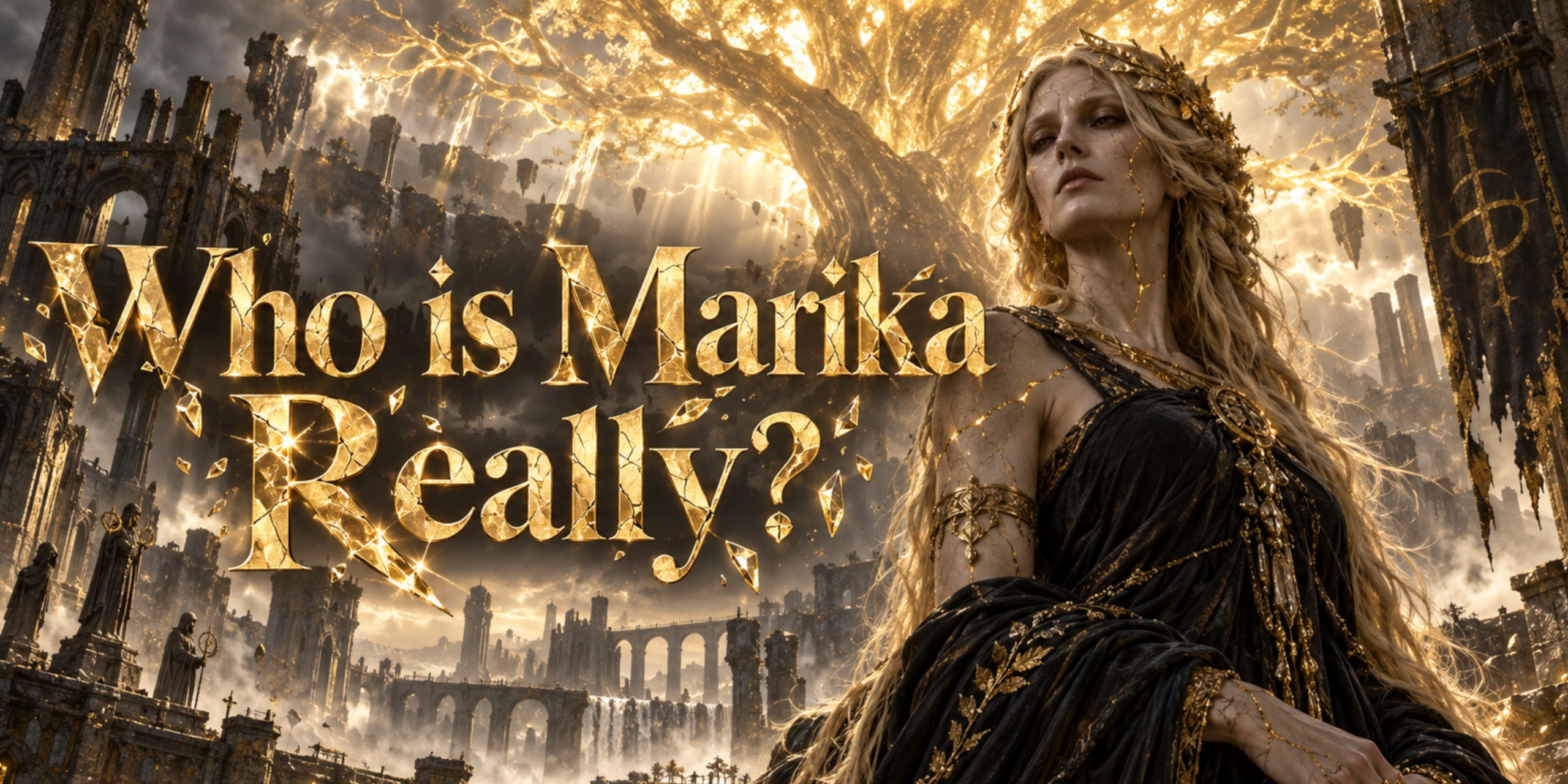
Queen Marika the Eternal is Elden Ring’s reigning goddess, the vessel of the Elden Ring and the ruler whose decisions helped bring the Lands Between to ruin. She established the Golden Order, then shattered the object holding that order together. Understanding her means investigating both acts.
There is also the small matter of her being Radagon, her own second husband. The family tree has officially become a health hazard.
What makes Marika fascinating, though, is how much of her survives through other people’s beliefs. Priests worship her, her children suffer under her legacy, and her statues stand across a world she helped break. Finding the person beneath all that religious architecture takes some work.
Spoiler warning: this article discusses the main game’s ending and major revelations from Shadow of the Erdtree.
Who Is Queen Marika the Eternal?
Marika occupies two connected positions: she is a sovereign who rules through conquest and dynasty, and a goddess who carries the Elden Ring within her.
The Elden Ring governs the order of the world. Its runes concern fundamental principles, including death, so changing it has consequences far beyond palace politics. Marika’s position gives her an extraordinary relationship with those principles, although divine status clearly does not grant unrestricted freedom.
Her consort holds the title of Elden Lord. Godfrey and Radagon both occupy that role during her reign. Marika remains the central divine figure, rather than simply the wife of whichever heavily armed man currently has the throne.
I think that distinction matters. Elden Ring gives us plenty of formidable warriors, but Marika’s influence reaches into the rules under which those warriors live, fight and die.
What Did Marika Do to the Golden Order?
The Golden Order was created by confining Destined Death, also known as the Rune of Death. Marika removed it from the Elden Ring and entrusted its protection to Maliketh.
This is often summarised as Marika “removing death”, but that phrasing makes the setting sound tidier than it is. Bodies, souls, burial and undeath still matter throughout Elden Ring. People can be killed. What has changed is death’s place within the governing order, rather than every living thing receiving straightforward invincibility.
The distinction becomes horribly important when Godwyn dies in soul while his body persists.
Marika’s order promises permanence, yet the world we explore is full of suffering that permanence cannot resolve. Looking around the Lands Between, “eternal” starts to sound less like a blessing and more like a contractual problem.
Are Marika and Radagon the Same Person?
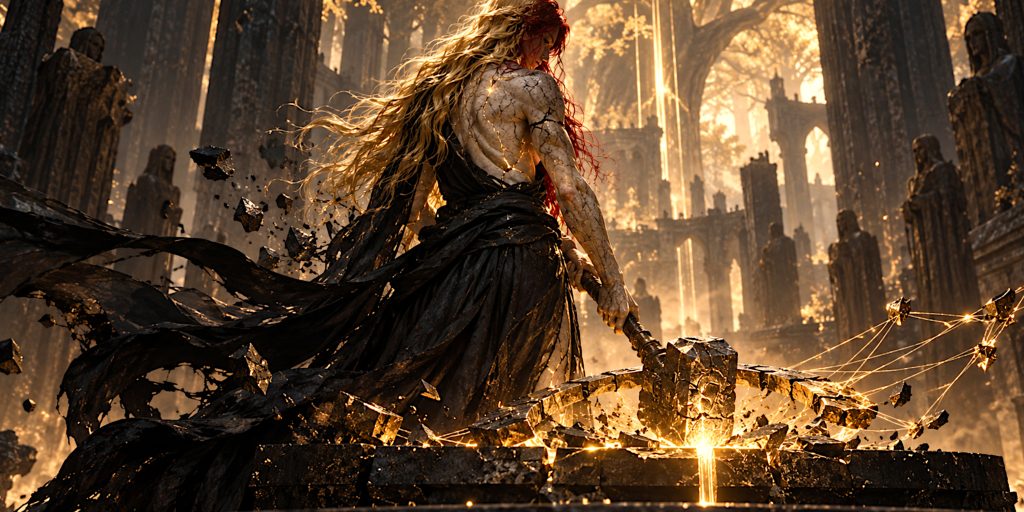
Yes. Radagon is Marika. The revelation in Leyndell and the transformation before the final battle establish their shared identity.
What the game leaves unresolved is how that identity began. We do not have a definitive account explaining whether they were always one being, separated at some point, or came together through a process we never witness.
Marika’s words, preserved through Melina, make the relationship even stranger. She addresses Radagon as her other half while suggesting that he has yet to become her. That is evidence of a complicated relationship, rather than a clear timetable for their union.
Their opposing actions are more firmly documented. The description of Marika’s Hammer states that she shattered the Elden Ring and Radagon attempted to repair it.
They share a body, but their intentions can conflict. That makes the final encounter feel particularly bleak: the figure defending the Golden Order is inseparable from the goddess who broke it.
Why Did Marika Shatter the Elden Ring?
We know she did it. We cannot confidently reduce her reasons to one answer.
Godwyn’s death provides a powerful context. The Night of the Black Knives demonstrates that the divine household is vulnerable despite the protections built into Marika’s order. Grief is therefore a persuasive reading of her subsequent actions.
However, Marika’s earlier words also reveal a desire to investigate the Golden Order beyond unquestioning belief. Her arrangements for Godfrey and his warriors anticipate exile, death and an eventual return. There are signs of longer planning alongside the possibility of personal devastation.
My reading is that grief and disillusionment can coexist here. Someone can spend years questioning a system before a particular loss makes continuing within it unbearable.
That remains an interpretation. Neither “she snapped” nor “she planned absolutely everything” accounts comfortably for all the evidence.
It also helps to separate two events: Marika shattered the Elden Ring; the Shattering was the war that followed, as demigods fought over its fragments.
What Shadow of the Erdtree Reveals About Marika
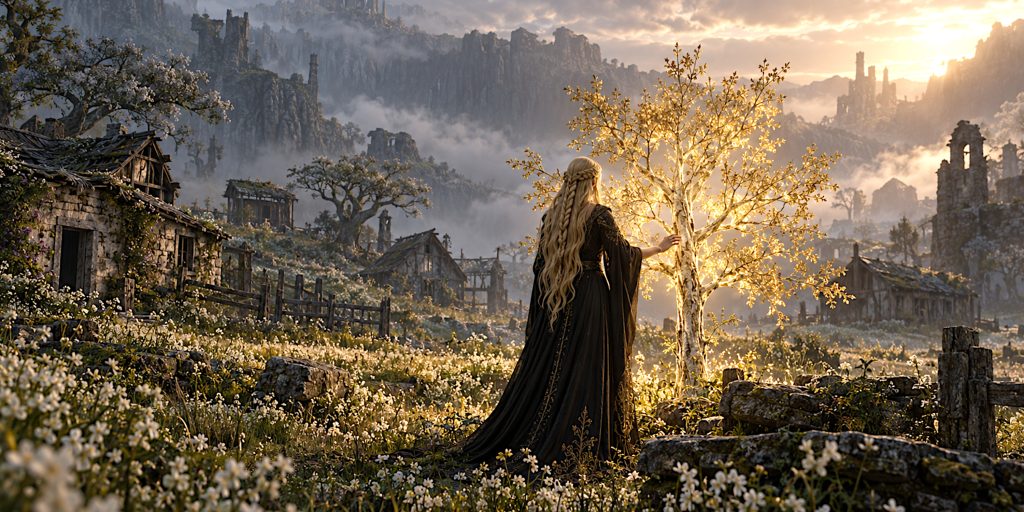
The expansion’s most affecting contribution to Marika’s story is Shaman Village.
Here, the monumental goddess acquires something much more intimate: a home. The Golden Braid records an offering to the Grandmother, while the Minor Erdtree incantation describes Marika bathing her village in healing gold despite knowing nobody remained to receive its healing.
That detail changed how I read her. A divine ruler can commission statues and demand devotion. Returning to an empty village with a useless act of tenderness feels painfully personal.
The expansion also reveals the persecution of shamans within the hornsent’s jar rituals. The Tooth Whip description connects their treatment to the supposed ability of shaman flesh to meld with other flesh. The horrors surrounding Bonny Village give that language a physical reality.
Together, these discoveries strongly suggest a traumatic background to Marika’s rise. They do not provide a complete account of her childhood, escape or intentions.
The village makes her easier to understand. It does not make everything she later authorised easier to forgive.
Marika, Messmer and the Hornsent
Messmer’s crusade exposes the violence behind Marika’s divine legacy. Acting on his mother’s behalf, he wages a devastating campaign against the hornsent in the Realm of Shadow.
Given what happened to the shamans, revenge is a compelling interpretation of Marika’s involvement. Yet presenting the entire campaign as a fully explained personal vendetta would exceed what the game confirms.
The uncomfortable possibility is that a survivor of persecution became responsible for inflicting collective punishment on others.
That is where Marika’s story becomes especially difficult. Her suffering deserves recognition, while the victims of her rule deserve more than being treated as necessary scenery in her tragedy.
Who Are Marika’s Children?
Marika’s family helps explain why almost every major political crisis feels like a disastrous reunion.
| Relationship | Children | Important distinction |
|---|---|---|
| Marika and Godfrey | Godwyn, Morgott and Mohg | Their experiences reveal very different sides of the dynasty |
| Marika and Radagon | Miquella and Malenia | Twins born of a single god, each afflicted from birth |
| Radagon and Rennala | Ranni, Radahn and Rykard | Children of Rennala and Radagon, brought into Marika’s demigod family through Radagon’s royal marriage |
| Marika, with the father unidentified | Messmer | His relationship to Marika is established; his father is not confirmed |
The family’s major relationships are established across the base game and expansion, although its complete chronology remains uncertain.
Melina is strongly implied to be Marika’s daughter. Her account of her mother within the Erdtree supports that reading, while Messmer’s Kindling mentions a younger sister who also bore a vision of fire. The connection is persuasive, although the item does not name that sister.
The uncertainty matters because it leaves room for discussion without making every popular theory equally well supported.
Did Marika Arrange the Night of the Black Knives?
This is one of the most tempting theories about her, but it remains unconfirmed.
Ranni admits her involvement in stealing the power of death and preparing the black knives. Meanwhile, the Black Knife Armor description says the assassins were rumoured to be Numen women with close ties to Marika.
Those connections justify suspicion. They do not establish that Marika ordered Godwyn’s murder, approved Ranni’s entire plan or knew exactly what would happen.
A close association is evidence worth investigating. It is not a signed confession, even by the rather relaxed evidential standards of a kingdom where important records are printed on trousers.
Was Marika Controlled by the Greater Will?
Marika belongs to a religious structure involving the Greater Will, the Fingers and the Elden Ring. Describing that relationship as constant, direct cosmic supervision is increasingly difficult after Shadow of the Erdtree.
The Staff of the Great Beyond describes Metyr receiving signs from the Greater Will, then continuing to await another message after being broken and abandoned. Eldenpedia
This complicates the authority claimed by the Fingers. It leaves open the possibility that institutions presenting themselves as divine intermediaries were operating with incomplete knowledge.
We still cannot precisely date every break in communication or establish what Marika understood at each stage.
For me, that uncertainty makes the mythology more unsettling. An oppressive religious system can continue functioning even when nobody within it can reliably explain who is issuing the instructions.
Is Marika a Villain?
There is ample reason to condemn her rule. Understanding her losses does not erase the violence associated with her dynasty or Messmer’s campaign.
Yet calling her simply evil misses the tenderness preserved at Shaman Village and the conflict embodied by her destruction of the Elden Ring.
I find her most convincing as someone whose desire for security hardened into an order that inflicted suffering of its own. That is a reading of the story, rather than a motive the game states outright.
Her final rebellion offers no easy absolution, either. Breaking the system also helps unleash catastrophe on the people living inside it.
Marika remains compelling because sympathy and judgement keep interrupting each other. You can mourn what happened to her, question what she became, and still wonder what she hoped somebody else might build from the wreckage.