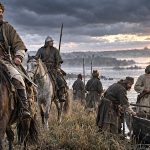
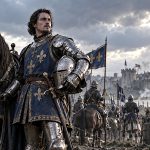
The Battle of Brunanburh, fought in 937, is one of those moments in British history that feels oddly underappreciated. Mention Hastings and people nod knowingly. Mention Agincourt and someone will usually mutter something about longbows. Mention Brunanburh and you are often met with a polite look that says, “Was that in Game of Thrones?”
Yet Brunanburh arguably mattered more than either. Here, King Æthelstan and his brother Edmund defeated a vast alliance of Vikings, Scots and Britons. Had they lost, England might never have emerged as a single kingdom.
The battle was brutal, bloody and fiercely contested. Contemporary writers described it as the greatest slaughter in living memory. Even today historians are still arguing over exactly where it happened, which somehow feels fitting for a battle wrapped in smoke, mud and a thousand years of argument.
Why the Battle of Brunanburh Happened

By the 930s, King Æthelstan had achieved something remarkable. He had united much of England under his rule and forced neighbouring rulers to acknowledge his authority. Unsurprisingly, this did not make him universally popular.
In 934, Æthelstan invaded Scotland, likely because Constantine II of Alba had broken an earlier agreement. That campaign did not end in a decisive battle, but it made one thing abundantly clear: if Æthelstan was to be defeated, it would require a coalition.
That coalition emerged in 937.
Olaf Guthfrithson, the Viking king of Dublin, joined forces with:
- Constantine II, King of Alba
- Owain, King of Strathclyde
- Various Norse, Scottish and Brittonic contingents
Together they launched the greatest challenge to English power that Æthelstan had yet faced.
Forces
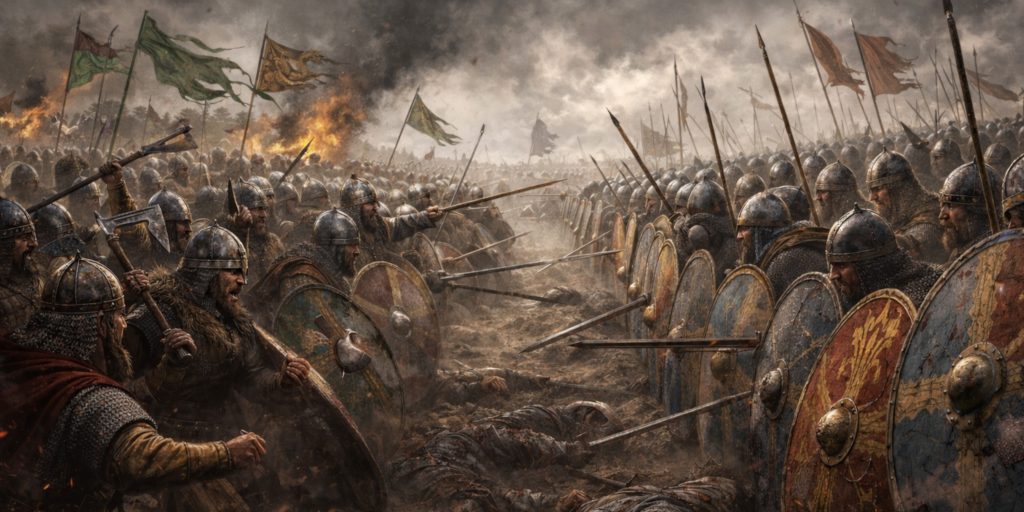
The exact numbers involved are unknown. Medieval chroniclers had a distressing habit of either wildly exaggerating troop numbers or simply deciding that “a great many” was specific enough.
Most modern historians believe both sides fielded several thousand men, perhaps between 8,000 and 15,000 in total.
| Side | Estimated Strength | Main Components |
|---|---|---|
| Kingdom of England | 4,000 to 8,000 | West Saxon fyrd, Mercian troops, royal household warriors |
| Allied Coalition | 5,000 to 8,000 | Vikings from Dublin, Scots, Strathclyde Britons, Norse mercenaries |
Leaders and Troop Composition
| Side | Leaders | Troop Composition |
| English Kingdom | King Æthelstan, Prince Edmund | West Saxon infantry, Mercian spearmen, elite household warriors, mounted retainers |
| Allied Coalition | Olaf Guthfrithson, Constantine II, Owain of Strathclyde | Viking axe-men, Norse spearmen, Scottish infantry, Strathclyde warriors |
The English army likely fought in a disciplined shield wall, supported by experienced household troops. Æthelstan had spent years campaigning and was no inexperienced king stumbling onto a battlefield because someone handed him a sword and wished him luck.
The allied army had more variety. Viking contingents probably formed the core, with heavily armed Norse warriors fighting alongside Scottish and Brittonic forces. Such alliances could be formidable, though keeping several kings happy in the same army was probably every bit as exhausting as it sounds.
Arms and Armour
Brunanburh was fought during the late Anglo-Saxon period, when warfare centred around shield walls, spears and brutal close combat.
English Arms and Armour
- Spear, the most common weapon in the English ranks
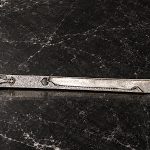
- Seax, a long fighting knife often carried as a sidearm
- Anglo-Saxon swords, especially pattern-welded blades of Petersen Type X and early Type Y forms
- Round wooden shields with iron bosses
- Mail shirts worn by wealthier warriors and household troops
- Iron helmets, often conical with a nasal guard
Allied Coalition Arms and Armour
- Viking swords, particularly Petersen Type H, S and X blades
- Danish axes and broad-bladed hand axes
- Spears and javelins
- Round shields decorated with painted or leather-covered fronts
- Mail hauberks for wealthier Viking and Scottish nobles
- Helmets of Norse and Scottish design
Specific Sword Types Likely Used
| Sword Type | Users | Description |
| Petersen Type X | English and Viking warriors | Broad-bladed sword suited for cutting and thrusting |
| Petersen Type H | Viking warriors | Distinctive sword with decorated hilt and heavy pommel |
| Seax | English warriors | Single-edged blade carried as a secondary weapon |
| Early Carolingian-style sword | Elite nobles on both sides | High-quality imported blade, expensive and prestigious |
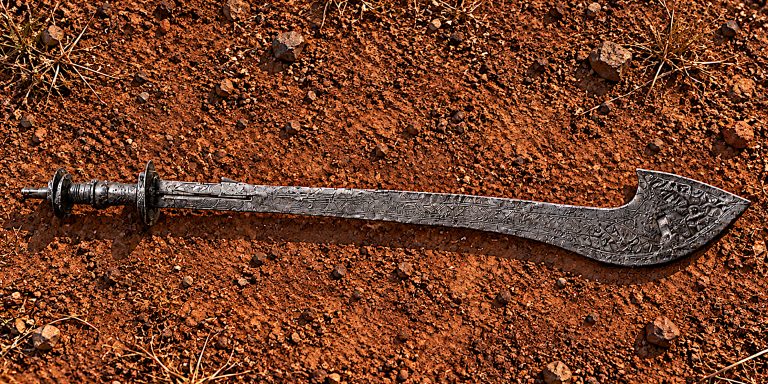
Many of the finest swords used at Brunanburh were imported or inspired by Frankish designs. A good sword was a status symbol as much as a weapon. Losing one in battle was unfortunate. Losing one after paying a small fortune for it must have been even worse.
The Battle Timeline
Before Dawn
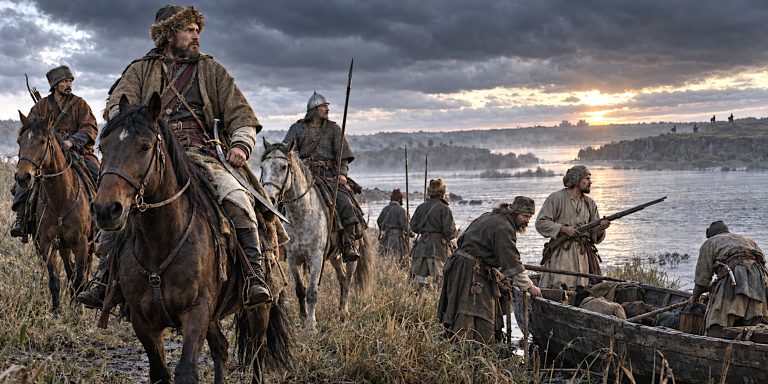
The two armies assembled near an uncertain location known only as Brunanburh. The exact site remains disputed, though the Wirral peninsula is now the strongest candidate.
Scouts, skirmishers and nervous men waiting behind shield walls likely filled the early hours.
Morning
The battle began with both sides forming shield walls. Spears and missiles were exchanged before the armies closed.
The fighting appears to have been ferocious from the outset. Contemporary poetry suggests that the English line held firm despite repeated attacks.
Midday
The centre of the battle became a brutal contest between Æthelstan’s elite troops and Olaf’s Viking warriors.
At some stage, Prince Edmund appears to have led a decisive counterattack. The Anglo-Saxon Chronicle later credited the brothers with breaking the enemy line.
Afternoon
The coalition army began to collapse.
Constantine II’s son was killed in the fighting. Several Viking jarls also fell. Olaf escaped, but only by fleeing to his ships.
The defeated army retreated in chaos, pursued by the English.
Evening
By sunset, the battlefield was covered with the dead.
The Anglo-Saxon Chronicle described the aftermath in unusually grim detail. For a medieval source, which normally treated mass death with the emotional range of a shopping list, this says a great deal.
Contemporary Quotes
The most famous account comes from the Anglo-Saxon Chronicle:
Never yet was there more slaughter on this island, never before as many people killed by the sword.
Another passage praises Æthelstan and Edmund:
King Æthelstan, lord of warriors, ring-giver of men, and his brother also, Edmund atheling, won eternal glory in battle.
The chronicler Æthelweard later wrote:
The fields of Britain were brought into one, there was peace everywhere.
These quotes matter because they show how contemporaries viewed Brunanburh. They did not see it as merely another battle. They saw it as the moment when the future of Britain was decided.
Archaeology and the Search for the Battlefield
The location of Brunanburh remains one of the great unsolved puzzles of medieval history.
More than forty possible sites have been proposed, including places in Yorkshire, Lancashire, County Durham and southern Scotland.
Today, the leading theory places the battle near Bromborough on the Wirral peninsula.
Reasons for this include:
- The place name Bromborough may preserve the older name Brunanburh
- The Wirral lay on a logical route for Olaf’s fleet arriving from Dublin
- Local archaeology has uncovered concentrations of metalwork and weapon-related finds
- The surrounding landscape broadly matches medieval descriptions
Archaeological finds from the wider area include:
- Fragments of weapons and fittings
- Belt mounts and horse equipment
- Evidence of large-scale military activity in the tenth century
- Areas with unusual concentrations of metal artefacts
No single discovery has definitively proved the site. Historians are still waiting for the medieval equivalent of a giant sign saying “battle happened here”. Sadly, Anglo-Saxon armies were inconsiderate enough not to leave one behind.
Casualties
The losses were enormous.
The Anglo-Saxon Chronicle lists the deaths of:
- Five kings
- Seven Viking jarls
- Constantine II’s son
- Large numbers of ordinary warriors
Modern estimates vary, but several thousand men may have died.
Given the size of Britain in the tenth century, this was a devastating loss. Entire noble families and warrior retinues may have vanished in a single day.
Why Brunanburh is considered so important
Brunanburh secured Æthelstan’s control of England and shattered the greatest coalition assembled against him.
Its consequences were immense:
- England remained united under a single ruler
- Viking hopes of breaking England apart were severely weakened
- Scotland and Strathclyde were pushed back from English affairs
- Æthelstan’s reputation became legendary
Many historians regard Brunanburh as the birth of England as a political nation.
That can sound slightly grandiose until you realise how different British history might have been had Olaf won. England could easily have fractured into several kingdoms again. The map of Britain, and perhaps even the language and culture of the islands, might have taken a very different course.
Legacy
For centuries Brunanburh lingered in poetry and chronicles, but gradually slipped from popular memory. It lacked the convenient certainty of Hastings or Bannockburn. Historians dislike admitting it, but we do tend to prefer battles where we know where they happened.
Even so, Brunanburh remains one of the defining battles of medieval Britain.
It was the largest battle of Æthelstan’s reign, the high point of early Anglo-Saxon warfare, and perhaps the closest England ever came to unravelling before it had fully begun.
Further Reading
- Sarah Foot, Æthelstan: The First King of England
- Michael Livingston, Never Greater Slaughter
- Michael Livingston and Paul Cavill, The Battle of Brunanburh: A Casebook
- Tim Clarkson, The Makers of Scotland
- Clare Downham, Viking Kings of Britain and Ireland