The Zweihänder is the sort of sword that makes an ordinary longsword appear rather modest. Developed chiefly in the German-speaking lands during the late fifteenth and sixteenth centuries, it could approach the height of the soldier carrying it. Yet surviving weapons show that it was not simply an iron club built for exceptionally large men.
A well-made Zweihänder was carefully proportioned, with a long grip, substantial pommel and an extended ricasso that could be held like part of the hilt. Its size provided reach, leverage and considerable authority over the space around its wielder. These qualities made it useful in battlefield formations, personal defence and ceremonial display.
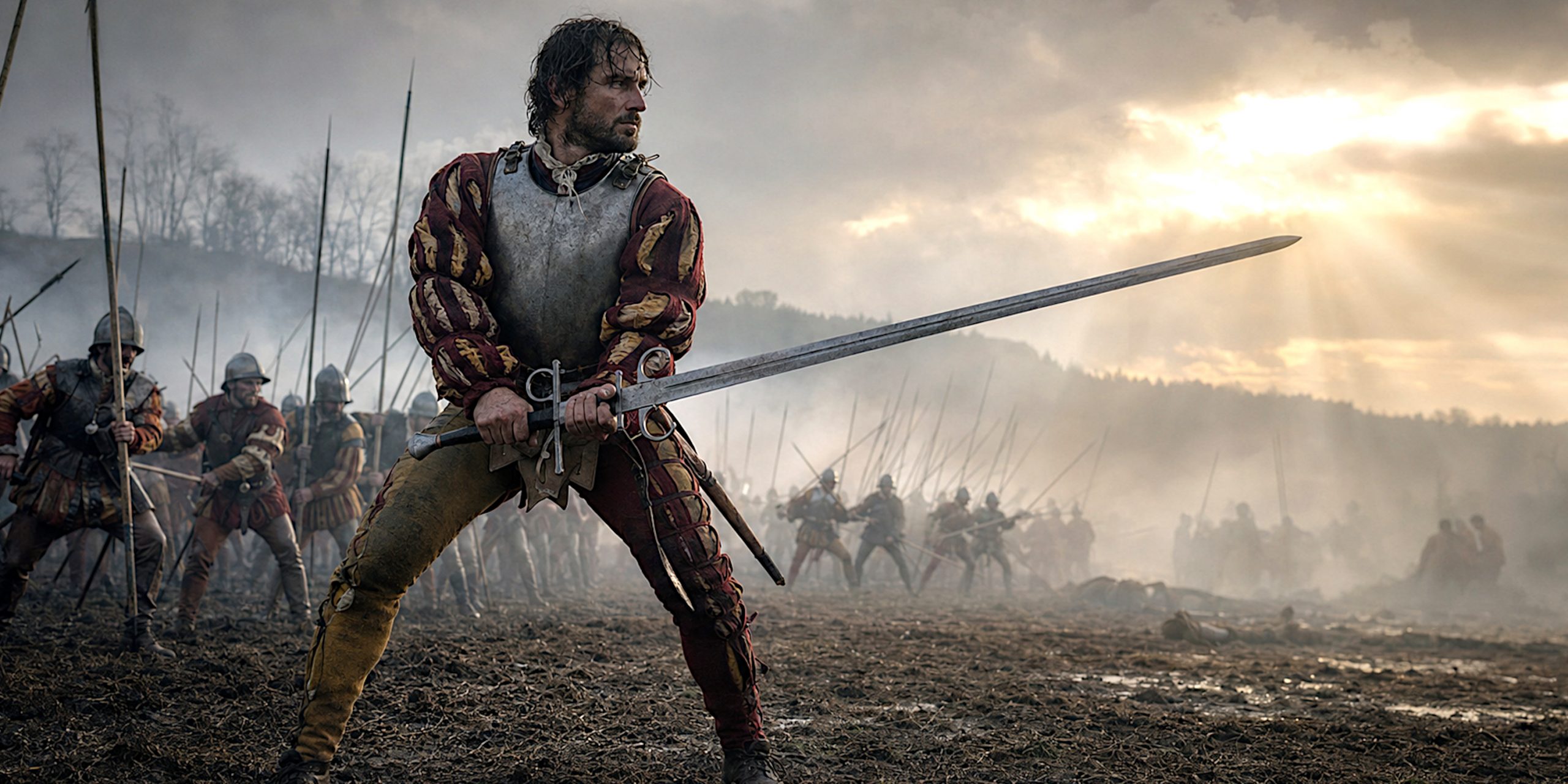
The weapon is strongly associated with the Landsknechte, the colourful German mercenary infantry who fought across Renaissance Europe. Contemporary images certainly show large two-handed swords among these troops. Claims that swordsmen routinely chopped the heads from enemy pikes, however, deserve more caution. Pike shafts were resilient, formations were dense and battles rarely behaved as neatly as later stories suggest.
What remains beyond doubt is that the Zweihänder was a specialised weapon. It demanded training, judgement and nerve. Flamboyant clothing was apparently optional, although the Landsknechte did their best to make it look compulsory.
Zweihänder specifications
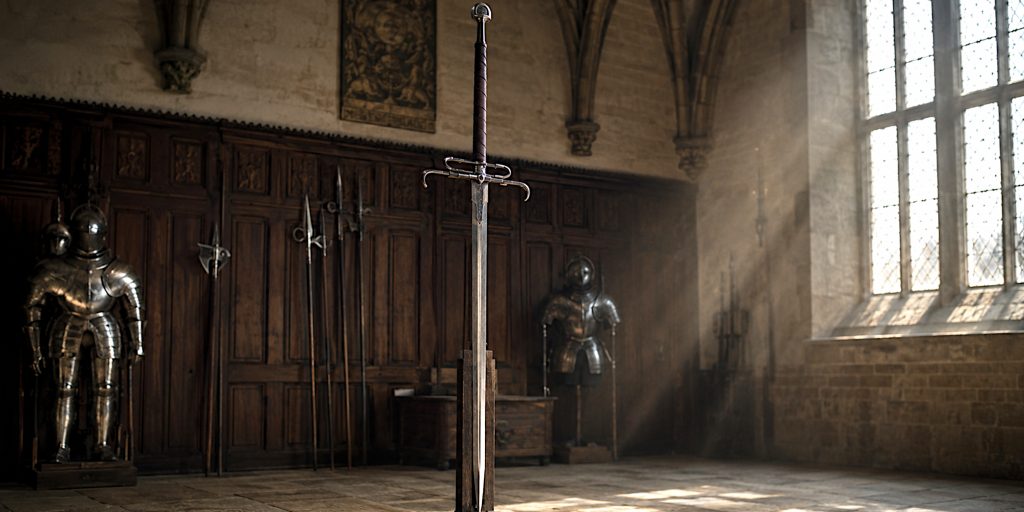
The German word Zweihänder means “two-hander”. Historical records and museum catalogues also use terms such as Schlachtschwert, meaning battle sword, and Bidenhänder, another form of “two-hander”.
Modern writers often apply Zweihänder to almost any enormous German sword of the Renaissance. Historical terminology was less tidy, and not every large two-handed sword belongs to one uniform design.
| Feature | Typical historical range |
|---|---|
| Overall length | Approximately 150 to 180 cm |
| Blade length | Approximately 110 to 140 cm |
| Weight | Commonly around 2.5 to 4 kg |
| Grip length | Approximately 30 to 45 cm |
| Blade form | Straight, double-edged and usually tapering |
| Crossguard | Long quillons, frequently with side rings |
| Ricasso | Often unsharpened and sometimes leather-covered |
| Parrying hooks | Common on developed sixteenth-century examples |
| Primary period | Late fifteenth to early seventeenth century |
| Main regions | German states, Austria and neighbouring European territories |
These figures are guides rather than a fixed standard. Functional battlefield swords and enormous processional weapons are frequently placed in the same category, despite being made for rather different purposes.
The Metropolitan Museum of Art notes that even large European two-handed swords generally weighed less than 10 lb, or roughly 4.5 kg. The notion that Renaissance swords were brutally heavy objects is largely a modern misunderstanding. Balance mattered as much as absolute weight.
Principal parts
- Long double-edged blade: Provided reach and allowed cuts from either side.
- Extended grip: Gave the hands room to shift during changes of direction.
- Large pommel: Helped counterbalance the blade and could assist with close-range techniques.
- Long crossguard: Protected the hands and helped control opposing weapons.
- Side rings: Added protection around the hilt.
- Ricasso: An unsharpened section immediately above the guard.
- Parrying hooks: Also called lugs or flukes, these projected from the blade above the ricasso and formed a secondary guard.
- Fullers: Grooves that could reduce mass while maintaining structural strength. They were not channels for blood, regardless of how often that particular tale refuses to die.
Some surviving examples have wavy or flame-shaped blades, now commonly described as Flamberge blades. These are particularly striking, although the practical benefits of the waves are difficult to separate from their decorative and symbolic value.
History and evolution of the Zweihänder
Origins in medieval great swords
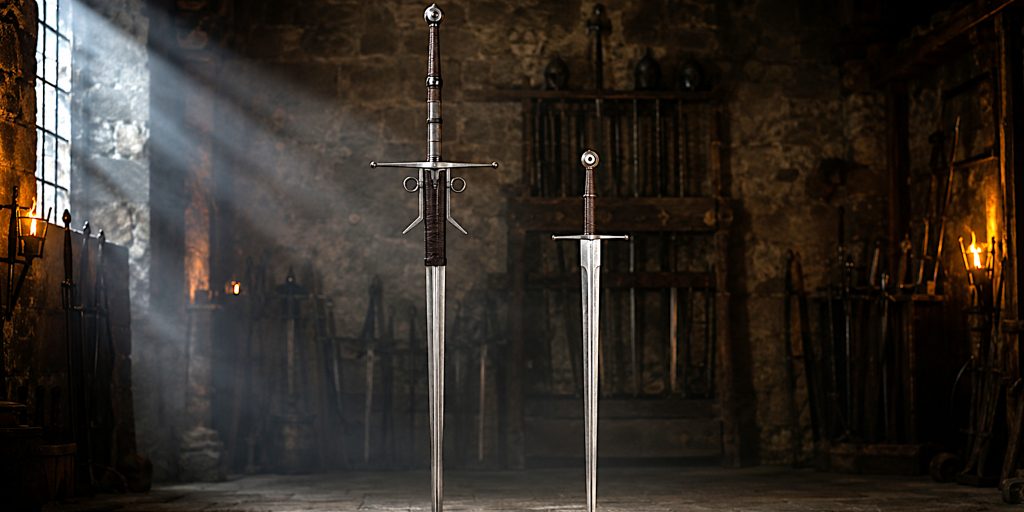
The Zweihänder did not appear fully formed. Its ancestry lies in the large European swords of the thirteenth and fourteenth centuries, including so-called great swords and swords of war. These weapons had longer grips and blades than ordinary arming swords, allowing them to be used with two hands when circumstances permitted.
During the fourteenth and fifteenth centuries, the longsword became increasingly sophisticated. Surviving fencing treatises show it being used for cutting, thrusting, grappling and half-swording. The largest Renaissance two-handers developed from this tradition, but became increasingly specialised.
Growth during the age of the pike
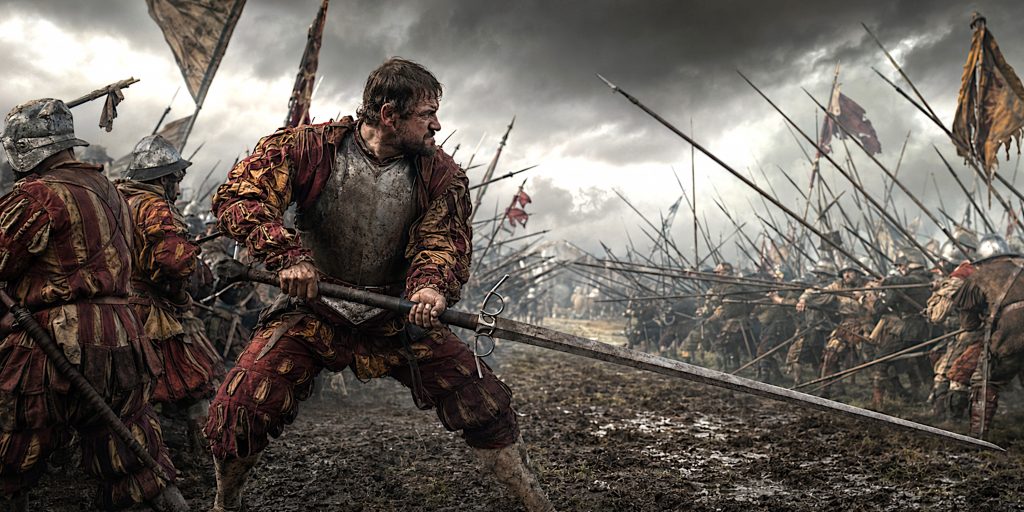
By the late fifteenth century, European warfare was being reshaped by disciplined infantry carrying pikes, halberds and firearms. Swiss forces had demonstrated the offensive potential of tightly organised pike formations, while German rulers answered with their own mercenary infantry, the Landsknechte.
The Zweihänder reached its most recognisable form during the early and middle decades of the sixteenth century. Blades became longer, guards more elaborate and ricassos more clearly developed. Parrying hooks provided protection when the sword was held above the main guard.
Soldiers equipped with great swords may have operated near standards, officers and the front or edges of formations. They could defend important personnel, contest space against enemy polearms and exploit disorder once formations met. Their exact tactical role probably varied by army, campaign and moment.
The Doppelsöldner connection
Zweihänder swordsmen are regularly identified as Doppelsöldner, or “double-pay men”. The relationship is genuine but often simplified.
Doppelsöldner received additional pay for undertaking dangerous or specialised work. Some carried great swords, while others used firearms or different weapons. It is therefore misleading to treat every double-pay soldier as a swordsman, or every great-sword carrier as part of a single, formally defined battlefield unit.
The Zweihänder nevertheless required an experienced soldier. A man using one among crowded ranks needed discipline at least as much as strength. An enthusiastic novice swinging six feet of sharpened steel would have endangered his own formation rather efficiently.
The pike-cutting question
Popular histories often claim that Zweihänder swordsmen charged into enemy formations and sliced through pike shafts to create gaps. This is possible in isolated circumstances, but doubtful as a standard technique.
A pike was a long, flexible wooden weapon held within a formation several ranks deep. Cutting through one cleanly would require favourable timing and contact. The swordsman would also have to survive the attention of its owner and the neighbouring pikemen.
More plausible uses include:
- Striking or displacing pike points rather than severing the shafts
- Pressing weapons aside to create a temporary opening
- Attacking exposed hands, arms or faces
- Defending standards and officers
- Fighting in the confused spaces created when formations collided
- Guarding narrow approaches or controlling a restricted area
The Zweihänder could influence a large area around its user, but it was not a medieval lawnmower.
Decline and ceremonial survival
During the later sixteenth century, firearms became more numerous and better integrated into infantry formations. The pike remained important, but the proportions and organisation of armies changed.
Large two-handed swords continued to be carried by guards and ceremonial troops into the seventeenth century. Some surviving examples were made principally for processions, court display or civic pageantry. These weapons can be unusually long, heavy or elaborately decorated.
This ceremonial afterlife complicates modern study. A sword that resembles a battlefield Zweihänder may have been intended to impress spectators rather than strike an opponent.
How was a Zweihänder used?
The weapon was not limited to broad horizontal swings. Its long hilt and ricasso allowed several methods of handling.
Conventional two-handed use
With both hands on the grip, the swordsman could deliver:
- Diagonal and vertical cuts
- Thrusts from extended positions
- Sweeping actions used to discourage approach
- Shorter cuts made by pulling with one hand and pushing with the other
- Defensive beats and displacements against other weapons
The rear hand helped accelerate or arrest the blade. This allowed a trained user to change direction more quickly than the sword’s size might suggest.
Half-sword and ricasso use
The unsharpened ricasso could be gripped above the main crossguard. The parrying hooks then acted as a secondary guard.
This shortened the effective weapon and improved point control, producing something closer to a short spear or polearm. It was useful when space narrowed, when greater thrusting precision was needed or when controlling an opposing weapon.
Controlling space
The greatest practical quality of a Zweihänder was its ability to threaten a broad area. Its user could keep several opponents at distance or make an approach hazardous.
Comparable principles appear in Iberian montante traditions, where large two-handed swords were used in exercises involving multiple opponents, protected persons and restricted passages. These sources should not be treated as direct instructions for every German weapon, but they demonstrate what a large, well-balanced sword could do in trained hands.
Advantages and disadvantages
| Advantages | Disadvantages |
|---|---|
| Exceptional reach | Awkward in very confined spaces |
| Strong leverage against opposing weapons | More tiring than a smaller sword |
| Powerful cuts and effective thrusts | Required considerable training |
| Could control a broad fighting area | Difficult to carry casually |
| Ricasso allowed the weapon to be shortened | Poorly suited to constant use within tightly packed friendly ranks |
| Imposing visual and psychological presence | More expensive to manufacture than an ordinary infantry sword |
| Useful against several weapon types | A missed action could leave the wielder exposed |
Principal advantages
- Reach: The user could threaten an opponent before entering the range of many shorter weapons.
- Leverage: Two widely spaced hands gave strong mechanical control over the blade.
- Versatility: The sword could cut, thrust, displace weapons and be shortened through gripping the ricasso.
- Area control: Its length made it valuable when guarding an approach, standard or important person.
- Intimidation: A large sword carried by an experienced mercenary was an effective announcement that negotiations had concluded.
Principal disadvantages
- Space: Interior rooms, dense woodland and tightly packed ranks restricted its movement.
- Fatigue: Good balance did not remove the physical demands of repeatedly moving a large steel weapon.
- Training: Reach becomes a liability when the user cannot control the point, edge or recovery.
- Transport: A true Zweihänder was not conveniently worn at the hip. It was commonly carried over the shoulder or transported with other military equipment.
- Specialisation: A longsword or shorter sidearm was more convenient for ordinary personal combat.
Zweihänder compared with similar weapons
| Weapon | Region | Typical character | Main distinction |
|---|---|---|---|
| Zweihänder | German-speaking Europe | Very large two-handed sword with long guard and often a developed ricasso | Closely associated with Landsknecht warfare and ceremonial guards |
| Montante | Iberian Peninsula | Large two-handed sword used for powerful continuous actions | Surviving rules emphasise area control, escort and fighting multiple opponents |
| Spadone | Italy | Italian great sword used with broad, flowing movements | Part of a sophisticated documented fencing tradition |
| Scottish two-handed sword | Scotland | Long sword with distinctive down-sloping guard | Different regional hilt design and military context |
| Longsword | Much of Europe | More compact two-handed or hand-and-a-half weapon | Lighter, easier to carry and more versatile in individual combat |
| Great sword | Western and Central Europe | Broad category of large medieval and Renaissance swords | A general classification rather than one precise national design |
| Halberd | Central Europe | Polearm combining axe blade, spike and hook | Greater reach and specialised armour-facing functions, but less sword-like flexibility |
Zweihänder and montante
The montante is probably the closest functional comparison. Both weapons could dominate space and resist several opponents. Iberian fencing texts preserve detailed exercises for defending a cloak, protecting a companion, guarding a narrow street and moving through hostile groups.
German material does not provide an equally neat tactical handbook specifically labelled for the Zweihänder. Applying every montante rule directly to German warfare would therefore be speculative, although the comparison remains instructive.
Zweihänder and longsword
The longsword was generally shorter and lighter. It could be worn more conveniently, used in tighter spaces and employed in wrestling or armoured combat with considerable precision.
The Zweihänder offered greater reach and authority but surrendered some portability. One was an adaptable personal weapon; the other leaned towards battlefield specialisation and control of space.
Zweihänder and Scottish claymore
The traditional Scottish two-handed sword, often called the claymore, usually had a guard with downward-sloping arms ending in quatrefoils. It lacked the complex ring guards and prominent parrying hooks seen on many German great swords.
Both belong to the broad family of European two-handed swords, but their design histories should not be collapsed into a single type.
The legacy of the Zweihänder
The Zweihänder became one of the defining weapons of the Landsknecht image. Woodcuts and engravings show enormous swords beside slashed clothing, feathers, pikes and standards. It was a weapon admirably suited to the visual culture of Renaissance mercenary warfare, where reputation could be nearly as important as armour.
Its later ceremonial use preserved the form after its battlefield importance had declined. Civic guards, princely households and court troops carried great swords as symbols of authority, martial tradition and institutional prestige.
The weapon now occupies several different worlds:
- Museum collections preserve original military and processional examples.
- Historical European martial arts practitioners reconstruct methods for using great swords.
- Re-enactors use safer reproductions to interpret Landsknecht warfare.
- Fantasy games and films exaggerate the type into weapons of improbable thickness and weight.
The fictional versions often owe more to sculpture and industrial machinery than historical swordsmithing. Real examples are usually slimmer, better balanced and considerably more elegant.
Where to see an original Zweihänder
Display arrangements change, so check with each museum before travelling specifically to see an individual weapon.
| Museum or collection | Location | What to look for |
|---|---|---|
| Royal Armouries | Leeds, England | European two-handed swords and related Renaissance arms |
| Wallace Collection | London, England | Large European swords, including an exceptionally long double-handed example |
| Germanisches Nationalmuseum | Nuremberg, Germany | German Renaissance arms and material associated with Landsknecht culture |
| Landeszeughaus | Graz, Austria | One of the world’s largest surviving historic armouries |
| Kunsthistorisches Museum | Vienna, Austria | Imperial arms, armour and courtly weapons |
| Bayerisches Nationalmuseum | Munich, Germany | South German arms and Renaissance decorative arts |
| Metropolitan Museum of Art | New York, USA | European great swords and extensive arms and armour displays |
| Philadelphia Museum of Art | Philadelphia, USA | European arms and armour, including large Renaissance swords |
The Wallace Collection records an enormous double-handed sword measuring approximately 1.99 metres. Weapons at this scale are particularly useful for understanding the difference between an ordinary fighting sword and the more imposing ceremonial end of the family.
Zweihänder collector’s guide
Original sixteenth-century two-handed swords are rare, costly and heavily copied. The category also contains genuine later processional weapons, nineteenth-century historicist pieces, theatrical props and modern reproductions.
That variety makes confident attribution difficult. A sword may contain an old blade fitted to a later hilt, or an assemblage of components from several periods. Such a piece is not necessarily worthless, but it should not be sold as an untouched Landsknecht weapon.
What to examine before buying
- Provenance: Look for old collection records, auction catalogues, inventory numbers and export documentation.
- Construction: Examine how the tang, pommel, grip and guard fit together. Fresh work around the peen can indicate later assembly.
- Blade profile: Authentic blades should show convincing distal taper and historical geometry, not simply a thick steel bar ground to a point.
- Ricasso: Check whether the parrying hooks were forged or securely attached in a manner consistent with the proposed date.
- Maker’s marks: Compare marks with published examples. A mark alone proves little because they have been copied for centuries.
- Patina: Uniform artificial ageing can be more suspicious than honest variation. Components naturally age differently.
- Decoration: Etching, inscriptions and heraldry should be assessed by a specialist familiar with Renaissance techniques.
- Dimensions and balance: Extremely heavy swords may have been processional objects, later replicas or theatrical pieces.
- Restoration: Replaced grips, leather coverings and wire binding are common. They should be declared and reflected in the price.
- Documentation: Request a full condition report and clear photographs of the blade, guard, pommel, grip and tang area.
Warning signs
- A precise association with a named Landsknecht but no documentary provenance
- Claims that the sword was used to cut through several pikes at once
- Newly applied armoury stamps or suspiciously crisp maker’s marks
- Acid ageing intended to imitate centuries of corrosion
- A blade and hilt whose wear patterns do not correspond
- Modern welding around the guard or parrying hooks
- An attribution based entirely on size
- A bargain price paired with a grand historical story
The market has no shortage of swords that supposedly belonged to famous soldiers. Those soldiers were remarkably careless with their paperwork.
Zweihänder auction prices
Prices vary sharply according to age, originality, condition, maker, provenance and whether the sword was intended for battle or ceremony. Buyer’s premium, tax, shipping and specialist insurance can add substantially to the hammer price.
| Category | Broad market range |
|---|---|
| Decorative modern replica | £150 to £600 |
| Functional reproduction | £400 to £1,500 |
| High-quality custom reproduction | £1,500 to £4,000 or more |
| Nineteenth or twentieth-century historicist example | £1,000 to £5,000 |
| Composite antique sword with later parts | £3,000 to £10,000 |
| Authenticated sixteenth or early seventeenth-century example | £7,000 to £25,000 |
| Exceptional named, courtly or highly decorated example | £25,000 to £50,000 or more |
These ranges are indicative rather than valuations. A documented sword from an important collection can exceed them, while a compromised or miscatalogued example may sell for much less.
Recorded market examples
- A fine German two-hand sword dated to the middle of the sixteenth century realised £6,900 at Christie’s in 1999. Its blade had a long ricasso, basal lugs and an elaborate iron hilt. View the Christie’s record.
- A large two-hand sword associated with the bladesmith Wolfgang Stantler sold for €7,750 at Hermann Historica after opening at €2,800. See the auction report.
- A sword made around 1612 for the guard of Prince-Archbishop Markus Sittikus sold for €14,500 in 2024, against a catalogue price of €12,000. Its heraldry and documented institutional connection materially strengthened its value. Read the Hermann Historica result.
- Later copies are much less valuable. A nineteenth-century German two-hand sword in an early seventeenth-century style sold with other objects for £2,280 at Christie’s in 2005.
Auction results from different years should not be compared without considering inflation, buyer’s premium and the condition of each weapon.
Buying and owning a Zweihänder in the UK
A conventional straight-bladed Zweihänder is not automatically covered by the UK prohibition directed at swords with curved blades of 50 cm or more. That does not mean it is free from legal controls.
In England and Wales:
- Bladed weapons cannot generally be sold to anyone under 18.
- Carrying a sword in public requires a legitimate reason or lawful authority.
- Transport should be secure, discreet and directly connected to a legitimate activity such as a museum loan, organised event or martial arts practice.
- Certain specifically prohibited weapon designs are subject to additional restrictions.
- Importation, delivery and sale can involve age-verification requirements.
The law can change, and rules differ across UK jurisdictions. Buyers should consult current government guidance on buying and carrying weapons and obtain professional advice when importing or purchasing a valuable sword.
Caring for an antique sword
An original Zweihänder should be treated as a historic object rather than restored until it looks new.
- Handle the steel with clean gloves to prevent fingerprints and salt deposits.
- Keep the sword in a stable, dry environment.
- Avoid abrasive polishing, wire brushes and chemical rust removers.
- Do not sharpen an antique blade.
- Support the weapon at several points when displaying it horizontally.
- Keep leather and wooden components away from direct heat.
- Ask a qualified arms conservator to assess active corrosion.
- Record every intervention, however minor.
Aggressive cleaning can remove tool marks, inscriptions, patina and evidence of manufacture. It can also remove a distressing amount of financial value in a single enthusiastic afternoon.
Is a Zweihänder practical?
Within its historical setting, yes. It offered reach, leverage and formidable control in the hands of a trained user. It could contest polearms, guard important positions and remain dangerous at shorter range through use of the ricasso.
It was never a universal solution. Its size made it demanding to carry, difficult to use in confined spaces and unsuitable for many ordinary military tasks. The sword belonged to a period when infantry tactics, social display and personal reputation met in unusually vivid fashion.
The best surviving Zweihänders are impressive because their makers understood proportion. They are enormous without being crude, elaborate without necessarily being impractical and intimidating without needing the fantastic bulk later artists gave them. That balance between spectacle and function is what keeps the Zweihänder interesting long after its battlefield career ended.