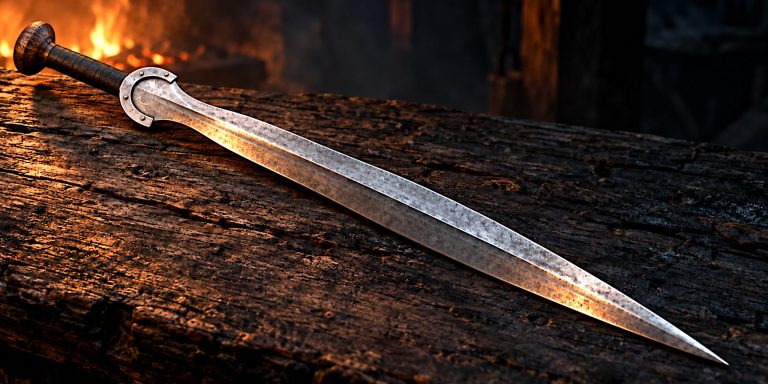
The Celtic sword sits at the centre of Iron Age warfare in Europe, yet it is often misunderstood as a single type. In reality, it spans centuries of development across La Tène culture, evolving from short thrusting blades into long slashing weapons carried by elite warriors. Classical writers admired and feared them in equal measure, sometimes exaggerating their weaknesses, though archaeology paints a more measured picture.
What remains consistent is this. These swords were status objects as much as weapons, carried by men who expected to be seen.
Celtic swords emerged during the early Iron Age, roughly from the 5th century BC onwards, associated with the La Tène cultural horizon stretching from modern France and Germany into Britain and beyond.
Early examples were relatively short, suited to thrusting. By the 3rd century BC, longer blades became common, favouring sweeping cuts from horseback or in open battle. Many were richly decorated, with hilts and scabbards showing intricate metalwork that signals both identity and prestige.
Roman authors such as Polybius and Diodorus Siculus describe these weapons in battle, sometimes criticising their flexibility. Modern metallurgical studies suggest that quality varied widely rather than being uniformly poor.
Specifications
| Feature | Typical Range |
|---|---|
| Blade length | 60 to 90 cm |
| Overall length | 70 to 100 cm |
| Weight | 1.0 to 1.5 kg |
| Blade type | Double-edged, leaf-shaped or parallel |
| Construction | Pattern-welded or piled iron |
| Grip | Organic materials over iron tang |
| Scabbard | Iron or bronze with decorative plates |
Key characteristics
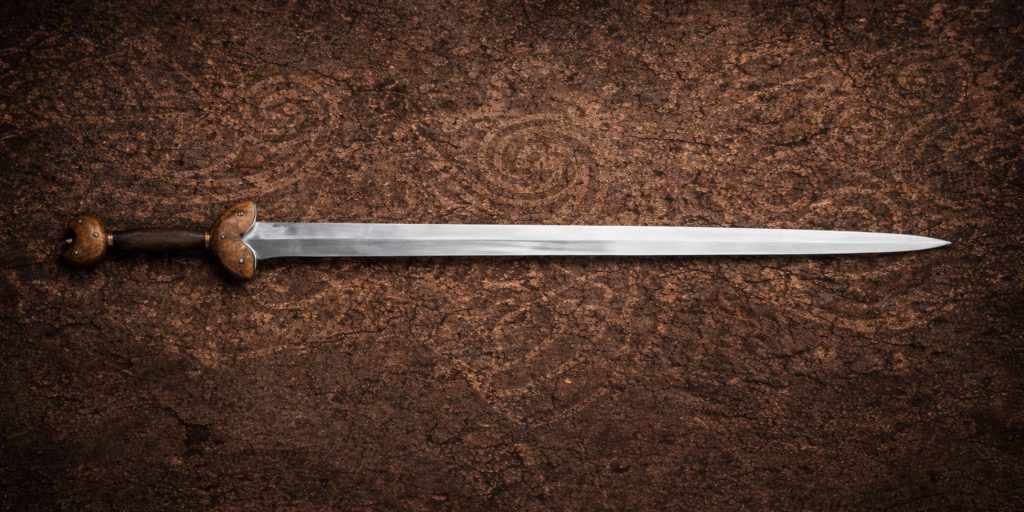
- Long, double-edged blade designed primarily for cutting
- Rounded or spatulate tip on later examples
- Narrow tang with organic grip materials such as wood, horn, or bone
- Scabbards often highly decorated, sometimes more elaborate than the sword itself
- Suspension systems allowed the sword to hang at the side rather than vertically
History and Evolution
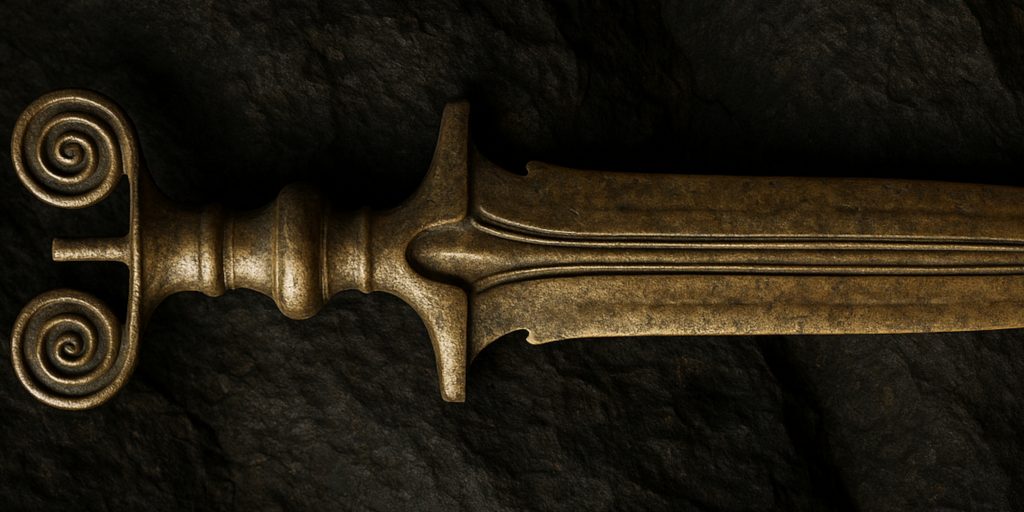
Hallstatt Period (c. 800 to 450 BC)
- Shorter swords with strong thrusting capability
- Influence from earlier bronze traditions
- Less decorative, more functional in appearance
Early La Tène (c. 450 to 300 BC)
- Increase in blade length
- Development of distinctive Celtic art styles on scabbards
- Wider distribution across Europe
Middle to Late La Tène (c. 300 to 50 BC)
- Long slashing swords dominate
- Blades often exceed 80 cm
- Associated with cavalry and elite warriors
- Roman encounters with Gauls highlight their battlefield presence
Roman Conquest Period
- Gradual replacement by Roman military systems
- Celtic sword traditions continue in peripheral regions such as Britain and Ireland
Advantages and Disadvantages
Advantages
- Strong cutting power, especially in longer La Tène examples
- Effective reach advantage over shorter weapons
- Psychological impact through size and ornamentation
- Flexible enough to absorb shock without snapping
Disadvantages
- Less effective for precise thrusting compared to later Roman designs
- Quality varied significantly depending on smithing skill
- Organic hilts rarely survive, making grip reconstruction uncertain
- Some blades may bend under heavy use, requiring straightening
Comparison with Similar Weapons
| Weapon | Culture | Key Difference |
|---|---|---|
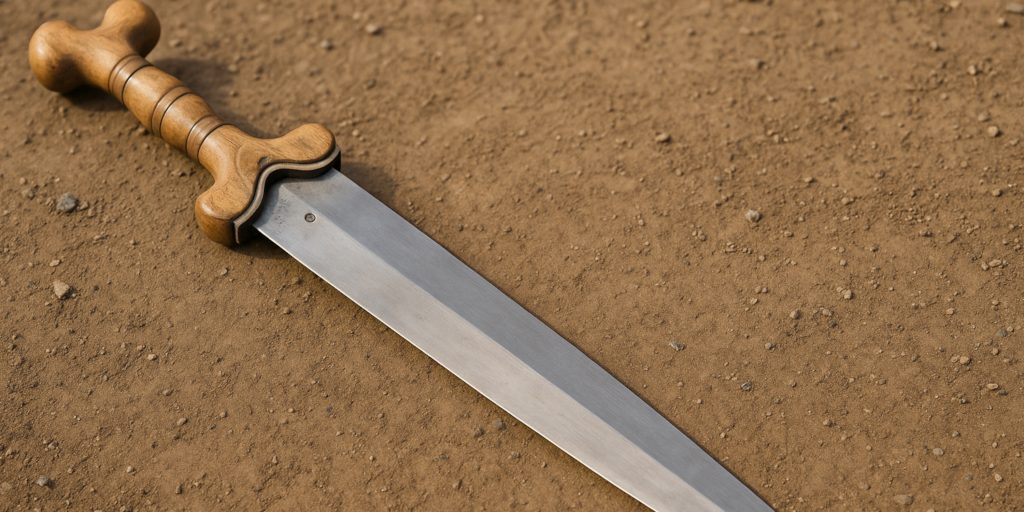
| Gladius | Roman | Short, thrust-focused, rigid discipline weapon |
| Xiphos | Greek | Shorter, leaf-shaped but more thrust-oriented |
| Spatha | Roman | Longer blade influenced by Celtic designs |
| Falcata | Iberian | Curved, forward-weighted cutting weapon |
Observations
- The Roman gladius contrasts sharply with the Celtic sword in both length and tactical use
- The Roman spatha likely reflects Celtic influence, especially in cavalry contexts
- Greek swords share similar shapes but tend toward more controlled thrusting roles
- Iberian weapons prioritise chopping power over reach
Legacy
The Celtic sword left a lasting imprint on European weapon design. Its most direct descendant is the Roman spatha, which later influenced early medieval swords used by Germanic and Viking cultures.
Beyond function, the Celtic approach to weapon decoration helped establish a tradition where swords carried symbolic and cultural meaning. This idea persists well into the medieval knightly period.
Archaeological finds, especially from river deposits and burial sites, suggest that many swords were deliberately deposited as offerings. That alone tells you they were more than tools.
Where to See Celtic Swords Today
Notable collections include:
- The British Museum, London
- National Museum of Ireland, Dublin
- Musée d’Archéologie Nationale, Saint-Germain-en-Laye
- Kelvingrove Art Gallery and Museum, Glasgow
These institutions hold some of the finest La Tène swords and scabbards, often displayed alongside other grave goods that help reconstruct the warrior’s identity.
Collector’s Guide
Availability
- Authentic Celtic swords are rare and typically only appear through major auction houses or private sales
- Most surviving examples are heavily corroded due to burial conditions
Typical Auction Prices
| Condition | Estimated Price |
|---|---|
| Fragmented blade | £2,000 to £6,000 |
| Complete but corroded sword | £8,000 to £25,000 |
| Decorated scabbard examples | £30,000 to £100,000+ |
What to Look For
- Provenance is critical, undocumented pieces carry significant risk
- Corrosion patterns should match long-term burial, not artificial ageing
- X-ray analysis can reveal internal structure and authenticity
- Beware of composite restorations assembled from multiple finds
Modern Replicas
- High-quality reproductions are widely available
- Ideal for handling and display without conservation concerns
- Look for historically accurate proportions and materials