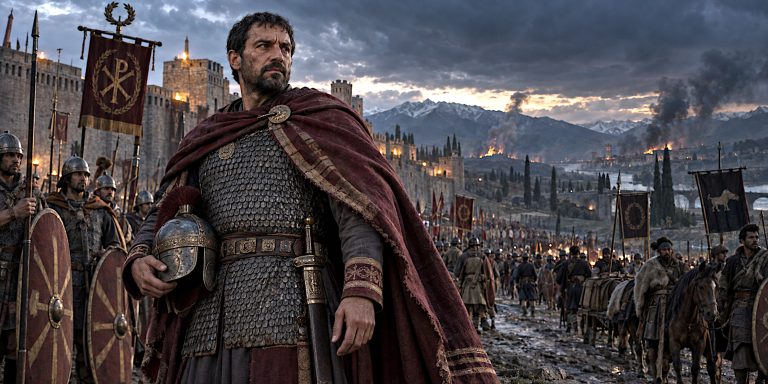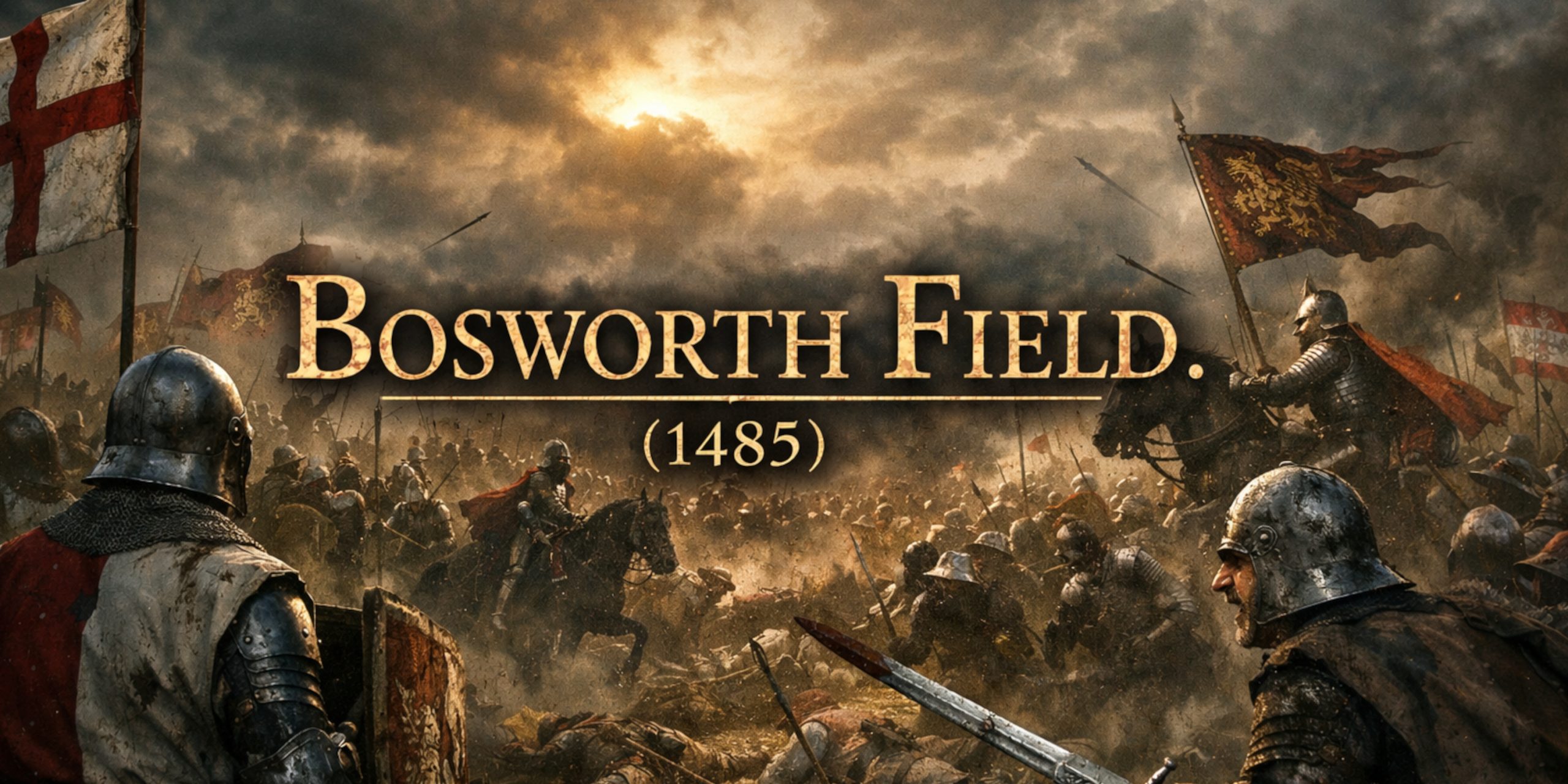
The Battle of Bosworth Field, fought on 22 August 1485, was one of those rare battles that feels almost absurdly decisive. One day England had a Plantagenet king. By the end of it, Richard III lay dead in a muddy Leicestershire field, Henry Tudor was being crowned with a circlet supposedly found in a hawthorn bush, and the Tudor dynasty had begun.
Bosworth was the final major battle of the Wars of the Roses, though the fighting and plotting did not quite stop there. English nobles had a stubborn habit of refusing to accept defeat quietly. Still, Bosworth marked the moment when the long and bitter struggle between Lancaster and York finally tilted beyond recovery.
It is also one of the most studied battles in English history. Chroniclers, archaeologists and historians have all argued over where the battle happened, who betrayed whom, and whether Richard III was doomed from the start or simply had the misfortune to trust the Stanleys.
Background
By 1485 Richard III had been king for just over two years. He had seized the throne in 1483 after declaring his nephews, the sons of Edward IV, illegitimate. The disappearance of the so-called Princes in the Tower left a stain on his reign that no amount of proclamations or public ceremonies could remove.
Henry Tudor, meanwhile, was a distant Lancastrian claimant living in exile in Brittany and then France. His claim to the throne was weak by blood. Frankly, if England had operated like a sensible filing system, Henry would have been several folders down and marked ‘unlikely’. Yet after years of civil war many nobles cared less about pedigree and more about finding someone who might end the chaos.
Henry gathered support from Lancastrian exiles, discontented Yorkists, and men who simply disliked Richard. In August 1485 he landed at Milford Haven in Wales with a relatively small force, marched through Wales and the Midlands, and slowly attracted supporters.
Richard moved quickly to intercept him. The two armies met near Market Bosworth in Leicestershire.
Why Bosworth Field Mattered
Bosworth was not the largest battle of the Wars of the Roses. Towton and Tewkesbury were bloodier. Yet Bosworth mattered more than almost any of them because the result changed the ruling dynasty.
Richard III became the last English king to die in battle. Henry Tudor became Henry VII and founded the Tudor dynasty that would eventually produce Henry VIII and Elizabeth I. England’s medieval age did not end overnight, despite what many school textbooks imply, but Bosworth certainly gave it a hard shove.
Forces
The numbers at Bosworth remain uncertain because medieval chroniclers were rather fond of exaggeration. Some gave Richard an army so large that one suspects they were counting every horse, cart and mildly enthusiastic bystander.
Most modern estimates are more cautious.
| Army | Estimated Strength | Commander |
|---|---|---|
| Royal army of Richard III | 10,000 to 12,000 men | King Richard III |
| Henry Tudor’s army | 5,000 to 6,000 men | Henry Tudor, Earl of Richmond |
| Stanley forces | 4,000 to 6,000 men | Thomas Stanley and Sir William Stanley |
The Stanley family sat awkwardly between the two sides. Thomas Stanley was married to Henry Tudor’s mother, Margaret Beaufort, but had outwardly supported Richard. Throughout the battle the Stanleys waited nearby with their own force, refusing to commit themselves.
It was an extraordinarily cautious approach. One can almost imagine them standing on a hill, arms folded, waiting to see who looked likely to win before deciding they had supported that side all along.
Leaders and Troop Composition
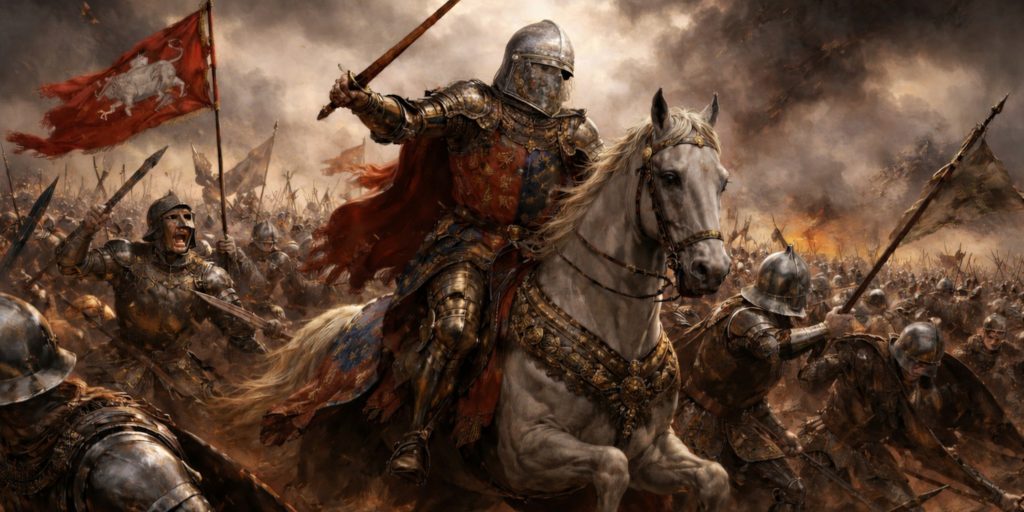
Richard III’s Army
| Leader | Role | Troops |
| Richard III | Overall commander | Household knights, men-at-arms, archers |
| John Howard, Duke of Norfolk | Vanguard commander | Billmen, archers, men-at-arms |
| Henry Percy, Earl of Northumberland | Rearguard commander | Northern levies, billmen, cavalry |
Richard’s army included:
- Experienced household men-at-arms
- Northern infantry loyal to the House of York
- Archers armed with the longbow
- Retainers from powerful nobles
- Mounted knights and cavalry
Henry Tudor’s Army
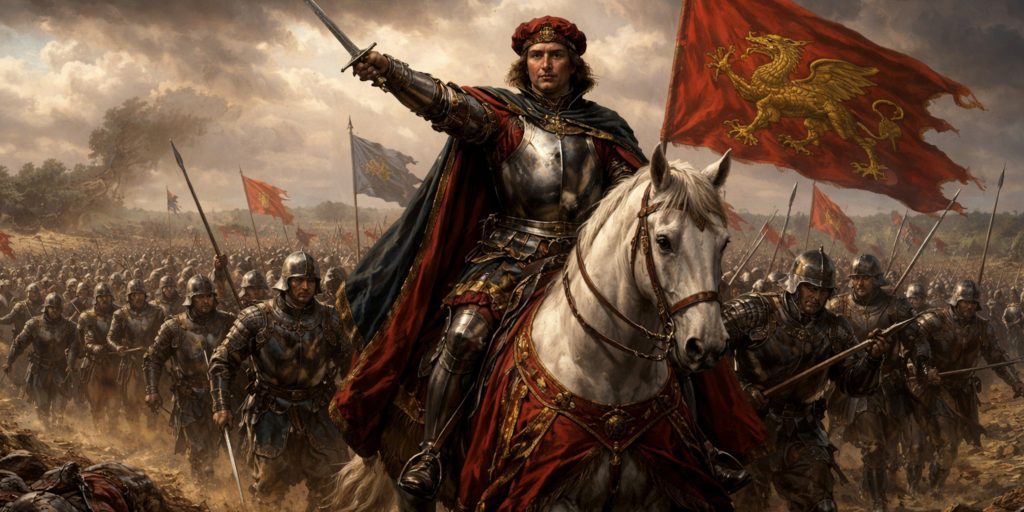
| Leader | Role | Troops |
| Henry Tudor | Overall commander | Lancastrian supporters, French mercenaries |
| John de Vere, Earl of Oxford | Battlefield commander | Experienced infantry and archers |
| Gilbert Talbot | Wing commander | Welsh and English retainers |
Henry’s force included:
- French mercenaries armed with pikes and handguns
- Welsh infantry
- English archers and billmen
- Lancastrian exiles and retainers
Stanley Forces
| Leader | Role | Troops |
| Thomas Stanley | Neutral observer, until convenient | Retainers and cavalry |
| Sir William Stanley | Later intervention against Richard | Experienced mounted men and infantry |
Arms and Armour
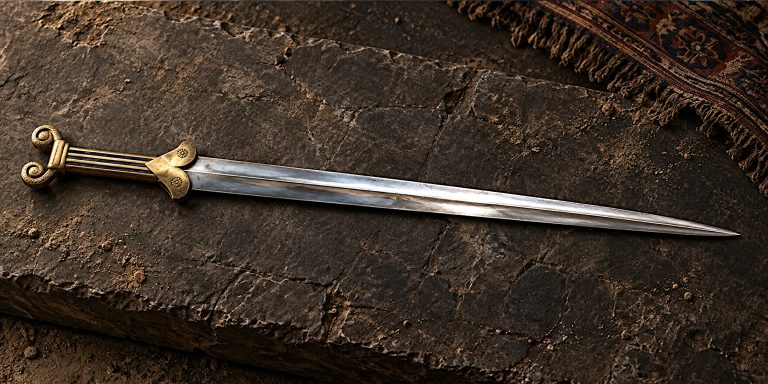
Bosworth was fought during a transitional period in warfare. Traditional medieval weapons still dominated, but gunpowder weapons and artillery were beginning to appear more often. Read our feature on Iconic Wars of the Roses weapons.
Weapons Used
- Longbows
- Bills and polearms
- Spears and pikes
- Swords
- Maces and war hammers
- Early handguns and small artillery
Specific Sword Types Used
Several sword forms were likely present on the battlefield:
| Sword Type | Description | Likely Users |
| Arming sword | One-handed knightly sword, broad-bladed and versatile | Men-at-arms and knights |
| Hand-and-a-half sword | Longer grip allowing one or two-handed use | Nobles and wealthier soldiers |
| Falchion | Single-edged cutting sword | Infantry and retainers |
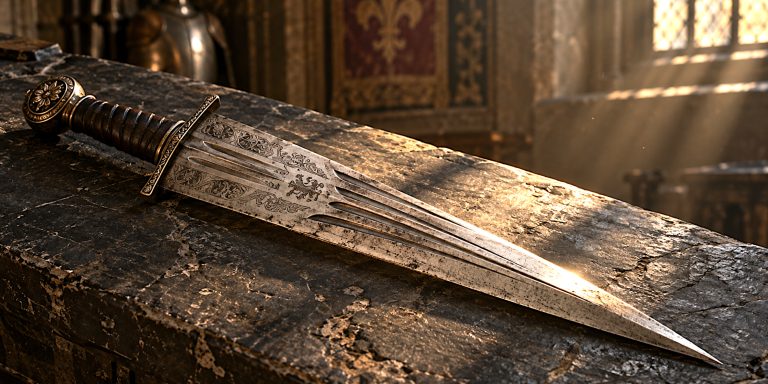
| Baselard dagger | Long dagger often used in close combat | Soldiers of all ranks |
| Rondel dagger | Narrow stabbing dagger designed to pierce armour gaps | Knights and men-at-arms |
Richard III himself almost certainly carried a fine hand-and-a-half sword alongside a dagger and perhaps a mace. Henry Tudor, less experienced in battle, probably relied heavily on his guards and commanders rather than charging dramatically about the field waving a sword for effect.
Armour
By 1485 English nobles and men-at-arms often wore full plate armour.
| Type of Armour | Description |
| Full plate armour | Steel armour covering the entire body |
| Brigandine | Cloth or leather garment reinforced with metal plates |
| Mail shirt | Worn under armour for additional protection |
| Sallet helmet | Common helmet with a rounded rear and sometimes a visor |
| Great helm or open-faced helmet | Used by some nobles and cavalry |
Richard III wore richly decorated plate armour. His skeleton shows that he was slight and suffered from scoliosis, though not the grotesque deformity later Tudor writers gleefully imagined. He was still capable of leading from the front and fighting hard.
The Battlefield
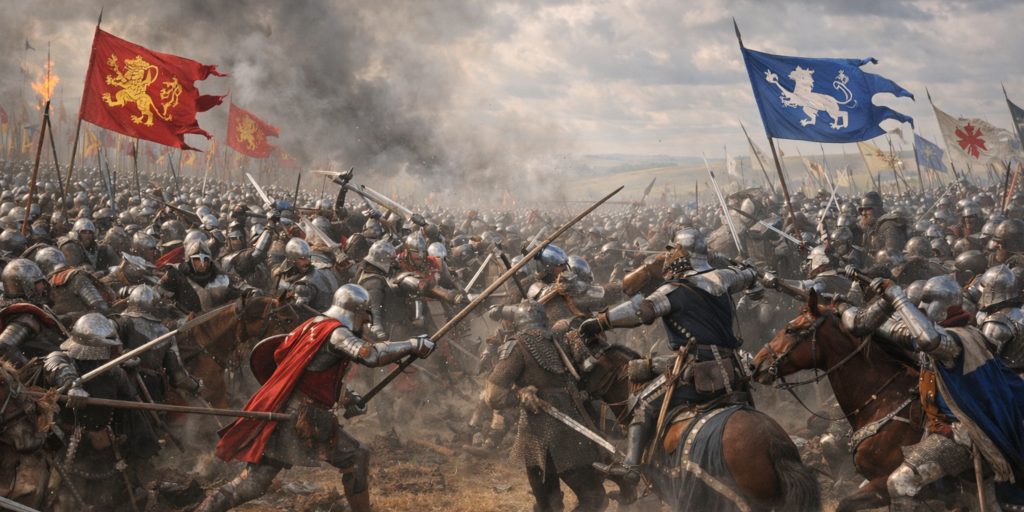
For centuries historians believed the battle took place directly on Ambion Hill. Modern archaeology has shown that the fighting probably happened further south-west, across a marshy area between the armies.
The ground mattered enormously. Marshland restricted movement and helped shape Richard’s final charge.
Henry’s smaller army took up a defensive position. Richard’s troops occupied higher ground. The Stanleys lingered nearby, infuriating everyone equally.
Battle Timeline
| Time | Event |
| Early morning, 22 August 1485 | Richard III deploys his army on high ground |
| Morning | Henry Tudor’s army advances cautiously |
| Mid-morning | Norfolk attacks Henry’s forces |
| Late morning | Heavy fighting between Oxford’s men and Richard’s vanguard |
| Around midday | Northumberland fails to engage effectively |
| Shortly after | Richard sees Henry exposed with a small bodyguard |
| Midday | Richard launches a direct cavalry charge toward Henry |
| Moments later | Sir William Stanley intervenes against Richard |
| Shortly after | Richard III is killed in the fighting |
| Afternoon | Richard’s army collapses and Henry is proclaimed king |
Richard III’s Final Charge
The most famous moment of the battle came when Richard spotted Henry Tudor with only a small escort nearby.
Rather than withdraw or wait, Richard launched a direct cavalry charge with around 800 mounted men. It was an extraordinarily bold move and, for a moment, nearly worked.
Richard cut down Henry’s standard-bearer, Sir William Brandon, and came close to reaching Henry himself. Few medieval kings fought with such personal courage.
Then the Stanleys intervened.
Sir William Stanley’s men attacked Richard’s flank. Richard and his followers were surrounded and overwhelmed. According to later tradition Richard refused to flee, fighting until the end.
The famous line attributed to him, ‘A horse, a horse, my kingdom for a horse!’, comes from Shakespeare rather than a contemporary source. Still, one suspects that after being unhorsed in the middle of a battle, Richard may indeed have developed a sudden and heartfelt appreciation for horses.
Contemporary Quotes
‘King Richard, alone, was killed fighting manfully in the thickest press of his enemies.’
Polydore Vergil
‘The king was brought to his death by the hands of many bold enemies.’
The Crowland Chronicle
‘This day was our king slain and our enemies made rulers.’
Anonymous Yorkist chronicler
‘The Earl of Richmond was by all the soldiers in the field proclaimed king.’
Jean Molinet
These sources vary in reliability. Tudor writers tended to paint Richard as a villain and Henry as England’s saviour. Yorkist writers often did the opposite. Medieval chroniclers were not entirely impartial. They had patrons, grudges and, occasionally, a noticeable flair for drama.
Casualties
| Side | Estimated Losses |
| Richard III’s army | 1,000 to 2,000 |
| Henry Tudor’s army | Several hundred |
The dead included Richard III, John Howard, Duke of Norfolk, and many Yorkist nobles.
Henry’s victory was relatively swift. Once Richard died, much of the royal army simply gave up or fled.
Archaeology
The archaeology of Bosworth has transformed our understanding of the battle.
Beginning in the early 2000s, archaeologists carried out extensive surveys around Bosworth. They discovered concentrations of cannonballs, lead shot and military objects well away from the traditional battlefield site.
Finds include:
- Lead cannon shot
- Musket and handgun balls
- Fragments of medieval weapons
- Horse fittings and buckles
- A silver-gilt boar badge associated with Richard III
The boar badge is especially important because Richard’s personal emblem was the white boar. Its discovery strongly suggests Yorkist troops fought in that area.
The most dramatic archaeological discovery connected to Bosworth came in 2012, when Richard III’s remains were discovered beneath a car park in Leicester.
The skeleton confirmed several long-debated points:
- Richard had scoliosis but was not severely deformed
- He suffered multiple battle wounds
- Several injuries were inflicted after death
- The fatal wounds were blows to the skull, probably from a halberd or sword
The injuries are chillingly direct. Richard seems to have fought without his helmet during the final moments. Medieval battles were many things, but gentle was not among them.
Where to Visit Today
Visitors can still explore the battlefield area in Leicestershire.
- Bosworth Battlefield Heritage Centre
- Ambion Hill
- Richard III Visitor Centre in Leicester
- Leicester Cathedral, where Richard III is buried
The landscape has changed since 1485, but standing on the field still gives a sense of the uncertainty and tension of the day.
Legacy
Bosworth ended the Plantagenet dynasty and brought the Tudors to power. Henry VII married Elizabeth of York, uniting the rival houses in theory, if not always in practice.
The battle also shaped Richard III’s reputation for centuries. Tudor historians and Shakespeare turned him into one of England’s great villains: hunchbacked, murderous and theatrical enough to shout at horses.
Modern historians have taken a more balanced view. Richard was ruthless, ambitious and capable of cruelty. So were most kings in the fifteenth century. He was not a cartoon villain, nor was he an innocent victim of Tudor propaganda.
Bosworth remains fascinating because it was so close. If the Stanleys had stayed neutral, if Northumberland had advanced, or if Richard’s charge had reached Henry, English history might have looked very different.
Instead, a king died in a muddy field, a new dynasty rose, and England embarked on the Tudor age.
That is not a bad return for a battle that lasted only a few hours.udor Rose. Richard III’s death became legendary, immortalized by Shakespeare and later reassessed through modern archaeology.