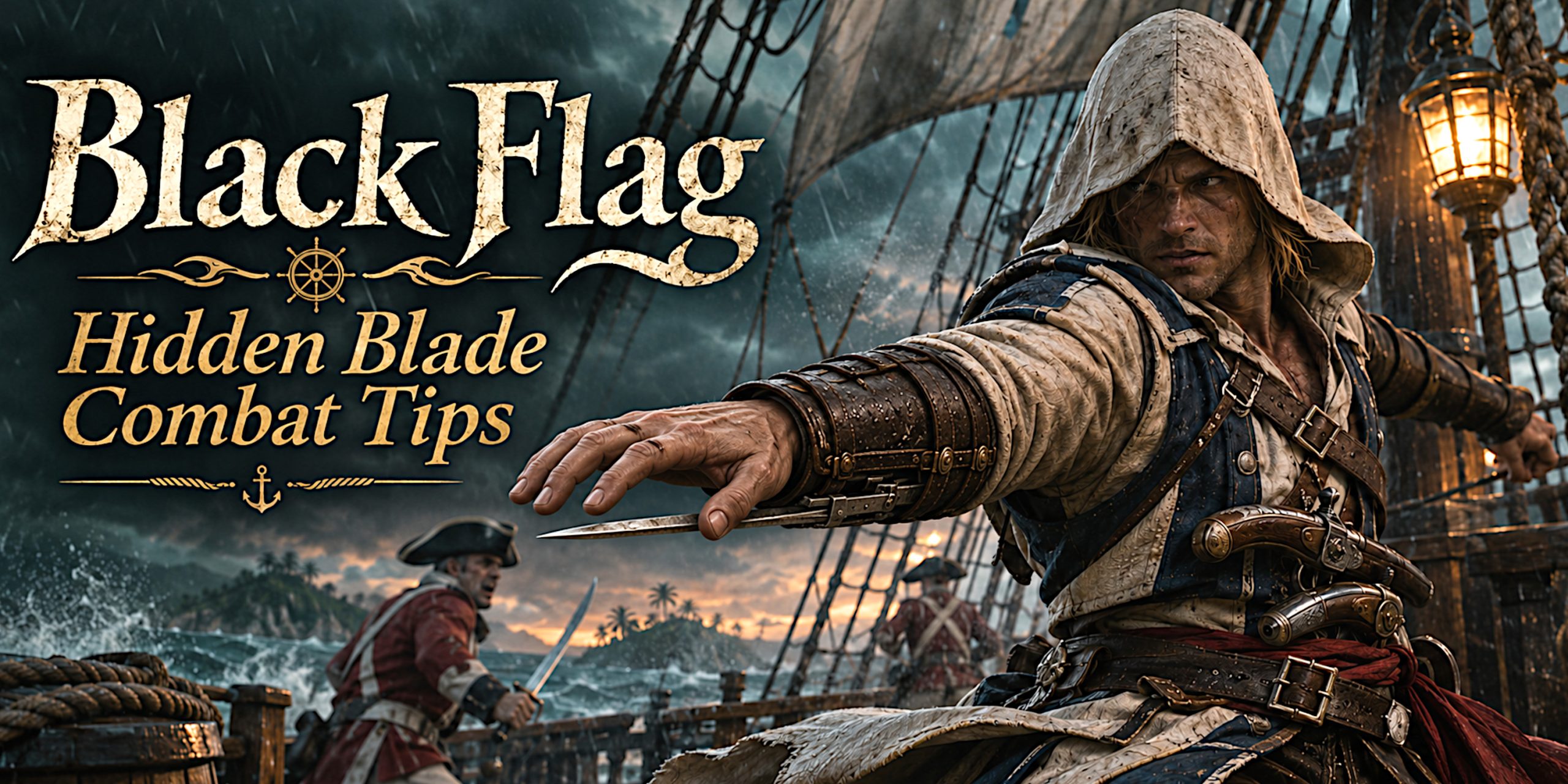
Edward Kenway carries enough weaponry to make a quiet afternoon in Nassau unlikely. Yet the hidden blades remain the most satisfying choice when you want a fight to feel deliberate.
The trick is knowing when to wait. Assassin’s Creed IV: Black Flag rewards reading an opponent, choosing an opening and keeping the surrounding guards in view. Frantically pressing attack mostly gives everyone more time to ruin your coat.
This guide covers the original Black Flag’s single-player combat.
Watch the video guide:
Start with an assassination when you can
A clean opening saves trouble later. Approach an isolated guard from behind, use a corner or wait inside a stalking zone for a patrol to come within reach. Low-profile assassinations attract less attention than running attacks, although nearby witnesses can still spot them.
Check the highlighted target before committing. For double assassinations, wait until two guards are close enough together. An aerial attack looks excellent, but landing beside the wrong pair rather spoils the entrance.
I would favour a dependable ground-level approach over a rooftop leap with uncertain targeting. Edward has enough confidence for both of you.
Learn the difference between a counter and a parry
With hidden blades selected, watch for an incoming melee attack. Tap Counter, then press Attack during the response window to attempt a counter kill against a susceptible opponent.
Holding the defensive input produces a parry instead. That distinction matters: tapping and holding serve different purposes.
Practise against a small patrol before taking on a crowded deck. Getting the timing comfortable is more useful than trying to memorise every animation.
Turn the first kill into a short streak
After a counter kill or combo kill, direct Edward towards another nearby, vulnerable enemy and press Attack during the finishing animation.
Keep the next target close. Taking damage or reaching for someone too far away can interrupt the streak. React to incoming attacks instead of stubbornly trying to finish your chosen sequence.
Two controlled kills are preferable to an ambitious chain that ends with Edward eating a musket ball. There is no bonus for artistic commitment.
Change tactics for brutes and captains
Enemy type matters more than how impressive your last finishing move looked.
| Enemy | Hidden blade approach |
|---|---|
| Regular soldier | Counter kills and streak attacks work well. |
| Scout | Wait for a counter opening rather than forcing normal attacks. |
| Brute | Use Break Defence twice, then finish the grounded enemy. |
| Captain | Hold Parry against an attack, then exploit the resulting stun. |
| Gunner | Remove before the brawl where possible. |
Brutes resist ordinary counter kills and streak attacks. Their heavy blows also defeat the idea that holding defence solves everything.
Captains require patience. Parrying creates an opening; repeatedly attempting the same rejected attack does not. Once stunned, they become vulnerable to follow-up techniques.
A failed move is useful information. Treat it as a cue to change approach, rather than an invitation to press the button harder.
Use smoke bombs before the fight gets messy
Smoke bombs are an excellent partner for hidden blade combat. They disable enemies caught in the cloud and create opportunities for quick assassinations, including against troublesome brutes and captains.
Use one when the crowd becomes difficult to read, then prioritise the opponents who would otherwise interrupt your rhythm. Keep targets within the smoke: enemies knocked outside it recover immediately.
There is a temptation to save every consumable for a hypothetical worse situation. Meanwhile, six guards are taking turns demonstrating that the current situation is quite bad already.
Deal with gunners before chasing another kill
Look for rooftop sentries before entering a restricted area. Once the blowpipe is available, a sleep dart can temporarily remove a gunner without the noise of a pistol.
Watch the sleep timer. Guards can wake naturally or be roused by allies, so a sleeping sentry is a temporary opportunity rather than a completed job.
During open combat, respond to firing warnings. A nearby enemy can serve as a human shield when the prompt is available; otherwise, break away towards cover.
The best hidden blade sequence is worth abandoning if someone outside it has a clear shot.
Make boarding fights easier to read
Ship decks encourage tunnel vision. Between crew members, rigging and several moving targets, it is easy to lose track of who Edward is actually facing.
My advice is to choose a patch of deck where you can see the approaching enemies. Let ordinary soldiers provide manageable openings, and use smoke when tougher opponents crowd in.
Keep checking the boarding objectives too. Winning an elegant duel does little for progress if the remaining task is elsewhere on the ship.
Common mistakes to stop making
- Forcing every enemy into the same counter routine. Identify the class and choose its opening.
- Holding defence indefinitely. Brute attacks, firearms and grenades require another response.
- Continuing a streak through danger. Cancel the ambition when a warning appears.
- Using lethal blades during a non-lethal objective. Switch to unarmed takedowns when the mission requires them.
Black Flag’s hidden blade combat feels best when you leave yourself room to react. Take a clean opening, keep the next target sensible and change tactics when the enemy demands it. Edward can supply the theatrical part.