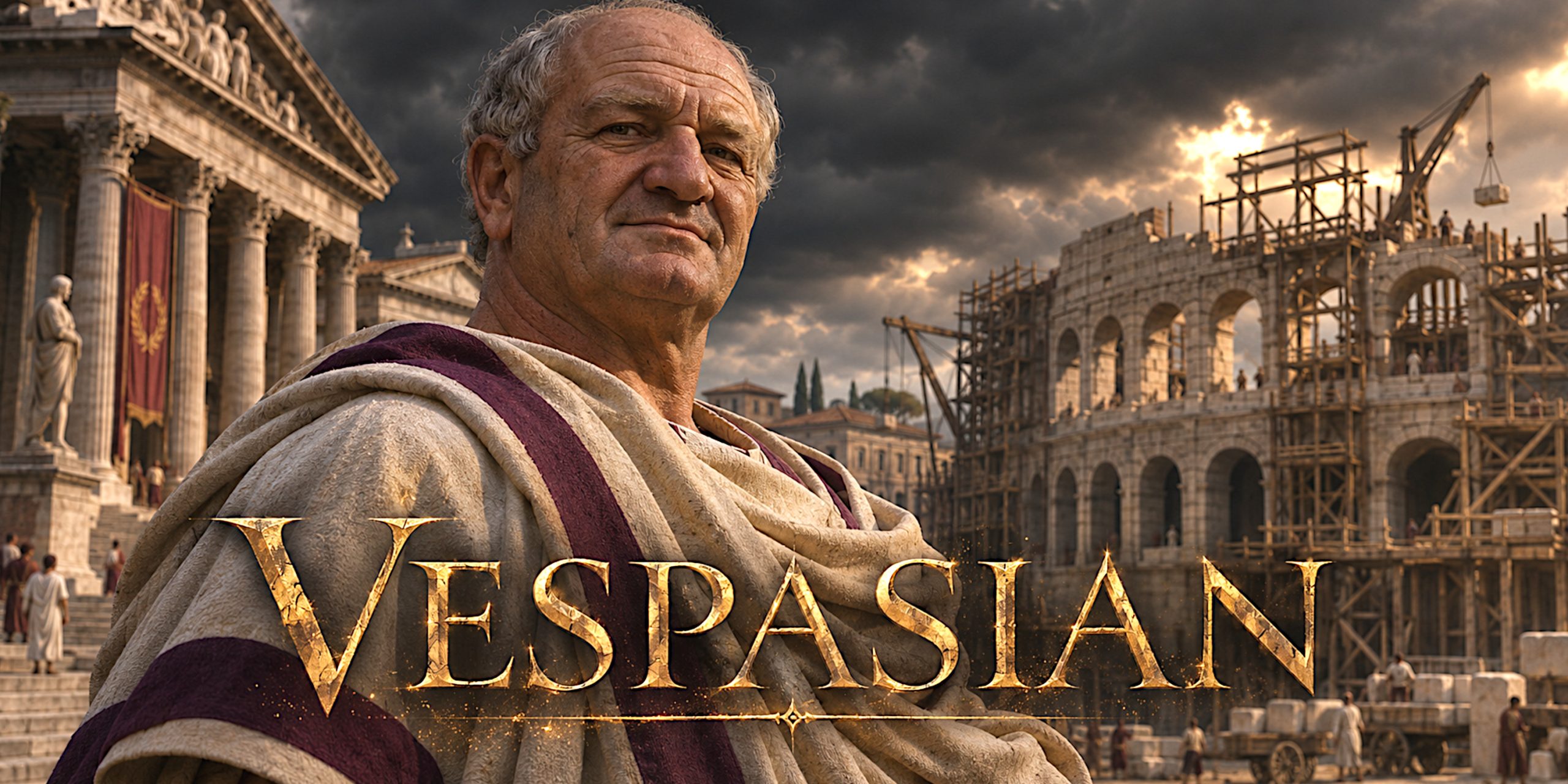
Vespasian inherited an empire which had spent a year demonstrating how many emperors it could dispose of. His achievement was to make the government work again, establish a dynasty and persuade enough influential people that the next succession need not involve another civil war.
Emperor from 69 to 79 CE, he founded the Flavian dynasty and began the Colosseum. He also rebuilt imperial finances, strengthened his family’s control of the state and turned the conquest of Judaea into a foundation of his regime’s public identity.
I find him among the more convincing Roman emperors precisely because the surviving portrait is so unromantic. There is a weathered face, an appetite for revenue and a readiness to laugh at imperial pretensions. Yet an agreeable anecdote should never be allowed to obscure a conquered city. Vespasian could be practical, approachable and ruthless within the same working day.
Vespasian at a Glance
| Detail | Information |
|---|---|
| Birth name | Titus Flavius Vespasianus |
| Born | 17 November 9 CE, at Falacrina in the Sabine country of Italy |
| Reign | 69–79 CE |
| Dynasty | Flavian, which ruled until 96 CE |
| Predecessor | Vitellius |
| Successor | Titus, his elder son |
| Died | 23 June 79 CE, aged 69 |
| Principal associations | Restoration after civil war, fiscal reform, conquest of Judaea and construction of the Colosseum |
Family and Early Life
Vespasian came from the Sabine country north-east of Rome. His family lacked the ancestral prestige of the Julio-Claudians, but descriptions of him as a peasant who somehow wandered onto the throne are misleading.
His father worked in tax collection and finance. His mother, Vespasia Polla, belonged to a family with military standing and senatorial connections. There was money, opportunity and access, even if there were no generations of celebrated consuls decorating the family history.
His career followed the established path of an ambitious Roman office-holder, through military service, provincial administration and magistracies. Advancement depended on patrons as well as competence. Under Caligula, he was capable of the public flattery which survival and promotion so often required.
He married Flavia Domitilla, with whom he had Titus, Domitian and a daughter, also named Domitilla. His wife and daughter died before his accession. His later companion, Antonia Caenis, was a freedwoman with experience of the imperial household. Her presence reminds us how much Roman politics could depend on people whose influence exceeded their formal status.
The Soldier Who Made His Name in Britain
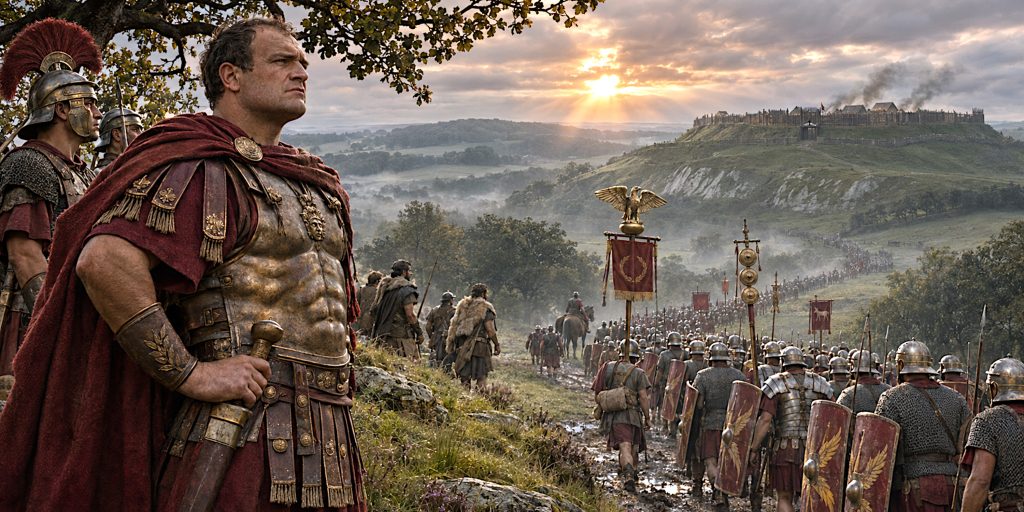
Vespasian’s military reputation grew during the invasion of Britain under Claudius, beginning in 43 CE. He commanded Legio II Augusta within the army initially led by Aulus Plautius.
His operations helped extend Roman control into southern Britain. Suetonius credits him with numerous engagements, the capture of more than twenty settlements and the subjugation of the Isle of Wight. These totals belong to an ancient account of a successful career, rather than a surviving campaign diary, but his distinguished service is not seriously in doubt.
It is tempting to attach him personally to every dramatic siege in the south-west. The evidence is less accommodating. Archaeological traces of conquest can establish violence and military activity without identifying the commander who stood nearby.
Britain gave Vespasian honours and credibility. It did not give the conquered communities much reason to applaud him.
Nero Sends Vespasian to Judaea
The Jewish revolt began in 66 CE. After Roman forces suffered a serious reverse, Nero appointed Vespasian to restore control.
He brought experience and an established military reputation. His relatively modest dynastic standing may also have made him appear less threatening than an aristocrat with an illustrious pedigree. Entrusting a large army to an apparently safe commander was a calculation Roman emperors repeatedly had cause to regret.
From 67 CE, Vespasian’s forces campaigned through Galilee and other areas, capturing fortified places and reducing the territory available to the rebels. His son Titus served alongside him. At Jotapata, the Jewish commander Josephus surrendered and subsequently became associated with the Flavian household.
Josephus’s account is indispensable, but his position matters. He wrote as a survivor who owed his security and patronage to the victorious dynasty. His narrative preserves valuable information while also explaining, and often defending, the outcome which had transformed his own life.
Vespasian did not personally capture Jerusalem. After his rise to imperial power, Titus conducted the siege of 70 CE, during which the Second Temple was destroyed. The distinction is essential, although the victory belonged politically to the entire Flavian regime.
How Vespasian Became Emperor
Nero’s death in 68 CE ended the Julio-Claudian dynasty. Galba, Otho and Vitellius then held power in rapid succession during 69 CE, the Year of the Four Emperors.
Vespasian’s successful challenge depended on a coalition. Tiberius Julius Alexander, prefect of Egypt, secured the allegiance of his troops on 1 July 69 CE, the date subsequently celebrated as Vespasian’s accession. The army in Judaea and the Syrian forces also supported him. Gaius Licinius Mucianus, governor of Syria, became a central organiser of his cause.
Control of Egypt offered access to resources and influence over Rome’s grain supply. Support from the Danubian armies added another decisive element. Forces led by Antonius Primus defeated the Vitellians at the second battle of Bedriacum and advanced on Rome.
Vespasian remained in the eastern Mediterranean while others fought the decisive battles. This does not diminish his political success. It does complicate the image of a solitary general marching straight from Judaea to seize the capital.
Vitellius was killed in December 69 CE. During the struggle in Rome, Vespasian’s brother Sabinus also died, and the Capitoline temple burned. Victory arrived with a considerable bill, in money and blood.
Restoring Government and Imperial Authority
Vespasian reached Rome in 70 CE. His immediate task was to make a military victory function as a durable government.
He restored discipline, rebuilt relationships with the Senate and replenished an elite depleted by political violence. His joint censorship with Titus in 73–74 CE gave the dynasty influence over the composition of the Senate and equestrian order.
This brought opportunities for men from Italian towns and the provinces, but it also strengthened the emperor’s network of supporters. Administrative renewal and political self-interest fitted together quite comfortably.
The surviving bronze text conventionally called the lex de imperio Vespasiani records powers granted to him through Roman legal forms. It is important evidence for imperial authority, although scholars debate how far its provisions were routine or distinctive. It should not be treated as a modern constitution written for a newly invented monarchy.
Vespasian worked through the institutions of the principate. He also made certain that the commanding position within them belonged to his family.
Taxes, Spending and the Famous Urine Story
Civil war, military commitments and reconstruction placed heavy demands on the treasury. Vespasian pursued revenue energetically, restoring taxes, increasing some obligations and tightening the collection of money due to the state.
The best-known anecdote concerns a tax associated with urine, a commercially useful substance employed in processes such as textile cleaning. According to Suetonius, Titus objected to the source of the revenue. Vespasian responded by asking whether money raised from it smelled unpleasant.
The story became attached to the maxim pecunia non olet, meaning money does not smell. It captures his reputation beautifully, although the familiar slogan is a summary of the anecdote rather than a verbatim sentence in Suetonius’s account.
More consequential was the levy imposed on Jews after the destruction of the Temple. The two-drachma payment formerly associated with Jerusalem was redirected to the temple of Jupiter Capitolinus in Rome. This was taxation as a statement of subjection, with religious humiliation built into the collection.
Calling Vespasian an economical emperor is reasonable. Calling every demand for money an impartial reform would be rather generous to the tax collector.
The Colosseum and the Rebuilding of Rome
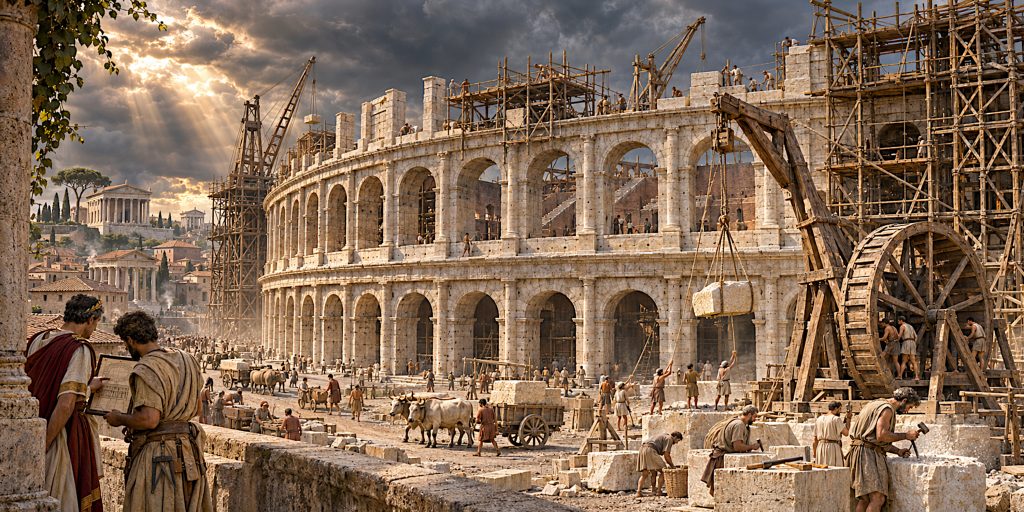
Vespasian began the Flavian Amphitheatre, now known as the Colosseum, on land associated with Nero’s palace complex and artificial lake. Titus inaugurated it in 80 CE, after his father’s death.
Its location carried a political message. Space linked to an emperor’s private enjoyment was transformed into a monumental venue for public entertainment. The new dynasty could present itself as returning something to the Roman people.
That generosity had limits. The entertainment included organised killing, while the dynasty’s building programme was connected to the wealth and prestige of conquest. The relationship between the amphitheatre and spoils from the Jewish war is supported by the reconstruction of its original dedicatory inscription. Precise modern claims about the number and identity of people who built it require greater caution.
Vespasian also promoted the restoration of the Capitoline temple and constructed the Temple of Peace, dedicated in 75 CE. The latter displayed treasures taken from Jerusalem alongside works of art.
The name deserves a moment’s attention. Roman peace was often exhibited through the possessions of people who had lost a war.
A Practical Emperor, but No Gentle Ruler
Ancient accounts often contrast Vespasian’s accessibility and plain habits with the extravagance of other emperors. There is substance to that reputation, although simplicity could itself become an effective imperial performance.
His government was capable of coercion and lethal repression. The treatment of the senator Helvidius Priscus, who was exiled and executed, exposes the limits of political independence under the regime. The surviving explanations of responsibility and attempted intervention do not turn his death into evidence of tolerance.
Nor should the restoration of order at Rome detach his reign from continuing warfare and suppression elsewhere. For provincial communities, efficient imperial government could mean more reliable extraction, more effective occupation and less room to resist.
I would place Vespasian among Rome’s more capable rulers. That judgement concerns his ability to govern an empire. It cannot settle the moral question of what that empire did to its subjects.
Portraits, Coins and Archaeological Evidence
Vespasian’s surviving portrait types are unusually memorable: a broad face, lined forehead and an expression which hardly invites anyone to waste his afternoon.
The apparent realism was useful. An older, experienced ruler offered a persuasive contrast to youthful glamour and theatrical display. Yet a portrait is a public statement, not an unfiltered encounter with its subject.
Coins provide another view of that statement. Images of peace, victory and conquered Judaea spread the dynasty’s claims across the empire. They reveal what the government wanted people to recognise, rather than how every recipient felt about it.
Buildings and inscriptions offer a necessary counterweight to literary anecdotes. The imperial-powers inscription, amphitheatre remains and Temple of Peace help reconstruct how authority was expressed in law and urban space. They also come with limits: later rebuilding can obscure the Flavian phase, and an inscription commemorating generosity rarely itemises its human cost.
Death and the Flavian Succession
Vespasian died on 23 June 79 CE after an illness, commonly described as involving severe bowel trouble. Titus succeeded him without the renewed civil war which had accompanied the end of Nero’s dynasty.
That orderly transfer was a substantial achievement, prepared through Titus’s prominent military and governmental responsibilities. Domitian would later succeed Titus in 81 CE, extending Flavian rule until his assassination in 96 CE.
Suetonius attributes to the dying Vespasian the remark:
“Dear me, I think I am becoming a god.”
It is a splendidly dry response to the prospect of imperial deification. It is also a reported remark preserved by a later biographer, rather than a securely recorded deathbed transcript. Historians may enjoy a good line without certifying it.
Vespasian’s Timeline
| Date | Event |
|---|---|
| 9 CE | Born at Falacrina |
| From 43 CE | Commands Legio II Augusta during the conquest of Britain |
| 51 CE | Holds the consulship |
| 67 CE | Begins major operations against the Jewish revolt |
| July 69 CE | Eastern armies proclaim him emperor |
| December 69 CE | Vitellius is killed and the Flavian cause secures power |
| 70 CE | Vespasian arrives in Rome; Titus captures Jerusalem |
| 73–74 CE | Holds the censorship with Titus |
| 75 CE | Temple of Peace is dedicated |
| 79 CE | Dies and is succeeded by Titus |
| 80 CE | Titus inaugurates the Colosseum |
Vespasian’s Legacy
Vespasian’s greatest achievement was making imperial government durable after a year of catastrophic instability. He combined military credibility, fiscal determination, public construction and careful preparation for his son’s succession.
He also understood presentation. The practical Italian, the ageing soldier and the emperor who could laugh at himself were persuasive identities for a dynasty without an ancient claim to rule.
The limits of his reputation are equally clear. Jerusalem’s destruction, punitive taxation and the suppression of opponents belong beside the restored treasury and monumental buildings. They cannot be tidied away as unfortunate details beneath the portrait of a sensible administrator.
Rome benefited from his capacity to govern. Others paid heavily for it. Both facts are necessary to understand the man whose name still clings to the greatest amphitheatre his dynasty built.
Sources
Ancient Evidence
- Suetonius, Life of Vespasian. Principal source for his career, family, financial reputation and reported sayings. Written after his death, with anecdotes requiring individual assessment.
- Tacitus, Histories, Book II. Particularly useful for the coalition behind his accession and the political calculations of 69 CE. Books III–IV continue the civil-war narrative and its aftermath.
- Josephus, The Jewish War, especially Books III–VII. Essential for the campaigns in Judaea, Jerusalem’s destruction and the Flavian triumph, read with attention to the author’s dependence on Flavian patronage.
- Lex de imperio Vespasiani. Surviving bronze inscription recording grants of imperial authority, held in the Capitoline collections.
Archaeology and Further Reading
- Mercati di Traiano, The Temple of Peace. Museum account of the dedication, captured treasures, remains and later rebuilding.
- Turismo Roma, Temple of Peace. Context for the building programme and the display of art and spoils.
- London Museum, denarius of Vespasian. Example of surviving coinage from his reign.
- Barbara Levick, Vespasian. Detailed modern study of his career and government.
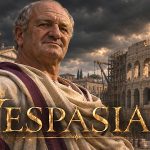
Suggested image alt text: Historical reconstruction of Emperor Vespasian in a white toga, with ancient Rome and the unfinished Colosseum behind him.
Suggested image caption: Vespasian founded the Flavian dynasty and began the Colosseum. This image is a modern historical reconstruction.