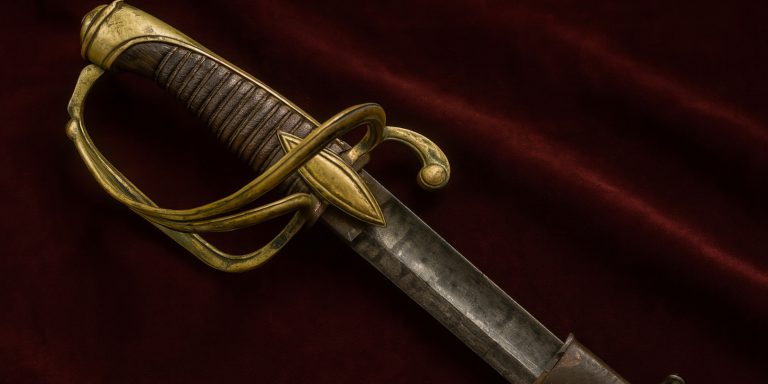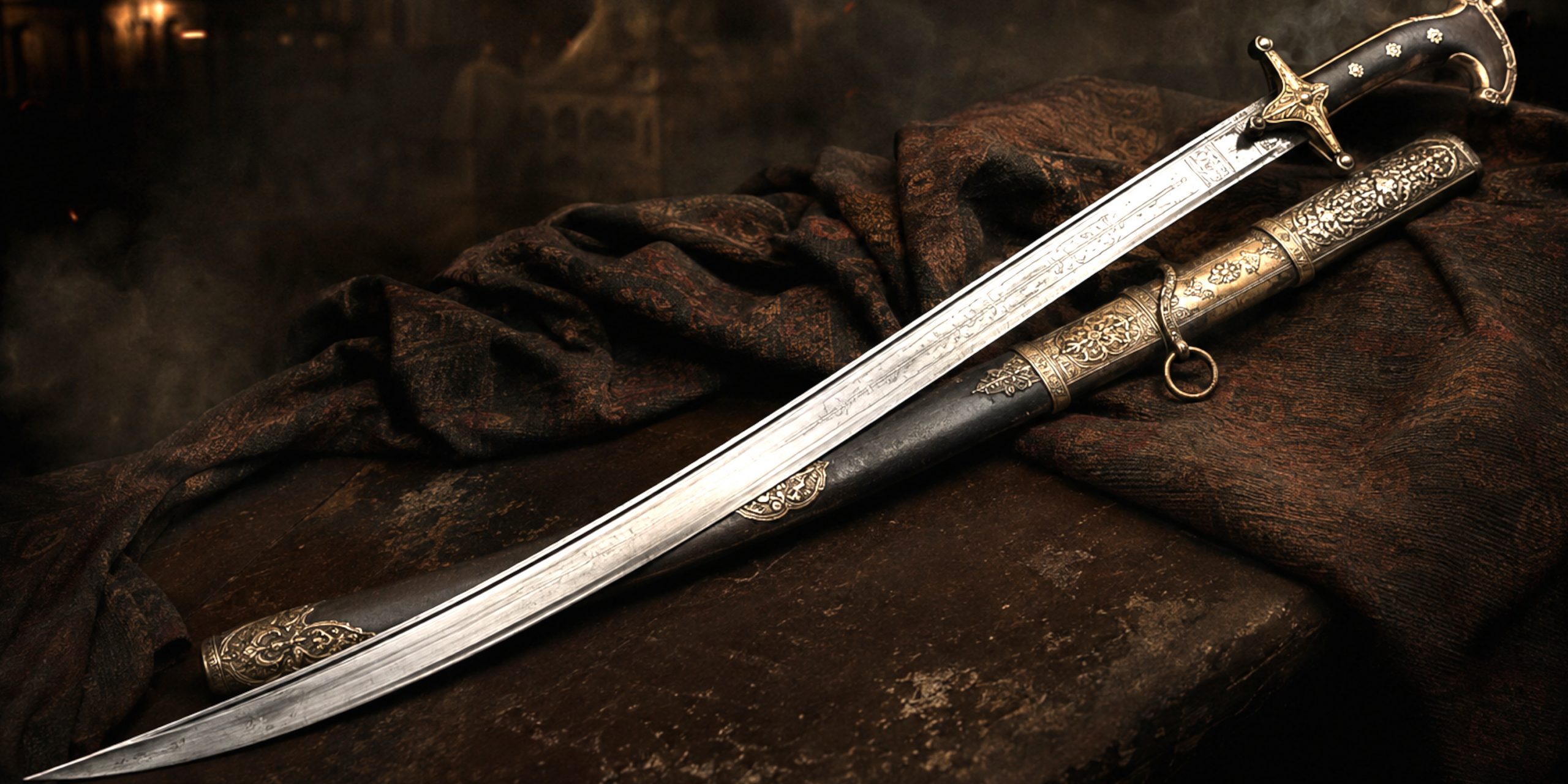
The shamshir is one of the defining swords of the Persianate world: slender, deeply curved and immediately recognisable. Its name comes from the Persian shamshīr, meaning simply “sword”, although in modern arms terminology it usually describes the strongly curved Persian sabre associated particularly with the Safavid, Afsharid and Qajar periods.
That distinction matters. The shamshir was not a single rigidly standardised military pattern manufactured to regulation dimensions. Surviving swords vary considerably, and blades, hilts and scabbards were sometimes assembled or remounted long after the blade itself was forged. What connects them is a family of characteristics: a narrow single-edged blade, pronounced curvature, a compact hilt and an emphasis on the draw cut.
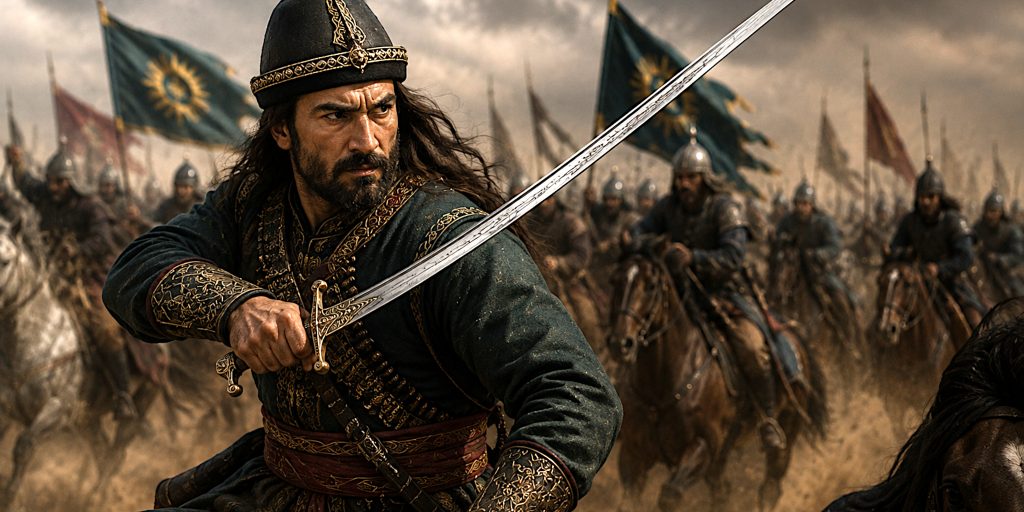
The mature shamshir is especially associated with cavalry warfare. From horseback, its curve allowed the blade to continue through a cutting motion rather than meeting the target like a straight chopping edge. It was quick in the hand, comparatively light and exceptionally well suited to cuts against unarmoured or lightly protected opponents.
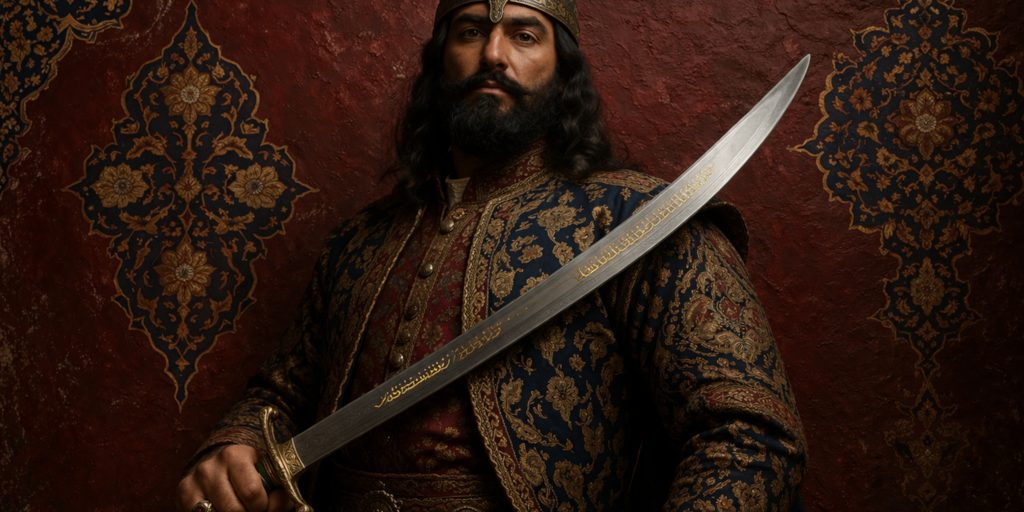
It was also capable of being a magnificent status object. Fine examples survive with crucible-steel blades, gold inscriptions, precious-metal fittings and richly decorated scabbards. Persian swordsmiths apparently saw no reason why a weapon could not be lethal and rather beautiful at the same time.
Shamshir Specifications
There was no universal specification, but surviving museum examples provide a useful picture of the weapon’s proportions.
| Feature | Typical characteristics |
|---|---|
| Weapon type | Single-edged curved sabre |
| Origin | Persia, with related forms across the Persianate world |
| Main period of use | Roughly 16th to 19th centuries in its classic form |
| Overall length | Commonly around 85 to 100 cm |
| Blade length | Often around 75 to 90 cm |
| Weight | Frequently around 750 g to 1 kg, although examples vary |
| Blade profile | Narrow, single-edged and strongly curved |
| Point | Fine, narrow point following the curvature of the blade |
| Grip | One-handed |
| Guard | Usually straight or slightly shaped quillons with a central langet |
| Pommel | Characteristically angled or hooked grip termination |
| Blade material | Forged steel, including prized crucible or watered steel |
| Primary attack | Draw cuts and slashing blows |
| Secondary attack | Thrusting possible, but less natural than with straighter swords |
| Typical users | Cavalrymen, warriors, officers and elite retainers |
Surviving pieces demonstrate how light these swords could be. A Persian shamshir in the Metropolitan Museum of Art, dated to the 18th or 19th century, measures about 92.9 cm without its scabbard yet weighs only around 757 g. Another early 17th-century Persian blade in the same collection forms part of a sword weighing approximately 978 g without its scabbard.
These figures are useful because modern reproductions can sometimes give the impression that historical sabres were heavy chopping implements. Good originals were often anything but.
Anatomy of the Shamshir
Blade
The defining feature is the pronounced curvature.
Unlike the broader Ottoman kilij, the classic shamshir generally maintains a relatively narrow profile towards the point. There is usually no dramatic widening of the blade near the tip.
This produces a sword particularly well adapted to slicing cuts. As the sword strikes, the curvature encourages the edge to travel across the target rather than simply striking directly into it.
Hilt
A traditional Persian shamshir hilt normally consists of:
- Two grip scales attached to the tang
- A small crossguard
- Straight or modestly shaped quillons
- A characteristic angled grip
- A hooked or projecting pommel area
- Metal, horn, ivory, bone or other decorative grip materials depending on period and status
The hilt is comparatively compact. Anyone expecting the substantial hand protection of a later European cavalry sabre will be disappointed.
Scabbard
Shamshir scabbards were normally curved to closely follow the blade and were often made from wooden cores covered with leather, textile or decorative materials.
Suspension fittings allowed the weapon to hang appropriately for mounted use. Wealthier owners could commission elaborate silver, gold or enamelled mounts.
History and Evolution of the Shamshir
Before the Shamshir
Pre-Islamic Persian armies were certainly familiar with swords, but the deeply curved shamshir should not simply be projected backwards into Achaemenid or Sasanian warfare.
Earlier Iranian swords included straight double-edged weapons. Curved sabres became increasingly important through centuries of interaction between Iranian societies and the mounted cultures of Central Asia.
Turkic military traditions were particularly significant.
Horsemen operating across the Eurasian steppe had long recognised the practical virtues of curved cutting blades. As Turkic peoples became increasingly influential within the Islamic world, their weapons and methods of mounted warfare travelled with them.
Medieval Development
Curved swords appeared increasingly across Iran and neighbouring territories during the medieval period, although early examples should not automatically be labelled shamshirs in the narrow modern sense.
The Seljuk conquests brought powerful Turkic military traditions into Persia. Later Mongol and Turco-Mongol domination reinforced the importance of mounted warfare.
Over time, Persian sword design moved towards the increasingly curved form now associated with the shamshir.
The Safavid Shamshir
The Safavid period, from 1501 to 1736, is central to the history of the mature weapon.
Persian cavalry remained an important part of warfare, while court culture encouraged extremely sophisticated arms production. Swords could combine practical military design with elaborate decoration and exceptional metallurgy.
The classic Persian shamshir became characterised by:
- Strong blade curvature
- Narrow proportions
- Fine cutting edges
- Compact crossguards
- Distinctive angled grips
- High-quality steel blades
- Calligraphic and religious inscriptions on prestigious examples
The sword had become both weapon and status object.
Crucible Steel and Watered Blades
Some of the most desirable surviving shamshirs have blades displaying the characteristic patterns associated with high-quality crucible steel.
This is often casually called “Damascus steel”, although that term can cause confusion. Historical crucible steel and modern pattern-welded Damascus are not the same manufacturing process.
A particularly important surviving example at the Met has a crucible-steel blade made in northern India in 1748 to 1749. Its inscriptions identify the Iranian swordsmith Baqir Mashhadi and his patron Safdar Jang Bahadur. The sword is a useful reminder of how craftsmen, technologies and weapon styles travelled across Persianate India.
Afsharid and Qajar Use

The shamshir remained important after the collapse of the Safavid state.
During the 18th and 19th centuries it continued to serve as a practical weapon while increasingly appearing as an officer’s weapon, presentation piece and symbol of rank.
Surviving swords from this period range from comparatively restrained military examples to extraordinarily ornate pieces decorated with:
- Gold koftgari or damascening
- Calligraphy
- Precious stones
- Ivory or horn grips
- Engraved fittings
- Elaborately decorated scabbards
By the 19th century, firearms increasingly dominated warfare, but the sword retained considerable military and social significance.
How the Shamshir Was Used
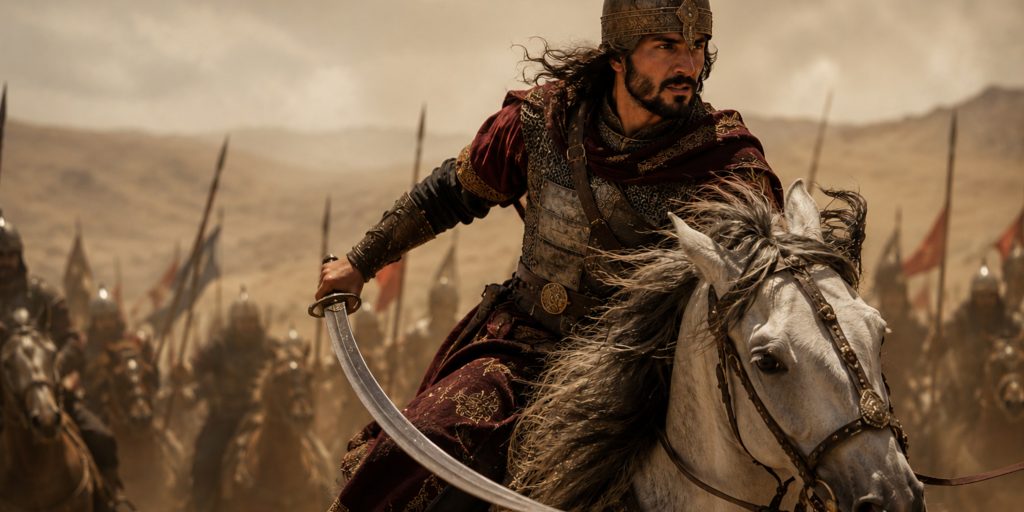
The shamshir is frequently described simply as a cavalry sword. That is broadly fair, but it can become too simplistic.
Its geometry strongly favours cutting.
When a curved blade contacts a target during a sweeping attack, the edge naturally travels across the surface. This creates a slicing action rather than relying entirely upon the force of impact.
From horseback, that offered obvious advantages.
A rider could deliver a passing cut while maintaining momentum. The curved blade also reduced the tendency for the weapon to become trapped in the target.
Typical attacks would have included:
- Descending cuts to the head and shoulders
- Horizontal cuts
- Diagonal cuts
- Draw cuts across exposed limbs
- Passing cuts from horseback
- Opportunistic thrusts
The shamshir could thrust, but extreme curvature made straight-line point control less convenient than with weapons such as the European backsword or some forms of tulwar.
It was a specialist cutter, and a very good one.
Advantages of the Shamshir
Excellent Cutting Geometry
The pronounced curve encourages slicing contact during a strike. Against lightly armoured or unarmoured opponents, this could produce devastating wounds.
Fast Handling
Many historical shamshirs are surprisingly light.
Their narrow blades keep unnecessary mass down, allowing rapid changes in direction and recovery after a strike.
Excellent for Mounted Combat
The combination of curvature, reach and relatively low weight makes the sword particularly suitable for cavalry.
Effective Draw Cuts
Few historical sword types advertise their intended cutting mechanics quite so clearly. The geometry naturally encourages the edge to move across the target.
High-quality Blades
Elite Persian examples could employ extremely sophisticated steel production and heat treatment.
Reach
The long curved blade gave mounted warriors useful striking distance without requiring an excessively heavy weapon.
Disadvantages of the Shamshir
Limited Hand Protection
The small crossguard provides considerably less protection than the developed guards found on later European military sabres.
Reduced Thrusting Efficiency
A shamshir can thrust, but the strongly curved blade makes point alignment less direct.
Less Effective Against Heavy Armour
Cutting swords face an obvious problem when armour becomes sufficiently strong.
Against plate armour or substantial mail combined with padded protection, simply producing a better cutting sword does not make steel armour politely disappear.
Specialised Blade Geometry
Its extreme curvature favours particular cutting mechanics. Straighter sabres can offer a more balanced compromise between cutting and thrusting.
Narrow Blade
The relatively slender blade does not provide the same forward mass as heavier cutting swords such as some forms of kilij.
Shamshir Compared with Similar Swords
The word “scimitar” has historically been applied rather carelessly to a wide range of curved swords. The shamshir, kilij and tulwar are related within the broader history of Eurasian sabres, but they are not interchangeable names for the same weapon.
| Sword | Region | Typical curvature | Blade character | Cutting | Thrusting |
| Shamshir | Persia | Very pronounced | Narrow and deeply curved | Excellent | Moderate to limited |
| Kilij | Ottoman Empire | Pronounced | Often broader with a widened yelman | Excellent | Moderate |
| Tulwar | Indian subcontinent | Moderate to strong | Considerable variation | Excellent | Moderate |
| Mameluke-style sabre | Middle East/Europe | Pronounced | Often inspired by Eastern sabres | Good | Moderate |
| European cavalry sabre | Europe | Mild to moderate | Usually more robust with developed guard | Very good | Good |
| Dao | China | Mild to moderate | Extremely varied family of single-edged swords | Very good | Good |
Shamshir vs Kilij
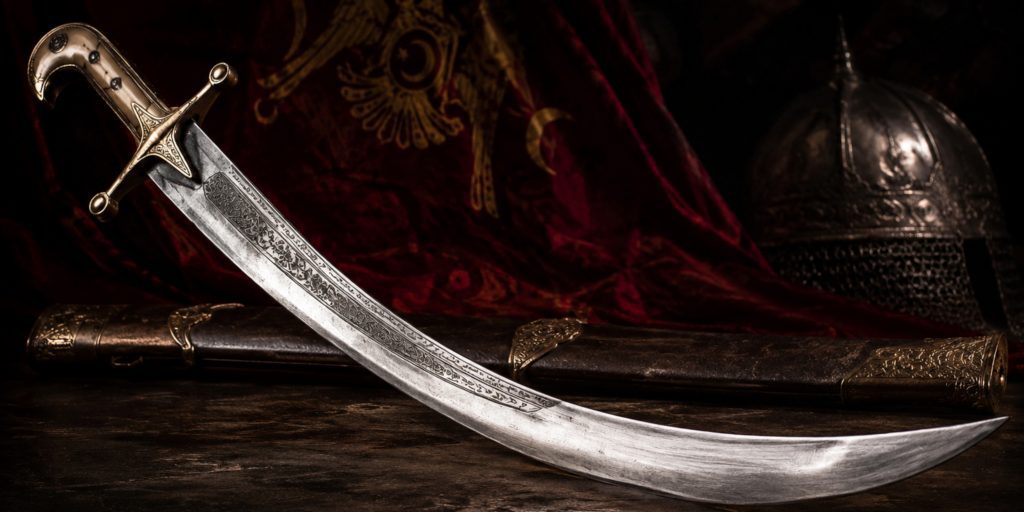
The Ottoman kilij is generally broader and can feature a yelman, a widened section towards the point.
That gives some kilij blades greater cutting authority near the tip.
The shamshir tends to be more uniformly narrow and more dramatically curved.
Shamshir vs Tulwar
The Indian tulwar is another weapon frequently confused with the shamshir.
The clearest difference is often the hilt. Tulwars commonly have the distinctive Indo-Muslim disc pommel, while Persian shamshirs usually employ grip scales and an angled pommel.
There was, however, considerable exchange between Persia and India. Persian blades could receive Indian hilts and Indian swords could employ blades inspired by Persian forms. Museum classification becomes interesting rather quickly once craftsmen start ignoring the categories created for them several centuries later.
Shamshir vs European Sabre
European cavalry sabres generally developed more substantial guards and often retained straighter blade profiles.
This gave many European designs greater thrusting versatility and hand protection.
The shamshir remains more aggressively focused upon the cut.
Shamshir, Scimitar and Sabre: What Is the Difference?
“Scimitar” is not a precise historical classification.
European writers used the word broadly for curved swords encountered across the Ottoman Empire, Persia, Arabia and India. Consequently, weapons with quite different hilts and blade geometries were bundled together under the same convenient label.
For accurate identification:
- Shamshir refers principally to the Persian tradition
- Kilij refers to the Ottoman Turkish tradition
- Tulwar refers to the Indian tradition
- Sabre is the broader weapon family
- Scimitar is best treated as a loose Western historical term
Calling every Islamic curved sword a scimitar is rather like calling every European straight sword a longsword. People will understand roughly what you mean, but collectors will begin twitching.
Decoration, Inscriptions and Status
Prestigious shamshirs could carry extensive decoration.
Common features include:
- Gold inscriptions
- Qur’anic passages
- Religious invocations
- Maker’s signatures
- Ownership inscriptions
- Royal names
- Floral decoration
- Gold-damascened guards
- Decorated scabbard fittings
One British Museum example has a watered-steel blade and a brass hilt formed as a peacock. Its history associates it with Mughal India around 1700 and with the court of Emperor Aurangzeb.
Another British Museum shamshir carries the name Asadallah Isfahani on its blade. Such inscriptions need careful scholarly assessment because prestigious names could be copied or invoked by later craftsmen. A famous signature is therefore evidence to investigate rather than an automatic certificate of authorship.
Legacy of the Shamshir
The shamshir became one of the most influential curved sword forms associated with the Islamic world.
Its significance extended beyond Persia through trade, conquest, diplomacy and the movement of craftsmen.
Its broader legacy can be seen in:
- Indian sword manufacture
- Central Asian sabres
- Arab swords using Persian blades
- European fascination with “Oriental” sabres
- Ceremonial military swords
- 18th and 19th-century European cavalry fashion
- Modern representations of Persian warfare
Curved Middle Eastern swords also influenced the development and ceremonial adoption of Mameluke-style swords in Western militaries, although these should not simply be described as direct copies of the Persian shamshir.
More importantly, surviving shamshirs preserve evidence for the sophisticated arms industries connecting Persia, Central Asia and India.
Where to See Original Shamshirs
British Museum, London
The British Museum holds several catalogued shamshirs in its collection, including Islamic, Persian-associated and Indian examples. Its online catalogue is particularly useful for studying inscriptions and construction details.
Individual objects are not necessarily on permanent display, so check before travelling specifically to see one.
Metropolitan Museum of Art, New York
The Metropolitan Museum of Art has an excellent collection of Persian and Indian shamshirs within its Arms and Armor holdings.
Its documented examples include Persian swords from the early 17th through 19th centuries and Indian weapons showing the movement of Persian swordmaking traditions into the Mughal world.
Victoria and Albert Museum, London
The Victoria and Albert Museum holds important Islamic arms and armour, including curved swords connected with Persian and Arabian traditions.
Other Collections
Collectors should also investigate major Islamic arms collections in Iran, continental Europe and North America. Display arrangements change, and many important swords spend far more time in museum storage than visitors might reasonably wish.
Shamshir Collector’s Guide
Original shamshirs remain accessible to private collectors, but the market ranges from modest 19th-century examples to museum-grade Persian blades.
Correct identification is essential.
What to Examine
Before buying, inspect:
- Blade curvature and profile
- Hilt construction
- Tang and grip condition
- Guard shape
- Steel quality
- Evidence of watered crucible steel
- Inscriptions
- Gold decoration
- Scabbard originality
- Signs of later remounting
- Corrosion
- Edge damage
- Excessive polishing
- Provenance
- Previous auction history
Watered Steel
A genuine historical crucible-steel blade can substantially increase value.
Be cautious of blades that have been artificially etched to exaggerate or imitate watering. Heavy polishing can also destroy or obscure an original pattern.
Inscriptions
Signatures associated with famous Persian swordsmiths can transform the potential value of a sword, but they also demand considerably more scrutiny.
Names such as Asadallah Isfahani occur on surviving weapons, but signatures could be copied, added or imitated. Attribution should therefore depend upon metallurgy, calligraphy, construction, provenance and expert examination rather than the inscription alone.
Composite Swords
A sword with an older Persian blade and later hilt is not necessarily a fake.
Historical blades were valuable objects and could remain in use for generations. They were traded, rehilted, repaired and transferred between regions.
Christie’s, for example, has documented a shamshir combining a 17th-century Iranian watered-steel blade with Arabian mounts dating to around 1900.
The question is not simply whether every component has the same date. It is whether the sword has been accurately described.
Shamshir Auction Prices and Values
Prices vary dramatically according to blade quality, attribution, age, decoration, provenance and condition. The following ranges should therefore be treated as broad collector guidance rather than fixed valuations.
| Type | Approximate auction range |
| Later or relatively plain 19th-century example | £500 to £1,500 |
| Good complete antique shamshir | £1,500 to £4,000 |
| Quality example with attractive blade and original scabbard | £3,000 to £8,000 |
| Fine watered-steel example | £5,000 to £15,000+ |
| Highly decorated or strongly provenanced sword | £10,000 to £30,000+ |
| Exceptional royal, signed or museum-quality example | £30,000 to six figures in exceptional circumstances |
These ranges overlap considerably. A plain-looking sword with an exceptional blade may be worth substantially more than an ornate example assembled from later components.
Auction houses including Christie’s and specialist Islamic art and arms sales periodically offer shamshirs. Published historic lots are particularly useful for comparing blade types, decoration, inscriptions and provenance. Christie’s records, for example, include a 17th-century Iranian watered-steel shamshir with later Arabian mounts, demonstrating the sort of composite history collectors frequently encounter.
Buyers should remember that the hammer price is not the final bill. Buyer’s premium, VAT where applicable, shipping, insurance and import requirements can make an apparently reasonable bid rather less reasonable by the time the sword reaches the front door.
What Makes a Shamshir Valuable?
The strongest prices generally result from several factors appearing together.
Blade quality
An attractive and convincingly identified crucible-steel blade is highly desirable.
Age
Safavid-period examples generally command greater interest than commonplace later pieces, although age alone does not determine quality.
Maker
Credible attribution to a significant swordsmith can dramatically increase value.
Provenance
Documented royal, aristocratic or old European collection history can be extremely important.
Condition
Original surfaces are generally preferable to aggressively polished blades.
Completeness
Original scabbards and suspension fittings add considerable interest.
Decoration
Fine gold work, calligraphy and precious materials can increase both artistic and financial value.
Historical association
A securely documented connection with a significant owner or event can move a sword into an entirely different market.
Reproductions and Common Collector Problems
The shamshir market includes reproductions, composites and incorrectly identified swords.
Particular warning signs include:
- Artificially aged metal
- Fresh engraving presented as historic
- Implausibly perfect inscriptions
- Modern etched “Damascus” patterns
- Incorrect hilt construction
- Newly made scabbards presented as original
- Indian tulwars described as Persian shamshirs
- Generic curved swords labelled “17th-century Persian”
- Famous swordsmith signatures without supporting evidence
Poor descriptions do not always mean deliberate fraud. Islamic arms classification is complicated, and swords frequently travelled between Persia, India, Central Asia, the Ottoman world and Arabia.
For expensive examples, independent specialist assessment is worth considerably more than the seller’s enthusiasm.
Is an Antique Shamshir Worth Collecting?
For anyone interested in Islamic arms, Persian history or historical sword manufacture, the shamshir is one of the most rewarding areas of collecting.
It combines distinctive design with serious metallurgical and artistic interest. Even relatively restrained examples can demonstrate remarkably sophisticated blade manufacture.
The challenge is attribution. Persian blades travelled widely and remained valuable for generations. Hilts were replaced, scabbards renewed and prestigious inscriptions copied. That complexity makes the field fascinating, but it also means buying purely on appearance is risky.
A good shamshir rewards close examination. The finest examples show that Persian swordsmiths understood something fundamental about weapon design: a sword did not need to be heavy to be formidable. The shamshir achieves its character through geometry, balance and a blade shaped around the mechanics of the cut.