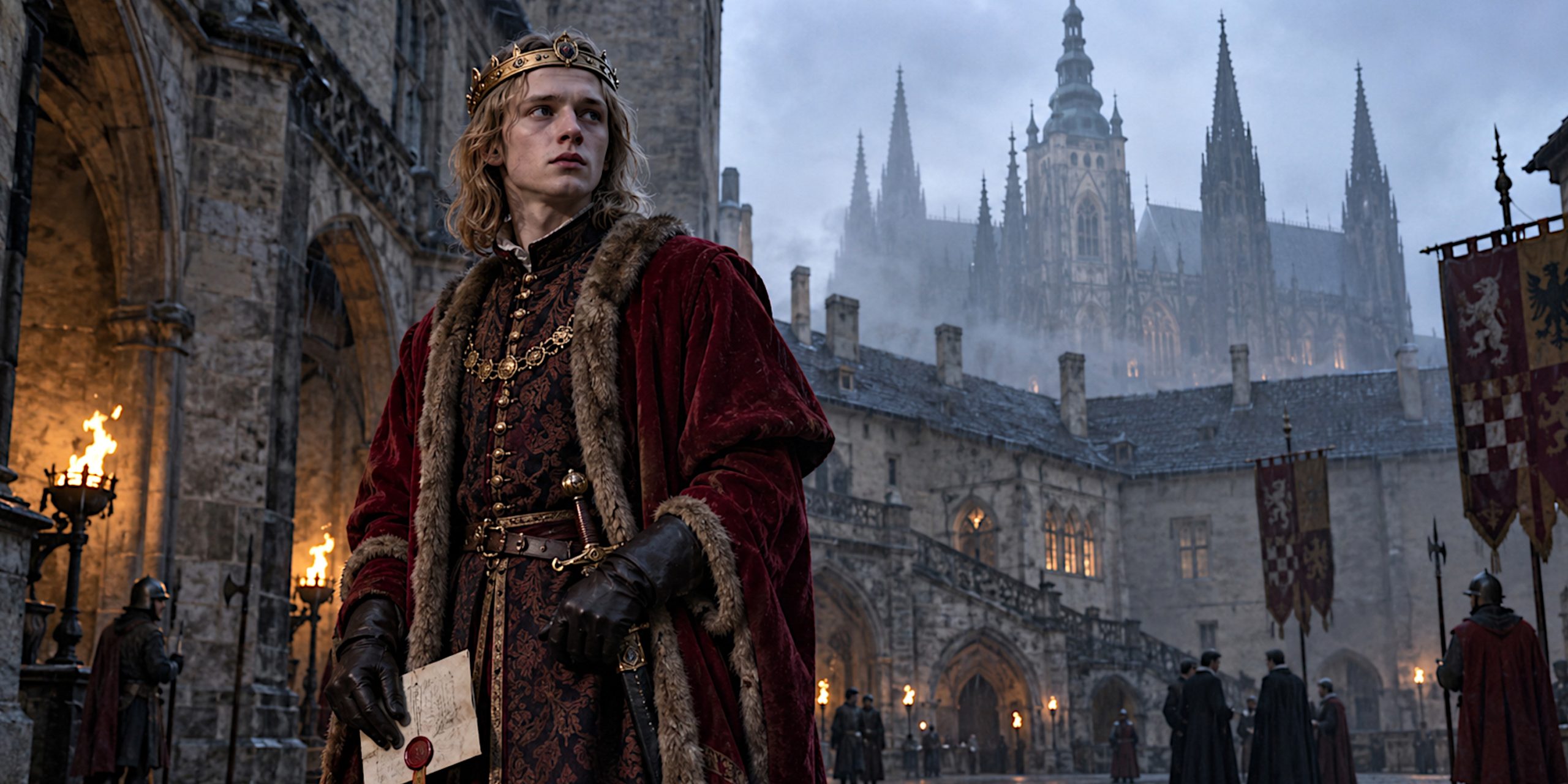
Born after his father’s death and crowned before he could speak for himself, Ladislaus the Posthumous inherited three politically fractured realms and almost no freedom to rule them. His short life unfolded among stolen crowns, rival guardians, ambitious magnates, an Ottoman advance and one of the most consequential executions in Hungarian history.
He was Duke of Austria, King of Hungary and Croatia, and King of Bohemia. On parchment, this made him one of the most important rulers in Central Europe. In practice, he spent much of his childhood being guarded, displayed, negotiated over and occasionally rescued by men who claimed to act in his interests. Medieval monarchy could be a brutal profession. Ladislaus entered it as an infant.
His death at seventeen ended the Albertine branch of the Habsburg dynasty and broke apart the union of lands gathered under his father. It also opened the way for two remarkable rulers, Matthias Corvinus in Hungary and George of Poděbrady in Bohemia.
Ladislaus the Posthumous at a glance
| Detail | Information |
|---|---|
| Full name | Ladislaus of Habsburg |
| Common name | Ladislaus the Posthumous |
| Hungarian name | V. László |
| Czech name | Ladislav Pohrobek |
| Born | 22 February 1440, Komárom, Kingdom of Hungary |
| Father | Albert II of Germany |
| Mother | Elizabeth of Luxembourg |
| Titles | Duke of Austria; King of Hungary, Croatia and Bohemia |
| Hungarian coronation | 15 May 1440 at Székesfehérvár |
| Bohemian coronation | 28 October 1453 at Prague |
| Principal guardians and advisers | Frederick III; Ulrich II, Count of Celje; later regional governors and magnates |
| Died | 23 November 1457, Prague |
| Age at death | 17 |
| Burial place | St Vitus Cathedral, Prague |
| Dynasty | House of Habsburg, Albertine line |
Why was he called “the Posthumous”?
Ladislaus was born at Komárom on 22 February 1440, roughly four months after the death of his father, Albert II. The epithet “Posthumous” therefore referred to his birth after his father’s death, not to a title bestowed after Ladislaus himself had died.
Albert had been Duke of Austria, King of Hungary and Bohemia, and King of the Romans. His sudden death in October 1439 left an enormous inheritance without an adult male heir. Ladislaus’s mother, Elizabeth of Luxembourg, was pregnant and determined to defend her unborn child’s rights.
That determination mattered. Medieval succession was shaped by blood, law, custom and military reality, usually in that order only when everyone was feeling unusually cooperative. Hungary faced an immediate Ottoman threat, and many Hungarian nobles wanted an adult warrior king rather than a royal infant. They invited Władysław III of Poland to take the throne.
Ladislaus was thus born into a disputed kingship. Before he had acquired a tooth, he had acquired a rival.
His family and dynastic inheritance
Ladislaus united two exceptionally powerful bloodlines. Through his father he belonged to the Habsburg dynasty. Through his mother he was the grandson of Sigismund of Luxembourg, Holy Roman Emperor and king of Hungary and Bohemia.
His elder sisters were Anne and Elizabeth. Their later marriages gave the Habsburg inheritance a complicated future, but in 1440 the infant Ladislaus represented the most direct male continuation of Albert II’s rule.
The territories associated with him were not a single unified state. Austria, Hungary and Bohemia possessed distinct laws, political communities and traditions of government. Each contained nobles and towns determined to protect their privileges. A shared ruler did not create a shared administration, especially when that ruler was still in swaddling clothes.
This distinction is essential. Ladislaus did not inherit an empire with a central government. He inherited several crowns, each surrounded by people who believed they had a right to decide how that crown should be worn.
The theft of the Holy Crown of Hungary
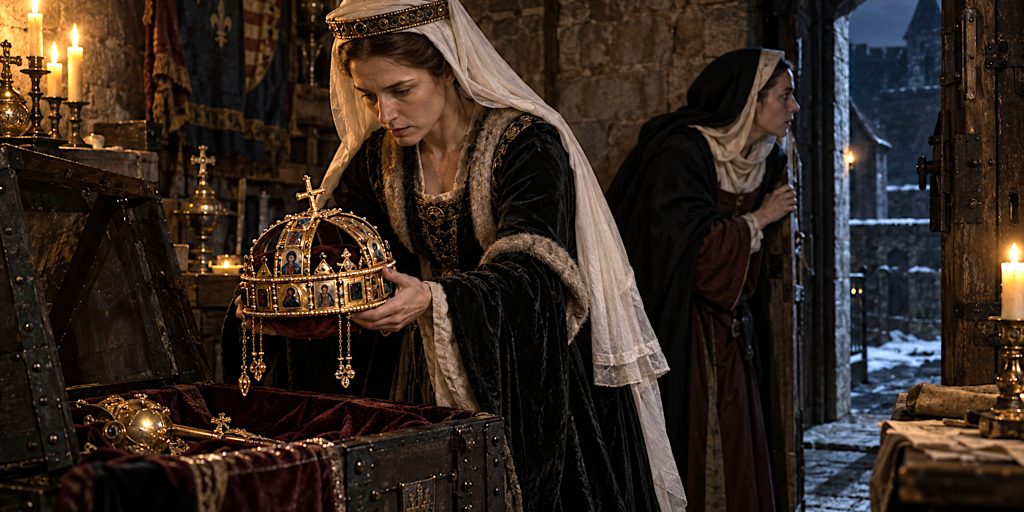
Elizabeth of Luxembourg moved quickly after her son’s birth. Her lady-in-waiting, Helene Kottanner, removed the Holy Crown of Hungary from Visegrád and carried it to the queen. Kottanner later wrote an extraordinary first-person account of the operation.
In the English translation of her memoir, Kottanner described the crown as “the holy crown” and presented the removal as a dangerous act undertaken for the legitimate heir. Her narrative dwells on locked doors, broken seals, darkness and fear. It reads at moments like a political thriller, except the object being smuggled was believed to embody the lawful kingship of Hungary.
On 15 May 1440, the infant Ladislaus was crowned at Székesfehérvár with the Holy Crown. Elizabeth hoped that correct possession of the crown, the proper coronation place and the required ceremony would settle the matter.
It did not. Władysław of Poland was also crowned, although without the Holy Crown. Hungary divided between their supporters and slid into civil conflict.
The episode reveals how medieval legitimacy worked. Ceremony was not decorative. The correct crown could make a legal argument more powerfully than several pages of constitutional prose. It could not, however, command an army by itself.
A child in the custody of Frederick III
Elizabeth placed Ladislaus and the Holy Crown in the keeping of her Habsburg relative Frederick III, then King of the Romans and later Holy Roman Emperor. She died in December 1442, leaving her son an orphan before his third birthday.
Frederick became the child’s guardian, but his guardianship increasingly resembled detention to Ladislaus’s Austrian subjects. Frederick controlled the boy’s household and treated possession of his person as a valuable political asset. Whoever held Ladislaus could influence claims across Austria, Hungary and Bohemia.
In Austria, a coalition led by Ulrich Eytzinger demanded the young duke’s release. Pressure became open revolt, and in 1452 Frederick was besieged at Wiener Neustadt. He eventually surrendered Ladislaus to the Austrian estates.
The thirteen-year-old did not emerge into independence. Control merely shifted. Ulrich II, Count of Celje, a relative through Ladislaus’s mother, became the most influential figure around him. The personnel changed; the basic problem did not.
Ladislaus’s childhood should therefore not be romanticised as merely sheltered. He was a dynastic hostage whose legal importance made genuine personal freedom almost impossible.
Hungary without its young king
The Hungarian civil war changed dramatically in 1444 when Władysław III was killed fighting the Ottomans at the Battle of Varna. Ladislaus was then generally accepted as king, but he remained in Frederick’s custody.
The Hungarian estates appointed the experienced soldier John Hunyadi as governor in 1446. Hunyadi administered the kingdom in the absent king’s name and led its defence against Ottoman expansion. His military record included serious defeats, but his authority became immense.
When Ladislaus began exercising kingship more directly after 1452, he entered a political landscape already dominated by Hunyadi, the Garai family, Nicholas Újlaki and other magnates. Royal authority existed, but much of its money, offices and military strength had passed into aristocratic hands.
One contemporary financial proposal estimated Ladislaus’s annual cash revenues at 216,000 florins. The figure appears substantial until set beside the cost of defending Hungary against Mehmed II. Crowns were expensive objects, even before anyone added an Ottoman invasion.
King of Bohemia
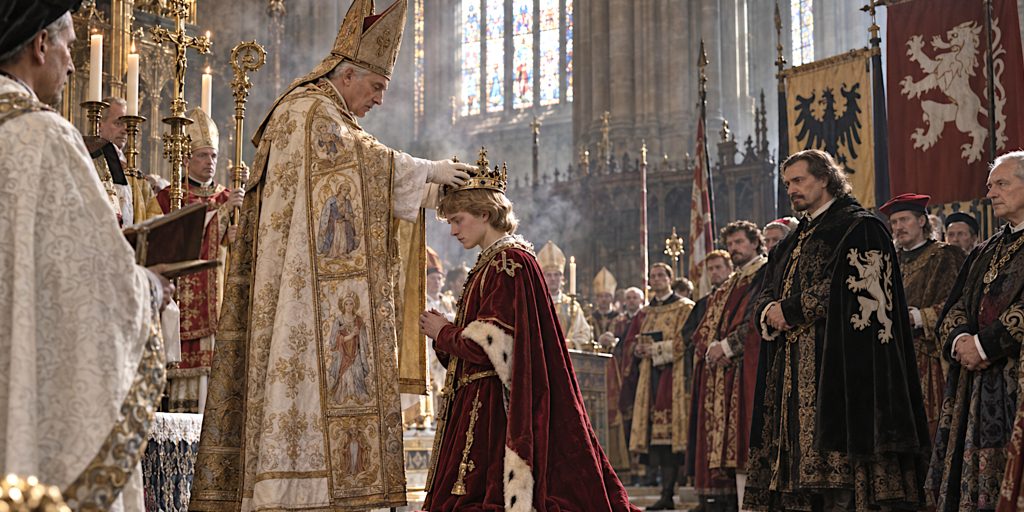
Bohemia had been transformed by the Hussite wars. It remained divided between Catholic and Utraquist interests, and Ladislaus’s hereditary claim did not remove those political and religious tensions.
He was crowned King of Bohemia at Prague on 28 October 1453. George of Poděbrady, the powerful Utraquist nobleman who had governed much of the country, retained the decisive influence. Ladislaus was accepted as king, but George controlled access, appointments and practical government.
The relationship has sometimes been presented as simple imprisonment. The reality was more political. Ladislaus held the crown and performed the public role of monarchy; George possessed the local network and authority needed to make government function. Neither could casually ignore the other.
The young king travelled through Moravia and Silesia, receiving homage from regional estates. Such journeys mattered because kingship was performed in person. Subjects expected to see the ruler, swear loyalty and secure confirmation of their rights. Ladislaus was learning the theatre of monarchy, although the stage managers remained rather visible.
What sort of king was Ladislaus?
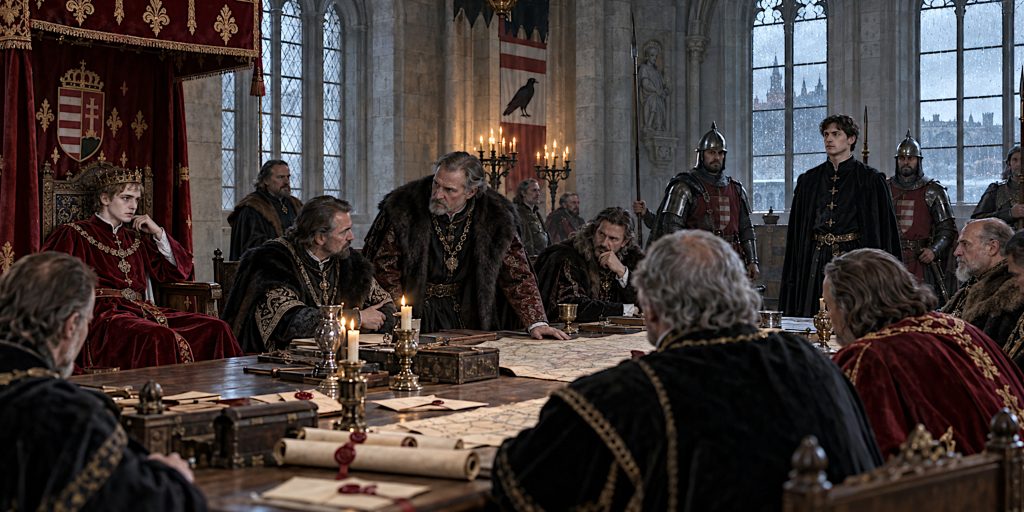
The difficulty in judging Ladislaus is that he died just as an independent political character might have emerged. Most surviving narratives show him through the actions of older advisers or through later national histories written to praise their opponents.
He received the education expected of a high-born prince and could operate within several court cultures. Portraits and descriptions present a fair-haired, youthful ruler of delicate appearance. Yet appearance is a poor guide to political ability, and seventeenth-century assumptions about weak bodies and weak kings should be left where they belong.
His conduct in 1456 and 1457 suggests that he understood the need to recover royal castles, revenues and offices. It also shows how easily he could be pushed into factional retaliation. The execution of Ladislaus Hunyadi remains the greatest stain on his reign, even if the decision was formed within a council of powerful barons.
My own reading is that Ladislaus was neither an innocent puppet nor a fully formed tyrant. He was an adolescent ruler learning politics in courts where nearly every lesson involved coercion, betrayal or a disputed fortress. This was excellent preparation for suspicion and rather poor preparation for wisdom.
Belgrade and the Ottoman threat
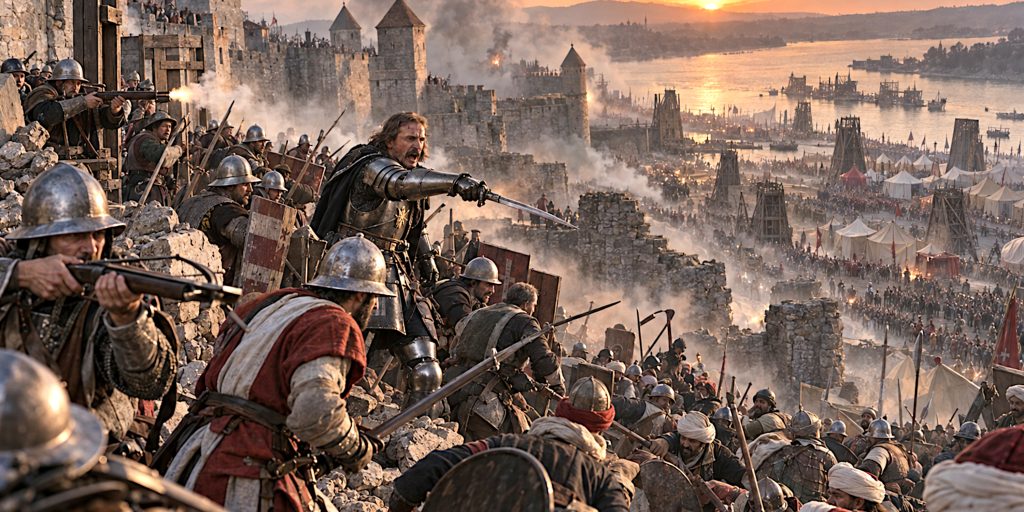
After conquering Constantinople in 1453, Sultan Mehmed II turned renewed pressure towards Hungary. In 1456 he besieged Belgrade, the great fortress guarding the kingdom’s southern approaches.
Ladislaus came to Hungary and a diet approved mobilisation and taxation. Yet the defence was led chiefly by John Hunyadi and the Franciscan preacher John of Capistrano. Hunyadi’s forces broke the siege in July 1456 in one of the most celebrated Christian victories of the century.
Pope Callixtus III praised Hunyadi as a defender of Christendom, while contemporary Christian reports treated the relief of Belgrade as providential. Ladislaus received little reflected glory. He had withdrawn towards Vienna before the decisive fighting, probably because his advisers feared both the Ottoman army and the political consequences of remaining exposed in Hungary.
Hunyadi died soon afterwards during an epidemic. His death removed the kingdom’s dominant soldier but did not remove the power of his family. His elder son, also named Ladislaus, inherited immense wealth, fortresses and armed supporters. The crown and the Hunyadis were now on a collision course.
The murder of Ulrich of Celje
Ladislaus returned to Hungary with Ulrich of Celje, whom he appointed captain-general. They intended to recover royal castles and revenues held by the Hunyadi faction.
At Futak, Ladislaus Hunyadi appeared to submit. He then invited the king and Celje into Belgrade. On 9 November 1456, Hunyadi’s retainers killed Celje inside the fortress after a violent confrontation.
The king was now effectively in Hunyadi hands. To secure his release, he swore that he would not seek revenge for Celje’s death. Contemporary accounts preserve the political substance of the promise: Ladislaus accepted Hunyadi as captain-general and pledged forgiveness.
The oath would not survive the winter.
Celje’s death also extinguished his family’s male line and altered the balance of power across the region. For Ladislaus personally, it removed the adviser most closely associated with his household. Whether the king loved Celje is harder to prove than later storytelling suggests, but he certainly understood the humiliation of being compelled to pardon the men responsible.
The execution of Ladislaus Hunyadi
Once in Buda and surrounded by magnates hostile to the Hunyadis, the king reversed course. Ladislaus Hunyadi and his younger brother Matthias were arrested in March 1457. A council of barons condemned the elder brother for treason, and he was beheaded on 16 March.
The proceedings were politically driven and legally questionable. The condemned man was given little opportunity to defend himself, and the speed of the judgment strongly suggests that leading courtiers had already settled the outcome.
Tradition claims that the executioner required several blows, an ominous breach of the custom by which a condemned noble might be spared after repeated failed strikes. The tale became central to Hungarian historical memory, although its dramatic details are difficult to verify from the earliest evidence.
Ladislaus cannot be absolved merely because he was young. The sentence was carried out under royal authority, after he had sworn not to take revenge. Nor is it satisfactory to imagine that a seventeen-year-old personally designed the entire political operation. Ladislaus Garai and other enemies of the Hunyadi family had their own interests, and the king was surrounded by men quite capable of sharpening a grievance into a death warrant.
The execution was a disastrous political choice. Elizabeth Szilágyi and Michael Szilágyi raised the Hunyadi faction in revolt. The king left Hungary, taking the captive Matthias with him. Less than a year later, that prisoner would be elected king.
Contemporary words and how to read them
Contemporary language surrounding Ladislaus is revealing, but it requires care. Medieval texts were rarely neutral transcripts. Charters asserted authority, memoirs defended conduct and chronicles assigned moral meaning after events.
Royal documents used a title equivalent to:
“Ladislaus, by the grace of God King of Hungary, Bohemia, Dalmatia and Croatia, Duke of Austria.”
This was not modest stationery. The formula projected a coherent authority that political reality frequently denied him.
Helene Kottanner repeatedly called the infant’s coronation object:
“the holy crown”
Her choice of words conveyed more than reverence for a precious object. It supported the argument that possession of this particular crown confirmed the child’s lawful kingship.
Accounts of the settlement after Ulrich of Celje’s killing preserve Ladislaus’s promise in the language of reconciliation, commonly translated as a pledge that he would:
“never take revenge”
The importance of the phrase lies in its later violation. Chroniclers did not need to invent thunderbolts or apparitions. An oath broken before an execution already supplied the moral structure of the story.
Aeneas Silvius Piccolomini, the future Pope Pius II, knew the politics of Central Europe closely and wrote of the young ruler within the language of dynastic promise and premature death. Later translations often describe Ladislaus as dying “in the flower of youth”. That conventional phrase should not be mistaken for an intimate character sketch, but it captures the central contemporary shock: a king burdened with enormous expectations died before anyone could discover what kind of adult ruler he might become.
The wording of translated medieval sources varies between editions. Short quotations are therefore best read as evidence of political language rather than as recordings of private speech.
His sudden death in Prague
Ladislaus travelled to Prague in 1457 while arrangements were being made for his marriage to Magdalena, daughter of Charles VII of France. On 23 November, after a brief illness, he died aged seventeen.
His sudden death immediately encouraged rumours of poisoning. George of Poděbrady became the obvious target of suspicion because he benefited politically and because unexpected royal deaths seldom lacked a convenient villain. Suggestions ranged from poisoned food to more imaginative methods. None has been demonstrated.
An examination of Ladislaus’s remains in the twentieth century found no persuasive evidence of poisoning. Researchers proposed an acute disease, with leukaemia later becoming a widely repeated diagnosis. Bubonic plague has also been suggested. The surviving evidence does not justify absolute certainty, but natural illness is much more credible than murder.
He was buried in St Vitus Cathedral in Prague. His planned French marriage never took place, and he left no children.
The collapse of his composite monarchy
Ladislaus’s territories did not pass together to a single successor. Their separation shows how dependent his monarchy had been on his person rather than on unified institutions.
In Austria, the inheritance returned to other branches of the Habsburg family, with Frederick III eventually securing control. In Hungary, the diet elected Matthias Corvinus king in January 1458. In Bohemia, George of Poděbrady was elected king in March.
Both elections strengthened the principle that the political communities of Hungary and Bohemia could choose rulers suited to local conditions. Matthias became a formidable Renaissance monarch. George became Europe’s only Hussite king and pursued an ambitious, if unsuccessful, plan for cooperation among Christian powers.
The boy whom Ladislaus had carried away as a prisoner thus took the Hungarian crown within weeks of his captor’s death. Medieval politics was rarely sentimental, but it did occasionally display an almost theatrical sense of timing.
Timeline of Ladislaus the Posthumous
| Date | Event |
|---|---|
| 27 October 1439 | Albert II, Ladislaus’s father, dies |
| 22 February 1440 | Ladislaus is born at Komárom |
| 15 May 1440 | Crowned King of Hungary as an infant |
| 1440 to 1442 | Civil war between supporters of Ladislaus and Władysław III |
| December 1442 | His mother, Elizabeth of Luxembourg, dies |
| 10 November 1444 | Władysław III is killed at Varna |
| 1446 | John Hunyadi becomes governor of Hungary |
| September 1452 | Frederick III releases Ladislaus to the Austrian estates |
| 28 October 1453 | Crowned King of Bohemia in Prague |
| July 1456 | Hunyadi relieves the Ottoman siege of Belgrade |
| 11 August 1456 | John Hunyadi dies |
| 9 November 1456 | Ulrich of Celje is killed at Belgrade |
| 16 March 1457 | Ladislaus Hunyadi is executed at Buda |
| Mid-1457 | The king leaves Hungary with Matthias Hunyadi as his prisoner |
| 23 November 1457 | Ladislaus dies in Prague aged seventeen |
| January 1458 | Matthias Corvinus is elected King of Hungary |
| March 1458 | George of Poděbrady is elected King of Bohemia |
How should Ladislaus be remembered?
Ladislaus the Posthumous is often reduced to three facts: he was born after his father’s death, permitted the execution of Ladislaus Hunyadi and died young. That summary is accurate but thin.
His reign exposes the limits of dynastic monarchy. Blood gave him claims to Austria, Hungary and Bohemia, but it did not give him obedient nobles, secure revenue or command of an army. His guardians protected him because he was valuable, while denying him the freedom expected of a ruler. Once he began to act, he inherited the feuds of the adults who had governed in his name.
The Hunyadi execution prevents a purely tragic portrait. Ladislaus broke a promise and allowed factional vengeance to pass as royal justice. Yet he was also seventeen, newly released from years of control and attempting to recover a monarchy hollowed out during his minority. Both truths belong in the same account.
What remains most striking is the density of his life. Before reaching adulthood, Ladislaus had been crowned twice, held by an emperor, liberated by rebels, governed through rival magnates, confronted by the Ottoman crisis, caught inside a fortress murder and implicated in a notorious execution. He then died on the edge of marriage and perhaps of genuine personal rule.
He was a king almost from birth, but scarcely had time to become a man.
Frequently asked questions
Why was Ladislaus called the Posthumous?
He was born after the death of his father, Albert II, who died in October 1439. Ladislaus was born in February 1440.
Was Ladislaus really King of Hungary and Bohemia?
Yes. He was crowned King of Hungary in infancy and King of Bohemia in 1453. He was also Duke of Austria. His practical control varied greatly across all three territories.
Did Ladislaus order the execution of Ladislaus Hunyadi?
The execution took place under his royal authority after a council of hostile barons convicted Hunyadi of treason. Advisers strongly influenced the decision, but the king cannot be separated from it.
Was Ladislaus poisoned?
There is no convincing evidence that he was murdered. Poisoning was widely suspected after his sudden death, but examination of his remains supported death from natural disease. Leukaemia and plague have both been proposed.
Who succeeded Ladislaus?
There was no single successor to all his lands. Matthias Corvinus became King of Hungary, George of Poděbrady became King of Bohemia, and Ladislaus’s Austrian inheritance passed within the Habsburg dynasty.
Where is Ladislaus buried?
He is buried in St Vitus Cathedral in Prague.
Sources and further reading
- Helene Kottanner, The Memoirs of Helene Kottanner, 1439–1440, translated and edited by Maya Bijvoet Williamson
- János M. Bak, The Laws of the Medieval Kingdom of Hungary
- Pál Engel, The Realm of St Stephen: A History of Medieval Hungary, 895–1526
- Jörg K. Hoensch, Matthias Corvinus: Diplomat, Feldherr und Mäzen
- František Šmahel, The Hussite Revolution
- Aeneas Silvius Piccolomini, Historia Bohemica
- Thomas Ebendorfer, Chronica Austriae
- The 1911 Encyclopaedia Britannica, “Ladislaus V”