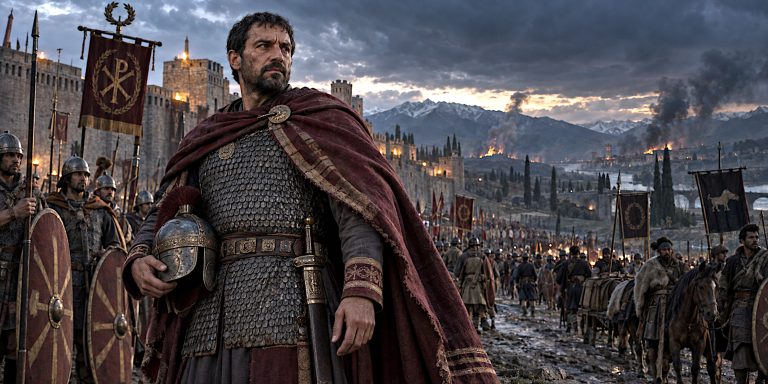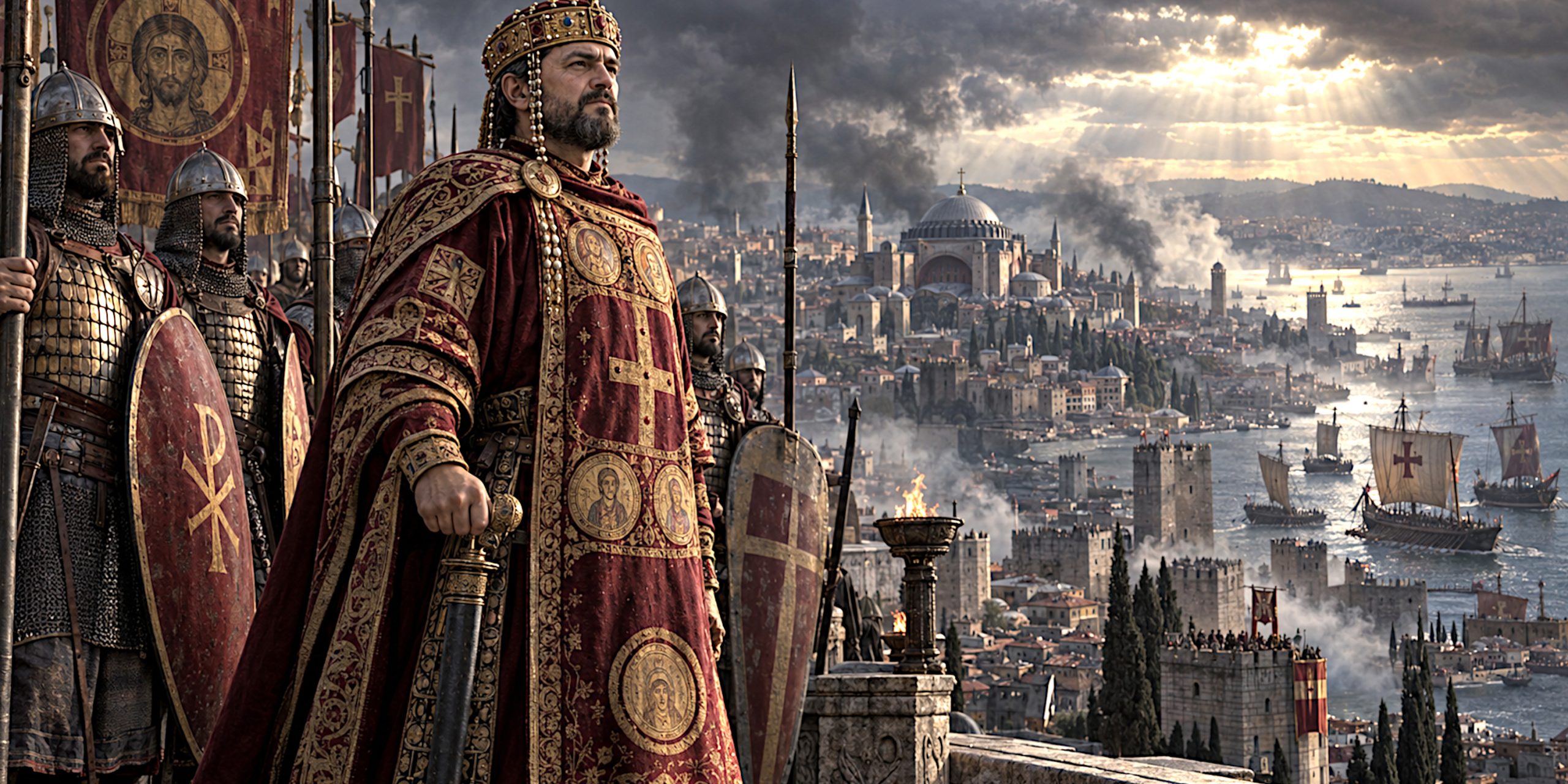
When Alexios I Komnenos seized Constantinople in 1081, the Byzantine Empire was in a dreadful condition. Much of Anatolia had been lost to Turkish powers, the Normans were attacking from the west, the currency had deteriorated and the imperial court had become painfully familiar with coups. The empire still possessed immense prestige, but prestige is not especially useful when the treasury is empty and hostile armies are approaching from several directions.
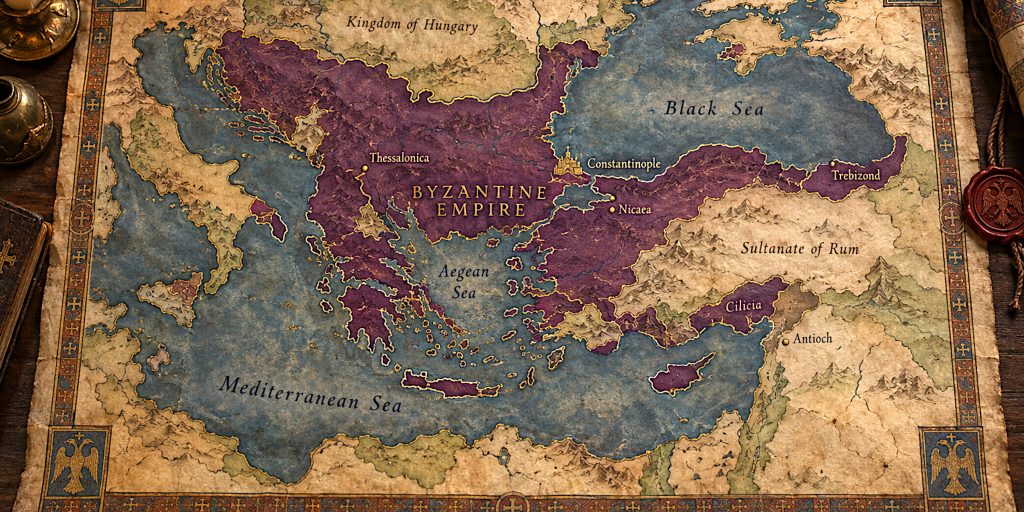
The Komnenian dynasty arrested that decline. Under Alexios I, John II and Manuel I, Byzantium recovered territory, rebuilt its armed forces and once again became the dominant Christian power of the eastern Mediterranean. Constantinople prospered as an imperial capital, commercial centre and meeting place between Greek, Latin, Armenian, Turkic, Syrian and Jewish worlds.
Yet the revival contained weaknesses. Government became increasingly dependent upon the ruling family and the great aristocratic clans connected to it. Foreign merchants secured extensive privileges. Military success often relied on the personality and energy of the emperor. When Manuel I died in 1180, leaving a young heir, the political structure proved far less stable than it had appeared.
The Komnenian century was therefore both a restoration and a warning. Byzantium recovered remarkably, but it did not entirely repair the institutions damaged during the eleventh century. A brilliant dynasty had rebuilt the imperial machine around itself. Once that family began tearing itself apart, the machine came apart with it.
Who Were the Komnenoi?
The Komnenoi were a military aristocratic family whose estates and influence were rooted principally in Asia Minor. Their name is traditionally associated with Komne, although the precise location and early history of the family remain uncertain.
The family first reached the throne through Isaac I Komnenos, who ruled from 1057 to 1059. Isaac attempted to strengthen the army and restrain court expenditure, but poor health and political opposition led him to abdicate. The family did not establish a lasting dynasty until Isaac’s nephew, Alexios I, took power in 1081.
The English forms Komnenian and Comnenian both appear in historical writing. Komnenian follows the Greek name more closely and is now generally preferred.
The dynasty that ruled from 1081 to 1185 consisted of five emperors:
| Emperor | Reign | Historical importance |
|---|---|---|
| Alexios I Komnenos | 1081–1118 | Stabilised the empire and founded the lasting dynasty |
| John II Komnenos | 1118–1143 | Consolidated the recovery and campaigned extensively |
| Manuel I Komnenos | 1143–1180 | Extended Byzantine influence across the Mediterranean |
| Alexios II Komnenos | 1180–1183 | Child emperor displaced during a political crisis |
| Andronikos I Komnenos | 1183–1185 | Attempted reform through increasingly violent rule |
Isaac I belongs to the wider history of the family, but the conventional Komnenian period begins with Alexios I in 1081.
Byzantium Before the Komnenian Restoration
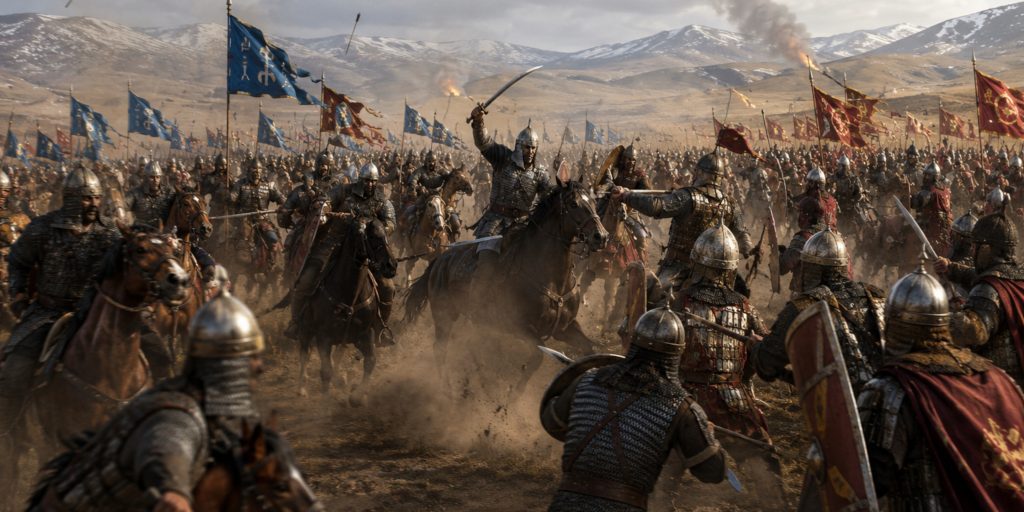
The empire inherited by Alexios had suffered a succession of military and political disasters.
The Battle of Manzikert in 1071 is often treated as the moment Byzantine Anatolia was lost. The battle was important, but its consequences were made far worse by the civil wars that followed. Rival Byzantine factions recruited Turkish soldiers, surrendered fortresses and neglected regional defence while competing for Constantinople.
The Seljuk victory did not cause Anatolia to vanish overnight. Rather, Byzantine authority disintegrated unevenly as Turkish war bands, settlers and political leaders established control across the interior.
Elsewhere, the Normans had conquered Byzantine southern Italy. The Pechenegs threatened the Balkans. The navy had declined, provincial taxation had become unreliable and the gold coinage had been repeatedly debased.
This was the world Alexios entered as emperor. One can admire his ambition while also wondering whether he had examined the job description.
Alexios I Komnenos: The Survivor Emperor
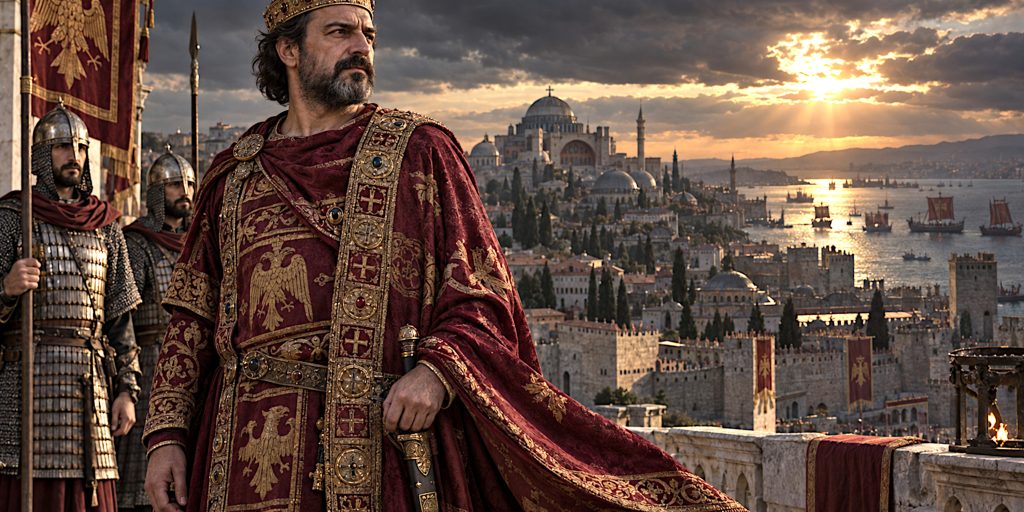
Alexios I was crowned on 4 April 1081 after forcing the abdication of Nikephoros III Botaneiates. His seizure of power was another military coup, but he proved far more durable than the rulers he replaced.
His immediate enemy was Robert Guiscard, the Norman ruler of southern Italy, who invaded the Balkans with his son Bohemond. Alexios suffered a serious defeat at Dyrrhachium in October 1081. The Norman heavy cavalry broke parts of the Byzantine line, while the Varangian Guard became isolated and was largely destroyed.
Alexios survived through diplomacy, improvisation and a readiness to continue after losing battles. He secured Venetian naval assistance by granting the republic valuable trading privileges. German pressure on Norman possessions in Italy also helped divert Robert Guiscard’s attention. After Robert’s death in 1085, the Norman offensive collapsed.
The emperor then confronted the Pechenegs, who had invaded the Balkans. In 1091 he allied with the Cumans and defeated the Pechenegs at the Battle of Levounion. The victory removed one of the most dangerous threats to Constantinople.
Alexios rarely enjoyed the luxury of fighting one enemy at a time. His reign involved conflict with Normans, Pechenegs, Cumans, Seljuk Turks, Serbian rulers, rebellious aristocrats and Crusader princes. He handled these threats through a characteristically Byzantine mixture of warfare, marriage agreements, bribery, titles and calculated displays of imperial majesty.
It was not always elegant. It was usually effective.
The First Crusade
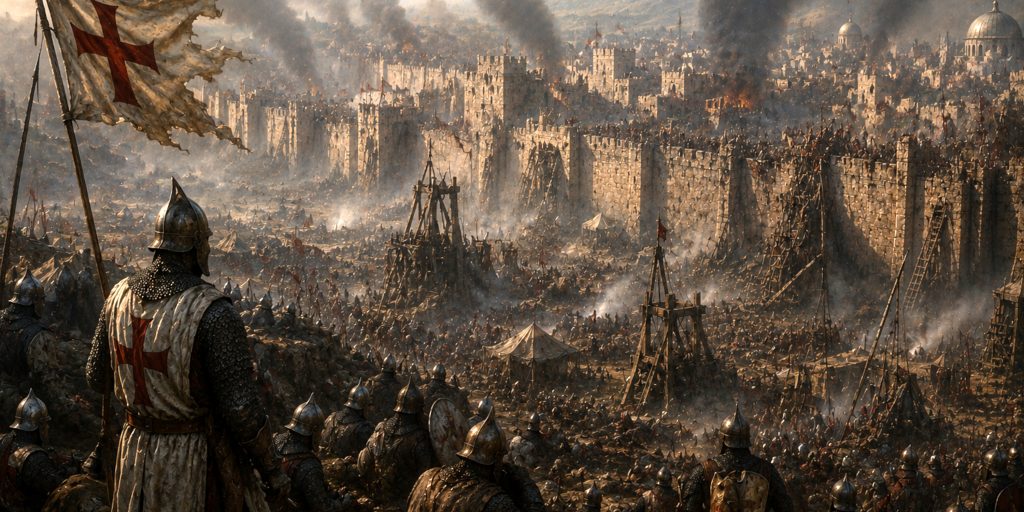
Alexios appealed to the West for military assistance against the Turks. His envoys addressed the Council of Piacenza in 1095, but the vast armed pilgrimage launched by Pope Urban II was far greater and less controllable than the emperor had expected.
The arrival of the First Crusade presented both an opportunity and a threat. Tens of thousands of armed Westerners were moving towards Constantinople, led by men who did not necessarily recognise Byzantine interests as their own.
Alexios required the principal Crusader leaders to swear oaths promising to return former imperial territories to Byzantium. Nicaea was recovered in 1097 and handed to Byzantine officials after negotiations conducted without the Crusaders. The arrangement prevented the city from being looted, although it irritated many Western soldiers who had been hoping for the traditional rewards of conquest.
As the Crusaders advanced, Byzantine forces recovered parts of western Anatolia, including Smyrna, Ephesus and Sardis. Relations deteriorated after the siege of Antioch. Bohemond claimed the city for himself, while the Byzantines considered it former imperial territory.
Alexios later forced Bohemond to accept the Treaty of Devol in 1108, under which Antioch was theoretically recognised as a Byzantine dependency. In practice, the principality resisted full submission.
The First Crusade benefited Byzantium, particularly in western Asia Minor. It also created independent Latin states whose rulers could be allies, rivals or exceptionally troublesome house guests.
Anna Komnene and the Alexiad
Much of what is known about Alexios comes from the Alexiad, written by his daughter Anna Komnene. Anna was born in 1083 and received an exceptional education in literature, philosophy, medicine, theology and mathematics.
The Alexiad is a history of Alexios’s reign, but it is not an impartial biography. Anna admired her father, defended his policies and wrote within the literary conventions of classical Greek historiography. She shaped speeches, emphasised imperial virtues and occasionally treated her father’s enemies with something less than sisterly warmth.
That does not make the work unreliable. It makes it a sophisticated historical source requiring careful reading. Anna preserves invaluable details about warfare, diplomacy, personalities and political thought. She also offers one of the most substantial historical works written by a medieval woman.
Anna was initially associated with a succession plan favouring her husband, Nikephoros Bryennios, over her brother John. How far she participated in an active conspiracy remains debated. After John secured the throne, Anna eventually retired to the convent of Kecharitomene, where she continued her intellectual work.
Her survival in the historical record is no small matter. Medieval courts produced many educated women. Far fewer were able to write themselves into history with such force.
John II Komnenos: The Quiet Conqueror
John II inherited the throne in 1118 after tension surrounding Alexios’s succession. His mother, Irene Doukaina, appears to have preferred Anna and Nikephoros Bryennios. John moved quickly to secure the palace and imperial regalia.
His reign is sometimes overshadowed by those of his father and son, partly because the surviving narrative sources provide less colour. This is unfortunate. John may have been the most consistently effective Komnenian emperor.
Known as John the Good, he cultivated an image of restraint, piety and justice. Contemporary praise should not be swallowed whole, as imperial reputation was carefully manufactured, but John appears to have avoided the theatrical extravagance associated with some rulers.
He campaigned extensively in the Balkans and Anatolia. In 1122 he defeated the Pechenegs at Beroia, ending their importance as an independent military threat. He also fought the Serbs and Hungarians and gradually pushed Byzantine authority eastwards.
John’s campaigns against the Danishmend Turks and the Armenian rulers of Cilicia strengthened the empire’s Anatolian frontier. In 1137 he captured Tarsus, Adana and Mopsuestia before compelling Raymond of Poitiers, prince of Antioch, to acknowledge Byzantine superiority.
His intended joint campaign with Antioch against Muslim-held Syria achieved limited results. Latin distrust, logistical difficulty and conflicting ambitions repeatedly weakened cooperation. Antioch recognised the emperor when an imperial army was nearby, which was a very medieval understanding of constitutional loyalty.
John died in 1143 after being wounded by a poisoned hunting arrow. He selected his younger son Manuel as successor rather than the elder surviving son, Isaac, judging Manuel better suited to rule.
Manuel I Komnenos: The Emperor Looking West
Manuel I was energetic, charismatic and intensely ambitious. He admired elements of Western aristocratic culture, participated in tournaments and married two Western princesses: Bertha of Sulzbach and, following Bertha’s death, Maria of Antioch.
This did not make him a Western ruler in Byzantine clothing. Manuel remained thoroughly committed to Roman imperial authority. His willingness to adopt Latin military practices was pragmatic rather than an abandonment of Byzantine identity.
Manuel pursued an exceptionally wide foreign policy. His armies and diplomats operated in Hungary, Serbia, Italy, Cilicia, Antioch, Egypt and Anatolia. He attempted to recover influence in southern Italy, intervened in the affairs of the Crusader states and cultivated relations with the papacy and Western courts.
Byzantine forces invaded southern Italy in 1155 and initially made rapid progress. The expedition eventually failed because of Norman resistance, disputes with allies and inadequate long-term support. Manuel’s Italian policy was grand, expensive and strategically understandable. It was also beyond what the empire could comfortably sustain.
In the Balkans, Manuel achieved more durable results. He defeated Hungarian forces, imposed Byzantine influence over Serbia and secured control of territories along the Adriatic and Danube frontiers.
To the east, he maintained Byzantine supremacy over the Principality of Antioch. Prince Raynald of Châtillon was forced to submit publicly to the emperor in 1159. Manuel then entered Antioch ceremonially, presenting himself as the senior Christian ruler of the region.
His attempt to cooperate with the Kingdom of Jerusalem in an invasion of Egypt was less successful. The campaign of 1169 failed amid poor coordination and mutual suspicion.
Manuel’s reign represented the high point of Komnenian international prestige. It also left the empire heavily committed across too many fronts.
The Battle of Myriokephalon
In 1176 Manuel led a major campaign against the Sultanate of Rum. His army advanced towards the Seljuk capital at Ikonion but was ambushed while passing through a restricted mountain route near Myriokephalon.
The Byzantines suffered significant losses, particularly among the siege train and sections of the marching column. Manuel compared the defeat to Manzikert, a judgement that has encouraged later historians to treat Myriokephalon as another fatal catastrophe.
That comparison is misleading. Much of the Byzantine army remained intact, and Manuel was able to negotiate a withdrawal. Byzantine forces subsequently defeated Turkish armies and continued to defend western Anatolia.
Myriokephalon mattered because it demonstrated the limits of imperial recovery. Manuel could protect much of the western Anatolian plateau, but he could not easily destroy the Seljuk state or restore Byzantine rule across the entire peninsula.
It was a strategic disappointment rather than the death of Byzantine Anatolia. History does occasionally permit a middle position, however inconvenient that may be for dramatic documentaries.
How the Komnenian Government Worked
The Komnenian emperors transformed government by placing the extended imperial family at its centre. Marriage connections linked the Komnenoi to the Doukai, Angeloi, Kontostephanoi and other aristocratic families.
Senior offices, military commands and court titles were distributed among relatives and trusted associates. Alexios created or expanded an elaborate hierarchy of titles derived from the word sebastos, meaning august or venerable. These included sebastokrator, a title reserved for exceptionally senior members of the dynasty.
This family system had genuine advantages:
- It gave the emperor a network of commanders with a personal interest in preserving the regime.
- Marriage alliances helped reconcile competing aristocratic families.
- Trusted relatives could govern distant territories or lead important armies.
- Dynastic prestige made political authority more coherent after decades of coups.
It also carried serious risks:
- Blood relationship did not guarantee loyalty.
- Powerful relatives acquired their own followers and ambitions.
- Government became less accessible to men outside the aristocratic network.
- A minority succession could release years of suppressed rivalry.
Komnenian government should not be dismissed as simple nepotism. Medieval states depended heavily upon personal relationships, and relatives were often the only people an emperor could trust at all. The difficulty was that the family became almost indistinguishable from the state.
The Economy and the Hyperpyron
Alexios inherited a badly debased currency. Around 1092 he introduced a major monetary reform centred upon a new gold coin, the hyperpyron. Although it contained less pure gold than the old nomisma of earlier centuries, it restored a stable basis for taxation and commercial exchange.
The reform created a tiered coinage system using gold, electrum, billon and copper denominations. It helped the government collect revenue and pay soldiers more reliably.
Economic recovery was supported by improved security. Agricultural production revived in surviving imperial territories, while Constantinople remained a major centre of consumption, manufacture and international trade.
Foreign commercial privileges formed the more uncomfortable side of this recovery. In return for naval assistance against the Normans, Alexios granted Venice extensive rights in 1082, including tax exemptions and trading facilities. Later emperors attempted to balance Venetian influence by extending privileges to Pisa and Genoa.
These grants encouraged commerce but reduced customs income and gave Italian merchants advantages over local competitors. Venetian, Pisan and Genoese communities grew within Constantinople, creating wealth alongside resentment.
The system worked while emperors could manage the rival republics. It became dangerous when commercial competition mixed with religious hostility and political instability.
Pronoia and Landholding
The Komnenian period is closely associated with pronoia. This system is sometimes described as Byzantine feudalism, but that label causes more confusion than clarity.
A pronoia generally granted an individual the right to receive specified state revenues, often collected from land or communities. It did not necessarily transfer ownership of the land itself. Grants could be temporary, conditional and revocable.
Some recipients owed military or administrative service, although the relationship between pronoia and military obligation changed over time. The system allowed emperors to reward supporters without immediately paying them from the treasury.
It also strengthened the position of wealthy landholders and military families. As grants became more entrenched, the central government risked surrendering control over income and provincial society.
The Komnenoi did not suddenly turn Byzantium into a Western feudal kingdom. They did, however, govern through a narrower aristocratic network whose wealth increasingly rested upon privileged access to imperial revenues.
The Komnenian Army
The army rebuilt by Alexios and his successors differed from the largely provincial forces of earlier centuries. It combined imperial guards, professional cavalry, foreign mercenaries, allied contingents, provincial troops and soldiers maintained through aristocratic households or revenue grants.
Its components included:
- The Varangian Guard, increasingly associated with English and Scandinavian warriors
- Imperial guard cavalry stationed near Constantinople
- Native Byzantine heavy cavalry
- Horse archers and light cavalry recruited from Turkic peoples
- Pecheneg and Cuman auxiliaries
- Norman and other Latin heavy cavalry
- Armenian infantry and cavalry
- Serbian, Hungarian and allied contingents
- Provincial infantry, archers and garrison troops
Alexios formed the Archontopouloi, reportedly recruited from the sons of officers killed in battle. Sources also mention units called the Immortals, although their organisation and continuity remain difficult to reconstruct.
The Komnenian army could operate across remarkable distances. It was capable of siege warfare, field battles, punitive raids and elaborate combined campaigns. Under John II in particular, campaigning became methodical, with fortresses captured and communications secured before the army advanced further.
Its weakness was cost. Professional soldiers and mercenaries required regular payment. The system also depended upon commanders who remained loyal to the emperor.
Arms and Armour
Komnenian soldiers used equipment drawn from Byzantine, steppe, Islamic and Western military traditions.
Swords and sidearms
The straight, double-edged sword remained widely used. Byzantine examples commonly had broad blades, simple crossguards and wheel, disc or rounded pommels. Imported or locally made swords influenced by Western European forms also appeared, particularly as contact with Crusaders and Latin mercenaries increased.
The paramerion was a single-edged, slightly curved sword associated with Byzantine cavalry. Its form reflected contact with steppe and eastern military traditions. It was worn suspended from the belt and was suited to mounted cutting.
Other close-combat weapons included:
- Straight double-edged swords
- Curved sabres and parameria
- Maces with iron or bronze heads
- Battle axes
- Daggers and large fighting knives
- Lances and shorter thrusting spears
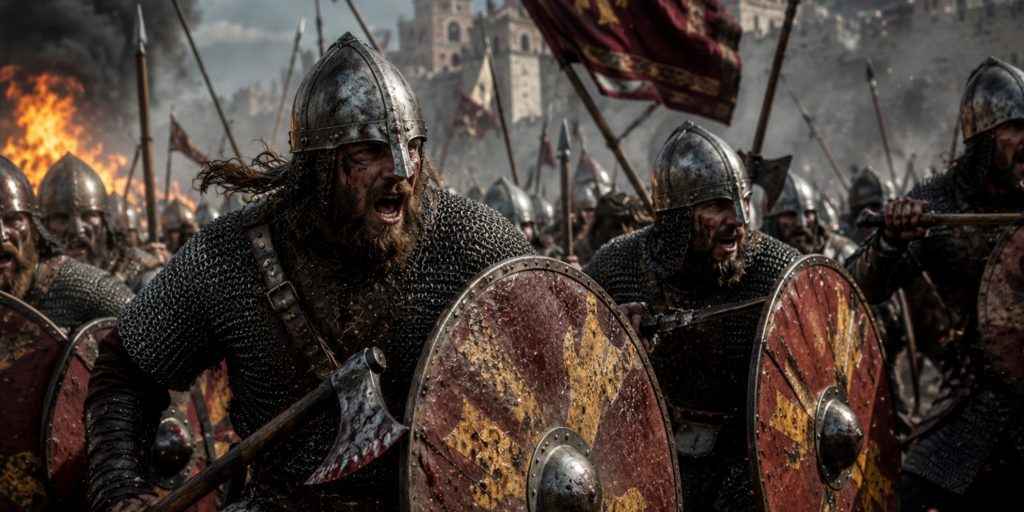
The Varangian Guard remained famous for its axes, particularly long-shafted two-handed weapons, although individual Varangians also carried swords.
Missile weapons
Composite bows were essential to Byzantine warfare. Horse archers could harass formations, screen movements and exploit broken ground. Infantry archers and crossbowmen also served in Komnenian armies.
The crossbow became increasingly prominent during the twelfth century, particularly through contact with Western soldiers. Byzantine writers were fascinated and occasionally appalled by its penetrative power, which is exactly the reaction any effective new weapon tends to receive from the people standing at the wrong end.
Armour
Elite cavalry could wear:
- Mail shirts or hauberks
- Lamellar or scale corselets
- Padded textile armour
- Iron helmets with nasal guards
- Conical or rounded helmets
- Greaves and arm protection
- Kite-shaped, round or almond-shaped shields
The klivanion, formed from lamellar plates, remained an important form of body armour. Mail became increasingly common, partly reflecting interaction with Western military practice. Armour varied greatly according to rank, wealth and tactical role.
Heavy cavalry could deliver powerful lance charges, but Byzantine commanders normally expected different troop types to cooperate. The army’s effectiveness came from combining cavalry, infantry, archers and manoeuvre, not from searching for one heroic fellow with a very expensive horse.
The Byzantine Navy
The navy never fully recovered the overwhelming position it had enjoyed in earlier centuries. Alexios’s reliance upon Venetian assistance illustrates how far Byzantine maritime strength had declined by 1081.
Nevertheless, the Komnenian emperors maintained fleets for operations in the Aegean, Adriatic and eastern Mediterranean. Manuel assembled substantial naval forces for expeditions against Italy and Egypt.
Byzantine warships included galleys propelled by oars and sails. Greek fire remained part of the imperial naval tradition, although the evidence for its precise employment during this period is less detailed than for earlier centuries.
Dependence on Venice was particularly dangerous. The empire needed Italian maritime strength while simultaneously fearing the economic and political influence gained by Italian merchants. It was rather like hiring a locksmith who then acquired a permanent commercial interest in every room of the house.
Constantinople Under the Komnenoi
Constantinople remained one of the largest and wealthiest cities in the medieval world. Its population cannot be calculated securely, but it greatly exceeded that of most contemporary European cities.
The imperial court operated primarily from the Great Palace and, increasingly, the Palace of Blachernai near the city’s north-western walls. Blachernai was closer to the land defences and became a favoured Komnenian residence.
The city contained churches, monasteries, workshops, markets, harbours and communities of foreign merchants. Silks, metalwork, jewellery, manuscripts, spices and luxury goods moved through its markets.
Visitors often responded to Constantinople with amazement, envy and moral disapproval, sometimes all within the same paragraph. Western observers admired its wealth while suspecting its inhabitants of excessive cleverness. Byzantine writers returned the compliment by presenting many Westerners as culturally unfinished men who had somehow acquired horses.
Religion and Imperial Authority
The emperor was not a priest, but he exercised extensive authority in religious affairs. Komnenian rulers appointed or influenced senior church officials, convened councils, supported monasteries and intervened in theological disputes.
Alexios I acted forcefully against groups considered heretical. The Bogomil teacher Basil was executed by burning after an investigation described in the Alexiad. Alexios also confronted Paulicians and debated theological questions with intellectuals whose teachings attracted official suspicion.
The dynasty promoted an image of divinely sanctioned rulership. Imperial ceremonies, coins, mosaics and religious foundations connected the emperor and his family with Christ, the Virgin Mary and the saints.
Komnenian devotion was not necessarily cynical. Medieval rulers could be sincerely religious while also understanding the political value of public piety. Human beings have always been capable of holding two useful thoughts at once.
Churches, Monasteries and Art
Komnenian patronage produced important developments in architecture, mosaics, icons, manuscripts and devotional art. Middle Byzantine art flourished through support from the imperial family, aristocratic patrons and monasteries.
John II and his wife, Irene of Hungary, founded the Pantokrator Monastery in Constantinople. Its complex included churches, charitable institutions and a hospital. Parts of the structure survive as the Zeyrek Mosque in modern Istanbul.
The famous Komnenos mosaic in Hagia Sophia depicts John II and Irene presenting gifts to the Virgin and Christ Child. Their son Alexios appears on an adjacent panel. The images present the dynasty as pious guardians of the Christian empire.
Komnenian religious art often displays heightened emotional expression. Figures bend, mourn and interact with an immediacy that would influence later Byzantine and wider Orthodox art.
Manuscript production, ivory carving, enamelwork and metalwork also prospered. Byzantine objects circulated through diplomacy, marriage, trade and war, carrying imperial artistic influence into the Latin West, the Caucasus, the Balkans and the Islamic world. The Metropolitan Museum of Art’s overview of Byzantium places this artistic production within the wealth and broad patronage of the Middle Byzantine world.
Education and Intellectual Life
The Komnenian court valued classical learning. Writers consciously imitated ancient Greek historians, philosophers and rhetoricians. Education remained an important route into church and government service, particularly for men connected to Constantinopolitan networks.
Anna Komnene is the most celebrated Komnenian intellectual, but she belonged to a much broader culture. Nikephoros Bryennios wrote history, John Tzetzes produced extensive literary and scholarly works, and Eustathios of Thessaloniki became renowned as a scholar, churchman and commentator on Homer.
Michael Italikos, Theodore Prodromos and other writers composed speeches, poems, letters and works of theology. Court patronage encouraged learning, but it could also produce writing so flattering that one suspects the emperor must occasionally have become tired of being compared with every admirable figure from antiquity.
The twelfth century also witnessed increased intellectual contact with the Latin world. Translation and debate did not erase religious disagreement, but the two Christian cultures were not sealed off from one another.
Women of the Komnenian Court
Komnenian women exercised influence through marriage, patronage, education and dynastic connections.
Anna Dalassene, the mother of Alexios I, was central to the family’s rise. Alexios trusted her sufficiently to leave much of the civil administration in her hands while he campaigned. The formal authority granted to her was exceptional, but her political role reflected the importance of senior women within aristocratic households.
Irene Doukaina, Alexios’s empress, connected the Komnenoi to the powerful Doukas family. She founded the Kecharitomene convent and supported Anna Komnene.
Anna herself became a historian of lasting importance. Irene of Hungary, the wife of John II, was involved in religious and charitable patronage. Manuel’s wives linked Byzantium with the German and Crusader aristocracies.
Maria of Antioch, Manuel’s second wife, became regent for their young son Alexios II. Her Latin background made her vulnerable to political hostility, although much of the criticism directed at her came from opponents with reasons to present the regency as corrupt and foreign-controlled.
These women did not operate in anything resembling an equal political system. They nevertheless shaped patronage, succession and diplomacy. Ignoring them would leave the dynasty’s history with several large and rather obvious holes.
Byzantium and the Latin West
The Komnenian relationship with Western Christians was complex. Byzantines and Latins traded, intermarried and fought alongside one another. They also competed for territory, disputed religious authority and produced increasingly hostile descriptions of each other.
The schism between the churches had not yet become an absolute social barrier. Greek and Latin Christians continued to cooperate, particularly when politics made cooperation useful.
Manuel I was unusually receptive to Western customs and diplomacy. Latin knights entered imperial service, Western princesses married into the dynasty and Byzantine envoys negotiated with popes, emperors and kings.
Yet commercial tension grew inside Constantinople. Italian communities enjoyed tax privileges, maintained their own quarters and became associated with foreign influence. Resentment was directed especially towards the Venetians.
In 1171 Manuel ordered the arrest of Venetians across the empire and confiscated their property. The action caused a lasting breach. By the time of Manuel’s death, relations between Byzantines and Latins were burdened by trade rivalry, political suspicion and increasingly bitter religious rhetoric.
Alexios II and the Crisis of Succession
Manuel I died on 24 September 1180. His son Alexios II was about eleven years old and therefore unable to rule independently.
Government passed to a regency dominated by Empress Maria of Antioch and the protosebastos Alexios Komnenos. Their opponents accused them of favouring Latins and mismanaging the empire. Some allegations were political propaganda, but public hostility was real.
Manuel’s cousin Andronikos Komnenos presented himself as the protector of the young emperor and the enemy of corrupt officials. He marched towards Constantinople in 1182, attracting support from those who resented the regency and aristocratic establishment.
His advance triggered the collapse of the government. During the upheaval, a massacre of Latin inhabitants took place in Constantinople. Men, women and children were killed, and churches, homes and commercial properties were attacked. The exact number of victims is unknown, but the violence permanently damaged relations with the West.
Maria of Antioch was imprisoned and executed. Alexios II was compelled to sign his mother’s death warrant. In 1183, the young emperor was strangled on Andronikos’s orders.
Whatever grievances existed against the regency, the murder of a child emperor was an exceptionally grim solution.
Andronikos I Komnenos: Reform and Terror
Andronikos I was one of the most extraordinary figures ever to occupy the Byzantine throne. He was intelligent, physically imposing, militarily experienced and capable of considerable personal charm. He had also spent much of his life rebelling, escaping imprisonment, travelling between foreign courts and becoming involved in scandalous relationships.
He entered Constantinople as a reformer. Andronikos sought to restrain corrupt tax collectors, prevent the sale of offices and protect provincial populations from aristocratic exploitation. Officials were expected to perform their duties and were paid sufficiently to reduce the temptation of bribery.
Some of these measures appear to have been genuinely effective. Even hostile accounts acknowledge his hostility towards administrative abuse.
The problem was his method. Andronikos increasingly governed through executions, mutilations, confiscations and terror. His campaign against corruption became entangled with an attempt to destroy political rivals and weaken aristocratic families.
Rebellions followed. Several provinces slipped from imperial control, while neighbouring powers recognised Byzantine vulnerability.
In 1185 William II of Sicily launched a Norman invasion. Norman forces captured Dyrrhachium and advanced across the Balkans before taking Thessaloniki. The city suffered a brutal sack.
Panic spread through Constantinople. When Andronikos’s officials attempted to arrest Isaac Angelos, Isaac killed the officer sent against him and sought refuge in Hagia Sophia. A popular uprising proclaimed Isaac emperor.
Andronikos attempted to flee but was captured. The Constantinopolitan crowd tortured and killed him on 12 September 1185. The details recorded by Niketas Choniates are deliberately horrifying. They reflect both the cruelty of the mob and the depth of hatred Andronikos had inspired.
With his death, direct Komnenian rule in Constantinople ended.
Why Did the Komnenian Dynasty Fall?
The dynasty did not fall because of a single battle or policy. Several weaknesses converged after 1180.
A child inherited the throne
Alexios II could not control the court, army or imperial family. The regency lacked the prestige required to contain rival factions.
Government depended on dynastic authority
The Komnenian system worked best under an adult emperor capable of managing aristocratic relatives. Once central authority weakened, the same family networks became channels for conspiracy.
Manuel’s policies were expensive
His campaigns enhanced imperial prestige but placed sustained demands upon the treasury and armed forces. His empire remained formidable in 1180, although it had less room for political failure than appearances suggested.
Relations with the Latin powers deteriorated
Commercial rivalry, religious suspicion, the arrests of 1171 and the massacre of 1182 created bitter hostility. These events did not make the Fourth Crusade inevitable, but they contributed to the antagonism that later surrounded it.
Andronikos destroyed political trust
His reforms addressed real problems, but his violence destabilised the government, alienated the aristocracy and encouraged revolt. He attempted to save the empire from exploitation while behaving like a man determined to leave no potential supporter alive.
Did the Komnenoi Save or Weaken Byzantium?
The fairest answer is that they did both, although not in equal measure.
Alexios I inherited an empire close to military and financial collapse. He restored the currency, defeated major enemies and recovered valuable territory. John II consolidated those gains through disciplined campaigning. Manuel I made Byzantium a central power in the politics of Europe and the eastern Mediterranean.
Their achievement was real. The empire of 1180 was wealthier, stronger and territorially larger than the state Alexios had seized in 1081.
However, the recovery was incomplete. Central Anatolia remained under Turkish rule. The navy could not dominate the Mediterranean without foreign assistance. Italian commercial privileges reduced imperial control over trade. Political power became concentrated within a small group of interconnected families.
The Komnenoi stabilised Byzantium by adapting to the conditions of their age. Those adaptations created a powerful state, but one unusually dependent upon capable emperors. That is less a contradiction than the central fact of the period.
What Happened After 1185?
Isaac II Angelos founded a new ruling dynasty, but the empire continued to be governed by families and institutions shaped during the Komnenian century.
The loss of central control accelerated. Bulgaria broke free after the uprising of Peter and Asen in 1185. Serbia expanded its independence. Relations with Western powers remained volatile, while aristocratic factions continued to compete for the throne.
In 1204 the Fourth Crusade captured Constantinople. Members and descendants of the Komnenian family established successor states.
Alexios and David Komnenos founded the Empire of Trebizond on the Black Sea coast. The rulers of Trebizond adopted the name Grand Komnenos and maintained their state until the Ottoman conquest of 1461.
The rulers of the Despotate of Epirus used the combined family name Komnenos Doukas, drawing legitimacy from their aristocratic descent. Komnenian bloodlines also spread through marriage into Georgian, Armenian, Balkan and Western ruling families.
The dynasty therefore did not disappear in 1185. It ceased to rule Constantinople, but its descendants and political reputation remained active for centuries.
Komnenian Dynasty Timeline
| Date | Event |
|---|---|
| 1081 | Alexios I seizes the throne |
| 1081 | Byzantines defeated by the Normans at Dyrrhachium |
| 1082 | Alexios grants major commercial privileges to Venice |
| 1091 | Pechenegs defeated at Levounion |
| 1092 | Major Byzantine coinage reform |
| 1095 | Byzantine request for Western military assistance |
| 1096–1099 | First Crusade |
| 1097 | Recovery of Nicaea and parts of western Anatolia |
| 1108 | Treaty of Devol with Bohemond |
| 1118 | Death of Alexios I and accession of John II |
| 1122 | John II defeats the Pechenegs at Beroia |
| 1137 | John campaigns in Cilicia and imposes authority over Antioch |
| 1143 | John II dies and Manuel I succeeds him |
| 1147 | Second Crusade passes through Byzantine territory |
| 1155 | Byzantine expedition begins in southern Italy |
| 1159 | Manuel enters Antioch in triumph |
| 1167 | Byzantine victory over Hungary at Sirmium |
| 1169 | Unsuccessful Byzantine and Crusader campaign in Egypt |
| 1171 | Manuel orders the arrest of Venetians |
| 1176 | Battle of Myriokephalon |
| 1180 | Manuel dies and Alexios II succeeds him |
| 1182 | Andronikos enters Constantinople and Latins are massacred |
| 1183 | Alexios II is murdered and Andronikos becomes sole emperor |
| 1185 | Normans sack Thessaloniki |
| 1185 | Andronikos is overthrown and killed |
Important Surviving Sites and Objects
Material evidence for the Komnenian period survives across the former Byzantine world.
Hagia Sophia, Istanbul
The Komnenos mosaic shows John II, Empress Irene and their son Alexios beside the Virgin and Christ Child. It is among the most recognisable surviving images of the dynasty.
Zeyrek Mosque, Istanbul
Originally the Pantokrator Monastery founded by John II and Irene, this complex preserves an important example of Komnenian religious architecture.
Chora and other Constantinopolitan churches
Although much surviving decoration belongs to later periods, these sites reflect the religious and artistic environment fostered by Middle Byzantine patronage.
Byzantine coins
Gold hyperpyra and lower-value coins preserve imperial portraits, titles and religious imagery. They also provide direct evidence for Alexios’s monetary reforms and their continuation.
Manuscripts and luxury objects
Illuminated books, enamels, reliquaries, ivory carvings and liturgical objects survive in collections across Europe and the eastern Mediterranean. The Met’s open publication, The Glory of Byzantium, provides a broad survey of the artistic and cultural setting.
Fortifications and provincial churches
Komnenian construction and restoration can be traced in Constantinople, Anatolia, Greece, the Balkans and the Aegean. Precise dating is sometimes difficult because Byzantine buildings were repeatedly repaired and adapted.
The Komnenian Legacy
The Komnenian dynasty gave Byzantium another century as a major imperial power. That achievement should not be reduced to a temporary pause in an inevitable decline. Nothing about Byzantine collapse was inevitable in 1081, 1143 or even 1180.
Alexios, John and Manuel responded intelligently to the changed military world around them. They recruited foreign soldiers, integrated aristocratic households into imperial government, restored monetary stability and used diplomacy as aggressively as any army.
Their Byzantium was cosmopolitan, prosperous and culturally productive. It influenced the Crusader states, Balkan kingdoms, Italian cities, Armenian courts and Georgian monarchy. Its art and political traditions survived long after Komnenian rule in Constantinople ended.
Yet the dynasty’s final years exposed the cost of personalised government. The state had become too closely bound to the authority of one family and, within that family, to the abilities of one reigning emperor. Manuel’s death opened a succession crisis. Andronikos turned that crisis into terror.
My own view is that the Komnenoi deserve to be remembered primarily as restorers. They did not solve every structural problem, and some of their solutions produced later difficulties. Even so, they inherited a fractured empire and returned it to the centre of medieval politics. Few dynasties are given such a poor hand and play it so effectively.
They also demonstrated a recurring Byzantine truth: Constantinople could survive invasion, financial collapse and foreign hostility. What it found much harder to survive was a large imperial family with several plausible heirs and no patience whatsoever.