For several centuries, the Khazars controlled one of the great strategic crossroads of the medieval world. Their Khaganate stretched across the Pontic-Caspian steppe, linking the Black Sea, Caucasus, Volga and lands north of the Caspian. Sitting there meant dealing with Byzantines, Arabs, Bulgars, Alans, Rus’, Pechenegs and a revolving cast of steppe peoples who were rarely inclined to knock politely.
Cavalry made Khazar power possible.
The Khazars inherited the mounted military traditions of the western Turkic world, combining horse archery, mobile warfare and increasingly well-protected elite cavalry. Yet reconstructing the Khazar army is surprisingly difficult. They left relatively little written material of their own, while much of what we know comes from Arab, Persian, Byzantine, Armenian, Georgian and Hebrew sources, supplemented by archaeology.
The result is a military culture we can reconstruct in broad detail, but should resist turning into a perfectly uniform army with standardised equipment. The Khazar cavalryman was not one single type of warrior.
He belonged to a military system built around mobility, horses, bows, armour and the ability to operate across distances that would make most medieval infantrymen quietly reconsider their career choices.
Who Were the Khazars?
The Khazars emerged as a major political force during the seventh century following the fragmentation of the Western Turkic Khaganate.
Their ruling elite was Turkic-speaking, although the population of the Khazar Khaganate was ethnically and culturally diverse. Khazar territory incorporated or dominated numerous peoples, including Alans, Bulgars, Slavs and other steppe communities.
At its greatest extent, Khazar influence reached across much of the region between the lower Volga, northern Caucasus, Don and northern Black Sea.
The Khazars occupied an unusually important geopolitical position. They controlled sections of the trade routes connecting northern Europe, Central Asia, the Islamic world and Byzantium.
Their wars were equally international.
Khazar armies fought Arab forces attempting to push north through the Caucasus, intervened in Byzantine politics, campaigned against neighbouring steppe peoples and eventually faced increasing pressure from the Rus’ and Pechenegs.
This was a state whose geography demanded mounted warfare.
The Khazar Cavalry Tradition
Khazar warfare developed from the broader military traditions of the Eurasian steppe.
The horse was the foundation of the system.
Khazar warriors could travel rapidly across open country, conduct raids, avoid unfavourable engagements and concentrate forces before opponents had properly understood where they were.
Horse archery was central to this approach.
Mounted archers could harass enemy formations from a distance, retreat before counter-attacks and attempt to disrupt formations before heavier troops closed for combat.
The Khazars also fielded more heavily equipped cavalry.
Archaeological finds associated with the Saltovo-Mayaki cultural horizon include helmets, lamellar armour components, sabres, spearheads, arrowheads and horse equipment. Not every Saltovo-Mayaki object can automatically be labelled Khazar, which is one of the persistent problems with the archaeology, but the overall military picture is convincing.
Khazar armies probably contained a spectrum of mounted troops rather than neat categories of “light” and “heavy” cavalry.
A wealthy retainer might possess armour, helmet, shield, bow, lance and sword. A less affluent mounted warrior could carry a bow and relatively modest protective equipment.
How Khazar Cavalry Fought
The Khazars belonged to a military world in which manoeuvre often mattered more than holding a fixed battle line.
A likely sequence in battle involved mounted archers approaching the enemy, releasing arrows and withdrawing before close contact. Repeated attacks could weaken formations, provoke pursuit or expose vulnerable flanks.
Retreat was not necessarily defeat.
Steppe armies famously used deliberate withdrawals to draw opponents away from supporting troops. It is dangerous to assume that every recorded Khazar retreat was a sophisticated feigned retreat, but the technique belonged firmly within the wider Turkic military tradition.
Once an enemy became disorganised, cavalry armed with lances, spears and swords could attack at close range.
This produced a highly flexible battlefield system.
Khazar horsemen could scout, raid, pursue, screen an army, attack supply lines and participate in pitched battles. Their strategic mobility was arguably more important than any individual weapon they carried.
Arms and Armour
Khazar cavalry equipment reflected influences from the Turkic steppe, Caucasus, Iran and neighbouring settled societies.
There was considerable variation according to period, wealth and status.
Composite Bow
The composite reflex bow was probably the defining missile weapon of Khazar cavalry.
Constructed from combinations of wood, horn, sinew and adhesive materials, composite bows could produce considerable power despite being compact enough for mounted use.
Archaeological evidence includes bone or antler components associated with bows, alongside large quantities of arrowheads.
Different arrowheads could serve different purposes. Narrow armour-piercing forms existed alongside broader cutting heads and other specialised shapes.
The bow allowed Khazar cavalry to determine the distance of an engagement whenever circumstances permitted.
Sabres
The curved sabre became increasingly important across the western Eurasian steppe during the early medieval period.
Single-edged sabres associated with Saltovo-Mayaki contexts are particularly relevant to discussions of Khazar weaponry.
These blades were generally slightly or moderately curved rather than resembling the dramatically curved sabres of much later periods.
The curvature assisted cutting from horseback because the blade could continue moving through the target as the rider passed.
For a mounted warrior travelling at speed, that is rather useful. Getting your sword lodged in somebody while your horse continues in the opposite direction is the sort of practical inconvenience medieval military manuals rarely dwell upon.
Palashes and Straight Single-Edged Swords
Some steppe blades occupied an intermediate position between straight swords and later curved sabres.
The term palash is sometimes applied to long, relatively straight or slightly curved single-edged blades associated with Eurasian cavalry traditions.
Weapon typology is not always consistent between modern scholars, so individual archaeological examples are better understood by examining their construction rather than forcing every blade into a modern category.
Double-Edged Swords
Straight double-edged swords were also known within the wider cultural environment of the Khazar Khaganate.
These weapons could reflect Byzantine, Caucasian, Iranian or European influences depending upon their construction and archaeological context.
The sabre appears more characteristically associated with steppe cavalry, but the Khazar military world was far too interconnected for one sword design to have enjoyed complete exclusivity.
Spears and Lances
Spears were among the most practical weapons available to mounted warriors.
A cavalryman could use a long spear for thrusting against infantry or opposing horsemen before drawing a sword for close combat.
Archaeological sites linked with the Saltovo-Mayaki horizon have produced numerous iron spearheads.
Some heavily equipped Khazar warriors may therefore have operated in a role approaching shock cavalry.
Armour
Lamellar armour was particularly important.
It consisted of numerous small plates, usually of iron or hardened organic material, laced together into flexible protective garments.
Lamellar construction had significant advantages for cavalry. It offered substantial protection while allowing more movement than a single rigid cuirass.
Mail was also known in the region.
A wealthy warrior might therefore combine lamellar protection with mail components or additional defences for the limbs.
The archaeological record should make us cautious about imagining every Khazar horse archer wrapped in armour. Good armour required resources, skilled manufacture and maintenance.
Elite retainers probably looked considerably more intimidating than ordinary levies.
Helmets
Conical and sphero-conical helmets were widespread across the Eurasian steppe and neighbouring regions.
Khazar-associated examples could incorporate segmented construction, nasal protection or attachments for mail or other neck defences.
The pointed profile was practical because it could help deflect downward blows rather than absorbing their full force.
Shields
Mounted warriors could carry relatively small shields, including round examples.
A cavalry shield needed to provide protection without interfering excessively with the bow, reins or other weapons.
This created an obvious problem for horse archers. Humans stubbornly continue to have only two hands.
Consequently, shields were probably more useful during particular phases of combat than while actively shooting.
The Khazar Horse
The horse deserves to be treated as military equipment in its own right.
Steppe cavalry depended upon tough animals capable of travelling substantial distances under difficult conditions.
Mounted warriors could maintain access to several horses during campaigns, changing mounts to prevent exhaustion. This dramatically increased the operational range of an army.
Horse equipment recovered from Khazar-period archaeological contexts includes bits, stirrups, buckles, harness fittings and decorative mounts.
The widespread adoption of stirrups improved stability for mounted archers and close-combat cavalry.
Stirrups did not magically create heavy cavalry, as older historical arguments sometimes implied, but they were certainly useful. Medieval horsemen did not spend centuries using them because they enjoyed unnecessary ironwork.
Elite Cavalry and the Khagan’s Army
The Khazar political system appears to have contained an unusual form of dual kingship.
The Khagan occupied a sacral or supreme position, while practical political and military authority was often exercised by another ruler commonly identified in sources as the bek or khagan bek.
Arab and Persian geographical accounts describe the Khazar ruler maintaining professional forces.
Al-Mas’udi, writing in the tenth century, described a royal force containing Muslim troops known as the Arsiyya or al-Arsiyya, probably of Khwarazmian origin.
This is an important reminder that a “Khazar army” did not necessarily consist exclusively of ethnic Khazars.
The Khaganate was an imperial structure.
Its military strength could include Khazar retainers, subject peoples, allied contingents and foreign professional soldiers.
Khazar Cavalry Against the Arab Armies
The most significant military struggle in early Khazar history came against the expanding Umayyad Caliphate.
During the seventh and eighth centuries, Arab armies repeatedly attempted to advance through the Caucasus.
The fighting was ferocious.
Control of the mountain passes around Derbent became strategically crucial. Once an army emerged north of the Caucasus, it entered terrain where Khazar cavalry could exploit mobility far more effectively.
In 730, Khazar forces achieved a major victory at the Battle of Marj Ardabil.
Khazar troops advanced deep into what is now north-western Iran and defeated an Umayyad army commanded by al-Jarrah ibn Abdallah.
Arabic accounts describe al-Jarrah being killed during the fighting.
The victory demonstrated that Khazar armies were capable of far more than defensive raiding.
They could conduct major strategic offensives across the Caucasus.
Marwan’s Invasion of 737
The Arab response eventually became overwhelming.
In 737, the future caliph Marwan II led a massive campaign into Khazar territory.
Islamic accounts describe Arab forces penetrating deep into the steppe and pursuing the Khazar ruler northwards.
The Khazar leadership eventually sought terms.
Some Arabic sources claim that the Khagan agreed to accept Islam, although the permanence and political meaning of this supposed conversion remain disputed.
What matters militarily is that the campaign demonstrates one limitation of cavalry-based steppe warfare.
Mobility could make the Khazars extremely difficult to defeat in a conventional battle, but it could not always prevent a sufficiently large and determined enemy from penetrating their territory.
Even then, the Arabs did not permanently conquer Khazaria.
The Caucasus broadly stabilised as a frontier between the Islamic world and the Khazar sphere.
Relations with Byzantium
Khazar military power also mattered enormously to the Byzantine Empire.
The two powers frequently found common interests against Arab expansion.
Dynastic relationships reinforced the connection.
The Byzantine emperor Justinian II married a Khazar princess traditionally known as Theodora. Later, Emperor Constantine V married another Khazar princess, often identified as Tzitzak, who took the Christian name Irene.
Their son became Emperor Leo IV, remembered as Leo the Khazar.
Khazar cavalry therefore existed within a much broader diplomatic system in which military alliances, marriages and trade intertwined.
The Byzantines understood perfectly well that having powerful steppe cavalry north of the Caucasus could be preferable to having it riding south towards Constantinople.
Archaeology and the Saltovo-Mayaki Culture
Much of our physical evidence for Khazar-period warfare comes from archaeological material classified within the Saltovo-Mayaki culture.
This archaeological horizon flourished between roughly the eighth and tenth centuries across areas associated with the Khazar Khaganate.
Important sites and regions include the Don basin, lower Don, Donets, northern Caucasus and territories around major Khazar centres.
Finds include:
| Archaeological evidence | What it suggests |
|---|---|
| Sabres | Strong mounted close-combat tradition |
| Arrowheads | Extensive use of archery |
| Bow fittings | Composite bow technology |
| Spearheads | Cavalry and infantry thrusting weapons |
| Lamellar plates | Armoured elite warriors |
| Mail fragments | Additional forms of body protection |
| Stirrups | Developed riding equipment |
| Horse bits | Extensive equestrian culture |
| Harness fittings | Investment in military horses |
| Belt fittings | Status and military identity |
The major caution concerns ethnicity.
Saltovo-Mayaki culture encompassed multiple populations, including Alans and Bulgars as well as communities living under Khazar authority.
An object excavated from a Saltovo cemetery is therefore not automatically a “Khazar weapon”.
This distinction matters.
Archaeology gives us an excellent picture of the military environment of the Khaganate, but identifying the ethnicity of the person who carried an individual sabre can be considerably harder.
Sarkel and the Defence of the Don
One of the most important Khazar archaeological sites is Sarkel.
The fortress was constructed on the lower Don during the ninth century with Byzantine technical assistance.
Emperor Theophilos sent engineers to assist in its construction, including Petronas Kamateros.
Sarkel demonstrates that Khazar defence was not based entirely upon mobile cavalry.
Fortifications protected strategically important river crossings and trade routes, while cavalry could patrol and respond across the surrounding territory.
This combination of fixed strongpoints and mobile forces was considerably more sophisticated than the old stereotype of steppe peoples simply wandering around until somebody inconveniently built a city.
Contemporary Accounts of Khazar Warfare
Most surviving descriptions of the Khazars were written by outsiders.
The tenth-century Muslim historian and geographer al-Mas’udi described Khazar society and the forces maintained by its ruler. His account is particularly valuable because it depicts a multicultural military establishment rather than a purely tribal host.
Ibn Fadlan, who travelled through the Volga region in the early tenth century, also provides information about the wider political and cultural environment surrounding Khazaria.
The Byzantine emperor Constantine VII Porphyrogenitus discussed the Khazars extensively in De Administrando Imperio.
His work reveals how seriously Constantinople regarded Khazar power and diplomacy.
The Hebrew Khazar Correspondence, traditionally associated with Hasdai ibn Shaprut and King Joseph of the Khazars, presents the Khazar ruler describing his kingdom and neighbouring peoples.
One famous passage attributed to Joseph describes the territorial position of his kingdom:
“I guard the mouth of the river.”
The precise wording varies between translations and manuscripts, but the political message is clear. Khazar power was closely connected with controlling the Volga corridor and the movement of peoples and trade through it.
These sources need careful handling. Byzantine, Islamic and Hebrew authors all wrote for different audiences and purposes.
None was preparing an equipment catalogue for historians twelve centuries later, inconsiderately enough.
Khazar Cavalry Against the Rus’
By the ninth and tenth centuries, the political balance north of the Black and Caspian seas was changing.
Rus’ trading and military networks expanded southwards along the great river systems.
Initially, Khazar-controlled routes could accommodate Rus’ merchants and raiders. Eventually the relationship became increasingly hostile.
The Rus’ ruler Sviatoslav I launched major campaigns against Khazar power during the 960s.
Khazar centres including Sarkel and probably Atil were attacked.
The destruction of major political and commercial centres severely weakened the Khaganate.
Khazar cavalry remained militarily relevant, but cavalry alone could not compensate for the loss of fortified centres, revenue networks and political control over subject peoples.
The Khazar state fragmented during the later tenth century.
How Effective Was Khazar Cavalry?
At its best, Khazar cavalry was exceptionally effective within the environment for which it had developed.
Its strengths included strategic mobility, mounted archery, reconnaissance, rapid concentration of forces and the ability to operate over enormous distances.
Elite troops could also fight effectively at close quarters.
The weakness was less tactical than structural.
A cavalry empire required horses, grazing land, tribute, trade revenues and political cooperation from numerous subordinate groups. When those systems weakened, maintaining large mounted forces became increasingly difficult.
Khazar military power therefore depended upon the health of the Khaganate itself.
This helps explain why the tenth-century collapse could be so dramatic.
Once control over trade routes and subject populations fractured, the military system supporting Khazar cavalry fractured with it.
Khazar Cavalry Compared with Other Steppe Horsemen
Khazar cavalry belonged to a long continuum of Eurasian mounted warfare.
Earlier Huns and Turkic armies had already demonstrated the effectiveness of composite bows and operational mobility. Later Pechenegs, Cumans and Mongols would develop related methods within very different political systems.
The Khazars occupy an interesting middle position.
Their forces combined traditional steppe warfare with an increasingly settled imperial infrastructure.
Fortresses such as Sarkel, major commercial centres such as Atil, diplomatic relations with Byzantium and professional foreign troops reveal something considerably more complicated than a nomadic horde.
The Khazar warrior remained fundamentally a horseman, but the state behind him was becoming increasingly urban, commercial and administratively sophisticated.
What Did a Khazar Cavalryman Probably Look Like?
There was no universal Khazar cavalry uniform.
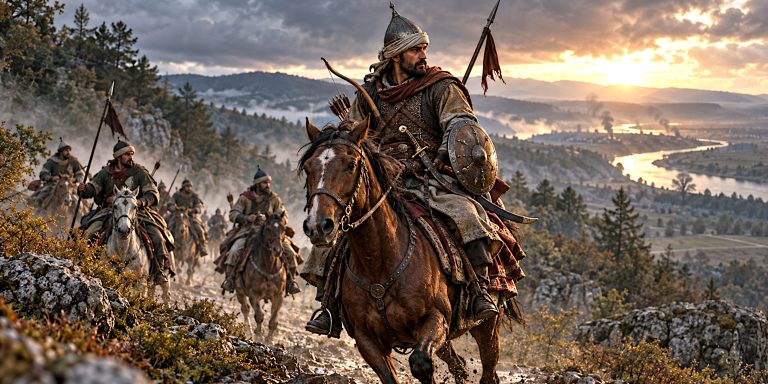
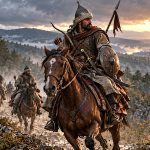
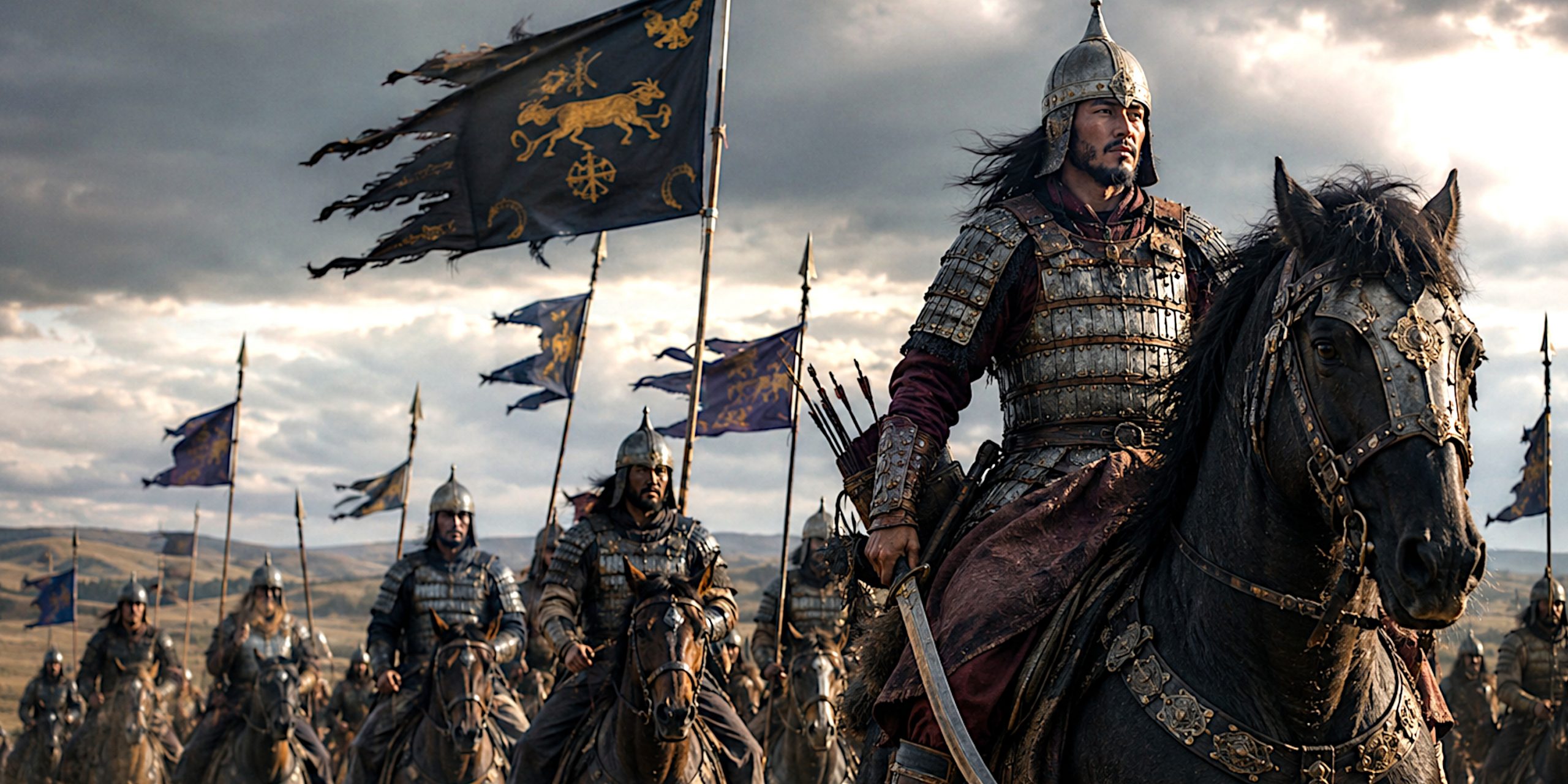
A reasonably well-equipped warrior of the eighth or ninth century might have worn a conical iron helmet and lamellar body armour over clothing suited to riding.
He could carry a composite bow in a bow case, arrows in a quiver, a spear or lance and a sabre suspended from a decorated belt.
His trousers and boots would reflect the practical demands of spending long periods on horseback.
Belt fittings could also advertise status.
His horse might carry an iron bit, stirrups and decorated harness fittings.
An elite retainer could possess significantly richer equipment, while poorer warriors probably fought with considerably less armour.
This range matters when reconstructing Khazar armies visually. Covering every rider from helmet to ankle in identical lamellar armour produces something impressive, but archaeology rarely behaves quite so conveniently.
The Legacy of Khazar Cavalry
Khazar cavalry helped sustain one of medieval Eurasia’s most important states for roughly three centuries.
Its success rested upon an effective combination of steppe mobility, mounted archery, armoured cavalry and strategic control of major routes.
The Khazars also played an important geopolitical role.
Their resistance to Arab expansion helped establish the Caucasus as a durable frontier. Their alliances affected Byzantine strategy. Their control of the Volga and Don influenced trade between northern Europe, Central Asia and the Islamic world.
Yet their cavalry should not be romanticised as an unbeatable steppe superweapon.
Khazar armies suffered serious defeats. Their territory was penetrated by Arab forces. Their political system eventually buckled under pressure from Rus’, Pechenegs and changing regional trade patterns.
What impresses me is the longevity.
Surviving on the medieval steppe was difficult enough. Building a state there that could negotiate with Constantinople, fight the Caliphate, tax international trade and dominate enormous territories for generations required a military system of considerable sophistication.
At the centre of that system was the mounted warrior, carrying the composite bow and sabre that had become signatures of warfare across Eurasia.
The Khazars did not invent steppe cavalry warfare, nor were they its final masters. They were, however, among the peoples who demonstrated just how powerful it could become when mounted warfare was backed by an organised state.