Among the absurd number of magical weapons scattered across the Forgotten Realms, Icingdeath has managed something surprisingly difficult. It feels powerful without becoming ridiculous.
This is the frost scimitar carried by Drizzt Do’Urden, usually in his right hand alongside Twinkle. It does not contain the soul of an ancient god, demand regular sacrifices or spend half the novel whispering suspicious career advice into its owner’s head. Icingdeath is simply an extremely effective magical sword with a particularly useful hatred of fire.
That relative simplicity is probably why I like it.
Icingdeath first enters Drizzt’s story through The Crystal Shard, where he discovers the weapon within the treasure hoard of the white dragon Ingeloakastimizilian. Drizzt and Wulfgar know the dragon by a considerably easier name: Icingdeath. The scimitar eventually inherits the dragon’s nickname.
For a weapon acquired comparatively early in Drizzt’s adventures, it has shown remarkable staying power.
Icingdeath at a Glance
| Detail | Icingdeath |
|---|---|
| Weapon type | Magical scimitar |
| Famous wielder | Drizzt Do’Urden |
| Typical hand | Right |
| Companion weapon | Twinkle |
| Enchantment in older rules | +3 |
| Magical type | Frost weapon / frostbrand |
| Blade | Silver with a diamond edge |
| Hilt | Black adamantite |
| Pommel | Traditionally depicted as a hunting cat’s head |
| Major ability | Protection against fire and heat |
| Found | Hoard of the white dragon Icingdeath |
| Region | Reghed Glacier, northern Faerûn |
| Acquired | 1356 DR |
The weapon is generally described in Forgotten Realms game material as a +3 scimitar possessing frost-related abilities, including the properties associated with a frostbrand.
Where Did Icingdeath Come From?
The story begins with a dragon.
During the events surrounding The Crystal Shard, Drizzt and Wulfgar travel into the frozen wilderness and confront Ingeloakastimizilian, a white dragon inhabiting the region around the Reghed Glacier.
Fortunately for readers attempting to pronounce that aloud, the dragon is better known as Icingdeath.
Drizzt and Wulfgar kill the creature, and Drizzt subsequently discovers an enchanted scimitar among its treasure. The event is dated to 1356 DR in Forgotten Realms chronology.
There is something pleasingly old-school Dungeons & Dragons about the whole arrangement.
Kill dragon. Search hoard. Find excellent sword.
No crafting menu required.
The weapon was not originally called Icingdeath when it first appeared. Although the sword appears in The Crystal Shard, the name was applied later in the Drizzt novels. The connection between dragon and weapon nevertheless became one of the most recognisable pieces of Drizzt’s equipment.
What Does Icingdeath Look Like?
The original literary description gives Icingdeath considerably more personality than some later illustrations suggest.
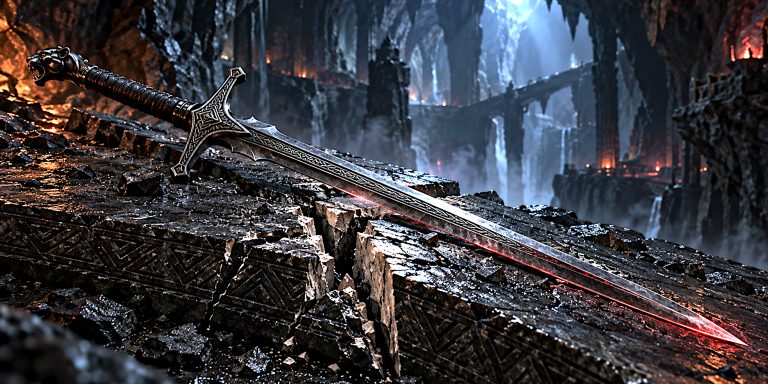
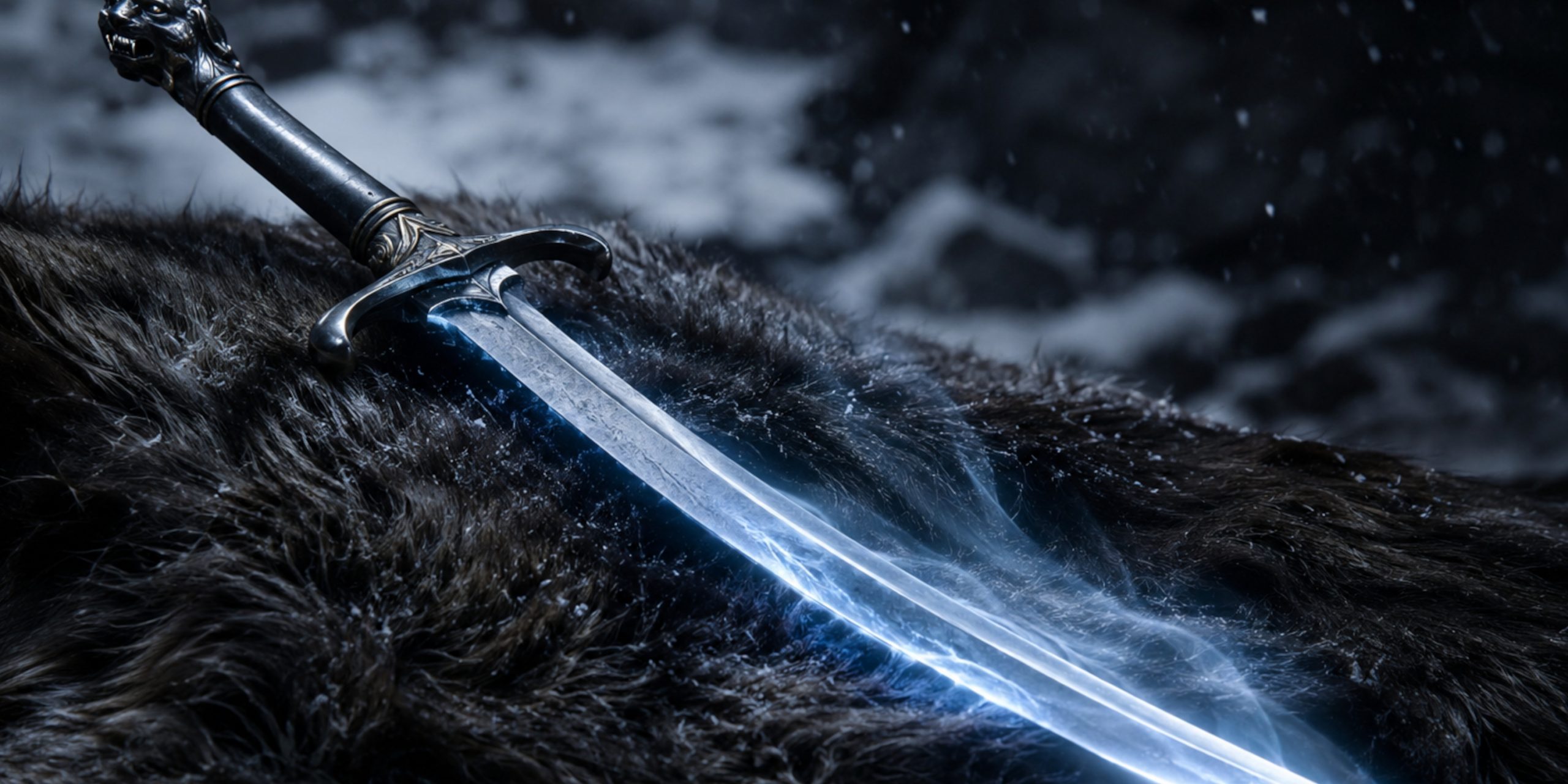
Its hilt is described as black adamantite, while the blade is silver with a diamond edge. Most distinctively, the pommel is fashioned into the head of a hunting cat.
That makes the traditional design roughly:
| Component | Description |
| Blade | Silver |
| Edge | Diamond |
| Hilt | Black adamantite |
| Pommel | Hunting cat design |
| Magical glow | Pale blue when reacting to fire |
The combination works beautifully for Drizzt. Black metal, silver blade and cold blue magical light is about as close as Forgotten Realms gets to designing a weapon specifically for fantasy cover art.
The appearance has not remained completely consistent, however. Later depictions of Drizzt’s weapons have sometimes altered the curvature and hilt design, with Icingdeath and Twinkle becoming visually more alike.
This creates a familiar fantasy problem where the “canonical” sword depends slightly on which book cover, illustration or game you happen to be looking at.
How Powerful Is Icingdeath?
Icingdeath is traditionally presented as a +3 frost scimitar, although translating weapons between different editions of Dungeons & Dragons is never completely straightforward.
Its most important characteristic is its relationship with heat.
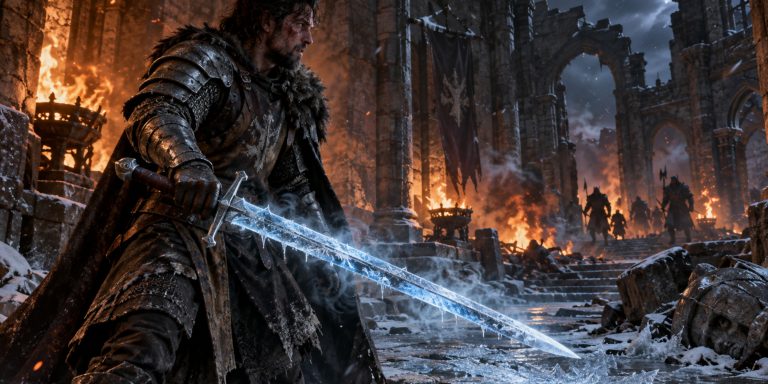
Icingdeath can absorb or counter fire and provides its wielder with significant protection against it. The blade reacts to nearby fire by producing a pale blue glow.
More impressively, its magic can interfere directly with magical flames.
During Drizzt’s encounters with the balor Errtu, Icingdeath demonstrates exactly why this matters. The sword is capable of extinguishing part of a magical wall of fire. It later counters other powerful fire magic, including a fireball cast by Valindra Shadowmantle.
That is where Icingdeath becomes much more interesting than “sword that does cold damage”.
For Drizzt, resistance to fire can fundamentally alter an encounter.
Icingdeath as a Frostbrand
Icingdeath belongs broadly to the Dungeons & Dragons tradition of frostbrand weapons, magical swords associated with cold and resistance to fire.
The modern legacy rules for a standard Frost Brand give a wielder additional cold damage while providing resistance to fire damage. Frost Brand weapons can also extinguish nearby non-magical flames when drawn.
Icingdeath’s portrayal in the novels and older Forgotten Realms material is more distinctive than simply applying the current generic Frost Brand statistics to a scimitar.
That distinction matters.
D&D statistics change between editions. Fictional events remain part of the character’s narrative history. Treating every description of Icingdeath as though it were one perfectly consistent tabletop stat block tends to create more confusion than clarity.
Conceptually, though, the weapon is easy to understand:
Icingdeath is a magically enhanced scimitar built around cold and protection from fire.
And it is very, very good at that job.
Why Fire Resistance Matters So Much
At first glance, resistance to fire sounds less exciting than some of the more extravagant powers attached to legendary Forgotten Realms weapons.
Then you remember what lives in the Forgotten Realms.
Dragons.
Demons.
Wizards.
Elementals.
More dragons.
Probably another wizard.
Fire is one of the setting’s most common supernatural threats. A weapon that simultaneously functions as an excellent melee blade and protects its wielder from heat has enormous practical value.
This becomes particularly significant against Errtu.
A balor is exactly the sort of creature against which Icingdeath should excel. Drizzt is not simply carrying a sharp piece of magical metal into those encounters. He has a weapon whose properties directly counter one of his opponent’s defining strengths.
It is basically the fantasy equivalent of discovering your boss fight has an elemental weakness and realising you accidentally equipped the correct build.
Icingdeath and Errtu
The encounters between Drizzt and Errtu demonstrate Icingdeath at its most narratively useful.
Errtu is a balor, a powerful fiend strongly associated with flame. Against such an opponent, ordinary weapons and conventional defences become considerably less reassuring.
Icingdeath gives Drizzt another option.
Its frostbrand properties allow it to absorb heat and combat supernatural flame, including interfering with Errtu’s magical fire.
This is important because the sword’s power does not merely make Drizzt numerically stronger. It changes what he can survive.
That is good magical weapon design.
The best fantasy weapons create tactical possibilities rather than simply adding increasingly silly numbers to damage rolls.
Icingdeath and Twinkle
You cannot really discuss Icingdeath without eventually getting to Twinkle.
Drizzt’s fighting style is strongly associated with dual-wielding scimitars, with Icingdeath normally occupying his right hand and Twinkle his left.
Despite being visually and culturally linked, the two weapons fulfil somewhat different roles.
| Icingdeath | Twinkle |
| Primarily associated with Drizzt’s right hand | Primarily associated with his left |
| Frost-based magic | Defensive magic |
| Counters fire | Enhances defence |
| Found in a dragon’s hoard | Given to Drizzt by Malchor Harpell |
| Traditionally a +3 frost scimitar | Described differently across rules sources |
| Aggressive and protective properties | Particularly suited to defensive fighting |
Twinkle was forged by elves and eventually given to Drizzt by Malchor Harpell. Its magical properties are particularly suited to defence.
Together the swords complement Drizzt’s fighting style remarkably well.
One helps him survive elemental attacks while delivering magically enhanced strikes. The other supports his ability to parry and defend.
That feels much more deliberate than simply giving the protagonist two identical legendary weapons.
Why Does Drizzt Use Scimitars?
The scimitar is central to Drizzt’s visual identity.
Within D&D rules, scimitars have generally favoured speed and finesse over the heavier impact associated with weapons such as greatswords. Forgotten Realms material similarly characterises them as specialised martial weapons requiring considerable skill.
That fits Drizzt perfectly.
He is not primarily portrayed as a fighter who wins through brute strength. His combat style revolves around speed, positioning, coordination and an almost absurd degree of technical proficiency.
Dual scimitars reinforce that identity immediately.
Give Drizzt a giant two-handed sword and he starts looking like an entirely different fantasy protagonist.
Give him Icingdeath and Twinkle and there is basically no mistaking the silhouette.
Icingdeath in Baldur’s Gate
Icingdeath also appears in the Baldur’s Gate games as part of Drizzt’s equipment.
In Baldur’s Gate II: Shadows of Amn, the weapon appears as Icingdeath +3, a Frostbrand scimitar providing substantial resistance to fire.
There is, naturally, a slightly awkward issue.
Players can acquire it.
Doing so traditionally involves killing Drizzt or otherwise separating him from his possessions, which is the sort of behaviour RPG players perform before immediately insisting their character is “chaotic good”.
Mechanically, though, the weapon’s appearance helped establish Icingdeath outside the novels. For many players, the games were their introduction to Drizzt and his famous paired scimitars.
Is Icingdeath Sentient?
There is no strong basis for treating Icingdeath as a sentient weapon in the same sense as some other famous Forgotten Realms blades.
That distinction is useful because Forgotten Realms has plenty of magical swords with personalities, motives and occasionally deeply questionable opinions.
Icingdeath’s identity comes from its powers, appearance, history and association with Drizzt rather than from an independent consciousness.
Personally, I think that helps.
Drizzt already has enough complicated relationships without needing to argue with his sword.
How Does Icingdeath Compare With Other Famous Forgotten Realms Swords?
The Realms contains some frankly outrageous magical weapons.
| Weapon | Famous wielder | Defining quality |
| Icingdeath | Drizzt Do’Urden | Frost and fire resistance |
| Twinkle | Drizzt Do’Urden | Defensive magic |
| Khazid’hea | Catti-brie and others | Powerful sentient weapon |
| Moonblades | Elven nobility | Ancient elven magical blades |
| Carsomyr | Baldur’s Gate II protagonist | Holy Avenger |
| Silver Sword of Gith | Githyanki | Powerful planar weapon |
Icingdeath is not necessarily the most powerful sword in Forgotten Realms history.
That almost makes it better.
It operates at a scale where its abilities remain understandable. You immediately know why Drizzt wants it and why an enemy relying on fire should be concerned.
There is elegance in that.
Is Icingdeath Drizzt’s Best Weapon?
This depends on what “best” means.
Twinkle has formidable defensive qualities and becomes enormously important to Drizzt’s fighting style. Other weapons and magical equipment acquired throughout his long career complicate any attempt to create a simple ranking.
But Icingdeath might be his most practical weapon.
A +3 magical scimitar is already excellent. Add frost-related offensive properties, protection from heat and the ability to interfere with magical fire and you have something useful against an unusually broad range of enemies.
More importantly, its powers do not replace Drizzt’s skill.
They complement it.
That distinction has helped prevent Icingdeath from becoming a narrative shortcut. Drizzt remains dangerous because he is an extraordinary swordsman. Icingdeath simply gives that swordsman a very nasty tool.
Why Icingdeath Remains One of the Best Forgotten Realms Weapons
Icingdeath works because its history, appearance and powers all make sense together.
It comes from the hoard of a white dragon.
It carries the dragon’s nickname.
Its magic revolves around frost.
Its pale blue glow reacts to fire.
Its most famous wielder repeatedly fights creatures for whom fire is a major weapon.
Nothing feels particularly random.
There is also a nice irony to Drizzt carrying it. A drow who rejected the brutal culture of the Underdark eventually builds his identity on the surface partly around a sword taken from a dragon’s frozen hoard. The weapon becomes associated with the life Drizzt chooses rather than the one into which he was born.
And unlike some legendary fantasy weapons, Icingdeath never needs to dominate the character holding it.
It is recognisable because Drizzt carries Icingdeath, rather than Drizzt becoming merely the bloke who happens to own Icingdeath.
For me, that is the sweet spot for a fictional sword. Distinctive enough that fans immediately recognise the name, powerful enough to matter, but never so important that the character disappears behind the item description.
Also, naming your frost sword after the dragon whose treasure pile you stole it from is objectively excellent adventurer behaviour.