The Tudors has a wonderfully casual relationship with historical accuracy.
Henry VIII remains suspiciously handsome. Several historical people are merged together. Years pass with barely a wrinkle appearing on anyone’s face. Politics is regularly interrupted because somebody has apparently misplaced their doublet.
And yet, nearly two decades after the series first appeared, I still think it is one of the most entertaining attempts to put Henry VIII’s court on television.
Created by Michael Hirst and broadcast between 2007 and 2010, The Tudors covers Henry’s reign across four seasons and 38 episodes. Jonathan Rhys Meyers plays Henry as young, charismatic, sexually voracious and increasingly dangerous, while Natalie Dormer’s Anne Boleyn became arguably the defining performance of the entire series.
It is emphatically not a documentary. Sometimes it barely seems interested in pretending to be one. But underneath the compressed timelines and suspiciously photogenic courtiers, there is quite a lot of genuine Tudor history.
So how accurate is The Tudors, what did it get completely wrong, and is it still worth watching?
The Tudors at a Glance

| Detail | The Tudors |
|---|---|
| Creator | Michael Hirst |
| Original run | 2007 to 2010 |
| Seasons | 4 |
| Episodes | 38 |
| Central figure | Henry VIII |
| Henry VIII | Jonathan Rhys Meyers |
| Anne Boleyn | Natalie Dormer |
| Catherine of Aragon | Maria Doyle Kennedy |
| Cardinal Wolsey | Sam Neill |
| Thomas Cromwell | James Frain |
| Charles Brandon | Henry Cavill |
| Historical accuracy | Mixed |
| Entertainment value | Extremely high if you accept the chaos |
The series follows Henry from the energetic king of his early reign through the political and religious upheavals surrounding his marriages, the English Reformation and eventually his physical and psychological decline.
That basic framework is historical. The journey between those points is considerably more adventurous.
Is The Tudors Historically Accurate?
The shortest useful answer is: sometimes surprisingly accurate, sometimes spectacularly wrong.
The major events are generally recognisable. Henry marries Catherine of Aragon. His failure to produce a surviving legitimate son destabilises the marriage. Anne Boleyn rises. Henry challenges papal authority. Thomas Cromwell becomes enormously powerful. Anne falls. Jane Seymour produces Edward. Cromwell eventually discovers that being Henry VIII’s indispensable servant is a remarkably temporary occupation.
But the writers regularly compress chronology, combine characters, invent relationships and alter circumstances.
That matters if you are using the series to learn Tudor history.
It matters considerably less if you are watching Natalie Dormer verbally dismantle half the royal court.
What The Tudors Gets Right
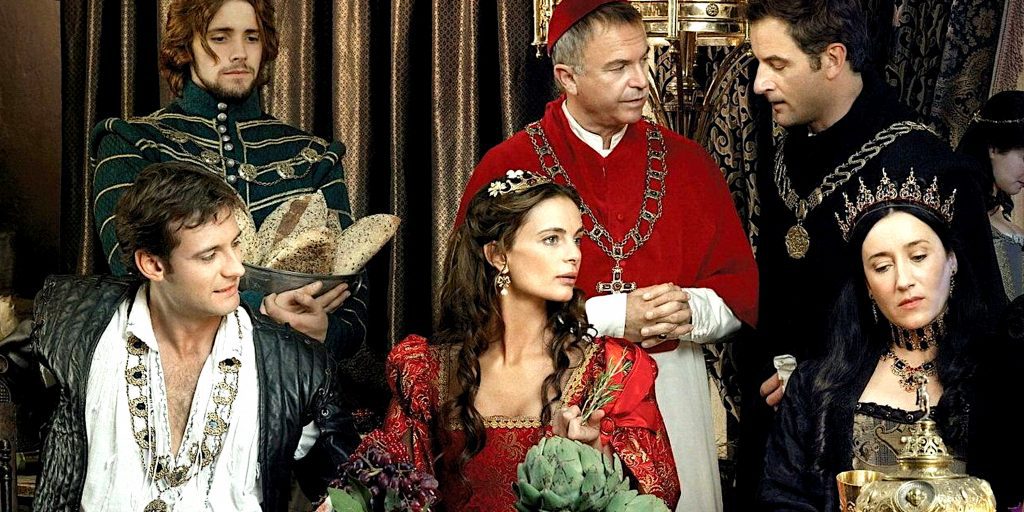
For all its liberties, the programme understands something important about Henry VIII’s reign: politics was intensely personal.
Marriage, religion, diplomacy, inheritance and factional rivalry were intertwined. A disagreement over Henry’s marriage could become a theological argument, which could become a constitutional crisis, which could end with someone’s head being separated from the rest of them.
That escalation is very Tudor.
Henry VIII Was Once Young and Athletic
Popular culture has made the later Henry so dominant that it is easy to forget the king did not emerge into adulthood looking like the Holbein portrait.
Young Henry was tall, athletic, musical and enthusiastic about hunting, jousting and courtly display. He was also extremely conscious of his image.
Jonathan Rhys Meyers is hardly a physical reconstruction of Henry VIII, but portraying the younger king as energetic and attractive is not itself historically absurd.
The problem comes later.
The real Henry’s physical deterioration became severe. The series acknowledges this through ageing, injury and changing temperament, but Rhys Meyers never approaches the enormous physical bulk associated with Henry’s final years.
Apparently even historical drama has limits.
Natalie Dormer’s Anne Boleyn Is the Real Star
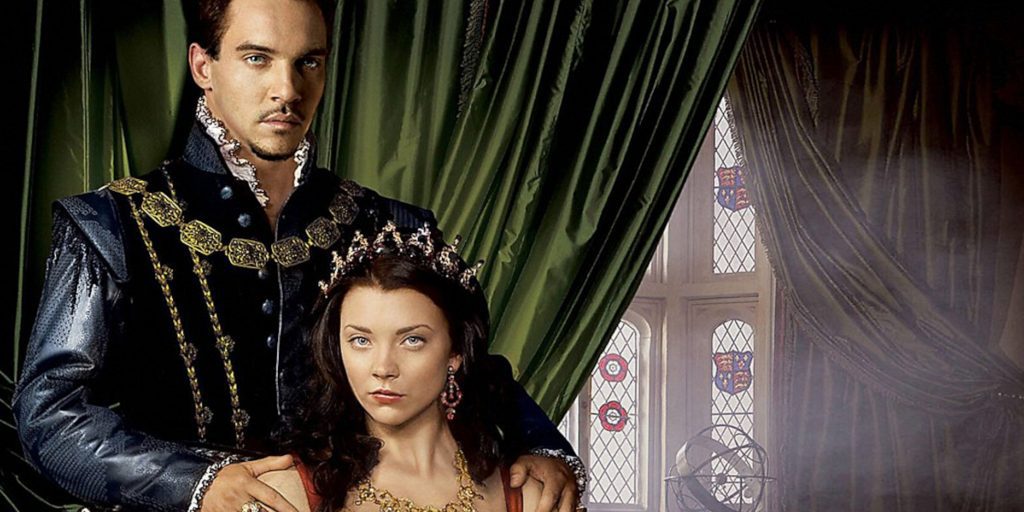
If one performance explains why The Tudors remains memorable, it is Natalie Dormer’s Anne Boleyn.
Her Anne is intelligent, ambitious, manipulative, frightened and occasionally cruel. More importantly, she feels politically aware.
That matters because Anne has often been reduced to either seductress or victim. The historical woman was considerably more interesting.
Anne spent years at European courts and developed sophisticated religious and cultural interests. She was involved in reformist networks and understood how patronage worked. Her relationship with Henry cannot simply be explained as a particularly elaborate attempt at flirting.
Dormer’s performance occasionally leans into modern characterisation, but it restores something valuable to Anne: agency.
Her downfall in the second season remains one of the strongest sections of the entire series.
Catherine of Aragon Deserved Better Than History Usually Gives Her
Maria Doyle Kennedy’s Catherine of Aragon is another highlight.
Catherine is sometimes treated as an obstacle standing between Henry and Anne. Historically, she was a formidable political figure in her own right.
She had been raised within the extraordinary court of Ferdinand II of Aragon and Isabella I of Castile. As Henry’s queen she acted as regent in 1513 while he campaigned in France, during which English forces defeated the Scots at Flodden.
The series captures her dignity, religious conviction and refusal to quietly accept Henry’s attempt to end their marriage.
Her appearance is less accurate. Catherine probably had fair skin, blue eyes and reddish-gold hair rather than the darker Spanish stereotype television audiences might expect.
Her personality matters rather more.
The Biggest Historical Mistakes in The Tudors
This is where things become entertaining.
Some alterations are understandable television shortcuts. Others make you wonder whether the historical record briefly offended the writers personally.
Henry VIII’s Sisters Get Merged Together
One of the strangest changes involves Henry’s sisters.
The real Henry VIII had two sisters, Margaret Tudor and Mary Tudor.
Margaret married James IV of Scotland. Mary married Louis XII of France and subsequently Charles Brandon, Duke of Suffolk.
The series effectively combines elements of the two women into a single character called Margaret.
She is then married to the fictional King of Portugal before becoming involved with Brandon.
Historically, Mary Tudor married Louis XII of France in 1514 and later secretly married Charles Brandon.
The real story already contained royalty, forbidden romance and an angry Henry VIII. Television somehow decided this required additional assistance.
The Timeline Is Heavily Compressed
This is probably the most important thing to understand when watching The Tudors.
Events that actually unfolded over years can appear almost simultaneous.
Characters meet earlier than they should. Political developments are shifted around. Historical figures appear at convenient moments because the narrative needs them.
Eustace Chapuys, for example, appears earlier in the series than his historical arrival in England warrants.
For drama, this works.
For chronology, absolutely do not revise for an exam using this programme.
Cardinal Wolsey’s Death Was Changed
Sam Neill gives Cardinal Thomas Wolsey considerable presence, and Wolsey’s collapse is broadly rooted in real events.
But his death is substantially altered.
The series has Wolsey take his own life.
Historically, Wolsey died at Leicester Abbey in November 1530 while travelling south to face accusations of treason.
His reported final reflections on serving Henry have become famous, although their precise wording comes through later accounts.
Suicide gives the television version a more dramatic conclusion. It also changes the historical character of Wolsey’s final days quite considerably.
Thomas Cromwell Was More Complicated Than the Show Suggests
James Frain’s Cromwell is clever, intimidating and increasingly ruthless.
None of that is entirely unfair.
Cromwell played a central role in the political and administrative transformation accompanying Henry’s break with Rome. He helped reshape royal government, oversaw major religious changes and accumulated considerable power.
But reducing him to Henry’s sinister political fixer misses part of what makes the historical Cromwell fascinating.
He was an administrator, reformer, patron and political survivor operating within an exceptionally dangerous court.
Until, of course, he stopped surviving.
His disastrous promotion of Henry’s marriage to Anne of Cleves contributed to his fall, and Cromwell was executed in 1540.
The king later reportedly regretted losing him.
A little late, Thomas.
Anne of Cleves Was Not the Disaster Television Loves
The Anne of Cleves episode has become one of the great stories of Henry VIII’s marriages.
Henry supposedly disliked her appearance, the marriage failed almost immediately and Anne was quietly removed.
The reality is more complicated.
Henry certainly rejected the marriage, but the famous idea that Anne was exceptionally unattractive is difficult to support. Political circumstances surrounding the match changed rapidly, while Henry’s own expectations played a major part in the debacle.
Anne handled the annulment intelligently.
She accepted Henry’s terms, received property and status, and remained in England as the king’s honorary “sister”.
She outlived Henry and every one of his other wives except Catherine Parr.
In Tudor terms, that counts as an absolutely spectacular result.
Henry Cavill’s Charles Brandon Versus the Real Man
Charles Brandon is one of the series’ longest-running characters, played by Henry Cavill.
The historical Brandon genuinely was unusually close to Henry VIII and enjoyed a remarkable ability to survive the political storms around the king.
His secret marriage to Henry’s sister Mary could have destroyed him. Instead, he remained one of Henry’s closest companions.
The programme exaggerates and invents parts of Brandon’s romantic and political life, but the central idea of a handsome courtier maintaining a remarkably durable friendship with Henry has historical foundations.
And yes, casting Henry Cavill probably helped.
The Swords and Weapons of The Tudors
This is where the series becomes particularly interesting from a Seven Swords perspective.
The sixteenth century was a transitional period in European arms. Medieval sword traditions had not disappeared, but weapons were becoming increasingly specialised for civilian status, duelling and military use.
Rapiers and Sidearms
The series frequently shows ornate swords worn at court.
That is broadly appropriate. Carrying a sword could signify status as much as provide a practical weapon.
However, the fully developed rapier is more strongly associated with the later sixteenth and seventeenth centuries. Early Tudor swords could feature increasingly elaborate guards and thrust-oriented designs, but viewers should be wary of treating every slender television sword as a perfect representation of Henry VIII’s court.
Military Swords
Soldiers continued to use robust single-handed swords alongside polearms, bows and increasingly important firearms.
The sword remained a useful sidearm rather than the dominant battlefield weapon television sometimes encourages us to imagine.
The Executioner’s Sword
One of the most memorable blades in The Tudors appears during Anne Boleyn’s execution.
This detail has genuine historical foundations.
Anne was executed on 19 May 1536 by a swordsman brought from Calais rather than by the more conventional English executioner’s axe.
It was an unusual concession.
The series handles the scene with surprising restraint, which makes it considerably more disturbing.
How Accurate Are the Costumes?
Visually, The Tudors is gorgeous.
Historically, things get complicated.
The costumes borrow heavily from Tudor fashions but frequently adjust silhouettes, fabrics and styling for modern visual appeal. Women’s clothing in particular can feel considerably more revealing than contemporary portraits suggest.
Yet the production understands the importance of clothing at court.
Tudor dress communicated wealth, hierarchy and proximity to power. Expensive fabrics, jewels and elaborate clothing were political statements.
The programme exaggerates the fashion.
It correctly understands why fashion mattered.
Which Season of The Tudors Is Best?
For me, Season 2 is comfortably the strongest.
Anne Boleyn’s position becomes increasingly precarious, Henry becomes more dangerous and the political manoeuvring surrounding religion and succession finally collides with the personal drama.
Natalie Dormer is exceptional throughout the final episodes.
The season also benefits from something later instalments cannot replicate: we know exactly what is coming.
Anne does not.
That creates a horrible tension around scenes that might otherwise seem mundane.
The later seasons remain entertaining, particularly as Henry’s court becomes darker and less stable, but Anne’s rise and destruction is where the series finds its identity.
The Six Wives in The Tudors
| Wife | Actress | Historical fate | Series portrayal |
| Catherine of Aragon | Maria Doyle Kennedy | Marriage annulled, died 1536 | Strong and sympathetic |
| Anne Boleyn | Natalie Dormer | Executed 1536 | Outstanding |
| Jane Seymour | Annabelle Wallis | Died after childbirth, 1537 | Gentle and idealised |
| Anne of Cleves | Joss Stone | Marriage annulled | Comic but sympathetic |
| Catherine Howard | Tamzin Merchant | Executed 1542 | Young and tragic |
| Catherine Parr | Joely Richardson | Survived Henry | Intelligent and mature |
One of the pleasures of rewatching the series is seeing how Henry changes around each marriage.
Initially he appears to pursue women.
Eventually marriage itself begins to look dangerous for everyone involved.
Why The Tudors Still Works
Historical dramas have become considerably more sophisticated since 2007.
Wolf Hall offers a subtler political world. Other modern productions have experimented more aggressively with perspective, casting and the traditional interpretation of Tudor personalities.
Yet The Tudors still has something many technically better historical dramas lack.
Momentum.
Almost every episode contains a marriage negotiation, betrayal, execution, religious crisis, affair or magnificently uncomfortable royal dinner.
It turns Tudor politics into prestige television without completely losing sight of the real historical events underneath.
Sometimes the historical inaccuracies are irritating.
Sometimes they are fascinating because they make you want to find out what actually happened.
For a history series, that is not the worst crime imaginable.
Is The Tudors Worth Watching Today?
Yes, with one condition.
Watch it as historical drama rather than history.
The broad story of Henry VIII is present. Many characters are based on genuine people and some episodes reproduce the atmosphere of Tudor politics extremely well.
But timelines are compressed, characters are merged and personal relationships are routinely invented or simplified.
If something seems particularly outrageous, look it up.
There is a roughly equal chance that the writers invented it or that Tudor history genuinely was that ridiculous.
The Seven Swords Verdict
Historical accuracy: 6/10
Casting: 9/10
Costumes and atmosphere: 9/10
Weapons: 7/10
Political intrigue: 9/10
Ability to make you suddenly spend two hours reading about Anne Boleyn: 10/10
The Tudors should never be mistaken for a faithful reconstruction of Henry VIII’s reign. It changes too many people, dates and events for that.
But dismissing it because of those inaccuracies misses why the programme worked.
Michael Hirst took a political and religious crisis from five centuries ago and made it feel immediate, dangerous and weirdly addictive. Natalie Dormer’s Anne Boleyn remains superb, Maria Doyle Kennedy gives Catherine of Aragon the dignity she deserves, and Jonathan Rhys Meyers makes Henry’s progression from charismatic prince to terrifying monarch compelling even when he looks approximately twenty years too healthy.
The history occasionally needs correcting.
The television rarely needs rescuing.
And honestly, for a series in which half the cast spends four seasons desperately trying not to annoy Henry VIII, survival itself feels like a pretty satisfying character arc.