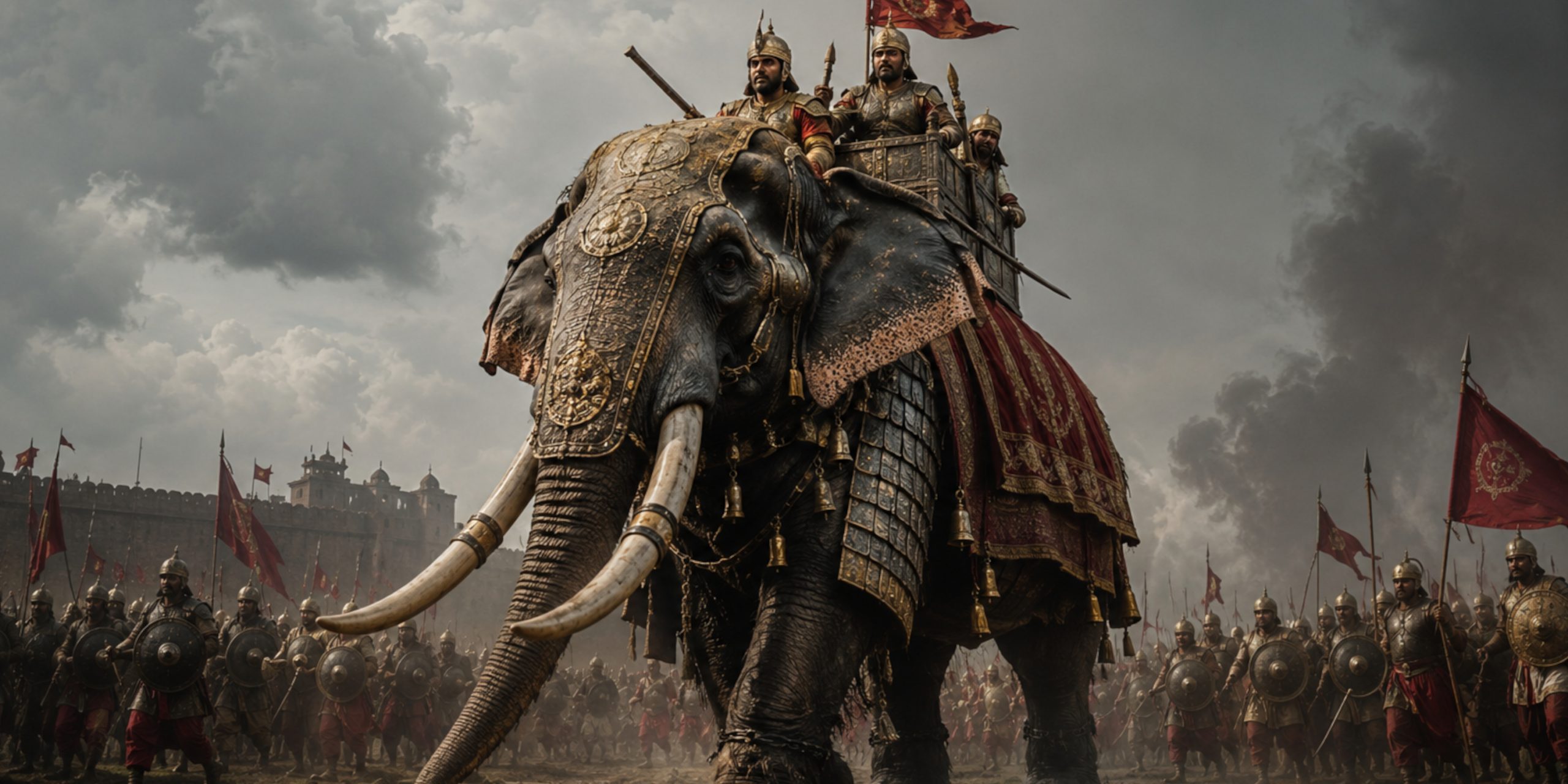
Few military animals have captured the imagination quite like the Indian war elephant. Horses could charge, camels could endure deserts and chariots could impress aristocrats, yet nothing inspired quite the same mixture of admiration and absolute panic as several tonnes of armoured elephant advancing through clouds of dust.
For over two thousand years, Indian rulers invested enormous resources into breeding, capturing, training and maintaining elephants for war. They became symbols of royal authority, mobile command platforms, living battering rams and psychological weapons capable of deciding battles before swords had even crossed.
Like many famous military technologies, however, their reputation sometimes exceeds their practical performance. War elephants were spectacular, but they were also expensive, unpredictable and vulnerable to disciplined enemies. History remembers their victories. It sometimes forgets the occasions when they caused chaos among their own side.
This is the story of one of history’s most extraordinary weapons.
Origins of War Elephants in India
The military use of elephants appears in India during the early first millennium BC, although the precise date remains debated. By the time of the great kingdoms known as the Mahajanapadas, elephants had become an established part of organised armies.
India possessed one enormous advantage over much of the ancient world.
It had access to the Asian elephant (Elephas maximus), particularly the Indian subspecies. These animals were intelligent, comparatively trainable and widespread across forests stretching from the foothills of the Himalayas into central and eastern India.
Unlike African forest elephants, Indian elephants could be trained on a large scale.
Rather than breeding elephants extensively in captivity, rulers generally captured wild adults before beginning years of careful training.
By the time the Mauryan Empire emerged in the fourth century BC, war elephants had become one of the defining features of Indian military power.
The Elephant Corps
Ancient Indian armies often divided their forces into four principal arms.
| Corps | Role |
|---|---|
| Infantry | Main fighting force |
| Cavalry | Mobility and pursuit |
| Chariots | Elite transport and missile platform |
| Elephants | Shock troops and command platforms |
This became known as the Chaturanga, literally “the four divisions.”
Interestingly, the modern word “chess” ultimately derives from this military concept. The elephant piece survives in several eastern versions of the game, even if it later transformed into the bishop in European chess. It is a pleasing reminder that military organisation occasionally finds unlikely afterlives.
Capturing and Training Elephants
Training a war elephant required patience measured in years rather than months.
Specialist handlers known as mahouts developed lifelong relationships with individual animals.
Training included:
- responding to spoken commands
- ignoring battlefield noise
- advancing into missile fire
- trampling obstacles
- pushing fortifications
- resisting panic
- carrying multiple warriors
Young elephants learned discipline gradually before progressing to increasingly realistic military exercises.
A calm temperament mattered just as much as physical size.
The largest elephant was not necessarily the best soldier.
The Bond Between Elephant and Mahout
The mahout occupied one of the most dangerous positions in any ancient army.
He sat directly behind the elephant’s head, controlling movement with voice commands, feet, pressure and a hooked implement called an ankusha.
Ancient manuals emphasise mutual trust rather than brute force.
An experienced elephant often responded to subtle commands almost instinctively.
Many remained paired with the same handler for decades.
If an elephant became uncontrollable during battle, some traditions describe the mahout carrying a hammer and chisel or dagger to kill the animal quickly rather than allow it to rampage through friendly troops. Whether this occurred frequently remains uncertain, although several literary sources mention the practice.
It was an unpleasant responsibility, but preferable to watching one’s own army flattened.
The Mauryan Empire and the Greatest Elephant Army
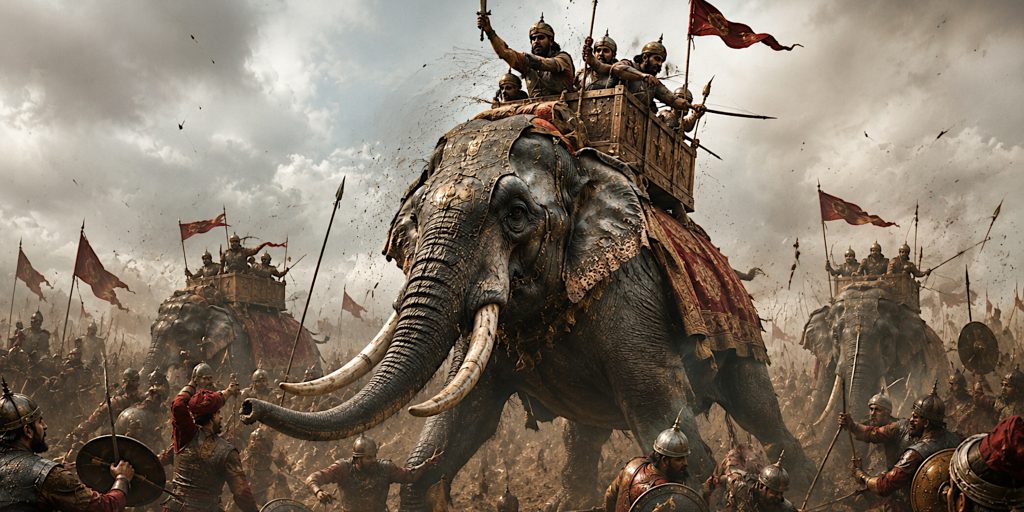
No state employed war elephants more effectively than the Mauryan Empire.
Founded by Chandragupta Maurya around 322 BC, the empire controlled enormous territories across the Indian subcontinent.
Greek writers describe astonishing numbers.
According to ancient estimates, the Mauryan military possessed approximately:
- 600,000 infantry
- 30,000 cavalry
- 8,000 chariots
- 9,000 war elephants
These figures may contain exaggeration, yet even conservative estimates indicate that the Mauryans fielded the largest organised elephant corps in history.
The state maintained forests specifically reserved for elephant capture and management.
Officials oversaw breeding grounds, training establishments and veterinary care.
The elephant had become an institution rather than simply another battlefield asset.
Seleucus, Chandragupta and the Elephant Exchange
One of history’s most significant diplomatic agreements involved elephants.
Following the fragmentation of Alexander the Great’s empire, Seleucus I Nicator invaded north western India.
Rather than continuing an expensive conflict, Seleucus negotiated peace with Chandragupta Maurya.
The agreement reportedly included the transfer of 500 trained war elephants.
Those elephants later helped Seleucus achieve victory at the Battle of Ipsus in 301 BC, where they played a decisive role in blocking enemy cavalry.
Indian military expertise therefore reshaped warfare far beyond the subcontinent.
Battlefield Tactics
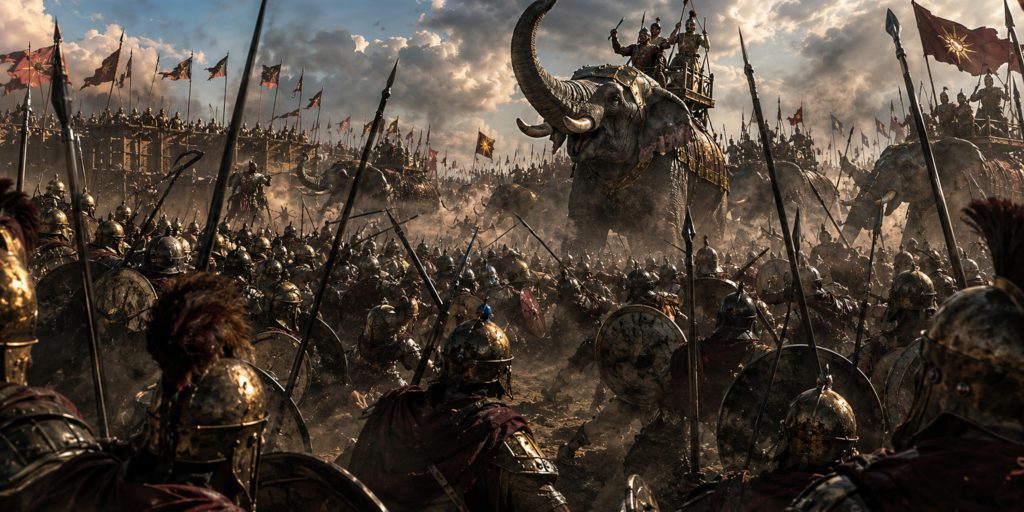
War elephants fulfilled several important battlefield roles.
Shock Assault
Their enormous size could break infantry formations through physical impact and fear.
Command Platforms
Generals frequently directed battles from elephant backs, enjoying exceptional visibility across the battlefield.
Cavalry Counter
Many horses hesitated when approaching elephants because of their unfamiliar smell, size and movement.
Missile Platforms
Archers and javelin throwers standing atop elephants could fire over friendly troops.
Siege Operations
Elephants pushed gates, hauled siege equipment and transported heavy supplies.
Arms and Armour
War elephants rarely fought alone.
Each formed a mobile fighting platform carrying multiple soldiers.
Weapons Carried by Elephant Crews
Archers commonly used:
- long bamboo bows
- composite bows
- cane bows
Missile weapons included:
- javelins
- throwing spears
- heavy darts
Close combat weapons varied according to period.
These included:
- Khanda, the broad double edged straight sword that became one of India’s most recognisable military weapons
- Asi, one of the earliest swords described in Indian literature
- Talwar, the curved sabre that became widespread in the medieval period
- straight iron swords of regional manufacture
- spears
- battle axes
- maces
The crew usually consisted of:
- one mahout
- two to four fighting soldiers
Elephant Armour
Not every elephant wore armour.
Protection depended upon wealth, period and intended role.
Armour could include:
- quilted cloth coverings
- leather protection
- bronze face plates
- iron forehead armour
- chainmail draped across the body
- reinforced tusk blades
- decorative headpieces displaying royal insignia
Some later medieval Indian elephants wore remarkably sophisticated armour protecting almost the entire animal.
Famous Battles
Battle of the Hydaspes (326 BC)
Alexander the Great faced King Porus beside the Hydaspes River.
Porus deployed around two hundred elephants across his battle line.
Although Alexander ultimately won, Greek sources describe the elephants causing severe casualties and considerable disruption.
Many Macedonian soldiers had never encountered such animals before.
Battle of Ipsus (301 BC)
Indian elephants supplied by Chandragupta Maurya allowed Seleucus to isolate enemy cavalry, helping determine the outcome of one of the Successor Wars.
Battle of Kalinga (261 BC)
The Mauryan invasion of Kalinga likely featured large numbers of elephants.
The immense bloodshed profoundly affected Emperor Ashoka, whose subsequent embrace of Buddhism transformed Indian history.
Medieval Indian Warfare
Elephants continued appearing in conflicts involving:
- the Delhi Sultanate
- Rajput kingdoms
- the Vijayanagara Empire
- the Mughal Empire
Even after gunpowder became widespread, elephants retained important command and ceremonial roles.
Strengths
War elephants possessed remarkable battlefield advantages.
- immense psychological effect
- exceptional height
- devastating physical power
- ability to carry multiple warriors
- effective obstacle clearing
- prestige for rulers
- logistical hauling capability
Few ancient weapons could match their ability to dominate the battlefield visually.
Sometimes appearance alone achieved part of the objective.
Weaknesses
Their disadvantages proved equally significant.
- expensive maintenance
- enormous food requirements
- vulnerability to missiles
- susceptibility to panic
- limited endurance during prolonged combat
- difficult transport
- unpredictable behaviour when wounded
As armies became more disciplined, elephant charges became easier to contain.
Firearms accelerated this decline.
Archaeology
Archaeological evidence confirms the extensive military use of elephants across India.
Important discoveries include:
Elephant Armour
Fragments of iron and bronze armour have been recovered from medieval Indian sites, demonstrating that protective equipment extended beyond literary descriptions.
Sculptures
Temple reliefs at sites including Sanchi, Bharhut and later medieval complexes depict elephants carrying warriors, banners and royal commanders.
These carvings provide valuable evidence for equipment, harnesses and crew arrangements.
Coins
Several Indian dynasties struck coins featuring elephants.
These images reinforced royal authority while celebrating military strength.
Inscriptions
Royal inscriptions frequently mention elephant corps, victories involving elephants and officials responsible for their management.
Ancient Manuals
The Arthashastra, traditionally attributed to Kautilya, contains extensive discussions concerning elephant administration, forests, veterinary care and military deployment.
Few ancient military treatises devote such detailed attention to animal management.
Contemporary Accounts
Greek observers left some of the most vivid descriptions.
The historian Arrian wrote:
“The elephants threw the Macedonians into confusion.”
Although writing centuries later using earlier sources, his account reflects the psychological shock experienced by Alexander’s army.
The ambassador Megasthenes observed Mauryan India and remarked:
“The elephant is the largest and strongest of animals.”
His writings describe state management of elephant forests and the importance attached to these animals within the Mauryan military.
The Arthashastra also states:
“The strength of the army depends upon elephants.”
Whether entirely literal or somewhat rhetorical, the statement captures their prestige in ancient Indian warfare.
Decline of the War Elephant
Gunpowder gradually transformed military realities.
Cannons frightened elephants.
Muskets wounded them from increasing distances.
Field artillery proved particularly dangerous.
By the eighteenth century, elephants remained valuable for:
- transporting artillery
- carrying commanders
- engineering work
- ceremonial duties
- logistics
Their role as battlefield shock troops had effectively ended.
Technology had finally caught up with one of history’s oldest military giants.
Legacy
Indian war elephants influenced military thinking across Asia, the Middle East and the Mediterranean.
Persian kings adopted them.
Successor kingdoms of Alexander prized them.
Carthage famously employed elephants, although usually North African species rather than Indian animals.
Within India, elephants became enduring symbols of kingship, courage and imperial authority.
Their image survives in sculpture, literature, religion and folklore.
Studying them also reminds us that military history is rarely a story of machines alone. Ancient warfare depended just as heavily upon relationships between humans and animals. The mahout and his elephant formed a partnership unlike anything else on the battlefield. Success depended upon trust every bit as much as strength.
Standing before an advancing war elephant must have been unforgettable. One suspects that after surviving such an experience, arguing about whose spear was longer suddenly felt like a rather trivial conversation.
Frequently Asked Questions
How large were Indian war elephants?
Adult males typically stood between 2.5 and 3.5 metres at the shoulder and weighed between 3,000 and 5,500 kilograms.
Did Indian war elephants carry towers?
Some did. Others carried warriors seated directly on padded platforms or cloth saddles. Artistic evidence suggests both methods were used.
Were elephants effective against cavalry?
Often yes. Many horses hesitated when approaching elephants, giving elephant corps an important tactical advantage.
Why did war elephants disappear?
The spread of firearms and artillery made them increasingly vulnerable while reducing their effectiveness as shock troops.
Which empire had the largest elephant corps?
The Mauryan Empire almost certainly maintained the largest organised military elephant force in recorded history, with ancient sources claiming around 9,000 trained war elephants.