Some fantasy swords are legendary because they are impossibly powerful. Others become famous because they belong to iconic heroes. Callandor somehow manages to be both, while also hiding one of the biggest catches in fantasy history.
At first glance, Callandor appears to be the ultimate weapon. It glows, channels unimaginable magical power and sits waiting in the Stone of Tear for the prophesied Dragon Reborn. Sounds straightforward enough. Pull the sword from the stone, save the world, everyone goes home.
Except nothing about Callandor is straightforward.
Robert Jordan built Callandor into far more than a magical sword. It represents destiny, temptation, sacrifice and the dangerous illusion that overwhelming power automatically brings control. Every time it appears, readers are reminded that strength without wisdom can be catastrophic.
It is one of fantasy’s most memorable weapons because its greatest flaw is hidden in plain sight.
What Is Callandor?
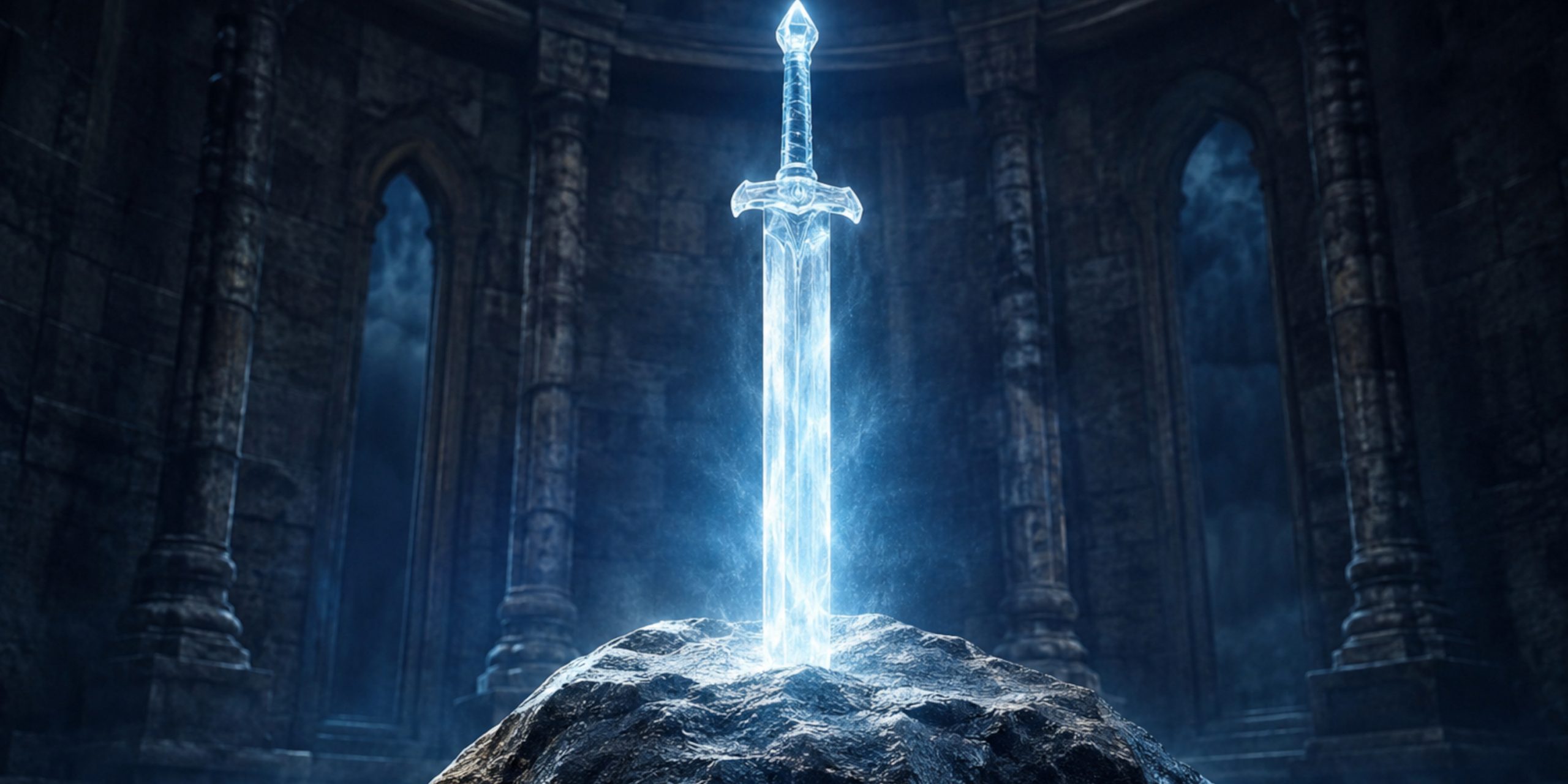
Callandor, often called The Sword That Is Not a Sword, is a crystal sa’angreal designed to amplify the One Power. Unlike an ordinary blade, it has no cutting edge and is not intended for physical combat.
Instead, it functions as one of the most powerful channeling tools ever created.
Only someone capable of channeling the male half of the One Power can truly wield it, making it inseparably tied to the Dragon Reborn and the prophecies surrounding the Last Battle.
Its appearance is equally striking. Rather than polished steel, Callandor resembles a transparent crystal sword that glows brilliantly whenever vast amounts of the One Power flow through it.
Its elegant design gives it an almost divine appearance, reinforcing its mythical status throughout the series.
Specifications
| Feature | Details |
|---|---|
| Weapon Type | Crystal sa’angreal |
| Material | Transparent crystal |
| Creator | During the Age of Legends |
| Primary Function | Amplifies the One Power |
| Wielder | Male channelers, primarily Rand al’Thor |
| Known Limitation | Lacks protective buffer against overchanneling |
| Symbolism | Prophecy, sacrifice, leadership and responsibility |
Why Is It Called “The Sword That Is Not a Sword”?
This title perfectly captures Robert Jordan’s love of layered symbolism.
Although shaped like a magnificent longsword, Callandor is not designed for sword fighting.
It exists almost entirely as a focus for channeling.
The blade itself carries no sharpened edge. Swinging it like an ordinary weapon would achieve very little compared with the devastating magical forces flowing through it.
The irony fits the wider themes of The Wheel of Time. Appearances rarely tell the whole story, and Callandor constantly reminds both characters and readers that true power comes from understanding rather than appearances.
The Prophecy of the Stone of Tear
One of the earliest and most famous prophecies surrounding the Dragon Reborn states that only he can remove Callandor from the Heart of the Stone.
For centuries this prophecy shaped politics, religion and fear across the Westlands.
The supposedly impregnable Stone of Tear stood as both fortress and sacred monument, housing Callandor while generations waited for the impossible.
When Rand al’Thor finally claims the sword, it becomes undeniable proof that prophecy is unfolding.
It is one of the defining moments of the series because there is no longer room for doubt. Rand is forced into accepting a destiny he has spent much of the story trying to escape.
The Extraordinary Power of Callandor
Few magical artefacts in fantasy possess the sheer destructive capability of Callandor.
When linked to the One Power, it allows its wielder to command enormous quantities of saidin.
This dramatically increases:
- Offensive destructive capability
- Defensive weaves
- Environmental manipulation
- Battle-scale attacks
- Precision channeling
- Long-distance magical reach
Entire armies become vulnerable to a single skilled channeler wielding Callandor.
Its power is so overwhelming that even experienced Aes Sedai view it with a mixture of awe and fear.
The Hidden Weakness That Changes Everything
Here’s the twist that catches many first-time readers completely off guard.
Callandor lacks the normal safety buffer found in most sa’angreal.
Normally, these devices help prevent channelers from drawing fatal amounts of the One Power.
Callandor offers no such protection.
Its wielder can unknowingly draw enough power to destroy themselves.
Even worse, Callandor also allows others to influence or seize control under the right conditions.
This flaw transforms what initially appears to be the perfect weapon into something far more dangerous.
Robert Jordan rarely wrote simple magical artefacts. Almost every great source of power in The Wheel of Time comes with an equally significant cost.
Rand al’Thor and Callandor
No character is more closely associated with Callandor than Rand.
Throughout the series, the sword mirrors his own personal journey.
Early on, it represents destiny.
Later, it becomes a symbol of overwhelming responsibility.
Eventually, it reflects humility, as Rand learns that victory cannot come through raw strength alone.
Watching Rand mature alongside Callandor is one of the strongest examples of long-term character development in epic fantasy.
The sword changes very little.
Rand changes completely.
Callandor During the Last Battle
By the time of Tarmon Gai’don, readers finally understand Callandor’s true purpose.
It was never intended simply as the strongest weapon available.
Instead, it functions as part of a carefully designed solution involving cooperation, trust and balance.
This revelation completely reframes everything readers thought they knew about the crystal sword.
Rather than rewarding individual heroics, Callandor ultimately reinforces one of the central themes of The Wheel of Time.
No single person can save the world alone.
Symbolism Behind Callandor
Few fantasy weapons carry as much symbolic meaning.
Callandor represents:
- Leadership rather than domination
- Responsibility over ambition
- Cooperation instead of pride
- Destiny balanced by free will
- Wisdom overcoming raw strength
Robert Jordan consistently challenged the fantasy trope that stronger weapons automatically solve bigger problems.
Callandor proves the opposite.
Sometimes the most powerful object in the world demands restraint rather than aggression.
How Callandor Compares With Other Legendary Fantasy Swords
| Sword | Universe | Primary Strength | Greatest Weakness |
| Callandor | The Wheel of Time | Amplifies immense magical power | Dangerous lack of safeguards |
| Excalibur | Arthurian Legend | Divine kingship and authority | Worthiness of the wielder |
| Andúril | The Lord of the Rings | Leadership and inspiration | Relies on the skill of its owner |
| Sting | The Hobbit | Detects nearby enemies | Limited overall power |
| Frostmourne | Warcraft | Soul-stealing corruption | Destroys its wielder’s humanity |
| Nightblood | Warbreaker | Consumes evil with devastating force | Extremely dangerous to use |
Callandor stands apart because it is neither cursed nor perfectly reliable.
Instead, it reflects the complexity of human nature itself.
Why Fans Still Love Callandor
Fantasy readers often gravitate towards swords that represent more than combat.
Callandor remains popular because every appearance advances both the story and Rand’s emotional journey.
Its beautiful design certainly helps, but the real appeal lies in its unpredictability.
Every time Rand reaches for Callandor, readers understand that extraordinary things are about to happen.
Not necessarily good things.
That constant uncertainty keeps the sword fascinating right through to the series finale.
Callandor’s Legacy
Among fantasy’s greatest magical weapons, Callandor occupies a unique place.
It is visually unforgettable, deeply symbolic and woven into every major theme of The Wheel of Time.
Rather than existing simply as an overpowered artefact, it becomes a lesson about restraint, trust and accepting help when it matters most.
For a sword that technically is not even a sword, Callandor leaves an enormous mark on fantasy literature.
Its brilliance lies not in being flawless, but in proving that true strength often comes from recognising your own limitations.
That is a surprisingly refreshing message in a genre filled with magical superweapons, and it remains one of the reasons readers continue returning to Robert Jordan’s world decades after the first book was published.