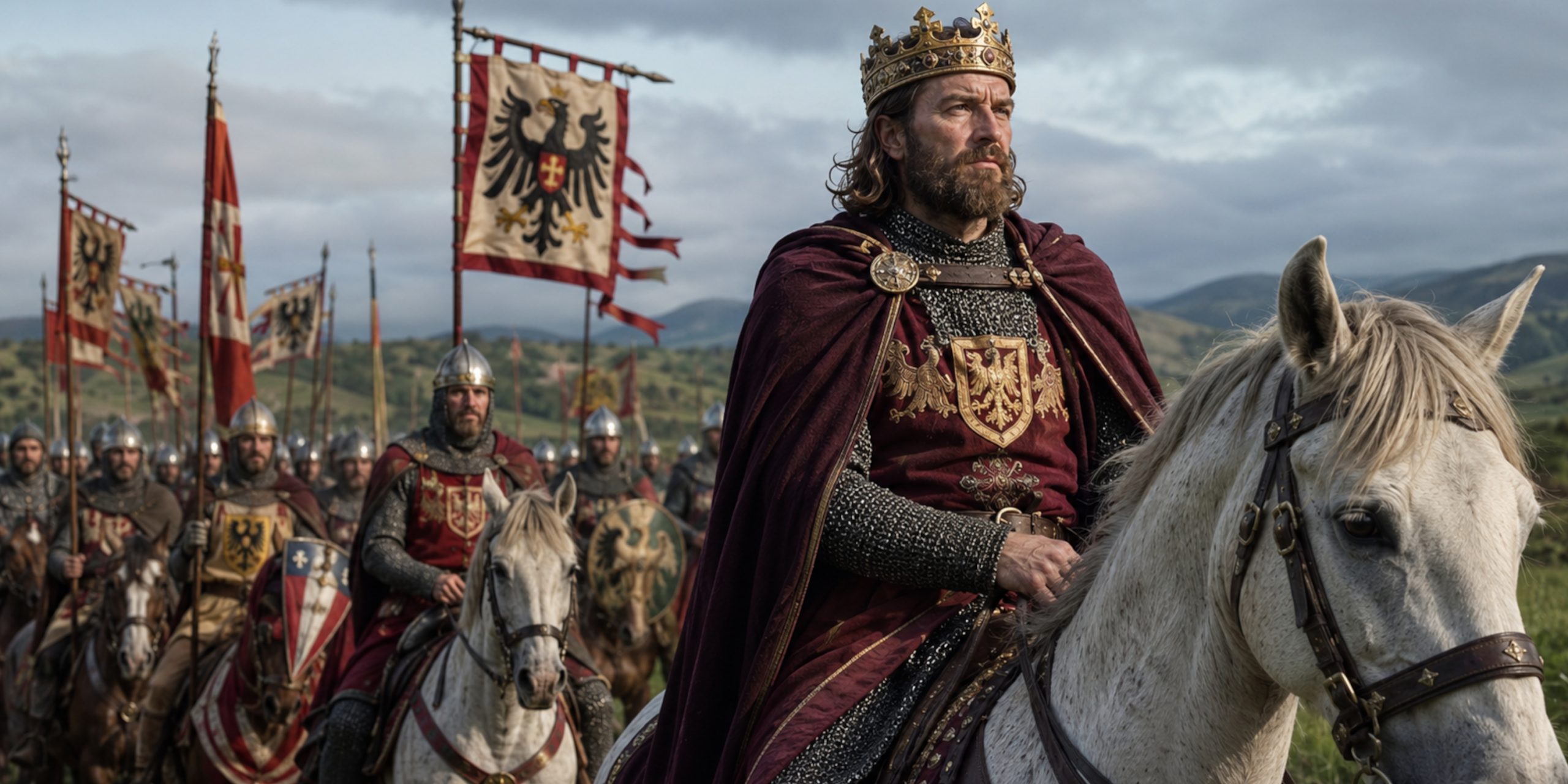
Conrad III of Germany (1093 to 1152) founded one of Europe’s most famous royal dynasties, fought across Germany, Italy and the eastern Mediterranean, and helped lead one of the largest crusading movements of the Middle Ages. Yet he never received the imperial crown.
As the first king from the Hohenstaufen dynasty, Conrad inherited a fractured political landscape where royal power was constantly challenged by ambitious nobles. His reign was less about grand conquest and more about survival, negotiation and keeping a kingdom from pulling itself apart.
He was not the most glamorous medieval ruler. He lacked the towering reputation of his nephew Frederick Barbarossa, but without Conrad’s persistence there may never have been a Hohenstaufen golden age at all.
Early Life and Rise of the Hohenstaufen Family
Conrad was born in 1093, the son of Frederick I, Duke of Swabia, and Agnes of Germany, daughter of Emperor Henry IV.
His family’s connection to the Salian emperors gave the Hohenstaufen claim significant prestige. During his youth, Conrad grew up surrounded by the politics of imperial Germany, where family alliances, church influence and military strength determined survival.
Key influences on his early career:
- Raised within the powerful Swabian aristocracy
- Connected by blood to the Salian imperial line
- Supported his brother Frederick II, Duke of Swabia
- Developed early experience in the conflicts between German princes
The rivalry that shaped his entire career was between the Hohenstaufen and the House of Welf. This struggle would dominate German politics for generations.
Becoming King of Germany
Following the death of Emperor Lothair III in 1137, many expected the powerful Duke Henry the Proud of Bavaria and Saxony to become king.
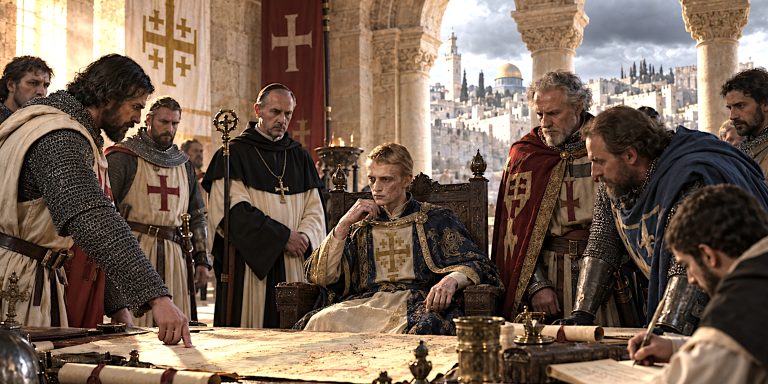
Instead, several German princes feared Henry controlled too much territory and chose Conrad. In 1138, Conrad was elected King of the Romans at Koblenz.
His election marked the beginning of Hohenstaufen royal rule.
However, his position was immediately challenged. Medieval kingship was not a comfortable throne and a nice crown. It was often a lifetime subscription to arguments with armed relatives.
Conrad spent much of his reign attempting to reduce Welf influence and strengthen royal authority.
Battles and Military Acumen
Conrad was an experienced commander rather than a revolutionary military genius. His greatest strength was persistence. He understood alliances, logistics and the importance of political victories.
Major Conflicts and Campaigns
| Conflict | Date | Opponents | Result |
|---|---|---|---|
| Anti-king campaign in Italy | 1127 to 1135 | Supporters of Emperor Lothair III | Failed attempt to claim power in Italy |
| German civil conflicts | 1138 onwards | House of Welf | Strengthened Hohenstaufen position |
| Siege of Weinsberg | 1140 | Welf supporters | Major Conrad victory |
| Second Crusade | 1147 to 1149 | Seljuk Turks and Muslim forces | Strategic failure |
| Byzantine diplomacy | 1148 | Manuel I Komnenos | Maintained imperial relationships |
The Siege of Weinsberg and the Famous “Loyal Wives”
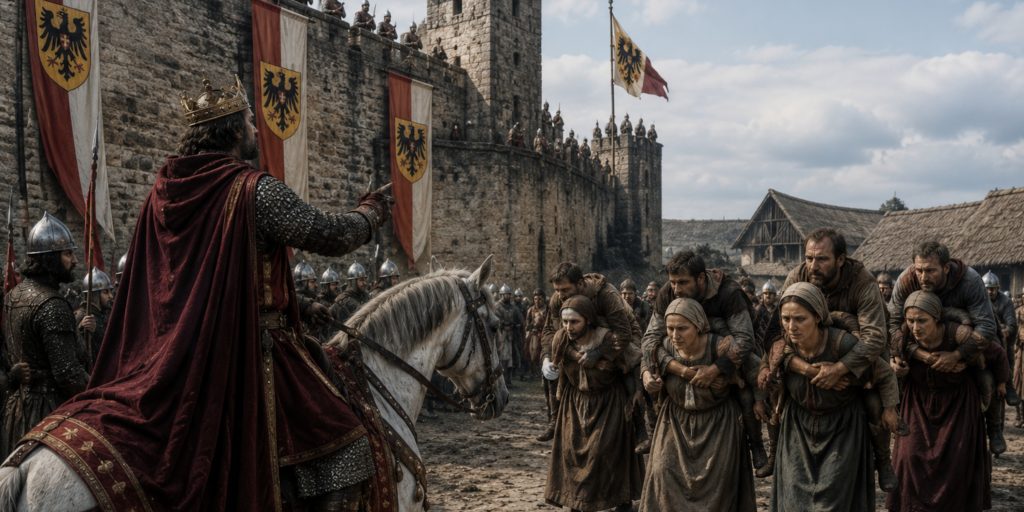
One of Conrad’s best remembered moments came during the siege of Weinsberg in 1140.
After defeating Welf forces, tradition claims Conrad allowed the women of the town to leave carrying whatever they valued most. Instead of taking possessions, they carried their husbands on their backs.
The story became known as the tale of the “loyal wives of Weinsberg.”
Whether completely true or enhanced by later storytelling, it reflected a medieval ideal of mercy and honour. It also gave Conrad a rare piece of good publicity in an era when kings were more often remembered for burning towns than sparing them.
The Second Crusade
Conrad’s most famous military expedition was also his greatest failure.
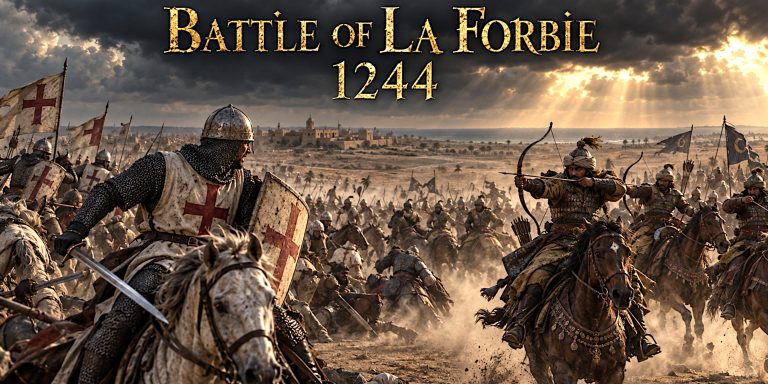
After the fall of Edessa in 1144, calls for a new crusade spread across Europe. Inspired by the preaching of Bernard of Clairvaux, Conrad took the cross and joined King Louis VII of France.
German Forces During the Second Crusade
| Category | Details |
|---|---|
| Commander | Conrad III |
| Estimated army size | Possibly tens of thousands at departure, greatly reduced during the campaign |
| Main forces | Knights, mounted retainers, infantry, servants and pilgrims |
| Main opponents | Seljuk Turkish forces |
| Major defeat | Battle of Dorylaeum, 1147 |
The German army suffered severely in Anatolia. Poor supply lines, difficult terrain and effective Turkish cavalry tactics devastated Conrad’s forces.
Conrad personally survived and later joined the failed attack on Damascus in 1148.
The crusade damaged his prestige, although many medieval observers blamed poor planning and divided leadership rather than Conrad alone.
Arms and Armour of Conrad III’s Era
The mid 12th century was a period of transition in European warfare. Knights were becoming more heavily armoured, while battlefield tactics increasingly focused on cavalry charges supported by infantry.
Royal and Noble Equipment
| Equipment | Description |
|---|---|
| Helmet | Nasal helmet, early enclosed helmet developments |
| Body armour | Riveted mail hauberk covering torso, arms and upper legs |
| Shield | Long kite shield, gradually shortening during the century |
| Sword | Knightly arming sword |
| Lance | Primary weapon of mounted nobles |
| Secondary weapons | Dagger, mace and war axe |
Sword Types Used
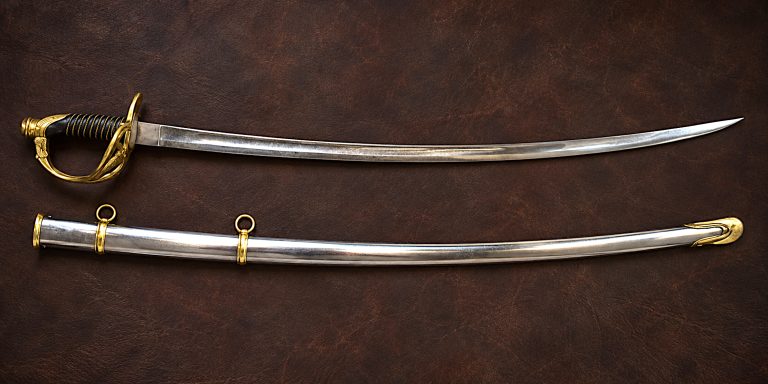
The typical sword carried by Conrad and his knights would have been the classic 12th century knightly sword.
Features included:
- Straight double-edged blade
- Length usually around 80 to 100 cm
- Cruciform guard
- One-handed grip
- Broad fuller to reduce weight
- Optimised for cutting, with thrusting capability
Relevant sword classifications:
- Oakeshott Type X, a continuation of Viking Age blade traditions
- Oakeshott Type XI, increasingly common among 12th century knights
- Early Type XII forms, appearing towards the later period
These swords were not oversized fantasy weapons. A good medieval blade was a carefully balanced tool. Surviving examples often surprise people because they feel quick and responsive rather than brutally heavy.
Forces Under Conrad III
German Royal Army Composition
| Unit Type | Role |
|---|---|
| Noble cavalry | Main battlefield strike force |
| Ministeriales | Professional warrior class serving nobles and kings |
| Infantry spearmen | Defensive formations and siege support |
| Crossbowmen | Increasingly important missile troops |
| Archers | Support and harassment |
| Engineers | Siege construction and logistics |
The German military system relied heavily on aristocratic obligations. Conrad could command powerful forces, but keeping those nobles loyal was often harder than defeating foreign enemies.
Relationship with Frederick Barbarossa
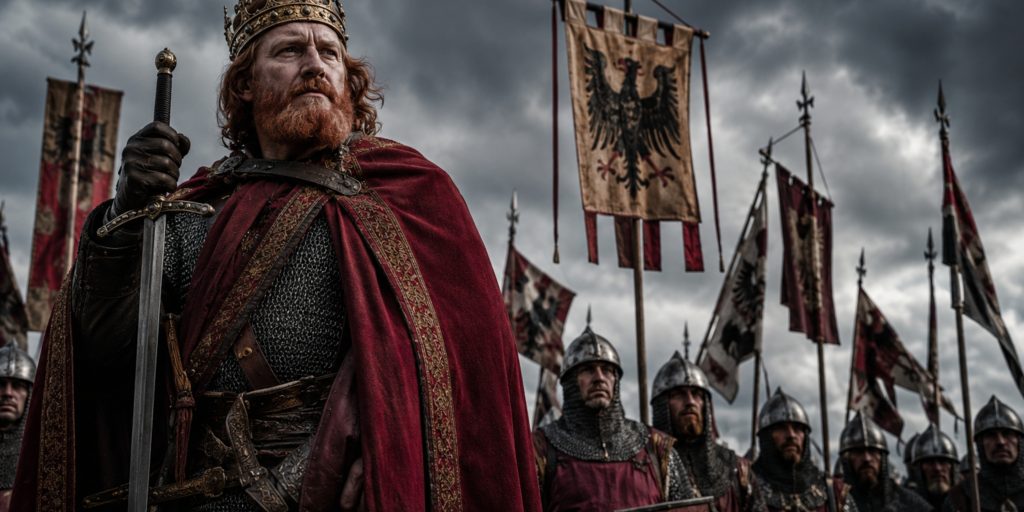
One of Conrad’s most important decisions came near the end of his life.
Instead of promoting his young son Frederick as successor, Conrad supported his nephew Frederick Barbarossa. It was a practical choice. Barbarossa had connections to both the Hohenstaufen and Welf families, making him a stronger candidate to unite Germany.
Conrad died on 15 February 1152. Barbarossa succeeded him shortly afterwards and became one of the most famous Holy Roman Emperors.
Conrad had laid the foundation. Barbarossa built the monument.
Artefacts and Where to See Material From Conrad’s Reign
No confirmed personal sword or armour belonging to Conrad III survives. This is common for rulers of the period, as weapons were reused, modified, gifted or melted down.
However, important objects connected to his world can still be studied.
Bamberg Cathedral, Germany
Conrad III was buried at Bamberg Cathedral. His tomb remains one of the most important physical links to the king.
Visitors can see:
- Medieval royal burial traditions
- Hohenstaufen period architecture
- Sculptural works connected to imperial Germany
German Historical Museum, Berlin
Collections include:
- Medieval weapons
- Armour fragments
- Manuscripts
- Objects reflecting the society of Conrad’s era
Kunsthistorisches Museum, Vienna
Relevant collections include:
- Imperial medieval artefacts
- Arms and armour from the Holy Roman Empire
- Later objects linked to German royal tradition
Landesmuseum Württemberg, Stuttgart
Especially relevant because of the Swabian origins of the Hohenstaufen family.
Collections include:
- Regional medieval archaeology
- Noble material culture
- Weapons and everyday objects
Archaeology and Recent Historical Research
Modern archaeology has helped historians better understand Conrad’s world, even if direct finds linked personally to him remain limited.
Important areas of research include:
- Excavations at Hohenstaufen castles and settlements
- Study of 12th century German fortifications
- Battlefield archaeology connected to medieval siege warfare
- Analysis of mail armour and sword production
- Research into crusader logistics and movement through Anatolia
Recent scholarship has moved away from judging Conrad only by the failure of the Second Crusade. His reign is increasingly viewed as a difficult but important transitional period between the Salian emperors and the dominance of Frederick Barbarossa.
Death and Legacy
Conrad III died in Bamberg in 1152 at around 58 years old.
His legacy:
- First Hohenstaufen King of Germany
- Preserved royal authority during internal conflict
- Limited the expansion of the Welf dynasty
- Strengthened the path for Frederick Barbarossa
- Played a central role in the Second Crusade
Conrad was not a conqueror who reshaped maps overnight. His achievements were slower and less dramatic. He survived a political battlefield where every duke had ambition, every alliance had conditions and every family dinner probably needed armed guards.
History often remembers the rulers who finish the castle, but Conrad III was the man who secured the foundations.
You have not enough Humanizer words left. Upgrade your Surfer plan.