Few role-playing series have grown as dramatically as The Witcher. The first game was an ambitious, slightly awkward PC exclusive made by a relatively unknown Polish studio. The third became one of the defining open-world adventures of its generation. Now CD Projekt Red is preparing to hand the lead role to Ciri in The Witcher IV.
The games draw upon the world created by Polish author Andrzej Sapkowski, but they tell an original continuation of his stories. Their version of the Continent is brutal, politically complicated and frequently funny in the bleakest possible way. A missing frying pan can matter almost as much as an approaching war.
This guide covers every major Witcher game, its expansions and spin-offs, alongside everything officially confirmed about The Witcher IV.
The Witcher Games at a Glance
| Game | Original release | Main character | Style |
|---|---|---|---|
| The Witcher | 2007 | Geralt of Rivia | Story-driven action RPG |
| The Witcher 2: Assassins of Kings | 2011 | Geralt of Rivia | Branching political action RPG |
| The Witcher 3: Wild Hunt | 2015 | Geralt and Ciri | Open-world action RPG |
| Gwent: The Witcher Card Game | 2018 | Various | Competitive card game |
| Thronebreaker: The Witcher Tales | 2018 | Queen Meve | Narrative RPG and card game |
| The Witcher: Monster Slayer | 2021 | Player-created witcher | Location-based mobile RPG |
| The Witcher IV | To be announced | Ciri | Single-player open-world RPG |
There are also two digital board-game adaptations, The Witcher Adventure Game and GWENT: Rogue Mage. Not every experiment has become essential, but CD Projekt has rarely been afraid to try something odd with the licence.
The Witcher, 2007
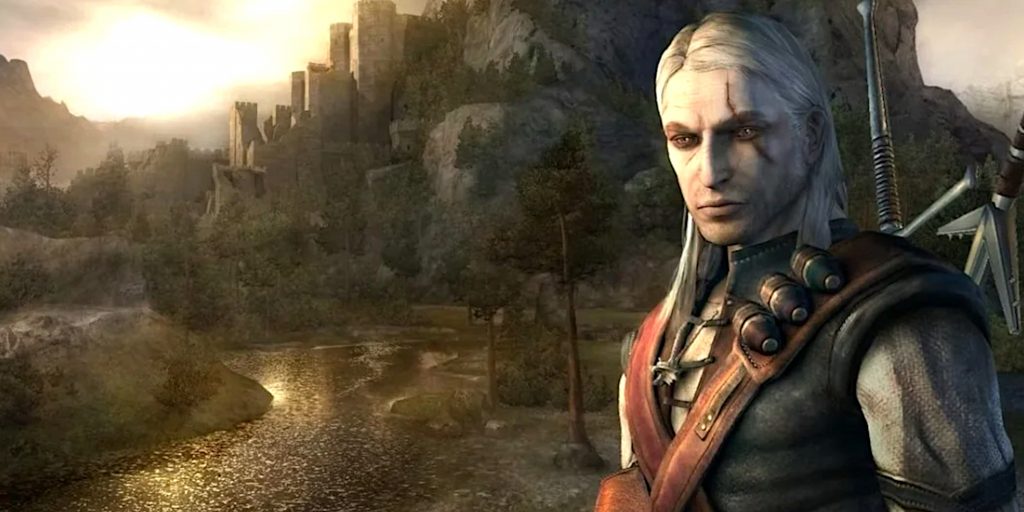
The original Witcher begins after the conclusion of Sapkowski’s novels. Geralt of Rivia returns with severe amnesia, which is convenient for a protagonist and even more convenient for players unfamiliar with several thousand pages of Polish fantasy.
After the witchers’ fortress at Kaer Morhen is attacked, Geralt pursues the criminal organisation Salamandra. His investigation takes him through the outskirts of Vizima and into a struggle involving King Foltest, religious fanatics, non-human rebels and enough morally dubious officials to fill a respectable municipal government.
What made it different
The game treated choice less like a row of coloured buttons and more like a delayed trap. Decisions could produce consequences hours later, often after the player had forgotten making them. There was rarely a perfectly clean answer.
Its version of Vizima also felt unusually grubby and lived-in. Disease, prejudice, poverty and political violence were embedded in the setting rather than added as decorative grit.
Combat and ageing mechanics
Combat uses three fighting styles:
- Fast style for agile enemies
- Strong style for heavily built opponents
- Group style for crowds
Players click in rhythm to extend attack combinations. It was distinctive in 2007, although it now feels rather like conducting an orchestra in which every musician is holding a sword.
Alchemy, potion preparation and monster research are more deliberate than in the later games. Geralt must learn about creatures before efficiently harvesting ingredients or exploiting weaknesses.
The Enhanced Edition improved dialogue, character models, animations and loading times, making it the preferable version today.
Is it still worth playing?
Yes, provided you can tolerate dated combat, repeated character models and a first act that takes its time. Beneath the technical creaking is an intelligent RPG with an atmosphere the sequels never quite replicated.
The Witcher 2: Assassins of Kings, 2011
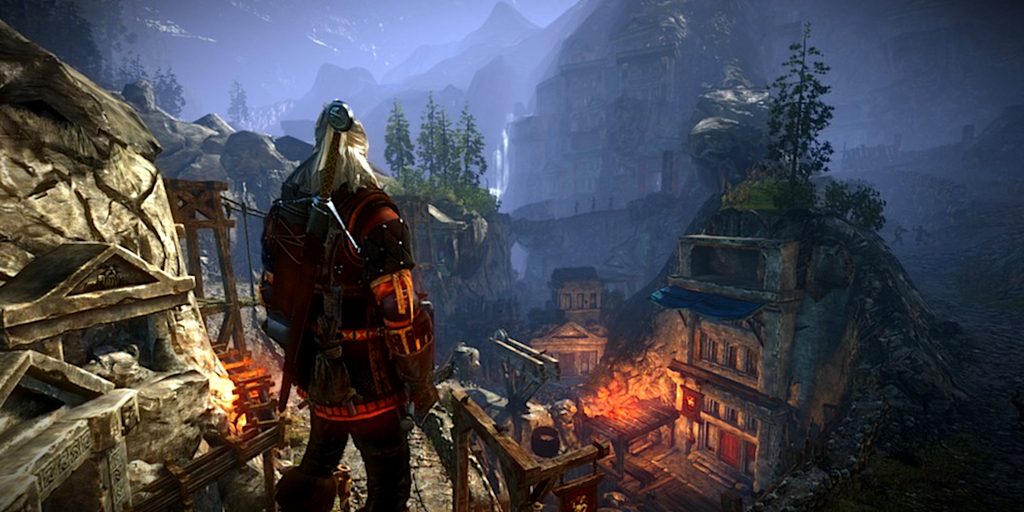
Assassins of Kings opens with Geralt serving King Foltest of Temeria. When the king is murdered by a witcher-like assassin, Geralt is blamed and forced to escape.
What follows is a compact political fantasy centred on the struggle for control of the Northern Kingdoms. Geralt becomes caught between rulers, spies, sorceresses, military commanders and the Scoia’tael guerrillas.
A genuinely branching story
Near the end of the first chapter, the player must side with Vernon Roche or the elven rebel Iorveth. This choice changes the location, characters and political perspective of much of the second act.
It remains one of the boldest branching structures in a major RPG. Considerable sections of the game cannot be seen in a single playthrough. Modern development budgets tend to regard that sort of generosity with visible alarm.
Combat and presentation
The rhythm system was replaced by direct action combat involving:
- Light and heavy attacks
- Dodging and blocking
- Magical Signs
- Bombs and throwing knives
- Traps
- Potions and weapon oils
The combat can be punishing, particularly early on. Geralt is powerful, but careless swordplay against several opponents usually ends with him becoming a cautionary tale.
Visually, the game was a major advance. Its forests remain richly atmospheric, while its castles, camps and besieged settlements give the political conflict a convincing physical presence.
Why it still matters
TheThe Witcher 2 established CD Projekt Red as a serious RPG developer. Its plot is denser and more overtly political than that of Wild Hunt, making it particularly rewarding for players who enjoy court intrigues, contested borders and conversations in which everyone has at least three motives.
The Witcher 3: Wild Hunt, 2015

The Witcher 3: Wild Hunt transformed the series from a successful RPG franchise into a global phenomenon.
Geralt searches for his adopted daughter Ciri, who is being pursued by the spectral Wild Hunt. His journey crosses the war-ravaged swamps and villages of Velen, the crowded city of Novigrad and the windswept Skellige Isles.
The main story is large, but its reputation was built equally upon its smaller tales. A routine monster contract might expose a murder, a family feud or a curse caused by someone making the worst possible decision at precisely the wrong moment.
Why the open world worked
Many open-world games provide size. The Witcher 3 gave its landscape context.
Velen is not simply a collection of enemy camps. It is a region damaged by war, famine and occupation. Novigrad’s wealth sits beside religious persecution. Skellige’s beauty is inseparable from clan rivalry and an enthusiasm for dangerous traditions.
Even apparently minor quests often contain developed characters, difficult choices and memorable conclusions. The infamous Bloody Baron storyline remains effective because it refuses to turn domestic abuse, addiction and grief into a neat morality puzzle.
Combat, Signs and preparation
Geralt fights with a combination of swordsmanship, alchemy and simple magic.
His five principal Signs are:
| Sign | Function |
|---|---|
| Aard | A telekinetic blast used to stagger enemies |
| Igni | A short burst of fire |
| Yrden | A magical trap effective against spirits |
| Quen | A protective shield |
| Axii | A mental influence used in combat and conversation |
The combat is more fluid than in the earlier games, although Geralt’s fondness for elaborate spinning attacks occasionally suggests he is aware of the camera.
Monster hunts reward preparation. Oils, bombs, potions and bestiary knowledge can make a difficult contract manageable. On higher difficulty settings, preparation becomes part of the hunt rather than optional menu housekeeping.
Ciri as a playable character
Several story sequences place the player in control of Ciri. She fights differently from Geralt, using speed, teleport-like movement and her extraordinary Elder Blood abilities.
These sections were relatively brief, but they established both her importance and her potential as the protagonist of a future game. That potential is now being developed in The Witcher IV.
Hearts of Stone
Released in 2015, Hearts of Stone follows Geralt’s dealings with the immortal nobleman Olgierd von Everec and the deeply unsettling Gaunter O’Dimm.
The expansion is smaller than Blood and Wine, but arguably tighter. It plays with bargains, punishment and the dangerous wording of wishes. O’Dimm remains one of the series’ most effective antagonists because the game never explains him completely.
It also introduces the Ofieri, a culture from beyond the familiar Northern Kingdoms, together with new equipment and the Runewright enchantment system.
Blood and Wine
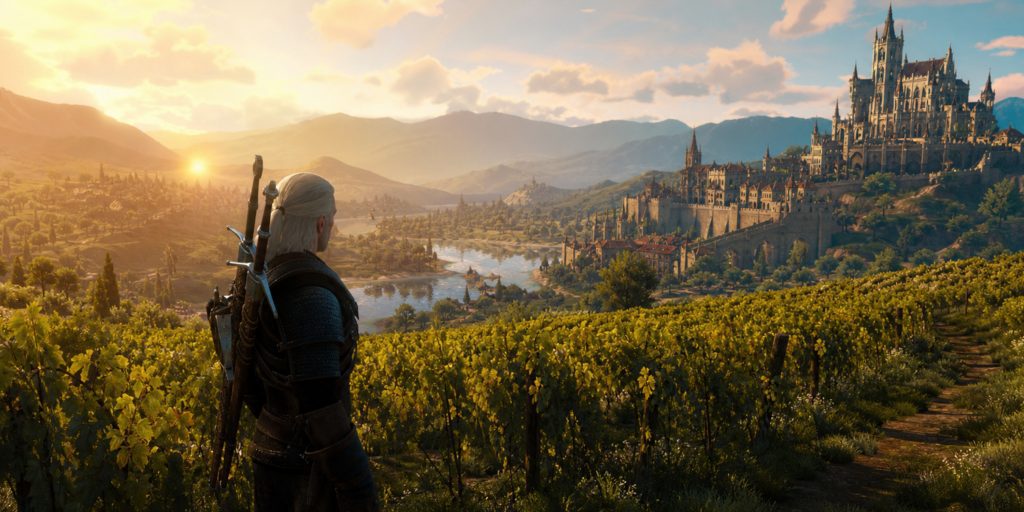
Blood and Wine arrived in 2016 and gave Geralt an entirely new region to explore.
Toussaint initially appears to be a colourful land of vineyards, tournaments and courtly manners. Naturally, something is murdering knights. The duchy’s polished ideals gradually give way to family resentment, political failure and old violence.
The expansion offers:
- A substantial new main story
- The Beauclair region
- Grandmaster witcher armour
- The mutation system
- Geralt’s Corvo Bianco estate
- New monsters, contracts and side quests
It functions as a farewell to Geralt’s original trilogy. Depending upon earlier choices, familiar characters may visit him at Corvo Bianco. After years spent wading through swamps and other people’s problems, he has certainly earned the vineyard.
Geralt’s return has since been confirmed for Songs of the Past, a third full expansion for The Witcher 3 due in 2027. CD Projekt says it is closer in scale to Blood and Wine than a minor add-on and is being co-developed with Fool’s Theory. CD Projekt’s May 2026 announcement confirms releases for PC, PlayStation 5 and Xbox Series X/S.
Gwent: The Witcher Card Game
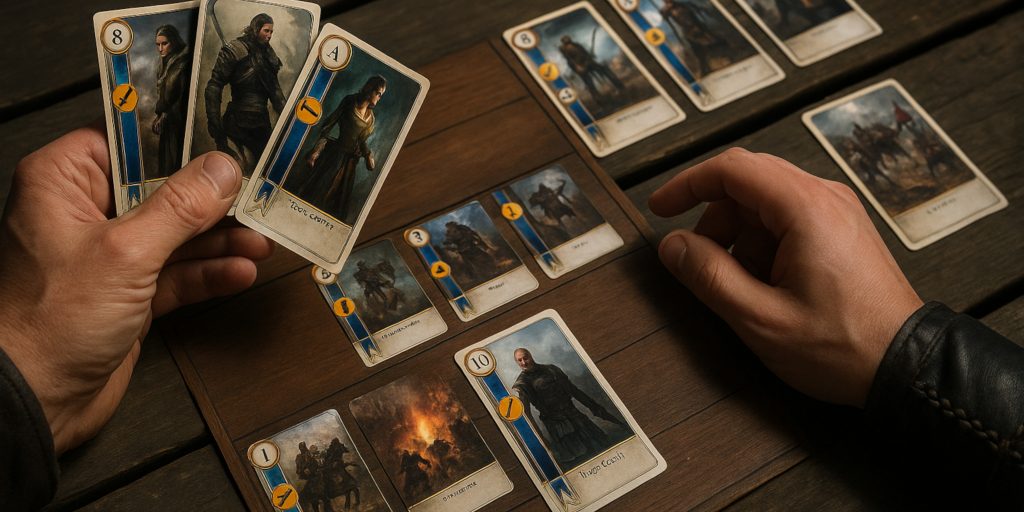
The card game played in The Witcher 3 became popular enough to receive a standalone adaptation.
Standalone Gwent is considerably more complex than the tavern version. Players construct decks based on factions from the Witcher world and attempt to win two of three rounds. Knowing when to pass is as important as playing the strongest card.
CD Projekt ended the production of new cards after 2023, but the game remains playable through its community-led balancing system. The former PlayStation 4 and Xbox One versions were discontinued, so the current platforms are PC, iOS and Android.
Thronebreaker: The Witcher Tales
Thronebreaker combines an isometric narrative RPG with card-based battles. It follows Queen Meve of Lyria and Rivia during the second Nilfgaardian invasion.
Meve travels across several kingdoms, gathering soldiers and attempting to reclaim her throne. Decisions affect morale, resources, companions and the composition of her army.
The writing is excellent, particularly when Meve’s responsibilities as a monarch conflict with her personal loyalties. Some players may find the card battles repetitive, but the campaign contains one of the strongest self-contained stories in the gaming series.
It also proves that the Witcher world can support a compelling game without Geralt at its centre, something rather relevant to the future of the franchise.
Other Witcher Games and Spin-Offs
The Witcher Adventure Game
Released digitally in 2014, this adaptation of the tabletop game lets players control characters including Geralt, Triss Merigold, Yarpen Zigrin and Dandelion.
It is more of a curiosity than an essential Witcher experience, but it captures the idea of several adventurers pursuing their own objectives across the same dangerous landscape.
The Witcher: Monster Slayer
Monster Slayer was a mobile augmented-reality game released in 2021. Players tracked creatures using their phone’s location services, effectively turning an evening walk into a witcher contract.
Its servers closed in June 2023, so the game is no longer playable.
GWENT: Rogue Mage
Released in 2022, Rogue Mage is a single-player deck-building game set centuries before Geralt’s adventures. It follows the sorcerer Alzur during his attempts to create the first witcher.
The story is relatively light, but its procedurally structured battles make it an interesting option for players who enjoy deck-building roguelikes.
Swords, Armour and Witcher Combat
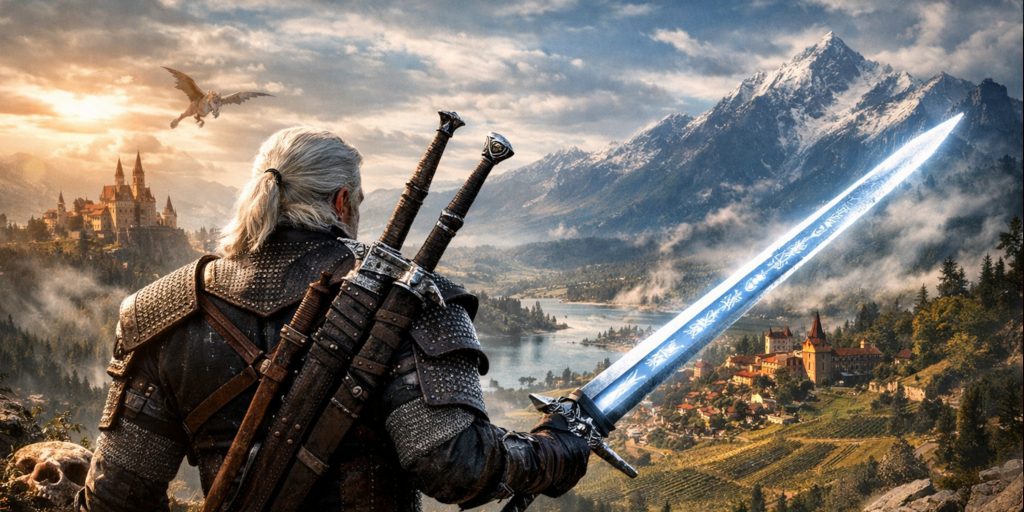
The Witcher’s two-sword system has become one of the franchise’s most recognisable ideas.
Geralt normally carries:
- A steel sword for humans and ordinary animals
- A silver or silver-plated sword for supernatural creatures
- Light, medium or heavy armour
- Potions, bombs and blade oils
- A crossbow in The Witcher 3
In Sapkowski’s books, Geralt does not always carry both swords across his back. The silver blade is often kept with his horse because it is a specialist and relatively fragile weapon. The games favour immediate access and a stronger visual silhouette.
The swords themselves resemble later medieval and Renaissance European weapons more than strict early medieval examples. Many have cruciform hilts, long grips and wheel or scent-stopper pommels. Some silver swords use elaborate fantasy crossguards which look magnificent and would be irritatingly eager to catch on clothing.
Witcher armour follows a similar approach. The best sets combine recognisable materials such as mail, leather, textile padding and plate components with fantasy tailoring. They are rarely exact historical reconstructions, but the designs usually look as though somebody could wear them without immediately falling down a staircase.
How the Series Changed Role-Playing Games
The Witcher games did not invent moral choice, open worlds or branching narratives. Their achievement was combining these ideas with unusually strong consequences and a setting uninterested in flattering the player.
Geralt can influence kingdoms, but he cannot solve every injustice. Helping one community may condemn another. Refusing to choose is itself a choice, usually accompanied by consequences and a disappointed sorceress.
The series also helped shift expectations for side quests. After The Witcher 3, collecting ten wolf pelts for a villager with no personality became much harder to defend as acceptable quest design.
Its influence can be seen in later games that place greater emphasis on:
- Cinematic side stories
- Character-led optional quests
- Delayed consequences
- Investigative monster hunts
- Regional storytelling
- Morally uncertain decisions
Not every aspect has aged equally well. The treatment of women in the first game can be painfully adolescent, and combat quality has varied across all three titles. The writing, world-building and willingness to let choices become uncomfortable remain the series’ strongest qualities.
Everything Confirmed About The Witcher IV
The Witcher IV is the beginning of a new trilogy rather than a direct fourth chapter in Geralt’s story. CD Projekt Red describes it as a single-player, open-world RPG and its most ambitious Witcher game to date.
The important shift is now official: Ciri is the protagonist.
Ciri is the new lead
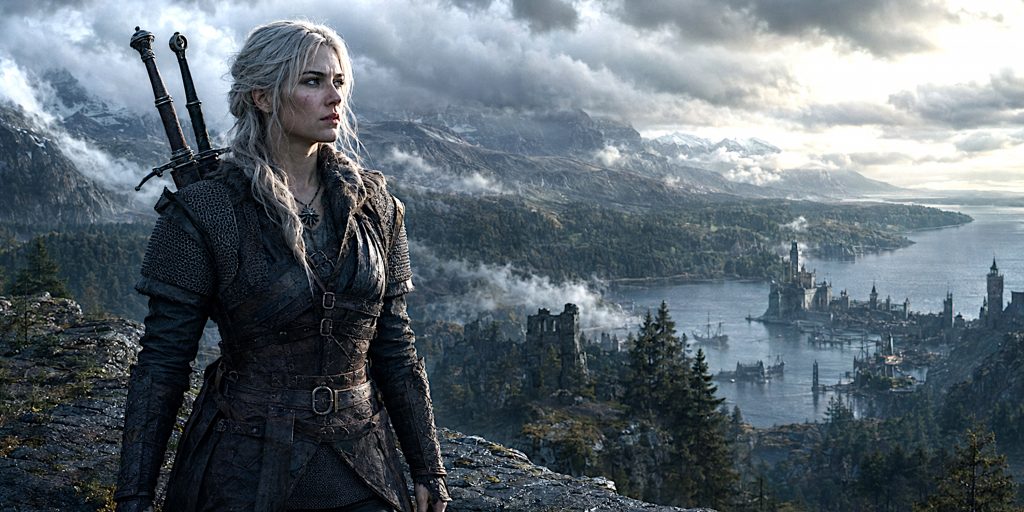
The cinematic reveal trailer shown at The Game Awards in December 2024 follows Ciri undertaking a contract in a remote village. She attempts to save a young woman selected for ritual sacrifice, only to discover that human fear and superstition may be more difficult to kill than the monster.
The older Ciri is presented as a professional witcher. She carries steel and silver swords, uses Signs, drinks witcher potions and wears a new lynx medallion.
CD Projekt’s choice makes narrative sense. Ciri was central to The Witcher 3, already had playable sections and stood at the point where Geralt’s personal story met the wider fate of the Continent.
What remains unexplained is how she underwent the Trial of the Grasses. In the earlier games and novels, Ciri trained at Kaer Morhen but did not receive the mutations traditionally used to create witchers. The trailer deliberately raises that question without answering it.
A new Witcher school
Ciri’s medallion represents a lynx rather than Geralt’s School of the Wolf. CD Projekt previously confirmed that the medallion teased in 2022 belonged to a lynx, but the studio has not fully explained the school’s origins.
It may be a newly founded order, an evolution of an existing school or something created specifically around Ciri. At present, claims about its history are speculation.
The game will visit Kovir
The 2025 technical demonstration took place in Kovir, a wealthy northern kingdom that has not previously appeared as an explorable region in the games.
Ciri travelled with her horse Kelpie through mountains and forests before entering the port town of Valdrest. Crowds reacted dynamically to events around them, while the environment included dense vegetation, detailed markets and large numbers of individually animated characters.
Kovir is confirmed as a region in the game, although CD Projekt has not revealed the full map or said whether the entire adventure will take place there.
Unreal Engine 5 technology
CD Projekt has retired its proprietary REDengine for the new Witcher saga and is building The Witcher IV with Unreal Engine 5 as part of a long-term partnership with Epic Games.
The June 2025 demonstration highlighted:
- Nanite foliage for dense forests
- Hardware ray tracing
- Improved open-world streaming
- The Unreal Animation Framework
- MetaHuman character technology
- Mass AI for large crowds
- Faster loading of detailed environments
The demonstration ran on a standard PlayStation 5 at 60 frames per second with ray tracing. That is encouraging, but it was a technical presentation rather than footage from the finished game. CD Projekt explicitly describes it as an engine demonstration, so its visuals, performance and mechanics should not be treated as final.
Development status
The Witcher IV entered full-scale production in late 2024. By the end of the first quarter of 2026, CD Projekt reported that 513 developers were working on it during what the company called the most intensive phase of production. CD Projekt’s Q1 2026 results provide the latest official team figure.
No release date or launch window has been announced. PC, PlayStation and Xbox have been referenced in relation to the project, but CD Projekt has not published a final platform list.
What has not been confirmed
CD Projekt has not yet confirmed:
- A release date
- The complete world map
- A detailed combat system
- Whether Geralt will appear
- How Ciri became a mutated witcher
- The role of the School of the Lynx
- Save imports from The Witcher 3
- Romance options
- Character customisation
- Final console performance
- Expansions for the new trilogy
CD Projekt has said it aims to release three games in the new Witcher trilogy within six years of the first game. That concerns the wider plan, not the release date of The Witcher IV itself.
What The Witcher IV Needs to Get Right
Ciri should not simply become Geralt with different hair.
Her speed, Elder Blood powers and complicated relationship with destiny offer opportunities for a substantially different combat and narrative style. At the same time, making her too powerful could weaken the preparation and vulnerability that make witcher contracts interesting.
The game also needs to preserve the smaller human stories beneath its technical ambition. Dense forests and reactive crowds are impressive, but The Witcher 3 became beloved because players remembered the people living in its world.
Then there is the familiar CD Projekt question of launch quality. Cyberpunk 2077 eventually became an excellent game, but its original console release damaged trust. A measured launch would do far more for The Witcher IV than any number of beautifully rendered trees, however individually simulated their leaves may be.
Which Witcher Game Should You Play First?
For most new players, The Witcher 3: Wild Hunt Complete Edition remains the best starting point. It explains enough of the setting to stand alone and offers the most polished combination of story, exploration and combat.
Choose according to what you want:
| If you want | Start with |
|---|---|
| The best all-round introduction | The Witcher 3: Wild Hunt |
| The complete Geralt game story | The Witcher: Enhanced Edition |
| Political intrigue and major branching choices | The Witcher 2: Assassins of Kings |
| A strong story without Geralt | Thronebreaker |
| Competitive deck building | Gwent |
| A shorter, darker Witcher story | Hearts of Stone |
Playing all three main games in order provides additional context, but it is not compulsory homework. The first game asks for patience, while the second occasionally asks whether you remembered to drink a potion before entering a cutscene. Sometimes the answer is no, and then everyone has a difficult evening.
The Future of The Witcher Games
CD Projekt is developing several projects within the franchise.
The Witcher IV and its sequels
The Witcher IV begins a planned trilogy centred upon a new saga. The second and third games are expected to use the technological foundation established for the first, allowing CD Projekt to produce them more efficiently.
The Witcher Remake
Fool’s Theory is developing a remake of the original Witcher using Unreal Engine 5, with CD Projekt Red providing creative supervision.
The remake is expected to rebuild the 2007 game rather than apply a simple visual upgrade. CD Projekt has described it as an open-world RPG, suggesting that Vizima and its surrounding regions may be reorganised into a more seamless environment.
It remains in development with no confirmed release date. Work on the remake has been temporarily integrated with The Witcher IV, which should help both projects share technology and design knowledge.
Project Sirius
The Molasses Flood is developing another Witcher game under the codename Sirius. It is intended to offer a different experience from the main role-playing series and has been associated with multiplayer features.
The project underwent substantial changes during development, and its final name, format and release date remain unconfirmed.
Songs of the Past
Geralt will return in Songs of the Past, a third full expansion for The Witcher 3, launching in 2027. It is being positioned as a bridge between the original trilogy and Ciri’s new saga.
That leaves the franchise in an unusual but promising position. Geralt is receiving one final major adventure, Ciri is taking command of the main series, and the original game is being rebuilt for a new generation.
Is The Witcher Series Still Worth Playing?
Absolutely, although each game requires a different degree of patience.
The first is imaginative but visibly old. The second is compact, difficult and politically dense. The third remains the easiest recommendation, particularly with its two major expansions.
Together, they trace the development of CD Projekt Red from a small studio wrestling with a licensed engine to one of the most prominent RPG developers in the industry. They also tell a remarkably consistent story about Geralt, Ciri and a world in which neutrality is usually impossible.
The Witcher IV now faces a difficult task. It must honour Geralt’s legacy without living entirely inside it. Choosing Ciri is the boldest and most logical first step.