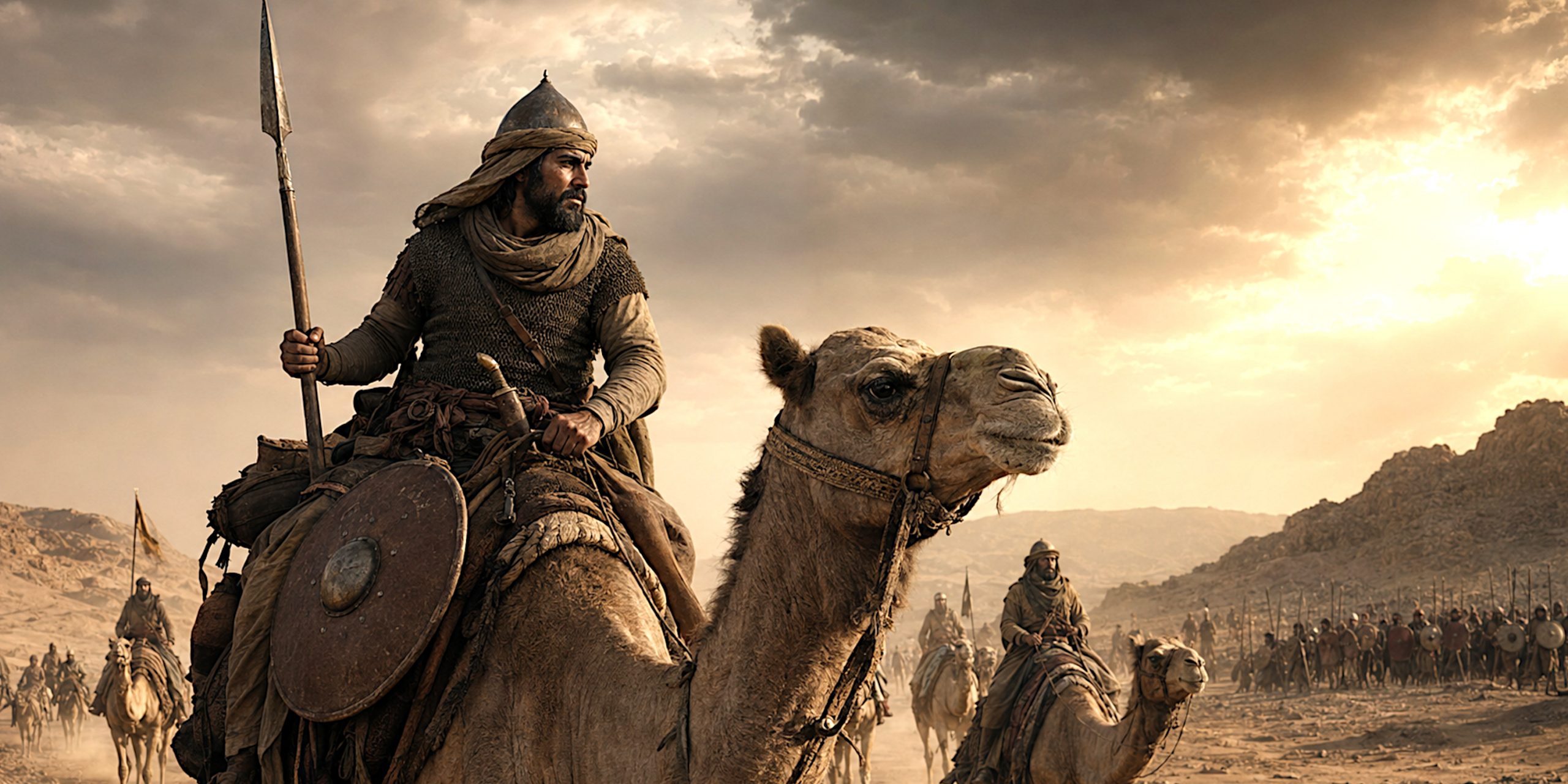
The Arab camel rider is one of the most recognisable figures in popular depictions of early Islamic warfare. He is also one of the most misunderstood. Films, games and nineteenth-century paintings have encouraged the idea that the armies of the early caliphates swept across the Near East as massed camel cavalry. The evidence suggests something rather different.
Camels were indispensable to Arab warfare, but principally as transport animals. They carried soldiers, water, food, tents, arrows and equipment across country where maintaining conventional armies was exceptionally difficult. Warriors commonly rode camels on the march and dismounted before battle. Horses, when available, were preferred for charges, pursuit and close combat.
There were genuine camel-mounted fighters, particularly among raiders, scouts, frontier troops and tribal contingents. Some could use bows or spears from the saddle. Yet the camel’s greatest military contribution was less theatrical and considerably more important: it allowed an army to arrive where its enemy did not expect it, still carrying enough water to remain there.
For a historian, that is the more impressive story. Charging is dramatic. Logistics wins rather more wars.
Who Were the Early Medieval Arab Camel Riders?
The term covers several overlapping groups active between approximately the sixth and tenth centuries:
- Pastoral nomads who used camels during tribal raids
- Guides and scouts familiar with desert routes
- Camel-mounted messengers
- Warriors travelling to battle before fighting on foot
- Archers or spearmen capable of fighting from the saddle
- Caravan guards
- Frontier troops patrolling Arabia, Syria, Iraq and Egypt
- Soldiers accompanying the armies of the Rashidun and Umayyad caliphates
- Tribal auxiliaries serving Byzantine, Sasanian or Islamic rulers
They were not a single regiment, social class or military tradition. An Arab camel rider from the Syrian steppe might serve a Ghassanid ruler allied to Byzantium, while another from central Arabia participated in a tribal raid or joined an early Muslim expedition.
The Arabic term jamal means camel, while ibil is a collective term for camels. The one-humped dromedary, Camelus dromedarius, was the normal Arabian mount. Two-humped Bactrian camels were more closely associated with Iran and Central Asia.
The Camel Before Islam
Arab military use of the camel was already ancient by the lifetime of the Prophet Muhammad.
Assyrian reliefs show Arab camel riders fighting in the first millennium BC. The Assyrian record of the Battle of Qarqar in 853 BC credits the Arab ruler Gindibu with providing 1,000 camels. Herodotus later described Arab archers mounted on camels in the army of Xerxes.
Roman forces recruited specialist dromedarii for service along the eastern frontier. These troops guarded routes, escorted caravans and patrolled regions where horses required more water and fodder.
By the sixth century AD, Arab communities occupied a broad military frontier extending from southern Arabia through the Syrian Desert and into Mesopotamia. The Byzantine Empire worked with Ghassanid Arab federates, while the Sasanians relied upon the Lakhmids and other allied groups. Both sides valued Arab troops for their regional knowledge, mobility and ability to operate beyond settled supply networks.
The early Islamic armies therefore did not suddenly invent camel warfare. They inherited a mature transport culture and placed it within an increasingly organised military system.
Why the Dromedary Mattered
The military value of the camel rested on endurance rather than battlefield agility.
| Characteristic | Military importance |
|---|---|
| Resistance to dehydration | Allowed movement between distant wells |
| Ability to eat coarse vegetation | Reduced dependence on transported fodder |
| High carrying capacity | Supported riders, weapons, food and water |
| Suitability for heat | Enabled campaigning in exposed desert regions |
| Long-distance endurance | Extended the range of patrols and raids |
| Milk production | Provided food during prolonged journeys |
| Height | Gave riders a good view during scouting |
| Familiarity with poor ground | Useful on sand, gravel and broken desert routes |
A camel could carry considerably more than a riding horse, although the precise load depended upon the animal, saddle and terrain. A rider might travel with water skins, food, bedding, spare clothing, weapons and portions of communal equipment.
Camels also sustained horses. During some expeditions, a mounted warrior could ride a camel while leading his warhorse, conserving the horse’s strength for battle. The camel carried fodder and water, while the horse remained the preferred combat mount.
This combination created a highly effective campaigning system. It did not make the camel a superior cavalry animal. It made cavalry possible in places where horses alone would struggle to survive.
Camel Saddles and Riding Equipment
The North Arabian saddle was one of the technological foundations of camel mobility. Its frame rested around the hump and distributed weight across the animal’s body rather than pressing directly upon the hump.
A typical saddle included:
- Two wooden arches positioned before and behind the hump
- Longitudinal wooden supports
- Leather thongs or bindings
- Woollen or woven saddle blankets
- Padding to prevent rubbing
- Ropes for securing baggage
- Saddlebags hung on either side
- A halter or nose rein for control
The raised front and rear sections helped stabilise the rider and provided points from which bags, water skins and weapons could be hung. This was valuable during long journeys, though less secure than the developed horse saddles used by some contemporary Byzantine and Sasanian cavalry.
Stirrups present a more difficult question. They spread gradually across western Asia during the early medieval period, but the chronology varied by region. Their use among seventh-century Arab camel riders cannot simply be assumed. Riders could mount, steer and fight without them, particularly when using established saddle forms, but stirrups would later improve stability and weapons handling.
Were They Really Camel Cavalry?
Sometimes, but not in the manner usually imagined.
Most early Arab warriors appear to have used camels as strategic transport. They rode to the vicinity of a battle, dismounted, tethered or hobbled the animals and fought as infantry. Wealthier warriors or dedicated cavalrymen might then transfer to horses.
True camel-mounted fighting was most useful in:
- Raids against camps, herds and caravans
- Pursuit across arid ground
- Screening an army’s movement
- Reconnaissance
- Harassment with arrows or javelins
- Protecting baggage
- Patrolling long desert frontiers
- Escorting messengers and supply columns
A camel could move rapidly, but it accelerated and turned less sharply than a horse. Its height made mounting and dismounting slow unless the animal was trained to kneel on command. Controlling it during close combat was also difficult.
The rider’s position was high, which helped with observation and missile use, but made striking enemies on foot awkward. A long spear could compensate for the distance. A sword was more practical after dismounting or when fighting another mounted opponent.
Calling every armed camel rider “camel cavalry” therefore obscures more than it explains. Many were mounted infantry, scouts or raiders.
Early Islamic Armies and the Camel
The rise of Islam transformed the political organisation of Arabian warfare. Tribal forces were increasingly mobilised by a central religious and political authority, first under Muhammad and then under the caliphs.
Camels were fundamental to this process. The early Muslim community needed them for expeditions from Medina, particularly when crossing the western Arabian landscape. Surviving narratives repeatedly mention the allocation, sharing, capture and loss of camels.
The Qur’an reflects the importance of mounts. In a passage concerning those unable to accompany an expedition, it describes men who turned away sorrowfully when told:
“I can find no mounts for you.”
The verse does not specify camels alone, but in its Arabian context they formed an important part of the available transport.
Accounts of Muhammad’s expeditions sometimes describe several men sharing one camel in rotation. These reports should not be treated as modern quartermaster returns, yet they convey a practical reality. Mounts were valuable, limited and carefully allocated.
After Muhammad’s death in 632, camels supported the armies of the Ridda Wars and the conquests of Byzantine and Sasanian territory. They carried troops from Arabia into Syria and Iraq, supported movements between wells and helped maintain communications across newly conquered regions.
The armies themselves were mixed. Infantry remained important, while horsemen formed the principal tactical cavalry. Camels were generally concentrated in the marching column and baggage train rather than formed into a dedicated shock arm.
How Camel Riders Fought
There was no universal method, but several tactical patterns are plausible from the written and comparative evidence.
Mounted archery
Some Arab riders had used bows from camelback since antiquity. The camel’s height provided range of vision, and a relatively steady walking pace could offer a useful shooting platform.
Mounted archery was more difficult at speed. A rider had to manage the animal while handling the bow, unless reins were secured or another person controlled the mount. Earlier Assyrian reliefs show two men sharing a camel, one directing it while the other shot.
By the early medieval period, an experienced rider could probably shoot alone, but mounted camel archery should not be confused with the rapid manoeuvres of steppe horse archers.
Spear fighting
Long spears and lances were better suited to the camel’s height. A rider could thrust downwards or keep an opponent at a distance.
A camel was capable of intimidating infantry and unfamiliar horses, but evidence for disciplined early Islamic camel-lancer formations is limited. The popular image of armoured camels crashing into Byzantine ranks owes rather more to modern imagination than contemporary documentation.
Mounted skirmishing
Camel riders could approach, throw javelins or shoot arrows, then withdraw into terrain difficult for horsemen to cross safely. Such tactics suited tribal raiding, where avoiding casualties was usually more sensible than seeking a heroic death over somebody else’s goats.
Dismounted combat
This was probably the most common method:
- Ride towards the operational area
- Leave the camels under guard
- Form an infantry line
- Fight with spear, sword, bow and shield
- Remount for withdrawal, pursuit or renewed movement
Camels could be tethered near the baggage. In desperate circumstances, closely packed animals and equipment might create an obstacle, but claims that early Muslim armies routinely constructed deliberate “camel walls” should be treated cautiously.
Arms and Armour
Equipment varied considerably with wealth, region and date. A tribal rider might carry only a spear and knife, while an elite warrior could possess mail, a helmet, shield, sword and bow.
| Weapon or protection | Arabic term | Likely use |
|---|---|---|
| Straight sword | Sayf | Cutting and thrusting in close combat |
| Spear or lance | Rumh | Mounted or dismounted thrusting |
| Bow | Qaws | Hunting, skirmishing and battlefield archery |
| Arrow | Sahm | Missile weapon |
| Javelin | Various regional terms | Harassment and raiding |
| Dagger or large knife | Khanjar or sikkīn | Utility and last-resort defence |
| Mail shirt | Dirʿ | Protection for wealthy warriors |
| Helmet | Bayḍa and related terms | Head protection |
| Shield | Turs, daraqa or mijann | Defence against missiles and hand weapons |
Swords used by Arab camel riders
The characteristic early Arab sword was normally straight, not strongly curved.
The broad popular association between Arab warriors and the curved scimitar belongs mainly to later medieval and early modern periods. Curved sabres became increasingly important through Iranian, Central Asian and Turkic military influence, but they should not be placed automatically in the hands of seventh-century Arabian fighters.
Likely sword forms included:
- Straight, double-edged swords derived from Late Roman and Sasanian traditions
- Long cutting swords with parallel or gently tapering blades
- Straight single-edged blades, though less common
- Imported or locally mounted blades from India, Yemen, Syria and Iran
- Shorter swords or large knives carried by men of lesser means
Early Arabic literary sources distinguish blades by provenance. Indian blades were particularly admired, while Yemen had an established reputation for arms manufacture and trade. Such labels did not always mean that an entire weapon was made in the named region. A valued imported blade could be fitted with a locally produced hilt and scabbard.
Surviving blades traditionally attributed to Muhammad, his companions and early caliphs are preserved in Istanbul. Their histories are difficult to verify, and some have later inscriptions or fittings. They nevertheless support the broader evidence that the prestigious early Islamic sword was usually straight. The British Museum’s early Islamic sword and scabbard offers another useful point of comparison, although individual museum pieces cannot represent every regional form.
Spears and lances
The spear was probably the most practical primary weapon for a camel rider. It was comparatively inexpensive, useful in war and hunting, and effective either mounted or on foot.
Long shafts helped compensate for the rider’s elevated seat. Spears could also be carried upright or secured against the saddle during travel. Some had iron heads suitable for thrusting, while lighter examples could be thrown.
Bows
Arab bows were generally composite or self bows, depending upon availability and region. Composite construction using wood, horn and sinew offered power from a relatively compact weapon but required skilled manufacture and careful protection from moisture.
Archers carried arrows in a quiver attached to the belt, saddle or baggage. A camel could carry substantial supplies of arrows, which made it useful even when the archers themselves fought on foot.
Shields
Shields ranged from wooden constructions covered with leather to compact hide shields. A round shield was easier to carry on a camel than a very large infantry shield.
A shield might be:
- Slung across the back
- Hung from the saddle
- Carried on the forearm during combat
- Used with sword or spear after dismounting
Mail and helmets
Mail shirts were known in Arabia before Islam and appear frequently in early Arabic accounts. They were expensive possessions associated with prominent warriors. The Qur’an refers to armour manufacture in its account of David, describing how he was taught to make “coats of mail”.
Mail could protect the torso and upper limbs but added considerable weight. A camel could carry an armoured man comfortably on the march, yet heavy equipment made mounting and dismounting slower.
Helmets were probably iron and might take conical, rounded or segmented forms influenced by Byzantine and Sasanian equipment. Padded caps, turbans and cloth wraps could be worn beneath or around them.
Camel armour
There is little convincing evidence that early medieval Arab camel riders routinely armoured their animals. Heavy camel armour is known in other periods and regions, particularly in Iranian military traditions, but it would have imposed additional weight and heat.
Protective blankets or padding may have been used, especially around the saddle. Full metal or scale barding should be regarded as exceptional unless supported by evidence for a particular time and place.
Clothing and Appearance
There was no early medieval Arab uniform. Clothing reflected region, season, status and personal wealth.
A rider might wear:
- A long or knee-length tunic
- A cloak or mantle
- Loose or fitted trousers, particularly in northern regions
- Leather sandals or boots
- A wrapped headcloth or turban
- A belt carrying a knife and small possessions
- Mail beneath or over a textile garment
- A helmet during battle
Colourful woven fabrics were available, although ordinary campaigning clothes quickly acquired the more universal military shade of dust. Tribal identity might be expressed through banners, personal ornaments, saddle textiles and styles of dress rather than standardised uniforms.
Later manuscript paintings are useful for understanding medieval Islamic visual culture, but they should not be copied directly when reconstructing a seventh-century rider. A thirteenth-century illustrator often dressed ancient figures like his own contemporaries, much as medieval European artists gave Roman soldiers fashionable armour.
Camels in Raiding Warfare
The raid, often described by the Arabic term ghazw, was central to pastoral competition in Arabia. Its aims could include taking livestock, asserting status, punishing rivals or securing access to resources.
Camels were ideal for this form of warfare because they allowed raiders to:
- Cover long distances with limited water
- Approach through lightly watched routes
- Carry away captured animals and goods
- Withdraw before a larger force assembled
- Remain away from permanent settlements
- Track rival herds across arid country
Speed mattered, but endurance mattered more. Horsemen might catch camel raiders during a short pursuit, while camels offered a better chance of escape over a prolonged desert journey.
Raiding was governed by social expectations, alliances and calculations of revenge. It was not simply uncontrolled violence. A successful leader needed to judge what could be taken without provoking a destructive coalition in response. This was warfare with an accountant lurking somewhere in the background.
Camels During the Early Muslim Conquests
Camels gave the armies emerging from Arabia an important operational advantage, though they do not by themselves explain the conquests.
Syria
During campaigns in Syria, camels supported movement between Arabia, the Jordanian steppe and the settled zones controlled by Byzantium. They transported supplies and helped armies use approaches that were difficult for conventional imperial forces to monitor.
At battles such as Ajnadayn and Yarmouk, the Muslim army fought primarily as infantry and horse cavalry. Later narratives mention women, servants, baggage and camels behind the fighting line, but their precise arrangement is uncertain.
Iraq and Persia
In Iraq, the landscape shifted between desert, irrigated farmland, marsh and river country. Camels remained valuable on the western approaches and for communications with Arabia.
At al-Qadisiyyah, Muslim troops faced Sasanian elephants, cavalry and infantry. Camels were present in the army, but claims of elaborate camel formations designed to frighten enemy animals rely heavily upon later narrative traditions.
Egypt and North Africa
Camels were well suited to routes linking Palestine, Sinai and Egypt. As Islamic rule expanded westwards, they supported frontier patrols and communications across increasingly long distances.
They did not replace ships, horses, mules or organised supply depots. Successful conquest required a mixed transport system. The camel was a crucial part of it, not a four-legged solution to every military problem.
The Battle of the Camel
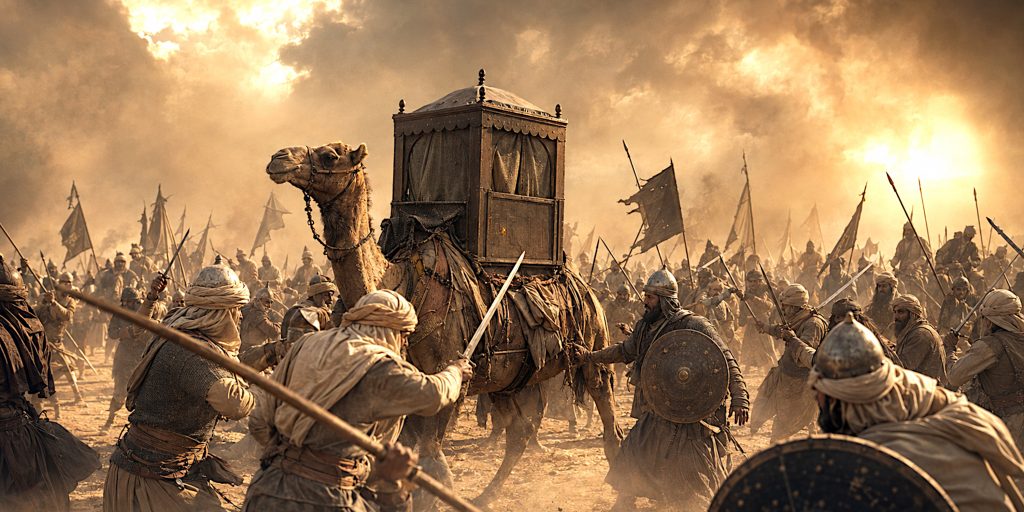
The Battle of the Camel in 656 is frequently misunderstood as a major engagement between camel-mounted armies. Its name derives from the camel carrying ʿAʾisha’s armoured litter, which became the focal point of the fighting near Basra.
Supporters gathered around the animal and defended it fiercely. As long as the camel and litter remained standing, they had a visible rallying point. The fighting reportedly subsided after the animal was brought down and ʿAʾisha was removed to safety.
The battle demonstrates the camel’s symbolic and command value, but it was not a classic camel cavalry engagement. The animal functioned more like a mobile standard or command platform.
What Contemporary and Near-Contemporary Sources Say
The evidence is scattered among religious texts, poetry, inscriptions and chronicles. Many detailed narratives were written generations after the events they describe.
The Qur’an offers the closest surviving literary evidence from seventh-century Arabia. It repeatedly treats livestock and mounts as sources of wealth, transport and military strength. One passage instructs believers to prepare:
“Whatever force you can muster, including warhorses.”
The explicit emphasis on horses in battle is revealing. Camels were everywhere in Arabian campaigning, yet the horse retained particular prestige as a combat animal.
The poet ʿAntarah ibn Shaddād, traditionally placed in the sixth century, celebrated horses, spears and swords rather than camel charges. In one famous passage, he describes his horse complaining through:
“Tears and a soft whinny.”
The surviving form of the poem cannot be treated as an untouched battlefield transcript, but its martial vocabulary reflects the prestige attached to horse combat.
Later writers such as al-Balādhurī, al-Ṭabarī and Ibn Aʿtham preserve extensive material on the conquests. They regularly mention camels as mounts, booty and transport. Their accounts must be read critically because they were compiled long after the first campaigns and often shaped by political, tribal and religious concerns.
Procopius, writing in the sixth century, describes Arab allies within Byzantine armies. His account of the Battle of Callinicum in 531 is particularly hostile towards the Ghassanid commander al-Harith. He claims that the Arab troops:
“Turned and fled away.”
Other sources give a less accusatory account, and modern historians have questioned whether Procopius was shifting blame after a Byzantine defeat. More importantly, these Arab auxiliaries should not automatically be imagined as camel cavalry. Ghassanid battlefield forces included substantial horse-mounted contingents.
Archaeology and Material Evidence
Archaeology provides a useful corrective to literary accounts, but the record is frustratingly incomplete.
Organic equipment rarely survives in Arabian conditions unless deposited in exceptionally dry or protected environments. Saddles, reins, leather quivers, bow cases and textile armour usually disappear. Iron weapons corrode, while prestigious objects may remain in use for generations or acquire later inscriptions.
Camel bones and settlement evidence
Camel remains have been recovered from sites across Arabia and the Near East. Changes in their distribution help scholars examine trade, husbandry and transport, but identifying a specifically military camel from its bones is difficult.
Possible clues include:
- Pathological changes caused by repeated heavy loading
- Bone wear associated with long-distance movement
- Concentrations of camel remains at forts or caravan stations
- Tack fittings found in military contexts
- Dung deposits and tethering areas
- Rock art showing armed riders
None of these automatically proves the existence of a battlefield camel corps.
Rock art and inscriptions
Arabian rock art contains numerous camel images, some accompanied by riders, weapons or inscriptions. Dating individual carvings can be difficult because similar motifs were produced across long periods.
Early Arabic and pre-Islamic inscriptions also illuminate tribal movement, raiding and pastoral life. They rarely provide the orderly unit descriptions that military historians would dearly like ancient people to have carved beside their pictures.
Desert roads and stations
Archaeological surveys have identified routes, wells, forts and stopping places across Arabia, Syria, Jordan, Iraq and Egypt. These landscapes reveal the infrastructure behind camel movement.
During the Umayyad period, desert residences and stations were connected to political authority, pastoral resources and communications. Their locations show that rulers understood the importance of controlling water and movement through marginal country.
Weapons
Early Islamic swords are uncommon and frequently difficult to date. Some blades preserved in later religious or imperial collections carry traditional associations with famous figures, but provenance is often uncertain.
Material evidence nevertheless indicates continuity with Late Antique weapon forms:
- Straight double-edged blades
- Simple guards
- Organic grips
- Rounded, flattened or compact pommels
- Scabbards suspended from belts or baldrics
Strongly curved sabres became more visible in Islamic armies later, particularly as Turkic military influence increased. The familiar scimitar silhouette should therefore be used sparingly in reconstructions of the seventh century.
Artistic evidence
Early Islamic art often avoided detailed narrative battle scenes. More useful visual evidence comes from:
- Late Roman and Sasanian depictions
- Umayyad sculpture and wall painting
- Coins and metalwork
- Rock carvings
- Later manuscripts preserving older themes
Each has limitations. Art can reveal equipment and status, but artists simplified, copied and imagined. A painted sword is evidence for how someone chose to represent a sword, which is useful, though not quite the same thing as finding one in the ground.
Advantages of Camel-Mounted Troops
| Advantage | Practical effect |
|---|---|
| Desert endurance | Extended operating range |
| Low water demand | Reduced dependence on wells |
| Carrying capacity | More provisions and ammunition |
| Mobility across arid terrain | Enabled unexpected approaches |
| Height | Improved observation |
| Familiarity among Arab riders | Efficient handling and navigation |
| Ability to support horses | Preserved cavalry strength |
| Economic value | Mount, pack animal and source of milk |
Camels allowed relatively small forces to threaten a wide area. Settlements, caravans and frontier posts could not assume that distance from a major water source provided security.
Their presence also complicated enemy planning. A defending army tied to roads and depots could struggle to pursue raiders who disappeared into the steppe.
Disadvantages and Limitations
| Disadvantage | Military consequence |
|---|---|
| Slower acceleration than a horse | Poorer performance in sudden charges |
| Wide turning circle | Less agile in close combat |
| Tall saddle position | Difficult sword reach against infantry |
| Slow mounting process | Vulnerable during surprise attacks |
| Temperamental behaviour | Required experienced handlers |
| Vulnerability of legs and neck | Exposed to missiles and spears |
| Difficulty in dense formations | Less suitable for disciplined shock tactics |
| Poor performance on some wet or rocky ground | Reduced versatility outside arid regions |
| Limited archaeological evidence | Easy for later writers to exaggerate their role |
Camels could unsettle horses unfamiliar with them, but this effect should not be treated as a guaranteed battlefield weapon. Horses raised alongside camels were unlikely to panic merely because one appeared nearby.
They were also conspicuous targets. A rider seated high above the ground was easy to see, and an injured camel could collapse awkwardly beneath its load.
Camel Riders Compared with Horse Cavalry
| Feature | Camel rider | Horse cavalryman |
|---|---|---|
| Long-distance desert movement | Excellent | Limited without support |
| Water requirements | Relatively low | High |
| Tactical speed | Moderate | High |
| Acceleration | Slow | Rapid |
| Manoeuvrability | Limited | Excellent |
| Carrying capacity | High | Moderate |
| Mounted archery | Possible | Generally more effective |
| Shock charge | Uncommon | Major battlefield role |
| Scouting height | Excellent | Good |
| Pursuit | Effective over distance | Superior over short distances |
| Close combat | Awkward | Better suited |
| Logistics | Outstanding | More demanding |
The two animals worked best together. Camels provided strategic reach, while horses supplied tactical speed.
An army that used only horses risked exhausting them before battle. An army that relied entirely upon camels lacked a decisive pursuit and shock arm. Early Arab commanders understood this distinction rather better than many modern strategy games.
Social Status and the Camel
Camels were measures of wealth, sources of food and objects of prestige. Ownership could determine whether a man joined an expedition mounted, travelled in rotation with others or marched on foot.
Not all camels were equal. Animals were bred and selected for different purposes:
- Fast riding camels
- Pack animals
- Milk-producing females
- Breeding stock
- Animals suited to caravan work
- Prestigious mounts associated with elite ownership
Capturing camels could be both economically profitable and politically humiliating. Raids on herds attacked a community’s wealth, mobility and food supply simultaneously.
The relationship between rider and animal was practical but close. A good camel knew familiar routes, responded to voice commands and could kneel for loading or mounting. Losing one in open desert could be fatal, which gives a certain weight to early accounts that list camels among the most important spoils of war.
Training and Daily Life
A competent camel rider required skills rarely mentioned in battle chronicles.
These included:
- Judging the condition of the animal
- Locating water and grazing
- Loading the saddle evenly
- Treating sores caused by tack
- Navigating by terrain and stars
- Controlling the camel by rein, voice and stick
- Mounting as it rose from a kneeling position
- Managing frightened or injured animals
- Protecting water skins
- Travelling during cooler hours
- Reading tracks and weather
Military effectiveness depended upon this knowledge. A heavily armed stranger placed on a camel was not automatically a camel warrior. He was more likely to become an argument between gravity and dignity.
Myths and Misconceptions
Early Islamic armies were mainly camel cavalry
They were not. Camels were essential to movement and supply, while most battlefield cavalry rode horses.
Every camel rider carried a curved scimitar
The prestigious early Arab sword was usually straight. Deeply curved sabres became widespread later.
Camels regularly charged formed infantry
Direct charges were possible but probably unusual. Camels were better suited to transport, scouting, raiding and skirmishing.
The smell of camels always frightened horses
Ancient authors mention horses reacting badly to camels, but trained horses could become accustomed to them. It was a situational advantage, not an enchanted ability.
Camel riders alone enabled the Arab conquests
They contributed to operational mobility, but the conquests also depended upon political organisation, infantry, horse cavalry, leadership, diplomacy, taxation and weaknesses within the Byzantine and Sasanian empires.
The Battle of the Camel was a camel cavalry battle
It was named after the camel carrying ʿAʾisha’s litter. The fighting centred upon the animal, but the battle was not fought by massed camel formations.
Decline or Adaptation?
Camel-mounted warfare did not disappear after the early medieval period. It remained useful wherever desert geography made motorless transport difficult.
Within the expanding Islamic world, however, elite battlefield cavalry became increasingly associated with horses. Iranian and Central Asian traditions brought new forms of mounted archery, armour, saddles and curved swords. Under the Abbasids, Turkic horsemen eventually became particularly influential.
Camels continued to serve as:
- Baggage animals
- Caravan escorts
- Desert patrol mounts
- Courier transport
- Platforms for archers
- Frontier reconnaissance animals
- Mounts for tribal levies
Later Islamic states occasionally fielded organised camel troops. Camel-mounted firearms and small artillery appeared in the early modern period, but these belong to a very different military world.
Where to See Early Islamic Arms and Camel Evidence
Objects directly identified with early medieval Arab camel riders are rare, but several collections offer relevant material.
British Museum, London
The British Museum holds early Islamic weapons, metalwork, coins and material from Arabia and the Near East. Its collections help place Arab military equipment within the wider Late Antique and Islamic worlds.
Metropolitan Museum of Art, New York
The Met possesses an extensive collection of Islamic arms and armour, including an early dated Islamic sword. Most of its armour is later than the first conquests, so visitors should check individual dates carefully. The museum’s catalogue of Islamic Arms and Armor is available online.
Topkapı Palace, Istanbul
The palace preserves swords traditionally associated with Muhammad, his companions and early caliphs. These are important devotional and historical objects, but individual claims of ownership cannot always be independently confirmed.
Museums in Saudi Arabia
Collections in Riyadh, al-ʿUla and other regional centres contain material relating to Arabian trade routes, inscriptions, pastoralism and camel culture. These provide the environmental context missing from conventional displays of swords and armour.
Jordan Museum, Amman
The museum’s archaeological collections help explain the development of settlement, trade and frontier society in a region central to Byzantine, Ghassanid and early Islamic movement.
Louvre, Paris
The Louvre holds early Islamic metalwork, textiles and weapons that demonstrate the mixture of Byzantine, Sasanian and regional traditions inherited by the caliphates.
Historical Legacy
The camel rider’s greatest legacy lies in the military geography of the early Islamic world.
Arab armies could cross spaces that Byzantine and Sasanian commanders often regarded as defensive barriers. Desert routes linked Arabia with Syria, Iraq and Egypt. Camels carried the water, food and equipment that turned those routes into usable lines of communication.
This did not make every rider a camel lancer. It created something more strategically valuable: armies that were difficult to isolate from their own environment.
The romantic camel cavalryman, sword raised against the horizon, is not entirely fictional. Raiders, scouts and warriors did fight from camelback. Yet the ordinary working reality involved long marches, careful loading, unpleasant saddles, scarce water and animals with strong opinions.
The early Arab camel rider was successful because he understood distance. His weapon was sometimes a spear, bow or straight sword. Just as often, it was the ability to keep moving after everybody else’s horses needed to stop.
Frequently Asked Questions
Did early Arab warriors fight from camels?
Yes, particularly during raids, scouting and skirmishing. However, many rode camels to the battlefield and then fought on foot or transferred to horses.
What sword did early Arab camel riders use?
The typical sword was the sayf, generally a straight, double-edged cutting and thrusting weapon. Strongly curved scimitars are more characteristic of later periods.
Did they wear armour?
Wealthier warriors could wear mail shirts and iron helmets. Poorer fighters relied upon shields, layered clothing and mobility. Full camel armour was rare.
Were camels better than horses in battle?
Camels were better for long desert journeys and carrying supplies. Horses were faster, more agile and better suited to charges, pursuit and close combat.
Were camel riders responsible for the early Islamic conquests?
They supported the conquests by providing transport, reconnaissance and logistical reach. The victorious armies nevertheless depended upon infantry, horse cavalry, command, diplomacy and the political condition of their opponents.
Why is the Battle of the Camel called that?
It was named after the camel carrying ʿAʾisha’s litter. The animal became the centre of resistance and a rallying point during the battle.
SEO Meta
SEO title: Arab Camel Riders: Warfare, Weapons and History
Meta description: Discover the history of early medieval Arab camel riders, including their weapons, armour, tactics, archaeology and role in the Islamic conquests.
Suggested URL: /arab-camel-riders-early-medieval/
Primary keyphrase: early medieval Arab camel riders
Secondary keyphrases: Arab camel cavalry, early Islamic warfare, camel-mounted warriors, Arab swords and armour, camels in Islamic conquests
Social title: Arab Camel Riders: The Reality Behind the Legend
Social description: Camel riders transformed desert warfare, but rarely in the way films and games suggest. Explore their weapons, tactics and real military role.