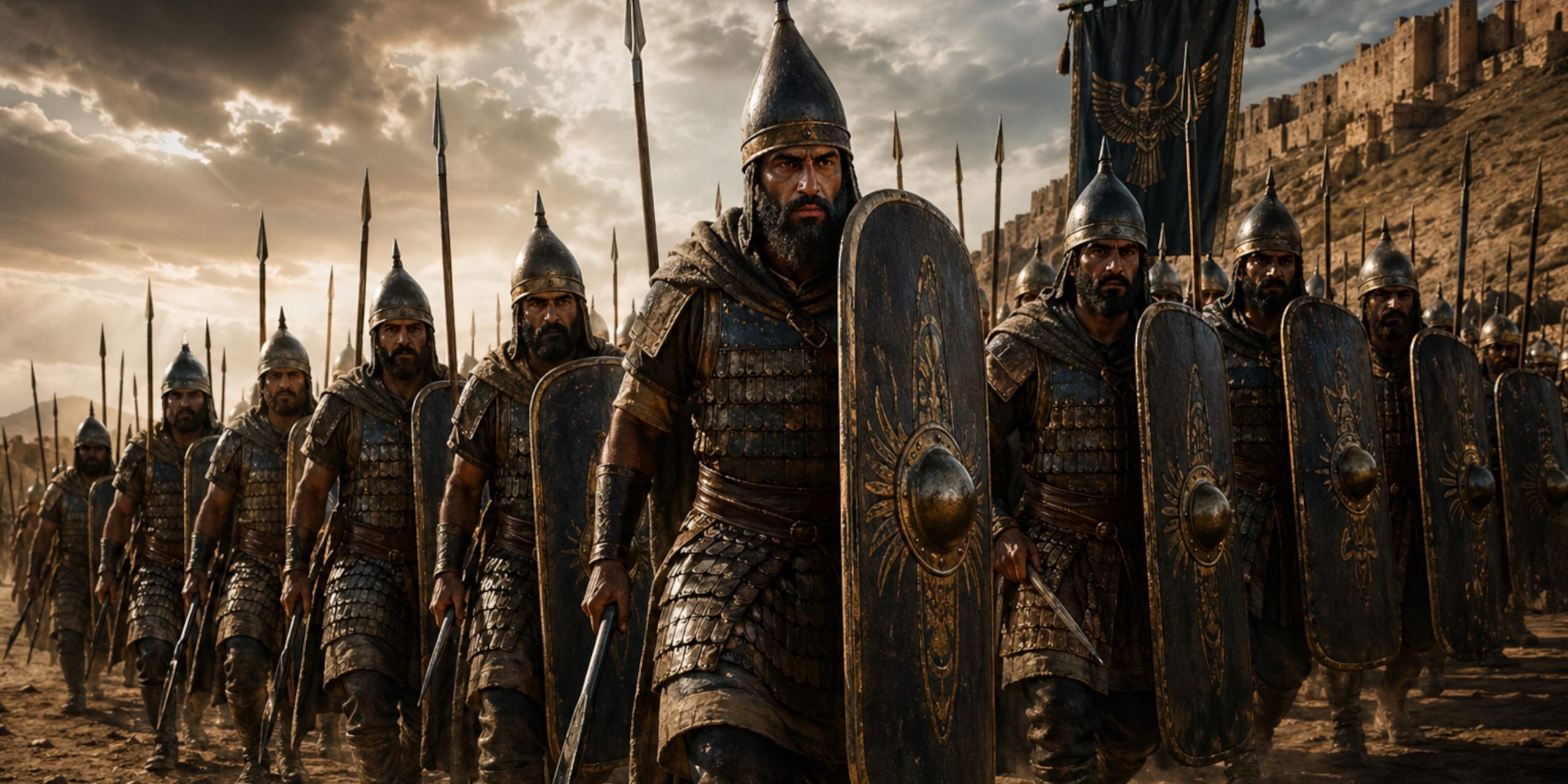
There is something quietly unsettling about the Assyrian army. It does not feel improvised or heroic in the romantic sense. It feels organised, deliberate, and relentless. By the 9th century BCE, the Neo-Assyrian Empire had developed what is arguably the first fully professional standing army in history, and at its core stood the heavy infantry.
These were not militia levies pulled from farms at short notice. They were trained soldiers, equipped by the state, drilled into formation, and expected to march, fight, and endure with mechanical consistency. When they advanced, they did so as part of a system rather than as individuals seeking glory.
Historical Context and Development
The rise of Assyrian heavy infantry sits within the broader expansion of the Neo-Assyrian Empire, particularly under rulers such as Ashurnasirpal II, Tiglath-Pileser III, and Sennacherib.
Earlier Mesopotamian armies had relied heavily on levies and chariot elites. The Assyrians changed this balance. They created a multi-arm force where infantry, cavalry, archers, and engineers operated together. Heavy infantry became the backbone of this system, holding ground, protecting archers, and leading assaults.
By the 7th century BCE, particularly under Ashurbanipal, the army had reached a level of coordination that feels surprisingly modern. Siege warfare, logistics, and battlefield integration were not afterthoughts. They were the point.
Role on the Battlefield
Assyrian heavy infantry were not glamorous, but they were essential.
They served several key roles:
- Forming shielded front lines during open battle
- Protecting archers and slingers behind them
- Leading assaults against fortified positions
- Supporting siege operations, including ladders and battering rams
- Maintaining order during prolonged campaigns
Reliefs from Nineveh show tightly packed formations, often advancing under large shields while archers fired from behind. It is not difficult to imagine the sound. Boots, shields, shouted commands, and then the sudden chaos of impact.
Arms and Armour
Assyrian heavy infantry were defined by consistency of equipment. This was not a loose collection of personal gear. It was standardised, practical, and designed for both protection and intimidation.
Core Equipment
- Helmets made of bronze or iron, often conical or rounded
- Scale armour constructed from overlapping metal plates sewn onto leather or fabric
- Large rectangular or slightly curved shields, sometimes reaching from shoulder to knee
- Spears used as primary weapons for thrusting and formation fighting
Sword Types
Swords were secondary weapons, but they were far from insignificant.
- Short swords or daggers were common, often with straight double-edged blades
- These resemble what scholars broadly classify as Near Eastern short swords, distinct from later Greek or Roman forms
- Some examples show a leaf-shaped blade, though simpler straight forms dominate
Unlike the later Gladius, Assyrian swords were not part of a tightly codified system of fencing or drill as far as we can tell. They were practical sidearms, used when formations broke or in close quarters during sieges.
Shields and Formation Use
The shield deserves particular attention. Assyrian heavy infantry often used large body shields, sometimes supported by dedicated shield bearers when covering archers. This created a layered defence that could absorb missile fire while maintaining forward pressure.
It is not elegant warfare. It is efficient warfare.
Organisation and Discipline
What sets Assyrian heavy infantry apart is not just their equipment, but how they were used.
Units were organised, likely along administrative and military lines tied to the imperial system. Officers maintained discipline, and soldiers were expected to operate within coordinated formations rather than as individuals.
There is a certain grim professionalism here. The Assyrians were not interested in heroic chaos. They preferred controlled violence, applied steadily until resistance collapsed.
Siege Warfare and Engineering
If heavy infantry were the backbone of the Assyrian army, siege warfare was its signature.
Reliefs show infantry advancing behind mobile shields, climbing ladders, and supporting massive siege engines. They worked alongside engineers who constructed ramps and battering rams.
Cities were not just attacked. They were methodically dismantled.
At sites like Lachish, the archaeological and visual record shows a coordinated assault involving infantry, archers, and siege equipment. The heavy infantry were the ones who closed the distance, often under intense defensive fire.
One suspects this was not a popular assignment.
Archaeology
Our understanding of Assyrian heavy infantry comes largely from a combination of reliefs, inscriptions, and excavated artefacts.
Key Archaeological Sources
- Palace reliefs from Nineveh and Nimrud
- Weapon finds including spearheads, helmets, and fragments of scale armour
- Siege reliefs depicting battles such as the assault on Lachish
These reliefs are detailed, almost obsessively so. You can see the stitching of armour, the curve of shields, even the posture of soldiers under strain. They are propaganda, certainly, but they are also invaluable records.
There is always a temptation to take them at face value. A cautious historian resists that, but quietly appreciates how much detail the Assyrians chose to preserve.
Contemporary Accounts
The Assyrians were not shy about recording their own actions, though “recording” may be a polite term.
Royal inscriptions often describe campaigns in blunt, sometimes chilling language.
From the annals of Ashurnasirpal II:
“I stormed the mountain peaks and took them. In the midst of the mighty mountains I slaughtered them.”
From Sennacherib, describing the siege of Lachish:
“I besieged and captured the fortified cities… I carried off their spoil.”
These are not reflective memoirs. They are statements of dominance. The heavy infantry are rarely mentioned directly, but they are implied in every successful assault, every captured wall, every subdued city.
Strengths and Limitations
Strengths
- High level of organisation and discipline
- Standardised equipment and state support
- Effective integration with archers, cavalry, and engineers
- Strong performance in both open battle and siege warfare
Limitations
- Heavy equipment could reduce mobility in rough terrain
- Reliance on coordinated systems meant disruption could be costly
- Less flexibility compared to lighter, irregular forces
Even so, the advantages outweighed the drawbacks. The Assyrian army dominated the Near East for centuries, and heavy infantry were central to that success.
Legacy
The influence of Assyrian heavy infantry extends further than is often acknowledged.
Their emphasis on:
- Professional standing forces
- Combined arms tactics
- Siege warfare as a central strategy
can be traced forward into later empires, including the Persians and, in more distant form, the Romans.
There is a tendency to view the Assyrians primarily through the lens of brutality. That is not entirely unfair. Yet it risks missing the more interesting point. They were innovators of military structure, and their heavy infantry were a key part of that system.
Seven Swords Takeaway
Assyrian heavy infantry do not inspire the same romantic fascination as Greek hoplites or Roman legionaries. They lack the tidy narratives and later literary tradition.
What they offer instead is something more grounded. A glimpse of warfare becoming organised, institutional, and, frankly, efficient in a way that feels uncomfortably familiar.
If you stand in front of an Assyrian relief and look closely, you start to notice the repetition. The same shields, the same armour, the same steady advance.
That is the point.