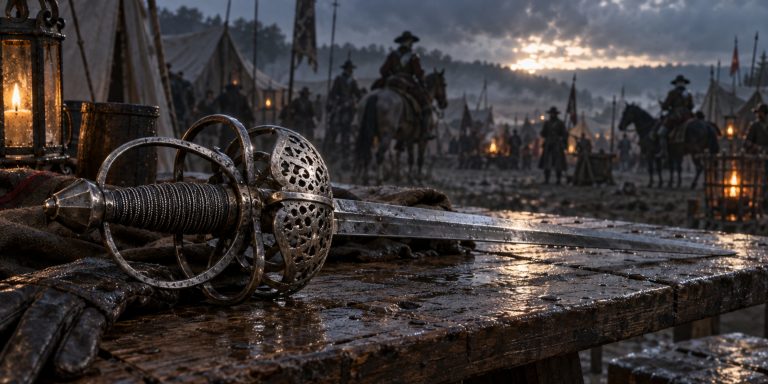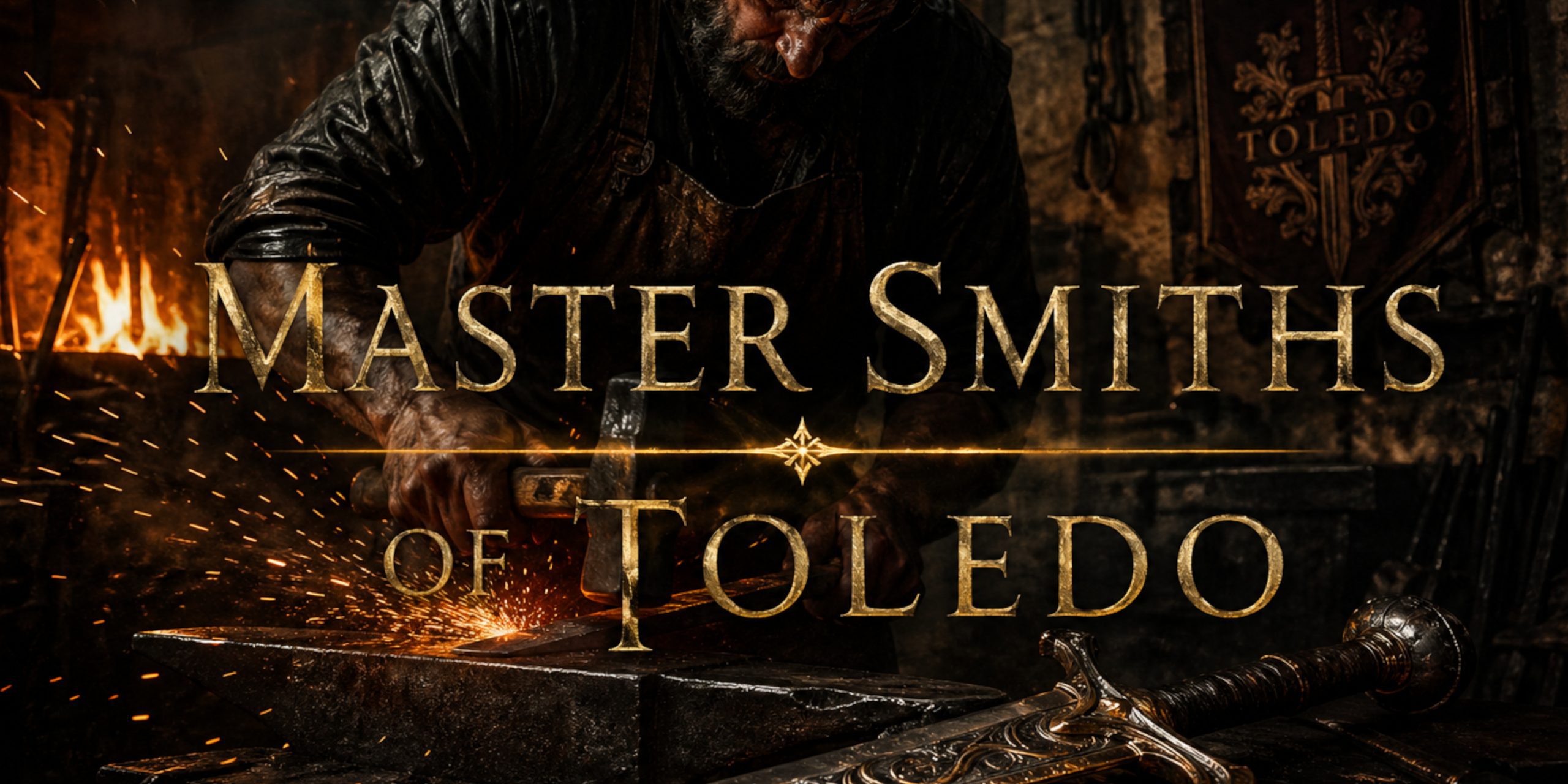
Toledo has a habit of appearing in history with a blade in hand. Perched above the Tagus, the city became synonymous with steel of such quality that kings trusted it with their lives and soldiers trusted it with their final arguments. The phrase “Toledo steel” was not a marketing invention, it was a warning.
What tends to get lost in that reputation is the human side. Behind every admired blade stood a craftsman whose name was sometimes stamped, sometimes whispered, and often forgotten entirely. These master smiths did not simply produce weapons. They built a tradition that survived Roman occupation, Islamic rule, and the ambitions of Spanish kings who understood that a good sword could be as valuable as a loyal army.
The Origins of Toledo Steel
Toledo’s rise as a centre of metallurgy begins in antiquity. The Romans valued Iberian steel, noting its flexibility and resilience. Later, under Islamic rule, the city absorbed techniques that likely drew from eastern traditions, including pattern welding and advanced heat treatment.
By the medieval period, Toledo had become a controlled and regulated hub for weapon production. Guilds governed quality, methods, and trade. A sword was not merely forged and sold, it was certified. That level of oversight did not stifle innovation, it refined it.
There is a certain irony here. The mystique of Toledo steel often feels romantic, yet its success rested on strict rules, inspections, and a rather bureaucratic approach to excellence.
The Craft, Materials, and Methods
Toledo blades gained their reputation through a balance of hardness and flexibility. Too hard and a sword snaps. Too soft and it bends like a bad promise. The smiths of Toledo found the middle ground.
Key elements of their craft included:
- Careful selection of iron and carbon content
- Repeated heating and hammering to remove impurities
- Quenching techniques that controlled hardness
- Tempering to restore flexibility
- Skilled grinding and polishing to refine the edge
Unlike some regions that relied heavily on pattern welding for visual effect, Toledo smiths prioritised performance. Their blades could flex and return to true, a quality that impressed both soldiers and those who preferred not to be cut in half.
Water sources around Toledo were also believed to play a role. Whether this was chemistry or superstition is still debated. Historians tend to favour chemistry. Locals tend to favour pride.
Notable Master Smiths of Toledo
Records are uneven, but several names have endured.
Juan Martínez
A 15th century master often cited in guild records. His work reflects the transition from medieval blades to early Renaissance forms.
Pedro Hernández
Known for producing high quality rapiers during the 16th century, when Spain’s military and duelling culture demanded precision over brute force.
Tomás de Ayala
Associated with royal commissions. His blades were reputed to meet the demanding standards of the Spanish court.
Diego de Zayas
A name tied to later Renaissance production, particularly elegant civilian swords that balanced function with artistry.
It is worth noting that many smiths remained anonymous. Guild systems often prioritised the workshop over the individual. The ego of the craftsman was secondary to the reputation of Toledo itself, which feels almost unthinkable today.
Famous Swords and Blades
Several types of swords became closely associated with Toledo production.
- Favoured in the 16th and 17th centuries
- Long, slender blades designed for thrusting
- Often carried by nobles and officers
Smallswords
- Lighter successors to the rapier
- Used in duelling and court life
- Elegant, refined, and sometimes more dangerous than they looked
Military Blades
- Broader and more robust
- Issued to Spanish troops during imperial campaigns
- Built for battlefield durability rather than finesse
Some surviving blades bear inscriptions such as “No me saques sin razón, no me envaines sin honor”
Translation, do not draw me without reason, do not sheath me without honour.
It is a line that sounds noble until one considers how often swords were drawn for rather poor reasons.
Reputation Across Europe
Toledo steel travelled far beyond Spain. Kings, mercenaries, and collectors sought these blades across Europe.
French and Italian nobles imported Toledo rapiers. English officers admired their resilience. Even regions with strong local traditions acknowledged Toledo’s standing, albeit sometimes through gritted teeth.
The Spanish Crown protected this reputation carefully. Export controls and quality checks ensured that inferior blades did not dilute the name. In effect, Toledo became an early example of a controlled brand, long before modern trademarks.
Contemporary Quotes
Historical references to Toledo blades appear in literature and accounts from across Europe.
“The blades of Toledo bend but never break.”
Attributed to Spanish military commentary of the early modern period
“A good Toledo sword is worth a soldier’s confidence.”
Paraphrased from 16th century accounts of European mercenaries
Miguel de Cervantes, writing in the early 17th century, alludes to the reputation of Spanish blades in Don Quixote, where arms and honour are treated with a mixture of admiration and gentle mockery. His work suggests that Toledo steel had already passed from practical tool into cultural symbol.
Guilds, Regulation, and Quality Control
The guild system in Toledo enforced consistency. Each blade underwent inspection. Faults could lead to rejection, fines, or worse, damage to a smith’s standing.
Marks and stamps served as guarantees of origin and quality. These early forms of branding helped buyers distinguish genuine Toledo blades from imitations.
One suspects that counterfeiters existed in abundance. Wherever reputation grows, imitation follows close behind, usually with less skill and more enthusiasm.
Decline and Transformation
The decline of Toledo’s dominance came gradually.
Firearms reduced the battlefield importance of swords. Changing tastes favoured lighter, decorative blades. Industrial production in other regions began to compete with traditional craftsmanship.
By the 18th century, Toledo remained respected but no longer unrivalled. Its identity shifted from military necessity to cultural heritage.
Legacy and Modern Toledo Steel
Toledo still produces blades today, though many are ceremonial or intended for collectors and tourists. The city’s reputation endures, even if the context has changed.
Museums and collections preserve original works, offering a glimpse into the skill that built Toledo’s name. Holding one of these blades, even behind glass, makes the reputation feel earned rather than exaggerated.
Modern reproductions vary widely. Some honour the tradition. Others rely more on the name than the craft. As ever, the buyer must decide which they prefer.
Seven Swords Takeaway
Toledo’s master smiths achieved something rare. They created a standard that outlived them. Their names may not all survive, but their work shaped the expectations of what a sword should be.
There is a quiet satisfaction in that. Steel fades, empires collapse, but a well made blade, and the idea behind it, tends to linger.
And if nothing else, Toledo leaves us with a simple truth. If you are going to trust your life to a piece of metal, it might as well be made by someone who took it very seriously indeed.