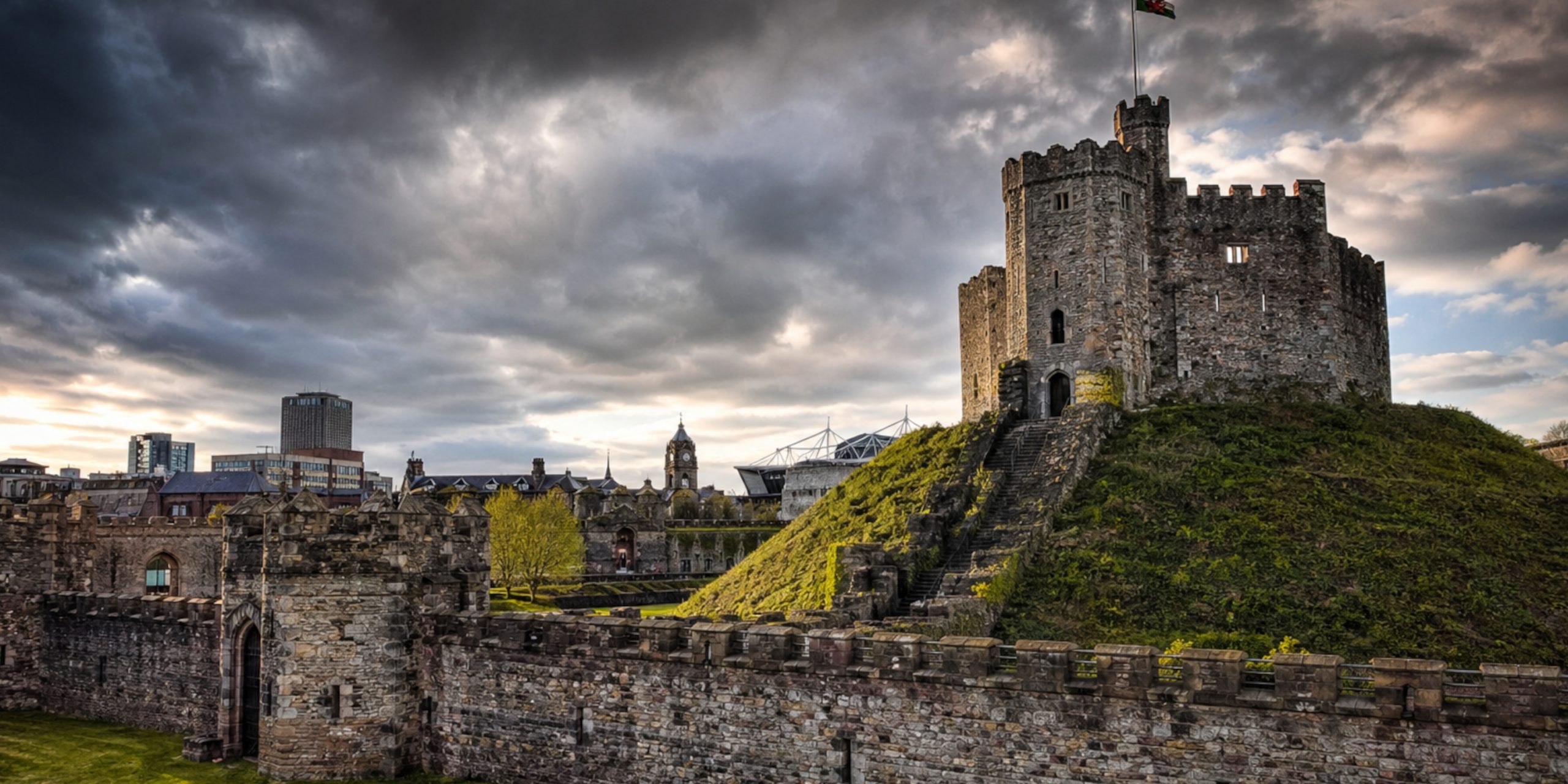
Cardiff Castle sits at the quiet heart of a busy capital, which feels faintly unfair to everything it has endured. Roman soldiers, Norman lords, medieval princes, Civil War garrisons and Victorian dreamers have all left their mark here. The result is not a single castle in the tidy sense, but a layered site where each century has added something rather than politely stepping aside.
If you stand in the outer ward today, you are effectively standing in several different periods at once. The Romans began it, the Normans fortified it, the medieval Welsh contested it, and the 19th century turned parts of it into something approaching fantasy.
Origins and Early Development
Long before stone towers rose above Cardiff, the site was already strategically valuable. Around the late 1st century AD, the Roman conquest of Britain brought Roman military infrastructure deep into south Wales. A fort was established here to control movement along the coast and into the Welsh interior.
- Early Roman timber fort replaced with stone walls in the 3rd century
- Defensive walls built using limestone and reused Roman materials
- Positioned to guard the River Taff and coastal approaches
Fragments of those Roman walls still stand, which gives Cardiff Castle a rare continuity. Many castles claim ancient roots. This one can point to visible Roman masonry and quietly let that fact speak for itself.
Norman Castle and Medieval Expansion
After the Norman Conquest, the site was transformed into a motte and bailey castle. The Normans did not waste time appreciating Roman ruins, they built straight on top of them.
- The great motte raised using earth from surrounding ditches
- A wooden keep replaced by a stone shell keep in the 12th century
- Extensive curtain walls enclosing the inner ward
The keep remains one of the most striking features today. It is steep, imposing, and mildly inconvenient to climb, which is precisely the point.
During the medieval period, the castle became a key marcher stronghold. Control of Cardiff meant influence over trade, movement, and local power in south Wales. Unsurprisingly, it changed hands more than once.
Occupants Timeline
A castle like this is best understood through its occupants, each leaving a different imprint.
Roman Period
- Roman garrison units stationed on site
- Fort used for regional control and coastal defence
Norman Lords
- Robert Fitzhamon established Norman control
- Later held by the powerful Richard de Clare family
Medieval Welsh Conflicts
- Targeted during Welsh resistance under leaders such as Owain Glyndŵr
- Periods of instability and contested ownership
Tudor and Early Modern Period
- Gradual decline in military importance
- Shift towards administrative and residential use
Bute Family Era
- Acquired by the John Crichton-Stuart in the 19th century
- Transformed into an extravagant Gothic revival residence
Modern Period
- Given to the city of Cardiff in 1947
- Now a major heritage attraction
It is worth noting that the Bute family did not simply restore the castle. They reimagined it, with enthusiasm and a considerable budget.
Sieges and Conflict
Cardiff Castle has not seen the sheer scale of prolonged sieges that define some English strongholds, but it has experienced repeated pressure, occupation, and skirmish.
Medieval Welsh Uprisings
- Attacked during regional rebellions
- Strategic importance made it a recurring target
Owain Glyndŵr’s Revolt
- Welsh forces captured Cardiff in 1404
- The town was burned, though the castle itself held out
English Civil War
- Garrisoned by Royalist forces
- Later taken by Parliamentarians during shifting control of south Wales
Compared with castles on the Anglo-Scottish border, Cardiff’s conflicts were less about long sieges and more about control during wider campaigns. It was a piece on the board rather than the entire game.
Victorian Transformation
The 19th century brought a change that still divides opinion. Under the 3rd Marquess of Bute and architect William Burges, Cardiff Castle became something extraordinary.
- Lavish interiors inspired by medieval and classical themes
- The famous Arab Room, rich with gold leaf and intricate decoration
- Clock Tower designed with symbolic and artistic detail
This was not restoration in a strict historical sense. It was imagination, scholarship, and theatrical flair combined. Some rooms feel closer to a dream of the Middle Ages than the Middle Ages themselves.
And yet, it works. Somehow.
Archaeology and Discoveries
Cardiff Castle offers a layered archaeological record that continues to inform historians.
- Roman wall sections and foundations clearly visible
- Excavations revealing earlier timber fort phases
- Medieval artefacts including pottery, tools, and defensive structures
- Evidence of continuous occupation across nearly two millennia
Modern archaeological work has focused on understanding how each phase interacted with the previous one. The Romans laid foundations that the Normans exploited, which later builders adapted again. It is less a clean timeline and more a conversation across centuries.
Architecture and Layout
The castle is best understood as three overlapping zones:
- Roman Walls forming the outer defensive boundary
- Norman Keep dominating the motte at the centre
- Victorian Gothic Interiors transforming the residential quarters
This combination creates a slightly disorienting experience. You can move from Roman stonework to medieval fortification to Victorian fantasy in a matter of minutes.
Contemporary Accounts and Quotes
Historical voices give some sense of how the castle was perceived across time.
From medieval chroniclers describing Welsh uprisings:
“The town was taken and burned, yet the stronghold endured above it.”
Attributed to accounts of Glyndŵr’s campaign.
From Victorian commentary on the Bute restoration:
“A palace of romance raised upon the bones of history.”
Modern historians tend to be more measured, though perhaps less poetic.
Cardiff Castle Today
Today, Cardiff Castle stands as one of Wales’ most visited historic sites. It serves several roles at once:
- Heritage attraction and museum
- Cultural venue for events and exhibitions
- Symbol of Cardiff’s long and layered past
It is also, rather conveniently, located in the centre of the city. Medieval lords would likely have approved of the footfall.
Legacy
Cardiff Castle represents continuity rather than dominance. It was never the largest fortress in Britain, nor the most heavily fortified. Its strength lies in survival and adaptation.
Roman engineers, Norman conquerors, Welsh rebels, and Victorian patrons all left something behind. The castle did not resist change, it absorbed it.
That may be its most defining trait.