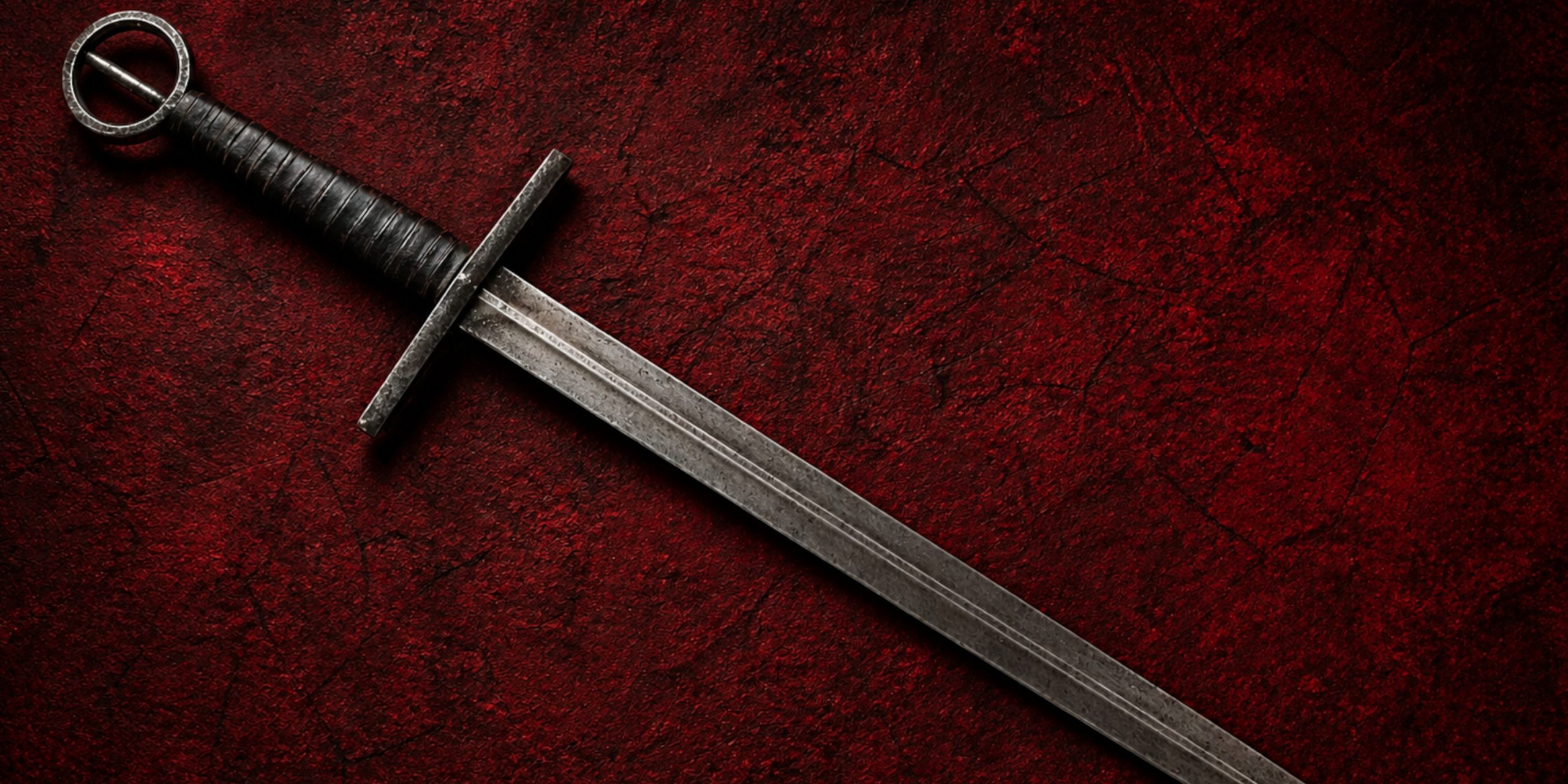
The Irish ring-pommel sword is one of the most distinctive weapons associated with early medieval Ireland. At a glance, the defining feature is obvious, a circular ring set into the pommel, often large, sometimes ornate, always deliberate. This is not a decorative afterthought but a structural and symbolic choice tied to identity, status, and cultural exchange.
These swords appear most frequently between the 9th and 11th centuries, particularly in areas shaped by Norse settlement such as Dublin. They sit at the intersection of Gaelic tradition and Viking influence, which gives them a slightly hybrid character. They are not purely Scandinavian, nor purely native. They belong to that uneasy but fascinating middle ground.
Specification
| Feature | Detail |
|---|---|
| Blade type | Double-edged, straight |
| Blade length | 70 to 85 cm |
| Overall length | 85 to 100 cm |
| Weight | 1.0 to 1.4 kg |
| Fuller | Present, often broad and shallow |
| Hilt construction | Short grip, straight guard |
| Pommel | Distinctive ring or loop |
| Materials | Pattern-welded iron cores with steel edges in earlier examples, later more uniform steel |
| Balance point | Typically 10 to 15 cm from guard |
Key Characteristics
- Prominent ring pommel, sometimes large enough to pass a finger through
- Compact grip suited to one-handed use
- Broad cutting blade with moderate taper
- Often associated with high-status burials or urban centres
History and Evolution
The ring-pommel sword emerges in Ireland during the Viking Age, roughly from the late 8th century onwards. Its presence is closely tied to Norse activity, particularly in coastal settlements like Dublin, Waterford, and Limerick.
Early forms likely developed from Scandinavian sword traditions, where ring elements occasionally appeared on hilts. In Ireland, this feature became more pronounced and consistent, suggesting local adaptation rather than simple import.
Over time, a few trends become clear:
- Early examples show strong Scandinavian typology, especially in blade form
- Later Irish variants develop more exaggerated ring pommels
- Decoration varies from plain iron to silver inlay and pattern work
- Use declines after the 11th century as sword forms evolve toward high medieval styles
There is also a cultural dimension. The ring may have carried symbolic meaning, possibly linked to oath-taking or status. While definitive proof is limited, its repeated use suggests it mattered beyond function.
Advantages and Disadvantages
Advantages
- Effective cutting blade suitable for slashing attacks
- Balanced for one-handed combat, ideal alongside a shield
- Distinctive hilt improves identification and status display
- Ring pommel may assist grip retention in certain conditions
Disadvantages
- Limited thrusting capability compared to later tapered blades
- Short grip restricts leverage and two-handed techniques
- Ring pommel can catch or interfere depending on size and design
- Less versatile than later medieval arming swords
Comparison with Similar Weapons
| Weapon | Region | Key Difference |
|---|---|---|
| Viking sword (typical Petersen types) | Scandinavia | Standard lobed or Brazil-nut pommel instead of ring |
| Carolingian sword | Frankish realms | More refined blade geometry, no ring feature |
| Anglo-Saxon sword | England | Heavier guards and pommels, less emphasis on ring forms |
| Early medieval Irish sword (non-ring) | Ireland | Simpler pommel construction, less symbolic emphasis |
Observations
- The Irish ring-pommel sword stands apart visually more than functionally
- Blade performance remains broadly comparable to Viking swords
- The ring is the defining cultural marker rather than a battlefield innovation
Legacy
The legacy of the Irish ring-pommel sword is tied to identity rather than widespread influence. It does not evolve directly into later medieval sword forms, but it remains a clear marker of a specific time and place.
Its importance lies in what it represents:
- The blending of Norse and Irish martial culture
- The emergence of Dublin as a major Viking urban centre
- The role of swords as symbols of authority and wealth
Modern interest is strong among historians and collectors because the form is so recognisable. It captures a moment when cultures met, clashed, and quietly reshaped each other.
Where to See
Several important examples are held in museums across Ireland and the British Isles.
- National Museum of Ireland, Dublin
- Ulster Museum, Belfast
- British Museum, London
- Waterford Museum of Treasures
These collections often display swords recovered from river deposits, graves, and urban excavations, especially around Dublin’s Viking layers.
Collector’s Guide
Availability
- Genuine examples are rare and tightly held by institutions
- Most pieces on the market are fragmentary or heavily conserved
- Provenance is critical and heavily scrutinised
Auction Prices
| Condition | Estimated Price Range |
|---|---|
| Fragmentary blade or hilt | £5,000 to £15,000 |
| Partial sword with identifiable ring pommel | £15,000 to £40,000 |
| Near complete example with provenance | £40,000 to £120,000+ |
What to Look For
- Authentic corrosion patterns and metallurgy
- Evidence of pattern welding in earlier blades
- Construction of the ring, forged not cast in originals
- Clear archaeological provenance or documented collection history
Risks
- Modern reproductions are common and sometimes convincing
- Misidentified Viking swords without true Irish association
- Restoration work that obscures original features
For most collectors, high quality replicas offer a more realistic route. Originals sit firmly in the realm of museums and specialist buyers.