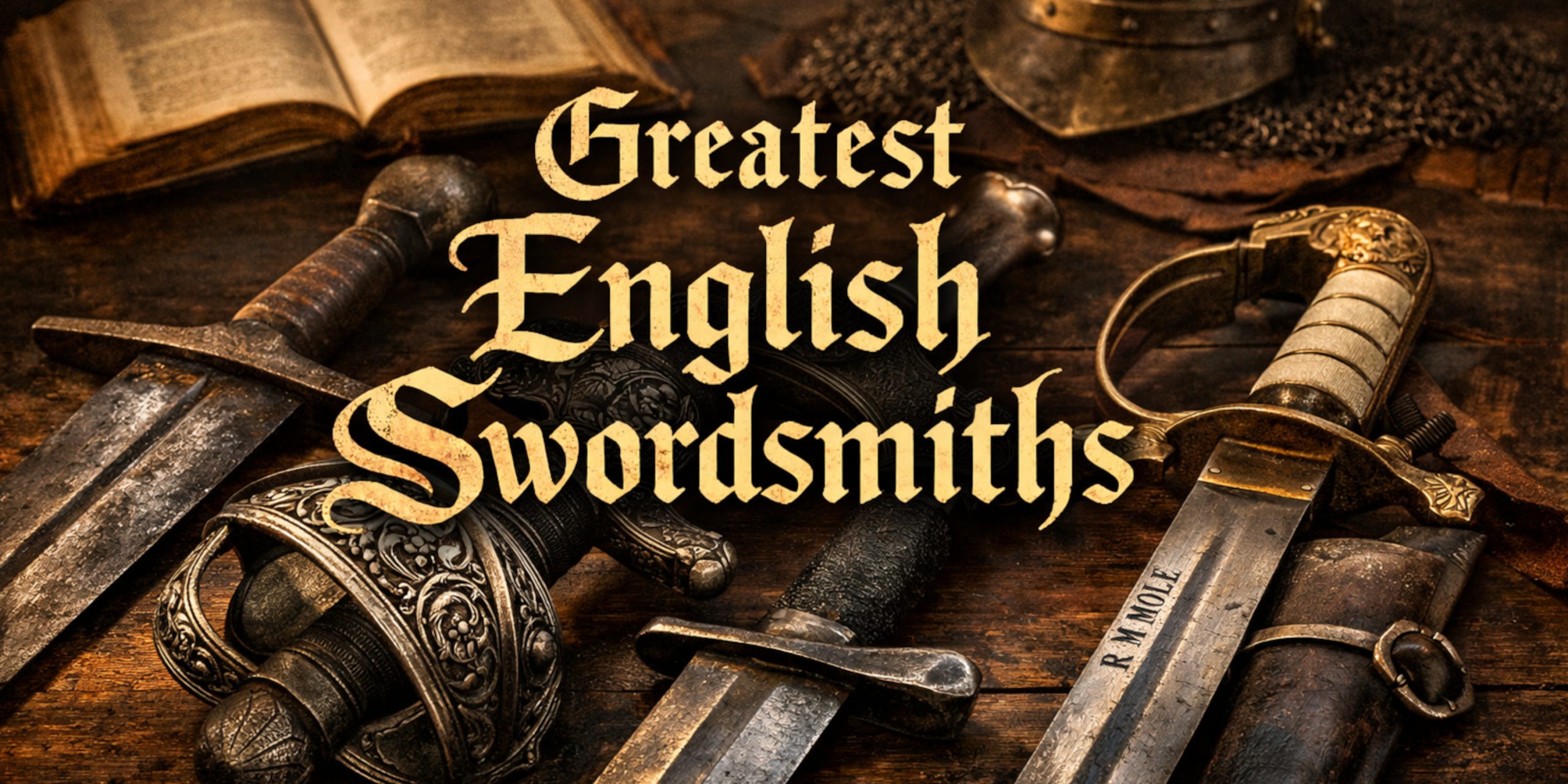
England’s swordsmiths rarely get the romance afforded to Toledo or Solingen, yet their work armed officers, cavalrymen, and sailors across centuries of war and empire. English blades were built for service rather than spectacle, and that practical mindset is exactly why so many survive, and why collectors still chase them.
This guide focuses on the most important English makers featured in the original article, with clear detail on where they worked, the era they belong to, their best-known weapons, identifying marks, and how they perform at auction today.
Henry Wilkinson and Wilkinson Sword
Wilkinson Sword
Henry Wilkinson founded his sword business in London in 1772, at a time when British military supply was becoming more formalised and quality control actually mattered. By the Napoleonic Wars, Wilkinson blades had earned a reputation for consistency and rigorous testing.
Wilkinson operated first from Soho and later Pall Mall, remaining closely tied to government contracts and officer commissions throughout the nineteenth century. What sets Wilkinson apart is documentation. From the 1820s onward, blades were serial numbered and logged, allowing precise dating that few makers can match.
Famous weapons include British infantry officer swords, cavalry sabres, and naval officer swords across multiple regulation patterns. Wilkinson blades are typically slender, well-balanced, and conservative in decoration.
Maker marks usually appear on the blade spine and include the Wilkinson name, a serial number, and often a proof slug inset into the blade. These features make authentication relatively straightforward.
At auction, Wilkinson swords are consistently strong performers. Standard nineteenth-century officer swords usually sell between £1,500 and £4,000. Rare regimental pieces, presentation swords, or blades tied to notable officers can exceed £10,000 with little effort.
Robert Mole and Sons
Robert Mole & Sons
Based in Birmingham, Robert Mole and Sons became one of the British Army’s most prolific suppliers during the nineteenth century. Unlike Wilkinson, Mole focused heavily on volume production, supplying swords not just to officers but to cavalry and colonial forces across the Empire.
The firm was active from the early 1800s through to the First World War, producing regulation patterns that followed War Office specifications closely. Their swords are not flamboyant, but they are mechanically sound and historically important.
Mole is best known for Pattern 1821 cavalry sabres, infantry officer swords, and later police and colonial service blades. Many surviving examples show clear signs of service wear, which collectors often see as a positive rather than a flaw.
Maker marks usually include “R MOLE” stamped on the blade, Birmingham proof slugs, and crown or inspector stamps. Etching tends to be restrained.
Auction prices remain relatively accessible. Most Mole swords sell between £900 and £3,000 depending on condition and completeness, making them a popular entry point for new collectors.
W and S Butcher
W & S Butcher
W and S Butcher were Sheffield cutlers who rose to prominence during the nineteenth century, benefiting from the city’s dominance in steel production. Their blades were widely issued and exported, supplying British officers as well as foreign and colonial markets.
Operating mainly from the early to mid Victorian period, Butcher swords are often well finished and more visually decorative than some Birmingham counterparts. They embraced etched blades and presentation work more readily.
Notable weapons include infantry officer swords, cavalry sabres, and export military blades. Butcher swords are particularly common in colonial service collections.
Maker marks typically read “W & S BUTCHER” and often include arrow or star motifs. Later examples may show royal warrants or crown marks.
Auction demand is steady rather than spectacular. Most Butcher swords sell between £800 and £2,500, with higher prices reserved for named, presentation, or unusually elaborate examples.
London Armourers and Early English Swordsmiths
Before named firms dominated the market, English sword production centred on London’s guild system, particularly the Worshipful Company of Armourers and Brasiers. These medieval and early modern smiths rarely signed their work in a modern sense, making attribution challenging.
Blades from this period date from the fourteenth through sixteenth centuries and were produced primarily in London workshops. They were designed for battlefield durability rather than elegance.
Weapons include medieval arming swords, hand-and-a-half swords, and early cut-and-thrust blades. Decoration was minimal, with emphasis on blade geometry and balance.
Identification relies on blade inscriptions, crosses, religious symbols, or armourers’ stamps rather than maker names. Provenance is critical.
When authenticated, English medieval swords command serious prices. Securely identified examples often exceed £40,000, driven by rarity rather than condition or ornament.
English Swordsmiths in the Twentieth Century
Wilkinson Sword continued production into the twentieth century, supplying ceremonial and service swords through both World Wars. By this point, swords were symbolic rather than functional battlefield weapons, but manufacturing standards remained high.
Later English swords are less dramatic but historically revealing, marking the final stage of sword use within a modern army.
Auction prices for post-1900 swords are modest, usually £600 to £1,200, unless tied to notable regiments or individuals.
Collecting English Swords Today
English swords reward patience and research. They are often understated, sometimes miscatalogued, and rarely dramatic at first glance. That works in a buyer’s favour.
Current collector interest focuses on:
- Napoleonic and Victorian officer swords
- Wilkinson serial-numbered examples
- Named or regiment-marked blades
- Complete swords with original scabbards
English swordsmiths may lack continental glamour, but they offer something better, reliability, documentation, and a clear place in military history.
English Swordsmiths and Sword Makers Comparison Table
| Swordsmith or Maker | Active Period | Primary Location | Notable Sword Types | Typical Maker Marks | Current Auction Range |
|---|---|---|---|---|---|
| Wilkinson Sword | c. 1772–mid 20th century | London (Soho, Pall Mall) | Infantry officer swords, cavalry sabres, naval officer swords | Wilkinson name on spine, serial numbers, proof slug | £1,500–£4,000 (exceptional pieces £10,000+) |
| Robert Mole & Sons | Early 19th century–1914 | Birmingham | Pattern 1821 cavalry sabres, infantry officer swords, colonial service blades | “R MOLE” stamp, Birmingham proof slug, crown inspection marks | £900–£3,000 |
| W & S Butcher | Early–late 19th century | Sheffield | Infantry officer swords, cavalry sabres, export military swords | “W & S BUTCHER”, arrow or star motifs, royal warrants | £800–£2,500 |
| London Armourers (Guild System) | 14th–16th centuries | London | Arming swords, hand-and-a-half swords, early cut-and-thrust blades | Crosses, religious symbols, armourers’ stamps | £25,000–£40,000+ |
| Wilkinson Sword (20th century) | 1900–1945 | London | Service and ceremonial officer swords | Wilkinson spine stamp, serial numbers | £600–£1,200 |