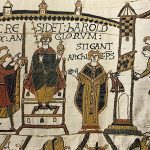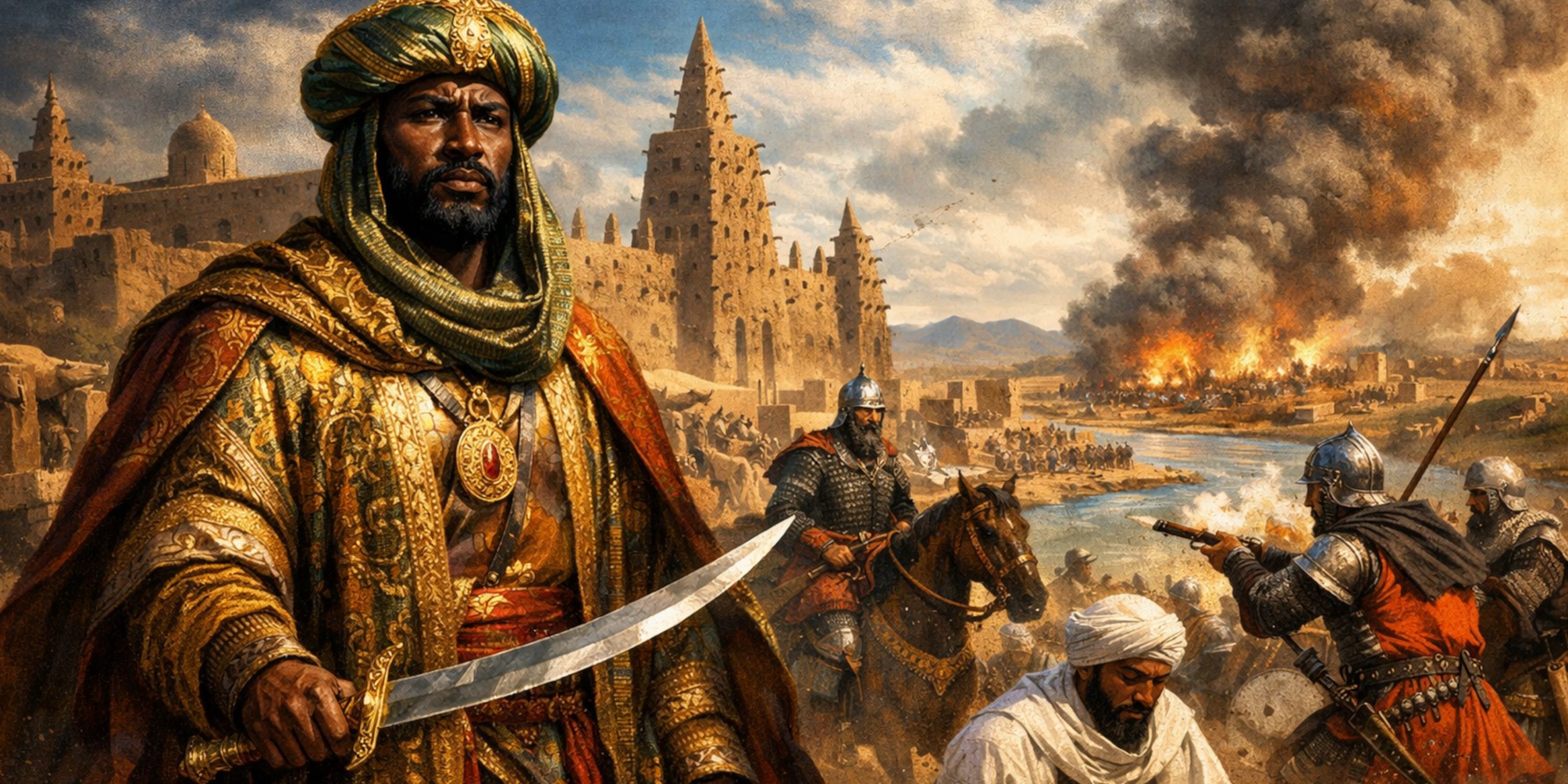
The Askia dynasty ruled the Songhai Empire at the very height of West African power. Between 1493 and 1591, Songhai stretched across much of the western Sahel, controlled the great bend of the Niger, commanded the trans-Saharan trade routes, and turned cities such as Gao, Timbuktu and Djenné into some of the richest and most learned places in the Islamic world.
There is a temptation, especially in older European histories, to treat the Songhai Empire as little more than a footnote between Mali and the arrival of Morocco. That has always struck me as rather unfair, rather like mentioning the Roman Empire only to discuss who came after it. Under the Askias, Songhai became the largest state in African history west of the Nile. It was organised, wealthy, intellectually alive and, at times, alarmingly ruthless.
The dynasty began with a coup. It ended with muskets, betrayal and the uncomfortable fact that even very large empires can be brought down by a smaller army if that smaller army arrives with gunpowder and a rather unpleasant determination.
Origins of the Askia Dynasty
The Askia dynasty began in 1493 when Muhammad Ture, better known as Askia Muhammad or Askia the Great, overthrew Sonni Baru, the son and successor of Sonni Ali.
The background to this struggle lay in the division within Songhai society after the death of Sonni Ali in 1492. Sonni Ali had built Songhai into a vast empire through conquest, particularly against the Mali Empire and the Tuareg. He was admired by soldiers and feared by almost everyone else. Contemporary chroniclers portray him as brilliant, violent and deeply suspicious. One rather suspects that dinner invitations from Sonni Ali were rarely relaxing affairs.
After Sonni Ali’s death, his son Sonni Baru inherited the throne. Baru attempted to continue his father’s rule, but he lacked his authority and perhaps his military talent. More importantly, he was opposed by many of the Muslim scholars and merchants of Songhai, particularly in Timbuktu. They viewed the Sonni dynasty as insufficiently Islamic.
Muhammad Ture, one of Sonni Ali’s leading generals, seized this opportunity. He challenged Baru, defeated him in battle in 1493, and took the title “Askia”.
The precise meaning of the title remains uncertain. Some traditions suggest it meant “usurper” or “he shall not be”. If so, it is one of the more unfortunate royal titles in history. Most kings prefer something reassuring, such as “the Great” or “Defender of the Realm”, rather than a title that sounds faintly like a muttered objection.
Askia Muhammad: Founder of the Dynasty
Askia Muhammad ruled from 1493 to 1528 and transformed Songhai from a military empire into a more organised and centralised state.
He was born Muhammad ibn Abi Bakr Ture, probably sometime in the mid-fifteenth century. He may have come from a Soninke, Fulani or mixed Songhai background. The surviving sources disagree, which is frustrating but hardly unusual. Medieval chroniclers were often excellent at describing battles and astonishingly vague when it came to mundane details such as where a ruler was born.
Under Askia Muhammad, the empire expanded dramatically. He conquered:
- Much of Hausaland to the east
- The Tuareg territories around the Sahara
- The region of Agadez
- Large parts of modern Niger and northern Nigeria
- Territories south toward the forest margins
By the early sixteenth century, the Songhai Empire stretched from the Atlantic approaches of Senegal to the fringes of modern Chad.
The Pilgrimage to Mecca
One of the defining moments of Askia Muhammad’s reign came in 1496 or 1497, when he undertook the hajj to Mecca.
This was no modest pilgrimage. Askia travelled with an enormous caravan, carrying gold, slaves, attendants and soldiers across the Sahara to Egypt and then onward to Arabia. Arab chroniclers claim he spent vast quantities of gold along the way.
In Cairo, he met the Mamluk authorities and presented himself as a great Muslim ruler. In Mecca, he received formal recognition from the Sharif of Mecca, who granted him the title “Caliph of the Western Sudan”.
The pilgrimage mattered for several reasons:
- It strengthened Askia’s legitimacy among Muslim elites
- It tied Songhai more closely to the wider Islamic world
- It increased the prestige of Timbuktu and Gao
- It brought scholars, judges and administrators back to Songhai
When Askia returned, he introduced reforms inspired by what he had seen abroad. He appointed Islamic judges, built mosques, promoted scholarship and expanded the role of Islamic law.
Government and Administration
One of the most impressive features of the Askia dynasty was its system of government.
Songhai was too large to govern by simply sending angry men on horses in every direction and hoping for the best. Askia Muhammad therefore created a far more structured administration.
The empire was divided into provinces, each ruled by governors appointed by the emperor. These governors were responsible for collecting taxes, maintaining order and raising troops.
Important offices included:
- The Kurmina-fari, governor of the western provinces
- The Benga-farma, commander of the river fleets
- The Hi-koi, governor of the city of Gao
- The Balama, military commander
- The finance officials responsible for taxation and trade
Many of these offices remained within trusted families or among loyal supporters of the Askia dynasty.
The central government in Gao supervised:
- Tax collection
- Justice
- Trade regulation
- Military organisation
- Diplomatic relations
Taxes were imposed on trade, agriculture, fishing and conquered territories. Customs duties on caravans crossing the Sahara provided enormous wealth.
The Wealth of the Empire
The Songhai Empire grew rich because it controlled the trans-Saharan trade.
The most important goods were:
- Gold from the forests of West Africa
- Salt from the Sahara, particularly from Taghaza
- Slaves
- Kola nuts
- Ivory
- Copper
- Textiles
- Books
Salt was especially important. In some areas, salt could be traded almost weight for weight with gold. It is one of history’s more curious reminders that people will always pay handsomely for what they need most. In the Sahara, salt was life.
Taghaza, the great salt-mining centre in the desert, was one of the empire’s most valuable possessions. The mines were worked largely by enslaved labourers. The conditions were brutal. Contemporary descriptions make the place sound like a bleak white wasteland where the sun punished everyone equally.
Caravans moved goods between North Africa and Songhai. These caravans could include thousands of camels. Merchants from Morocco, Egypt and elsewhere travelled to Songhai’s cities.
The wealth of the empire supported:
- Royal palaces
- Mosques
- Armies
- Schools and libraries
- Trade networks
Gao: Capital of the Askia Dynasty
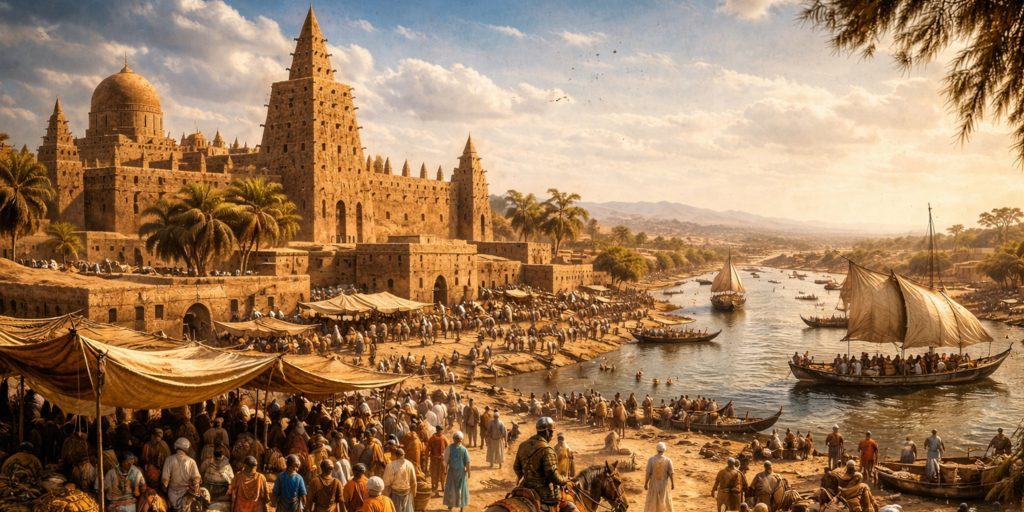
Gao was the political capital of the empire and the principal seat of the Askia rulers.
Located on the Niger River, Gao became one of the richest cities in West Africa. The Askias built palaces, mosques and administrative buildings there.
The Tomb of Askia, still standing today in Gao, is one of the most important surviving monuments of the dynasty. Built after Askia Muhammad’s pilgrimage, it was probably inspired by the mud-brick architecture of North Africa.
The tomb is a remarkable structure:
- Built of mud brick and timber
- Pyramid-like in form
- Around seventeen metres high
- Part of a wider mosque complex
It remains one of the great monuments of African architecture. It also has the sort of stern, monumental appearance that suggests one should not lean casually against it while holding a cup of tea.
Timbuktu and Learning
If Gao was the political capital, Timbuktu was the intellectual heart of the empire.
By the sixteenth century, Timbuktu had become famous across the Islamic world. Scholars travelled there from North Africa, Egypt and beyond.
The city contained:
- Mosques
- Schools
- Libraries
- Markets
- Houses of wealthy merchants
The most famous centres of learning were:
- Sankore Mosque and University
- Djinguereber Mosque
- Sidi Yahya Mosque
Scholars in Timbuktu studied:
- Islamic law
- Theology
- Mathematics
- Astronomy
- Poetry
- History
- Medicine
Thousands of manuscripts were copied and collected. These manuscripts survive today in private and public collections.
There is something wonderfully satisfying about the fact that one of the richest cities in the world at this time spent so much of its wealth on books. Not jewels, not enormous statues, not a palace entirely plated in gold. Books. Admittedly, some of them were probably dreadful, because every age produces terrible writing, but the principle remains admirable.
Important Rulers of the Askia Dynasty
Askia Muhammad I (1493–1528)
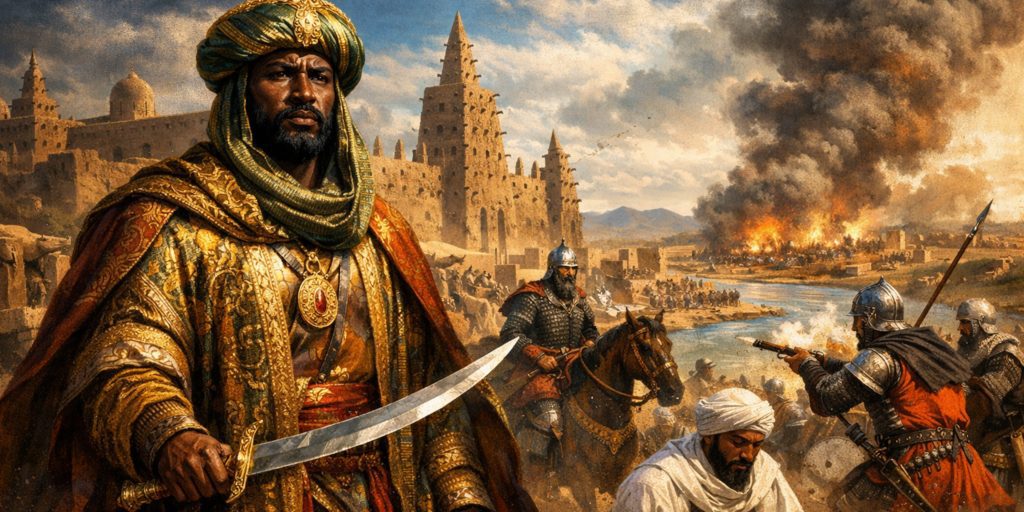
The founder and greatest ruler of the dynasty. He centralised the empire, expanded its territory and strengthened Islam.
Askia Musa (1528–1531)
Succeeded Askia Muhammad after forcing him from power. His short reign was unstable and marked by court intrigue.
Askia Muhammad Benkan (1531–1537)
Continued the dynasty but struggled to maintain control.
Askia Ismail (1537–1539)
Another short-lived ruler whose reign was dominated by political conflict.
Askia Ishaq I (1539–1549)
One of the stronger later rulers. He led successful military campaigns and restored some stability.
Askia Dawud (1549–1582)
Perhaps the last truly effective ruler of the dynasty. Under Dawud, the empire reached its greatest territorial extent and remained prosperous.
Dawud maintained peace for much of his reign and encouraged scholarship and trade. Contemporary accounts describe him as intelligent, generous and politically skilled.
Later Askias
After Dawud’s death, the dynasty weakened rapidly. A succession of rulers fought each other for power:
- Askia Muhammad III
- Askia Muhammad Bana
- Askia Ishaq II
By the 1580s, civil wars and disputes over succession had badly damaged the empire.
The Army of the Askia Dynasty
The Songhai army was one of the largest and most effective military forces in Africa.
It included:
- Cavalry
- Infantry
- River fleets
- Archers
- Spearmen
The cavalry was particularly important. Songhai’s horsemen fought with:
- Spears
- Swords
- Shields
- Quilted or leather armour
The infantry often carried bows, javelins and spears. Elite troops might also use swords.
Songhai maintained a navy on the Niger River. River boats transported soldiers and supplies. This gave the empire a major advantage in controlling trade routes and moving armies.
Despite its strength, the army relied largely on traditional weapons. By the late sixteenth century, this became a serious weakness.
Society Under the Askias
Songhai society was diverse and complex.
The empire included many peoples:
- Songhai
- Fulani
- Tuareg
- Mandé peoples
- Hausa peoples
- Berbers
Society was generally divided into:
- Nobles and ruling families
- Merchants
- Scholars
- Farmers
- Craftsmen
- Enslaved people
Women could hold considerable influence, especially within elite families. Noblewomen often controlled property and trade.
In towns and cities, women participated actively in markets. Travellers from North Africa often remarked on the relative freedom of women in West Africa compared with some Islamic societies farther north.
That observation always amuses me slightly. Time and again, foreign visitors arrived in West Africa, looked around in mild confusion, and discovered that women were rather more independent than they expected. One can almost hear the sound of their assumptions collapsing quietly in the background.
Religion and Belief
The Askia rulers strongly promoted Islam, but traditional beliefs remained important.
In the cities, Islam dominated public life. Mosques, Islamic courts and scholars played major roles.
In rural areas, many people continued to follow older religious traditions. These included:
- Ancestor worship
- Sacred spirits
- Local rituals
- Traditional ceremonies
The rulers themselves often combined Islamic practices with older customs. Songhai was not unusual in this respect. Across much of the world, people were perfectly capable of attending prayers in the morning and consulting an old local custom by afternoon.
The Moroccan Invasion
The Askia dynasty ended because of the Moroccan invasion of 1591.
The ruler of Morocco, Sultan Ahmad al-Mansur, wanted control of the gold and salt trade of Songhai. Morocco also needed wealth after expensive wars.
In 1590, Ahmad al-Mansur sent an army south across the Sahara under the command of Judar Pasha.
The Moroccan army was small, perhaps only around four thousand men, but it possessed:
- Muskets
- Cannons
- Gunpowder
The Songhai army was much larger, perhaps between twenty and forty thousand soldiers. Yet most of these men carried traditional weapons.
The decisive battle came at Tondibi in 1591.
According to tradition, the Songhai attempted to drive cattle into the Moroccan lines to disrupt them. The cattle panicked when the Moroccans opened fire and stampeded back into the Songhai army instead.
It is one of those episodes that would be funny if it were not so disastrous. History occasionally has a very dark sense of humour.
The Moroccans won the battle. Gao, Timbuktu and Djenné soon fell.
The End of the Dynasty
After the defeat at Tondibi, Askia Ishaq II fled. The empire fragmented.
Members of the Askia family attempted to continue resistance from the south, particularly in the Dendi region. These later rulers are sometimes called the Dendi Askias.
They survived for several decades but never recovered the power of the old empire.
Moroccan control over Songhai also proved difficult. The conquerors could not fully dominate such a vast territory.
Instead, the old empire broke apart into smaller kingdoms and states.
By the early seventeenth century, the great Songhai Empire of the Askias was gone.
Sources for the History of the Askia Dynasty
Much of what we know about the Askia dynasty comes from two major chronicles:
- The Tarikh al-Sudan
- The Tarikh al-Fattash
These were written in Timbuktu in the seventeenth century and preserve traditions about the Songhai Empire.
Other evidence comes from:
- Arabic travellers
- North African records
- Archaeology
- Surviving manuscripts
The chronicles are valuable but not always reliable. They were written after the events they describe and sometimes mix fact, memory and legend.
As a historian, I confess that this is both maddening and strangely charming. Medieval chroniclers had a habit of reporting impossible troop numbers, miraculous events and suspiciously convenient speeches. One must read them carefully, with affection and a raised eyebrow.
Legacy of the Askia Dynasty
The Askia dynasty remains one of the greatest ruling houses in African history.
Its rulers:
- Created the largest empire in West Africa
- Turned Timbuktu into a famous centre of learning
- Controlled some of the richest trade routes in the world
- Built lasting monuments
- Linked West Africa more closely to the wider Islamic world
Today, the memory of the Askias survives in:
- The Tomb of Askia in Gao
- The manuscripts of Timbuktu
- Oral traditions
- Modern histories of West Africa
The story of the Askia dynasty is not simply one of conquest and collapse. It is the story of an empire that built cities, encouraged learning and connected distant worlds across the Sahara.
For nearly a century, the Askias ruled one of the richest and most sophisticated states on earth. That deserves to be remembered far more often than it is.