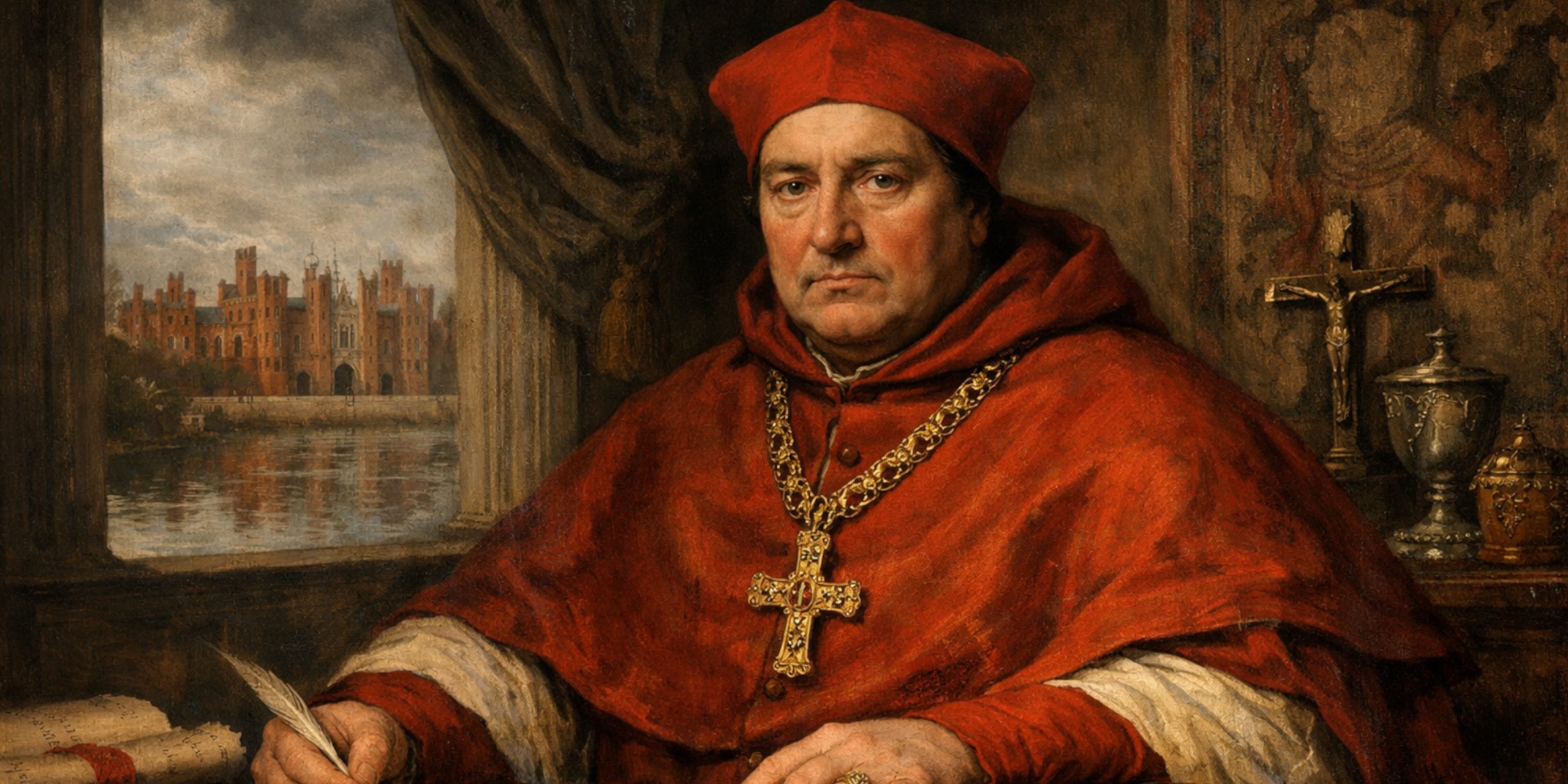
Cardinal Wolsey remains one of the most fascinating figures in Tudor England. He was not a king, yet for nearly two decades he exercised authority on a scale that made many nobles grind their teeth and mutter darkly into their wine. The son of an Ipswich butcher somehow became Lord Chancellor, papal legate, cardinal, diplomat, builder, churchman and, for a while, the closest thing England had to a prime minister.
He was brilliant, vain, energetic, generous, ruthless and deeply aware that everyone around him believed he had risen far above his station. Wolsey spent much of his life proving them wrong, then spent the rest of it making them resent him for it.
Who Was Cardinal Wolsey?
Thomas Wolsey was born in Ipswich around 1473. Later enemies sneered at his humble background and repeatedly described him as the son of a butcher. There is some truth in this, although his father also appears to have been a reasonably prosperous cattle dealer and innkeeper. Wolsey’s origins were respectable enough for a talented boy to receive an education, but nowhere near grand enough for the dizzying heights he would later reach.
He attended Magdalen College, Oxford, and showed such intellectual ability that he gained his degree unusually young. According to later tradition he was known as the “boy bachelor” because he completed his studies at around fifteen.
Oxford gave Wolsey more than learning. It gave him what Tudor England valued most, the ability to move comfortably among educated men, churchmen and courtiers. He entered the Church, not because he was especially saintly, but because the Church offered one of the few paths by which an ambitious and gifted commoner could rise.
Wolsey’s Early Career
Wolsey first served in relatively modest clerical positions. He became chaplain to several influential men, including Richard Nanfan, deputy governor of Calais. Through these connections he came to the attention of King Henry VII.
Under Henry VII, Wolsey proved himself to be exactly the sort of man a suspicious and hard-working king admired. He was efficient, tireless and capable of dealing with the sort of tedious administrative business that most nobles regarded as beneath them.
When Henry VIII became king in 1509, Wolsey’s real opportunity arrived.
Henry VIII was young, energetic, charming and rather less interested in paperwork than his father had been. He preferred hunting, jousting, music and grand plans. Wolsey, by contrast, positively relished paperwork. Between them, they formed a strangely effective partnership.
Rise to Power Under Henry VIII
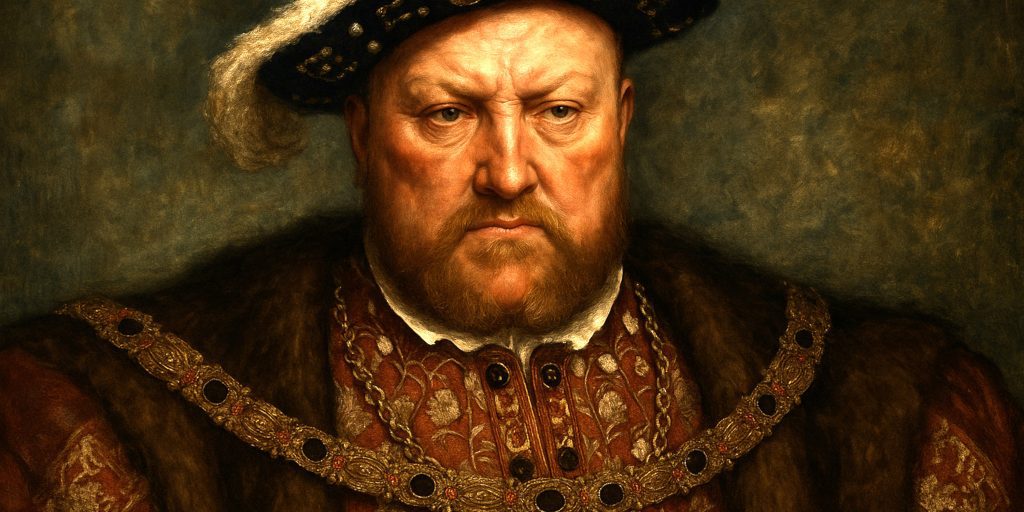
By 1514 Wolsey had become Bishop of Lincoln and then Archbishop of York. In 1515 he was made a cardinal by Pope Leo X and, in the same year, became Lord Chancellor of England.
This was an extraordinary rise. Within a few years Wolsey had become the king’s chief minister and most trusted servant. Foreign ambassadors often assumed that if one wanted anything from England, it was easier to speak to Wolsey than to Henry himself.
Venetian diplomat Sebastian Giustinian wrote:
“He rules both the king and the entire kingdom.”
That was perhaps an exaggeration, though not by much.
Wolsey controlled access to the king. He supervised government business, managed diplomacy, organised taxation, dealt with legal disputes and attempted to shape English foreign policy around England’s advantage rather than old feudal loyalties.
His household was enormous. It contained hundreds of servants, chaplains, clerks and gentlemen. It looked less like the household of a churchman and more like the court of a minor king. This did not make him popular.
Wolsey and Henry VIII
The relationship between Wolsey and Henry VIII is one of the most intriguing in Tudor history.
Wolsey understood Henry perhaps better than anyone else. He knew that the king wanted glory, admiration and the sense that he was a great European monarch. Wolsey therefore wrapped politics in spectacle.
He arranged magnificent ceremonies, elaborate diplomatic meetings and expensive military campaigns. He gave Henry the theatre of kingship while quietly managing the less glamorous business in the background.
For years, Henry trusted him completely.
Contemporary writer George Cavendish, who served Wolsey personally, later described the cardinal as:
“The man that put all his trust and confidence in the king’s favour.”
That favour was immense, but it was also dangerous. Henry VIII’s affection could be warm and generous, yet it had the unfortunate habit of disappearing at precisely the moment one most needed it.
Foreign Policy and the Dream of European Greatness
Wolsey believed England could play a major role in European politics even though the country was not as rich or powerful as France or the Holy Roman Empire.
He therefore pursued a foreign policy based on diplomacy, shifting alliances and the careful balancing of rival powers.
His finest diplomatic moment came in 1518 with the Treaty of London. Wolsey persuaded many European powers to agree to a general peace treaty. For a brief moment England stood at the centre of European diplomacy.
The following year, Wolsey attempted to become pope after the death of Pope Leo X. He failed. It was an ambition so large that even some of his admirers winced slightly.
In 1520 Wolsey organised the famous Field of Cloth of Gold, the grand meeting between Henry VIII and Francis I of France.
The event was astonishingly extravagant. There were golden tents, tournaments, banquets, fountains flowing with wine and enough velvet to bankrupt a small duchy.
As a diplomatic triumph, it achieved rather little. As a demonstration of Tudor splendour, it was impossible to ignore.
The Field of Cloth of Gold
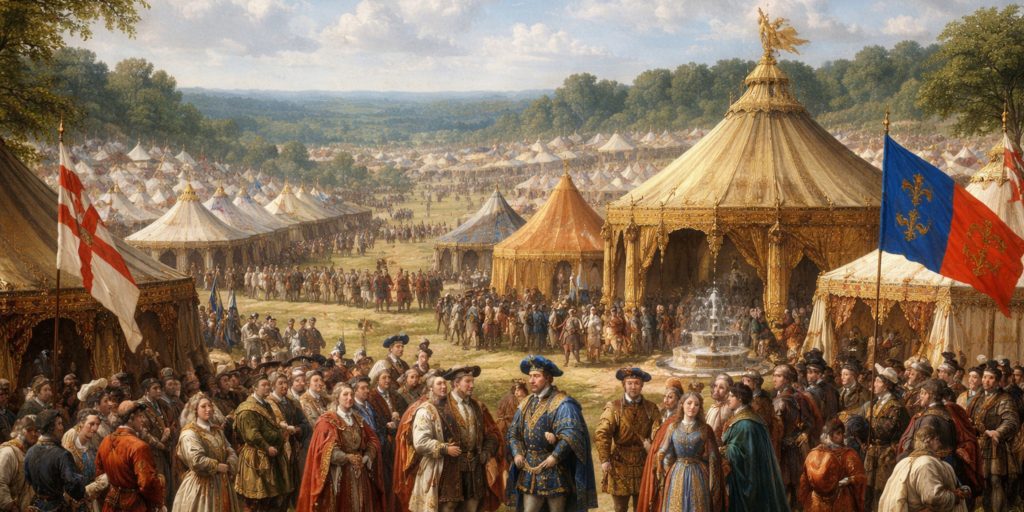
The Field of Cloth of Gold near Calais remains one of the most famous events of Wolsey’s career.
Henry VIII and Francis I met in June 1520 in a setting deliberately designed to overwhelm everyone present. Wolsey orchestrated the entire affair.
He wanted Europe to see England not as a distant island kingdom but as a great power. In fairness, if power could have been measured in embroidered fabric and competitive wrestling, England would have conquered the continent by teatime.
The meeting included:
- Lavish temporary palaces
- Tournaments and jousts
- Religious ceremonies
- Feasts and entertainments
- Diplomatic negotiations
Despite all the expense, England and France soon drifted apart again. Wolsey’s great gift was making politics look magnificent, though even he could not force rival kings to like one another for very long.
Wealth, Buildings and Hampton Court
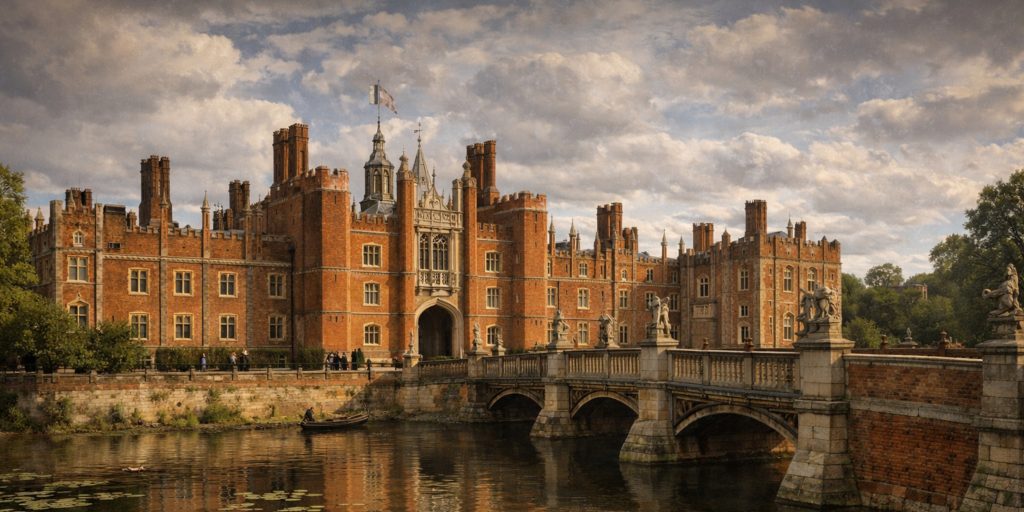
Wolsey became immensely wealthy. He accumulated bishoprics, offices and incomes on a remarkable scale.
His greatest architectural legacy is Hampton Court Palace. Wolsey began building it in the 1510s as a residence worthy of his status.
The palace was enormous, luxurious and carefully designed to impress visitors. Rich tapestries, grand halls and fine gardens announced that Wolsey had become one of the most powerful men in Europe.
There was, however, a problem.
Building a palace grand enough to rival the king’s was never entirely wise. Wolsey eventually presented Hampton Court to Henry VIII, perhaps out of generosity, perhaps out of fear, and perhaps because he had noticed that kings do not always enjoy being outshone.
Today, Hampton Court still bears traces of Wolsey’s vision, even though Henry later transformed much of it.
Wolsey and the Church
Wolsey was a senior churchman, yet his reputation as a religious reformer is mixed.
He was criticised for holding several church offices at once and for living in a style that seemed distinctly unmonastic. Critics complained that he behaved more like a prince than a priest.
There is truth in that criticism. Wolsey enjoyed splendour, luxury and power. He kept an impressive household, wore magnificent robes and entertained on a lavish scale.
Yet he was not indifferent to reform. He recognised that parts of the English Church were corrupt and ineffective. He dissolved some small monasteries and used the money to fund education, including Cardinal College at Oxford, later known as Christ Church.
He also founded a grammar school in Ipswich.
These projects suggest a more serious side to Wolsey. He genuinely valued learning and seems to have believed that education could strengthen both Church and kingdom.
Contemporary Opinions of Wolsey
People in Tudor England rarely felt neutral about Wolsey.
His supporters admired his intelligence, energy and administrative genius. His enemies regarded him as arrogant, greedy and intolerably self-important.
The poet John Skelton attacked him fiercely, portraying him as proud and overbearing.
Meanwhile George Cavendish offered a more sympathetic portrait:
“He was a man of a great stomach, for he compted himself equal with princes.”
That sentence captures Wolsey perfectly. He did indeed think himself equal to princes. The remarkable thing is that, for many years, he almost was.
French ambassador Jean du Bellay later observed:
“He was the most faithful servant to his prince that ever was.”
Even his enemies often admitted that Wolsey possessed immense ability. Their complaint was not that he was incompetent. Quite the reverse. It was that he was so obviously more capable than many of the noblemen who despised him.
The King’s Great Matter and Wolsey’s Fall
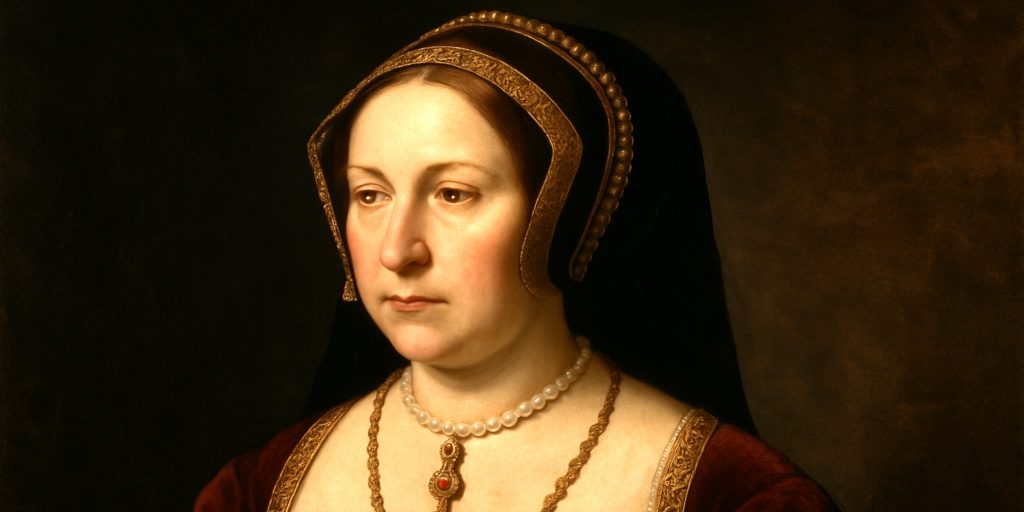
Wolsey’s downfall came because of Henry VIII’s desire to end his marriage to Catherine of Aragon.
By the late 1520s Henry desperately wanted an annulment so that he could marry Anne Boleyn. Wolsey was instructed to secure papal approval.
This was an impossible task.
Pope Clement VII was effectively under the influence of the Holy Roman Emperor Charles V, who happened to be Catherine’s nephew. Granting Henry the annulment would have offended one of the most powerful rulers in Europe.
Wolsey tried every possible diplomatic route. He negotiated, delayed, argued and manoeuvred. Nothing worked.
Henry’s patience ran out.
In 1529 Wolsey was stripped of office and accused of praemunire, essentially putting papal authority above the king’s. It was an accusation of magnificent hypocrisy. Wolsey had spent years serving Henry with exhausting loyalty, only to be condemned for the very powers Henry had once encouraged him to use.
His enemies at court closed in quickly. Anne Boleyn and her supporters were particularly eager to destroy him.
Wolsey’s Final Days
After his fall, Wolsey was allowed to retire to the north as Archbishop of York. For perhaps the first time in his life, he began actually performing the duties of the office.
Accounts from this period suggest that he was welcomed by many ordinary people. Away from court, he appears to have become calmer and perhaps even humbler.
That did not save him.
In 1530 he was arrested on charges of treason and ordered back to London. He never arrived.
Wolsey fell ill on the journey and died at Leicester Abbey on 29 November 1530.
According to tradition, his final words were:
“If I had served God as diligently as I have done the king, He would not have given me over in my grey hairs.”
It is one of the most famous lines in Tudor history because it feels painfully true. Wolsey had devoted everything to royal favour, and royal favour had proved a remarkably flimsy thing on which to build a life.
Cardinal Wolsey’s Appearance and Personality
Contemporary descriptions present Wolsey as large, imposing and highly conscious of his own dignity.
He dressed magnificently in scarlet robes appropriate to his rank as cardinal. He enjoyed ceremony and expected respect.
Yet he also possessed immense charm when he wished to use it. He could flatter, persuade and entertain. Ambassadors often remarked on his intelligence and conversational skill.
He was famously hardworking. Wolsey often worked long into the night, handling documents, letters and political problems.
One gets the sense of a man who could never sit still, partly because he enjoyed power and partly because he knew how precarious his position really was.
A butcher’s son could rise to the summit of Tudor England, but he could never entirely forget that others believed he did not belong there.
Cardinal Wolsey’s Legacy
Wolsey’s legacy is complicated.
He failed in the task that mattered most to Henry VIII, securing the annulment. That failure destroyed him.
Yet to remember Wolsey only for his fall is unfair.
He transformed the machinery of government. He made the royal administration more centralised, more efficient and more dependent on skilled officials rather than hereditary nobles.
In many ways, Wolsey helped create the style of government that later Tudor ministers would use.
He also left behind important buildings and educational institutions. Hampton Court, Christ Church, Oxford and Ipswich School all owe something to his ambition.
As a historian, I find Wolsey oddly moving. He was flawed, certainly. He was vain, ambitious and sometimes unbearably grand. One suspects he could enter a room in such a way that everyone else immediately felt underdressed.
But he was also one of the most gifted men of his age, a figure who rose through sheer ability in a society that usually preferred birth to talent.
His tragedy was not merely that he fell. It was that he rose so high that the fall could only ever be catastrophic.
Further Reading and Places Associated with Wolsey
For those wishing to explore Wolsey further, the following places remain closely linked to his life:
- Hampton Court Palace
- Christ Church, Oxford
- Ipswich, especially the site of his school
- York Place in Westminster, later transformed into Whitehall Palace
- Leicester Abbey, where he died
George Cavendish’s The Life and Death of Cardinal Wolsey remains one of the most valuable contemporary accounts. It is affectionate, occasionally dramatic and full of the sort of detail that only a devoted former servant could provide.