Outlander has always been a slightly ridiculous proposition on paper. A Second World War nurse touches a mysterious stone in Scotland, wakes up in 1743 and becomes entangled with a Highland warrior while attempting to navigate Jacobite politics, clan rivalries, war, medicine and an increasingly complicated family tree.
Somehow, it works.
Based on the novels by Diana Gabaldon, the television adaptation developed by Ronald D. Moore grew from a Scottish time-travel romance into an enormous historical drama spanning the Jacobite rising, the Battle of Culloden, colonial America and the American Revolution.
Eight seasons later, Outlander has reached its final chapter. STARZ lists all eight seasons, with the eighth and final season released in 2026.
For Seven Swords, though, there is another reason the series is interesting. Beneath all the romance and temporal chaos sits a surprisingly rich collection of Highland broadswords, dirks, targes, muskets, military uniforms and 18th-century fighting culture.
And yes, Jamie Fraser is involved in quite a lot of it.
Outlander at a Glance
| Detail | Information |
|---|---|
| First broadcast | 2014 |
| Final season | Season 8, 2026 |
| Based on | Outlander novels by Diana Gabaldon |
| Developed for television by | Ronald D. Moore |
| Main stars | Caitríona Balfe, Sam Heughan, Sophie Skelton, Richard Rankin |
| Main genres | Historical drama, romance, adventure, fantasy |
| Original network | STARZ |
| Starting period | Scotland, 1945 and 1743 |
| Major historical settings | Jacobite rising, Culloden, colonial America, American Revolution |
| Seasons | 8 |
| Related series | Outlander: Blood of My Blood |
What Is Outlander About?
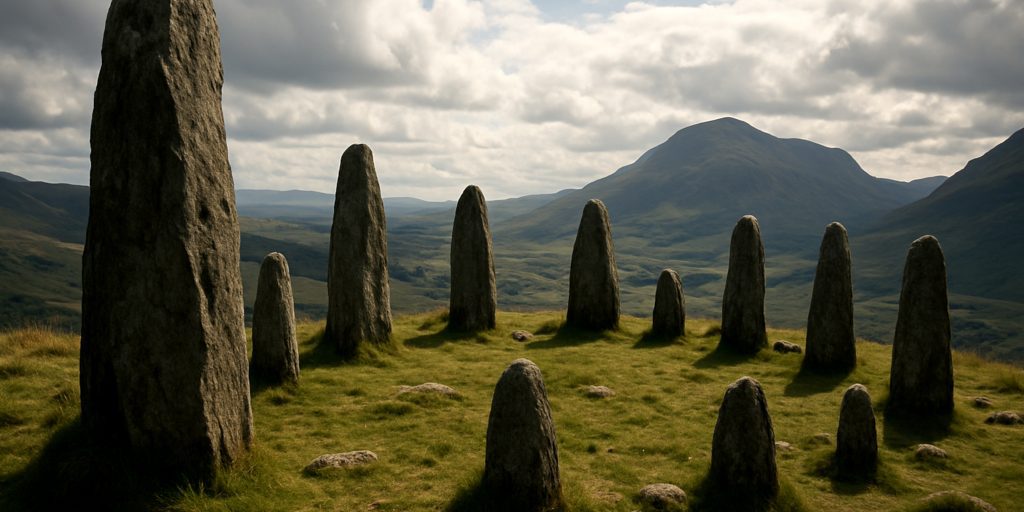
The story begins in 1945 with former combat nurse Claire Randall, played by Caitríona Balfe, visiting the Scottish Highlands with her husband Frank Randall.
Claire encounters the standing stones at the fictional Craigh na Dun and is inexplicably transported back to 1743.
This is not an especially convenient year in which to arrive in Scotland.
Britain is approaching the final Jacobite rising. Political loyalties are dangerous, Highland clans remain powerful and suspicion comes easily when a strangely dressed Englishwoman appears apparently from nowhere with medical knowledge well beyond anything expected of an 18th-century healer.
Claire soon meets Highlander Jamie Fraser, played by Sam Heughan.
Their relationship becomes the emotional centre of the series, but Outlander gradually expands far beyond the original premise. The characters become entangled with the Jacobite cause, encounter Bonnie Prince Charlie, experience Culloden and eventually cross the Atlantic into colonial North America.
The time-travel element gives the writers a useful narrative trick. Claire knows what is going to happen, but knowing history and changing it are two very different things.
That distinction becomes particularly brutal as Culloden approaches.
The Outlander Seasons Explained
The series becomes considerably larger in scope as it progresses.
| Season | Main Setting | Historical Background |
| Season 1 | Scotland | Highland clan society before the 1745 rising |
| Season 2 | France and Scotland | Jacobite preparations and the 1745 rising |
| Season 3 | Scotland, Caribbean and Atlantic | Aftermath of Culloden and imperial world |
| Season 4 | Colonial America | Settlement in North Carolina |
| Season 5 | North Carolina | Regulation movement and growing colonial unrest |
| Season 6 | North Carolina | Political tensions before revolution |
| Season 7 | America and Scotland | American Revolutionary War |
| Season 8 | Fraser’s Ridge and America | Final chapter of Claire and Jamie’s story |
The early Scottish seasons remain the most interesting from a sword-history perspective. Later episodes naturally shift towards firearms as the series moves deeper into the later 18th century.
That is historically appropriate. Swords had certainly not disappeared, but warfare was increasingly dominated by muskets, bayonets and artillery.
Claire Fraser
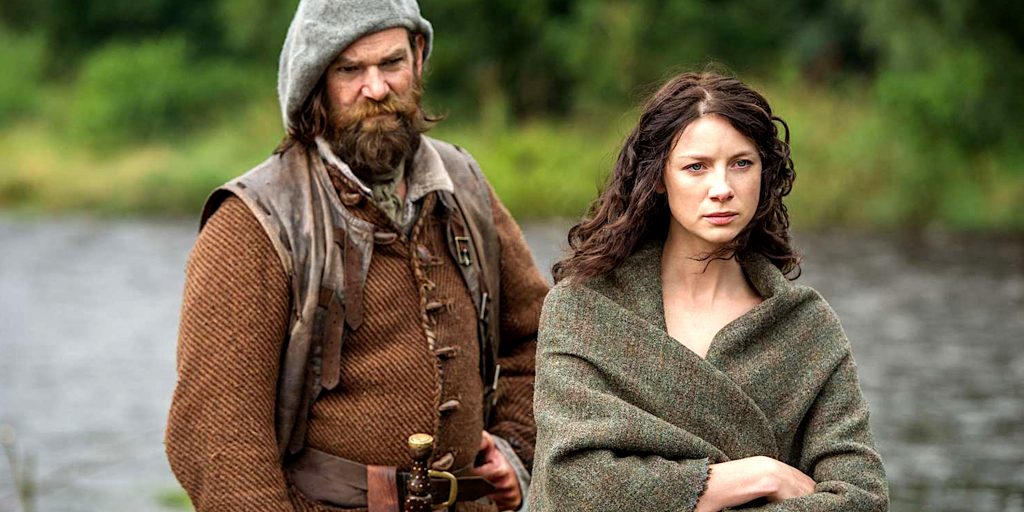
Claire is the cleverest part of the show’s central concept.
She possesses knowledge that appears almost supernatural to people living in the 18th century, yet she does not possess the technology required to reproduce much of the world she came from.
Knowing that antibiotics exist is useful. Producing penicillin in a cabin without modern laboratory equipment is rather more awkward.
Her medical background also gives Outlander an excuse to explore surgery, disease, childbirth and battlefield medicine. The results can occasionally make the sword fights look like the relaxing part of an episode.
Claire also provides a modern perspective on the societies she encounters. Sometimes this is handled subtly. Sometimes she has roughly the expression of somebody wondering why everyone around her has decided basic hygiene is an optional side quest.
Jamie Fraser
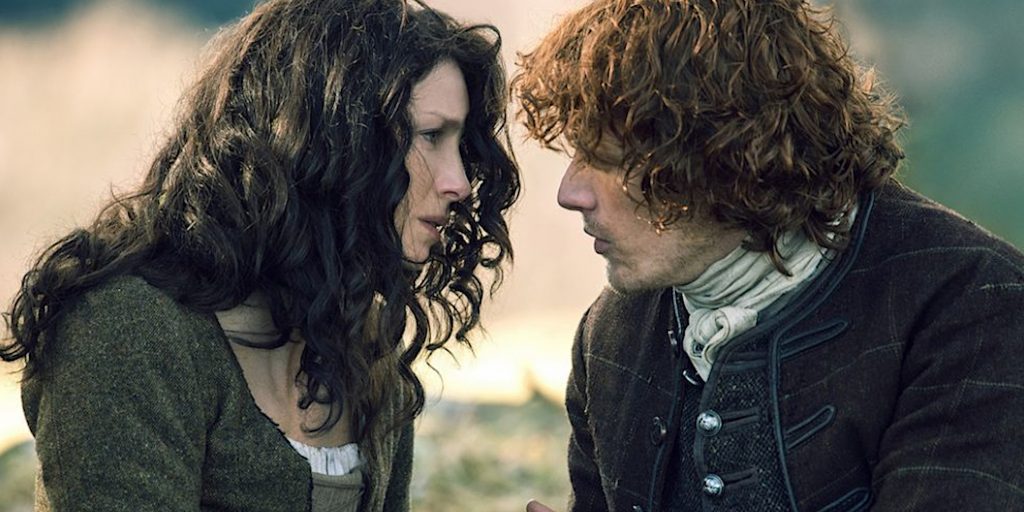
Jamie Fraser could easily have become a collection of historical-romance clichés.
Instead, Sam Heughan gives him considerably more depth.
Jamie is a Highland warrior, farmer, landowner, political operator, soldier and clan leader whose loyalties repeatedly collide with historical events outside his control.
His martial abilities are important without making him invincible. He understands horses, firearms and edged weapons, particularly the Highland sword culture associated with 18th-century Scotland.
The character also changes alongside warfare itself. The Jamie fighting in Scotland belongs to a culture in which the sword and targe remain meaningful battlefield weapons. The older Jamie living in America inhabits a world increasingly shaped by rifles, muskets and organised infantry.
The Real History Behind Outlander
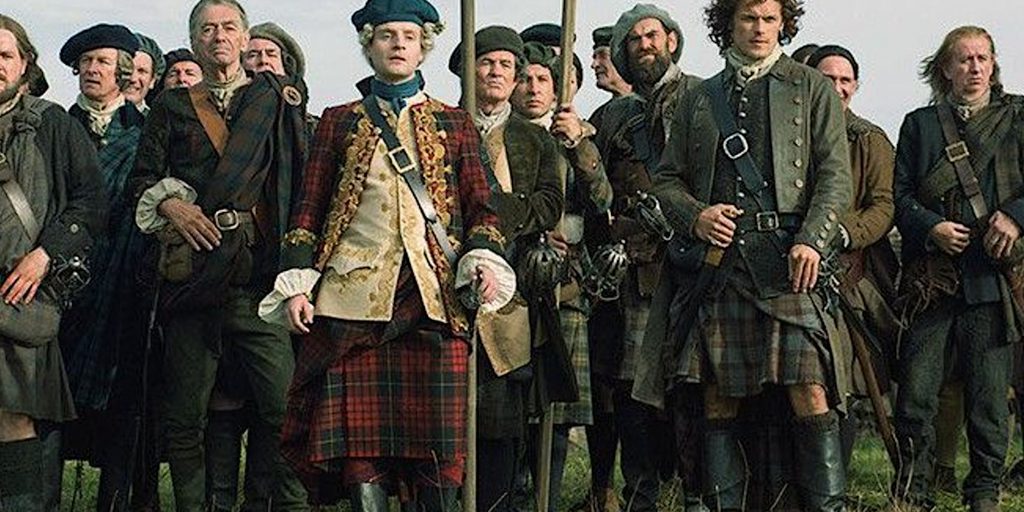
This is where Outlander becomes particularly interesting.
Claire and Jamie are fictional, but they move through genuine historical events and encounter real people.
These include:
- Charles Edward Stuart, better known as Bonnie Prince Charlie
- King Louis XV of France
- Lord Lovat
- Governor William Tryon
- George Washington
- Benedict Arnold
- General Simon Fraser
The series takes liberties, obviously. Claire Fraser was not secretly running around the 18th century attempting to interfere with major historical events. Historians would probably have mentioned that.
Yet the political background is often stronger than viewers might expect.
Historical analysis of the programme has particularly noted its treatment of Jacobitism as a complicated political movement rather than simply Scotland fighting England. Scottish families could be divided over the cause, while many Scots fought for the Hanoverian government.
That distinction matters enormously.
The Jacobite Rising of 1745
The early seasons are dominated by the approaching Jacobite rising.
Charles Edward Stuart landed in Scotland in 1745 hoping to restore his father, James Francis Edward Stuart, to the British throne.
Several Highland clans joined him.
The Jacobite army achieved a remarkable early victory at Prestonpans and advanced deep into England before retreating north. Government forces eventually caught the Jacobites near Inverness.
The resulting battle became one of the defining moments of Scottish history.
Outlander and the Battle of Culloden
The Battle of Culloden was fought on 16 April 1746.
For viewers of Outlander, the battle has an unusual sense of dread because Claire already knows the outcome. Much of the preceding story therefore concerns attempts to prevent, escape or somehow alter a disaster that appears unavoidable.
Historically, the battle was a catastrophic defeat for the Jacobite army.
Government troops under the Duke of Cumberland possessed disciplined infantry, cavalry and effective artillery. The Jacobite charge, often simplified in popular culture into a mass of sword-waving Highlanders, took place under extremely difficult battlefield conditions.
The Highlanders themselves were also far from technologically primitive. Many possessed firearms in addition to swords, targes and dirks. National Trust for Scotland historians note the use of muskets and pistols alongside the traditional close-combat weapons associated with the Highland charge.
Recent archaeological work at Culloden continues to demonstrate just how ferocious the battlefield was. Evidence includes round shot, grapeshot, canister and fragments associated with an exploding mortar shell fired during the fighting.
The real Culloden was arguably more frightening than the romantic version.
The Swords of Outlander
Now we get to the steel.
Outlander is set during a fascinating transitional period in European weapon history. The sword remained an important military and personal weapon, but firearms increasingly determined what happened on battlefields.
Basket-Hilted Broadsword
The weapon most strongly associated with the Highland warriors of Outlander is the Scottish basket-hilted broadsword.
Its defining feature is the elaborate metal guard surrounding the hand.
Typical characteristics included:
- Straight double-edged blade
- Substantial protective basket hilt
- One-handed grip
- Blade generally around 75 to 90 cm
- Designed for cutting and thrusting
- Frequently used alongside a Highland targe
The basket guard was extremely practical. Hand injuries are an obvious problem when somebody is attempting to hit you with another sword, and protecting the sword hand allowed increasingly complex guards to develop.
These swords became strongly associated with Highland martial culture, although variants were used throughout Britain.
What About the Claymore?
This is where terminology gets messy.
Mention a Scottish claymore and most people picture an enormous two-handed Highland sword.
That weapon certainly existed, particularly during the 15th to 17th centuries.
By the period depicted in Outlander, however, the one-handed basket-hilted sword was considerably more relevant to Highland warfare.
The word claidheamh mòr essentially means “great sword”, and the term claymore has subsequently been applied rather loosely to different Scottish swords.
So if you are imagining Jamie marching into Culloden swinging a gigantic medieval two-handed sword like a Highland version of an RPG character, dial things back a little.
The Highland Targe
The sword was frequently paired with another distinctive piece of equipment: the targe.
A Highland targe was a relatively small round shield, commonly made from layers of wood covered with leather.
It was intended primarily for active defence rather than simply hiding behind.
A Highland fighter could use the targe to deflect or control an opponent’s weapon while attacking with the sword. Historical discussion of Culloden describes the targe as a parrying tool rather than the large body-covering shield familiar from earlier warfare.
Decorated surviving examples can be extraordinarily beautiful.
Which feels slightly unfair considering their original purpose involved helping their owner get close enough to stab somebody.
Dirks and Other Highland Weapons
The Highland dirk also appears within the wider weapon culture represented by the programme.
A dirk was considerably larger than a modern pocket knife and could function as a serious close-combat weapon.
Highland equipment might include:
| Weapon | Primary Role |
| Basket-hilted broadsword | Cutting and thrusting |
| Targe | Defence and parrying |
| Dirk | Close combat and utility |
| Pistol | Short-range firearm |
| Musket | Battlefield firearm |
| Bayonet | Turning a musket into a close-combat weapon |
This mixture matters because the romantic image of Highland warfare can place too much emphasis on swords.
Highlanders used guns.
Lots of them.
The sword remained culturally important and potentially devastating at close range, but an 18th-century battlefield was already a thoroughly gunpowder-driven environment.
How Historically Accurate Is Outlander?
The sensible answer is: surprisingly good in places, deliberately flexible in others.
Outlander is historical drama rather than documentary.
The production puts considerable effort into material culture, locations, clothing, politics and historical personalities, but visual storytelling inevitably influences some decisions.
Costume is a good example. Researchers have praised the level of work behind the Highland clothing while also questioning choices such as the comparatively muted colours of some tartans. Costume designer Terry Dresbach openly discussed balancing historical research with the visual requirements of television.
The programme is particularly effective when showing history as something messy.
Jacobites are not universally heroic. Government supporters are not universally English. Clan politics are complicated. Wealth and status matter. Personal survival can be more important than ideological purity.
That is much closer to real history than the familiar “Scotland versus England” version of 1745.
Real Outlander Locations You Can Visit
Scotland’s scenery is practically another cast member.
Several filming locations have become closely associated with the programme.
| Outlander Location | Real Location |
| Castle Leoch | Doune Castle |
| 1940s Inverness | Falkland, Fife |
| Various Highland scenes | Cairngorms and surrounding areas |
| Jacobite settlement scenes | Highland Folk Museum |
| Culloden | Battlefield recreated elsewhere for filming |
One important distinction concerns Culloden itself.
The production did not film its battle sequence on the real battlefield. It recreated Culloden in a field near Cumbernauld. The genuine battlefield can still be visited near Inverness, where the National Trust for Scotland operates the visitor centre.
That was the right decision. Culloden is a battlefield, archaeological landscape and war grave. Turning it into a television production set would have been difficult to justify.
The Outlander Effect on Scottish History
One of the more interesting consequences of the series is that it has encouraged viewers to investigate the actual history behind the fiction.
Filming locations have become visitor destinations. Culloden attracts fans who subsequently encounter the real story of the Jacobite rising. Museums can connect fictional characters with genuine surviving objects.
There is a nice circularity to that.
Someone starts watching because Jamie Fraser looks good in Highland clothing and three weeks later they are reading about 18th-century succession politics and comparing basket-hilt typologies.
History has recruited people through stranger methods.
Outlander: Blood of My Blood
The Outlander universe has continued beyond the main story through the prequel Outlander: Blood of My Blood.
Rather than simply reproducing Claire and Jamie’s adventures with younger characters, the series explores the stories of their parents.
The franchise therefore has room to continue even after the main programme’s eighth season.
STARZ has confirmed that Season 2 of Blood of My Blood begins on 18 September 2026.
For viewers interested in Highland society rather than solely Claire’s time-travelling story, the prequel gives the franchise another substantial piece of historical territory to explore.
Is Outlander Worth Watching for History Fans?
Yes, with the usual warning label attached to historical television.
Do not treat it as a textbook.
Do pay attention to the world it creates.
Its strongest historical material comes from the texture surrounding the characters: competing loyalties, clothing, medicine, social hierarchy, weapons, travel, military service and the sheer inconvenience of living in a period without modern infrastructure.
The Jacobite sections remain particularly compelling because the audience knows where everything is heading.
Culloden cannot simply be defeated by clever protagonists because it actually happened.
That gives Outlander something many historical dramas lack: its characters occasionally have to accept that history is bigger than they are.
Takeaway
I went into Outlander expecting considerably more windswept romance than military history. To be fair, there is plenty of windswept romance.
But there is also a genuinely interesting historical drama underneath it.
The series is at its best when fantasy collides with events that cannot conveniently be rewritten. Claire has knowledge of the future, Jamie has considerable skill with a sword, and neither of those things is enough to make the 18th century behave itself.
For sword enthusiasts, the early seasons are especially good fun. Basket-hilted broadswords, targes, dirks and Highland fighting traditions appear within a world already being transformed by gunpowder warfare.
For history fans, Culloden provides the emotional and historical centre of the Scottish story.
And for everyone else, there are eight seasons of romance, violence, political scheming, accidental time travel and Sam Heughan looking suspiciously composed for somebody whose life has been in mortal danger approximately every twelve minutes.
That seems reasonable value for one television series.