Aethelred I of Wessex has the slightly unfortunate habit of being remembered as “Alfred the Great’s older brother”. It is rather like being the warm-up act before the most famous band in history. Yet without Aethelred, there may never have been an Alfred the Great at all.
Aethelred ruled Wessex from 865 to 871, precisely when the Great Heathen Army crashed into Anglo-Saxon England and began tearing kingdoms apart. Northumbria fell. East Anglia fell. Mercia staggered. Wessex was next. Aethelred inherited a kingdom under terrible pressure and spent almost every year of his short reign fighting to keep it alive.
He was not a grand conqueror or a king of long speeches. He was a hard, practical war leader who spent much of his reign in the saddle, at council, or standing on a muddy ridge waiting for Vikings to come over the horizon.
Who Was Aethelred I?
Aethelred was born around 845 to 848, the fourth son of King Æthelwulf of Wessex and his first wife Osburh. Few people expected him to become king. He had three older brothers ahead of him, Æthelbald, Æthelberht and perhaps most inconveniently of all, healthy brothers who kept surviving.
By 865, however, Aethelred inherited the throne after the death of Æthelberht. His youngest brother Alfred, later known as Alfred the Great, became his chief lieutenant.
The partnership between the two brothers is one of the most interesting in Anglo-Saxon history. Alfred is often treated as the sole hero of the age, but contemporary sources suggest that Aethelred remained firmly in command. Alfred fought, advised and occasionally argued, but Aethelred was the king.
England During Aethelred’s Reign
When Aethelred became king, England was in crisis.
The Viking Great Heathen Army had landed in East Anglia in 865. Over the next few years it conquered Northumbria and East Anglia, while Mercia was repeatedly invaded. The surviving Anglo-Saxon kingdoms were left facing a grim choice: fight, submit, or pay vast sums of silver and hope the Vikings went away.
Wessex chose to fight.
Aethelred also strengthened the alliance between Wessex and Mercia through his connection to King Burgred of Mercia, who was married to Aethelred’s sister Æthelswith. That alliance mattered. Without it, Wessex might have faced the Viking armies alone far earlier.
Battles and Military Acumen
Aethelred spent much of 870 and 871 campaigning against the Great Heathen Army. The speed of these campaigns is extraordinary. Within only a few months, Wessex fought battle after battle with almost no time to rest, recruit or bury the dead.
Nottingham, 868
Aethelred and Alfred marched into Mercia to help King Burgred after the Vikings occupied Nottingham.
The Anglo-Saxon army surrounded the town but could not storm the Viking defences. The Vikings stayed behind their earthworks and eventually Burgred paid them to leave.
It was not a glorious victory, but it showed that Aethelred understood the limits of his forces. Throwing men against a defended Viking position would have been heroic, foolish and very final.
Battle of Reading, 871
In early 871 the Vikings invaded Wessex directly. Aethelred and Alfred met them near Reading.
The result was a defeat. The West Saxons attacked too quickly and were driven back after heavy fighting. One of Aethelred’s ealdormen was killed.
Reading was a serious blow, but the king did not collapse or retreat into paralysis. Four days later he marched out again.
Battle of Ashdown, 871
Ashdown was Aethelred’s finest hour.
The Viking army took up position on high ground. According to later accounts, Aethelred delayed joining the battle because he was hearing Mass. Alfred, no doubt suppressing every younger-brother impulse to shout at him, attacked first.
When Aethelred finally arrived, the West Saxons launched a full assault and broke the Viking line. One Viking king and several jarls were killed.
Ashdown was the first major Anglo-Saxon victory against the Great Heathen Army. It proved that the Vikings could be beaten in open battle.
Aethelred deserves more credit here than he usually receives. He held his army together after defeat, chose to fight again immediately, and won one of the most important battles in English history.
Basing and Meretun, 871
The victories did not last.
Aethelred was defeated at Basing and again at Meretun. During the fighting at Meretun he appears to have been badly wounded.
He died shortly after Easter in April 871, probably at only twenty-three to twenty-six years old.
Had he lived longer, English history may have looked very different. Alfred might never have become king, and Aethelred himself might have become the ruler who finally broke the Viking threat.
Was Aethelred a Good Military Leader?
On balance, yes.
He inherited a kingdom under extreme pressure and managed to keep it standing during the worst stage of the Viking invasion. He fought repeatedly against a larger, more experienced enemy and remained aggressive even after setbacks.
His strengths included:
- Determination under pressure
- Ability to recover quickly after defeat
- Strong co-operation with Alfred and Mercia
- Willingness to meet the Vikings in open battle
- Skill at holding the loyalty of Wessex during crisis
His weaknesses were equally clear:
- He sometimes fought when his army was exhausted
- He lacked the time and resources later available to Alfred
- He never developed the defensive network and fortified burhs that eventually saved Wessex
Still, it is difficult not to admire him. Aethelred ruled for barely five years and spent nearly all of them fighting for survival. Most kings in similar circumstances disappear into a footnote. He came alarmingly close to saving England.
Arms and Armour
Very little survives that can be directly linked to Aethelred himself, but we know a good deal about the equipment used by West Saxon nobles and warriors in the late ninth century.
Royal and Noble Equipment
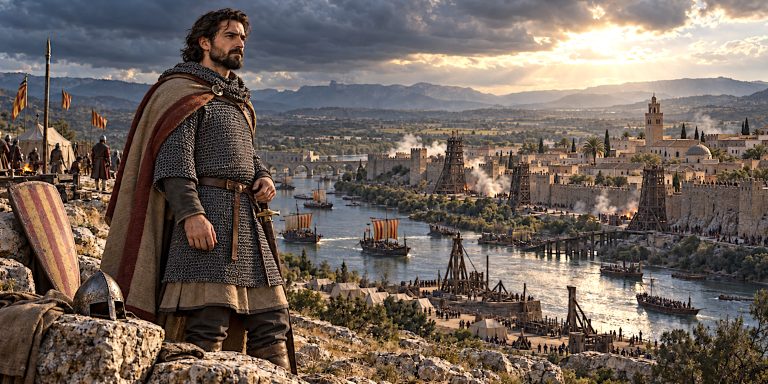
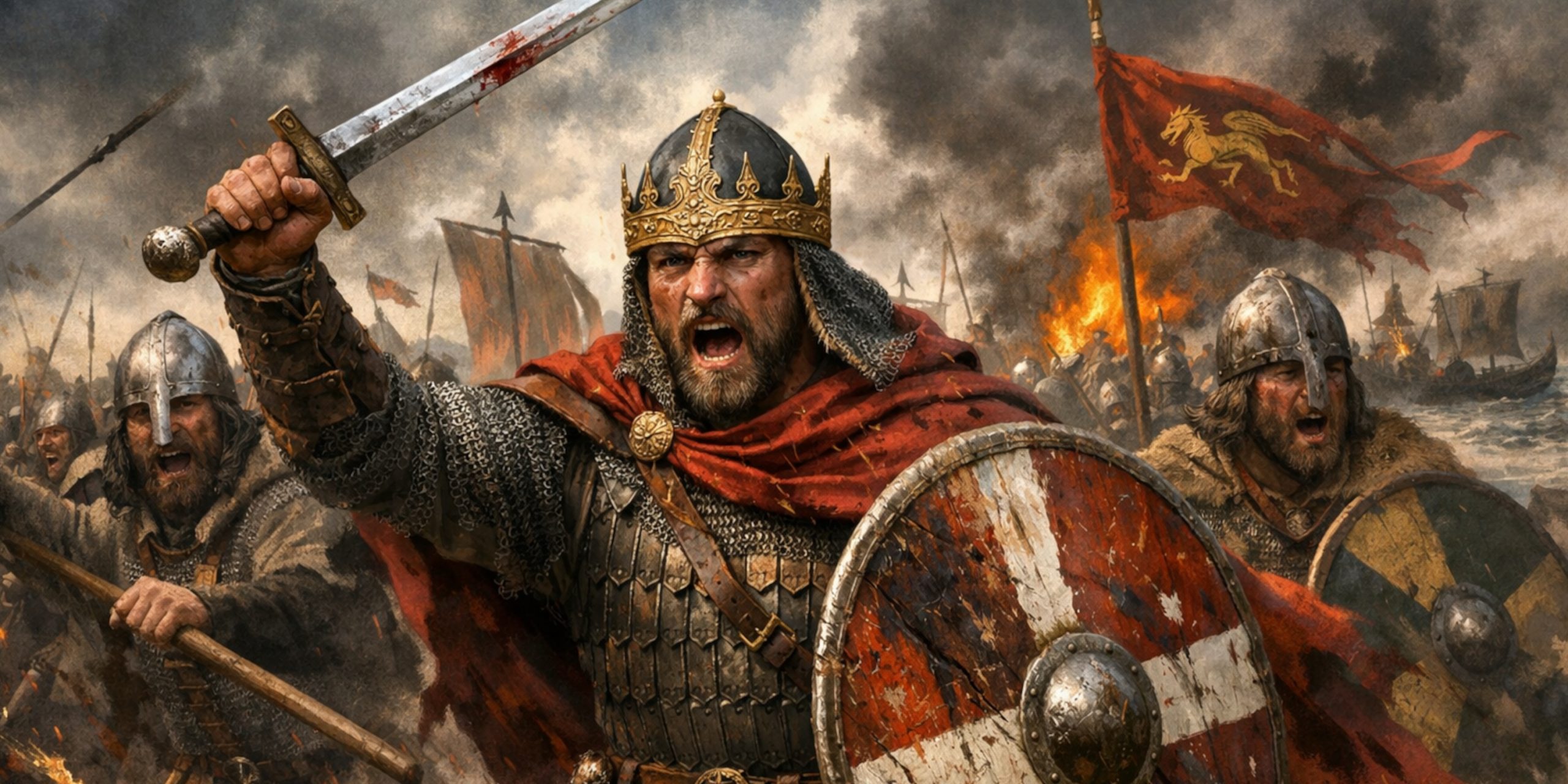
As king, Aethelred would probably have worn:
- A mail byrnie reaching to the thighs
- An iron conical helmet, possibly with a nasal guard
- A round wooden shield with an iron boss
- A spear, still the main weapon of Anglo-Saxon warfare
- A sword of high status, likely pattern-welded or imported
- A seax or fighting knife at the belt
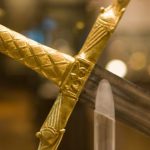
The sword carried by a king like Aethelred would have been both a weapon and a political symbol. Anglo-Saxon swords of this period often had richly decorated hilts, silver fittings and fine blades imported from Frankish workshops.
Sword Types of Aethelred’s Era
The most likely swords used by Aethelred and his household warriors include:
| Weapon | Description |
|---|---|
| Anglo-Saxon sword | Broad, double-edged blade designed for cutting and thrusting |
| Pattern-welded sword | High-status weapon with twisted iron and steel patterns in the blade |
| Carolingian-style sword | Frankish influence, longer blade and simpler guard |
| Seax | Large single-edged knife often carried as a sidearm |
Many Viking warriors carried very similar weapons. One awkward truth of the period is that Anglo-Saxon and Viking equipment often looked frustratingly alike. Archaeologists can spend months arguing over a sword while the sword itself remains unhelpfully silent.
Coinage and Government
One of Aethelred’s most important achievements had little to do with the battlefield.
During his reign he adopted the Mercian “Lunettes” coin design, creating a common coinage between Wessex and Mercia. It was the first real monetary partnership in southern England.
That may sound dry, but it mattered enormously. Shared coinage meant easier trade, closer political ties and a stronger alliance against the Vikings.
In a sense, Aethelred helped lay the foundations for a united England long before England actually existed.
Death and Burial
Aethelred died in April 871, probably from wounds suffered at the Battle of Meretun.
He was buried at Wimborne Minster in Dorset. The choice was symbolic. Wimborne was an important royal church associated with the West Saxon dynasty.
His sons were still children, so the throne passed to Alfred.
There is a faint melancholy to Aethelred’s story. He did the difficult part, surviving the first shock of invasion, and then died just before the eventual victory.
Where to See Artefacts From Aethelred’s Reign
No confirmed personal possessions of Aethelred survive, but several museums contain artefacts from his period and kingdom.
For anyone hoping to step a little closer to Aethelred’s world, several museums and historic sites preserve objects from his reign and the desperate struggle between Wessex and the Vikings.
British Museum holds one of the finest collections of ninth-century Anglo-Saxon coinage in Britain. Among them are silver pennies struck during Aethelred’s reign, including examples of the distinctive “Lunettes” type that linked the economies of Wessex and Mercia. They are small objects, easy to overlook in a display case, yet they say a great deal about a king trying to hold together a kingdom while Vikings were doing their level best to pull it apart.
The most important place associated directly with Aethelred is Wimborne Minster. He was buried here after his death in 871, probably following the wounds he received at Meretun. The exact location of his tomb is uncertain, which feels rather typical of early medieval kings, who had an irritating tendency not to leave tidy labels behind them.
Ashmolean Museum contains a strong collection of Anglo-Saxon weapons, jewellery and coin hoards from the late ninth century. Visitors can see the sort of swords, spearheads, shield fittings and finely worked ornaments that would have been familiar to Aethelred’s warriors and nobles.
For a more local view of Wessex itself, Wiltshire Museum displays ninth-century finds from southern England, including weapons, burial goods and everyday objects from the kingdom Aethelred fought to defend. Some of the artefacts come from the very landscape through which his armies marched in 871.
Finally, The Museum of Somerset includes material connected to the Viking wars in Wessex. Its collections help place Aethelred’s reign in the wider story of the Great Heathen Army and the long, exhausting struggle that eventually produced Alfred’s more famous victories.
Latest Archaeology and New Discoveries
Recent archaeology has shed more light on the world Aethelred lived in, even if it has not produced a labelled helmet reading “Property of the King of Wessex”, which would admittedly make everyone’s life easier.
Excavations across southern England have uncovered more evidence for ninth-century fortified sites, timber halls and emergency burhs associated with the struggle against the Vikings.
At Cookham in Berkshire, archaeologists uncovered a substantial royal hall complex dating from roughly the eighth to ninth centuries. Although it probably predates Aethelred, it offers a valuable glimpse into the sort of royal residence and political world in which he moved.
Metal-detector finds and coin hoards from Wessex continue to reveal more of Aethelred’s coinage. Several newly recorded silver pennies have confirmed how closely linked the economies of Wessex and Mercia became during his reign.
Archaeologists have also continued to investigate possible sites for the Battle of Ashdown and Meretun. The exact locations remain uncertain, although the Berkshire Downs and parts of modern Hampshire remain the leading candidates.
Recent landscape surveys around Reading have identified earthworks and river crossings that may help explain how Aethelred and Alfred manoeuvred during the 871 campaign. The campaign is gradually becoming easier to reconstruct, field by field and ridge by ridge.
Legacy
Aethelred is often overshadowed by Alfred, but he should not be.
He was the king who stood between Wessex and collapse. He fought the Great Heathen Army when it was at its strongest and most dangerous. He preserved the kingdom long enough for Alfred to inherit something worth saving.
Without Aethelred there is no Alfred the Great, no recovery of Wessex, and perhaps no England in the form we recognise.
That is quite a legacy for a king who ruled only five years.
Seven Swords Takeaway
Aethelred I remains one of the most underrated rulers in early English history.
He lacked the long reign, grand reforms and convenient victory at the end that made Alfred famous. What he had instead was courage, stubbornness and a remarkable refusal to give in while the rest of England was falling apart around him.
Historians often remember the men who win. Sometimes the more interesting figure is the one who held the line long enough to make victory possible.