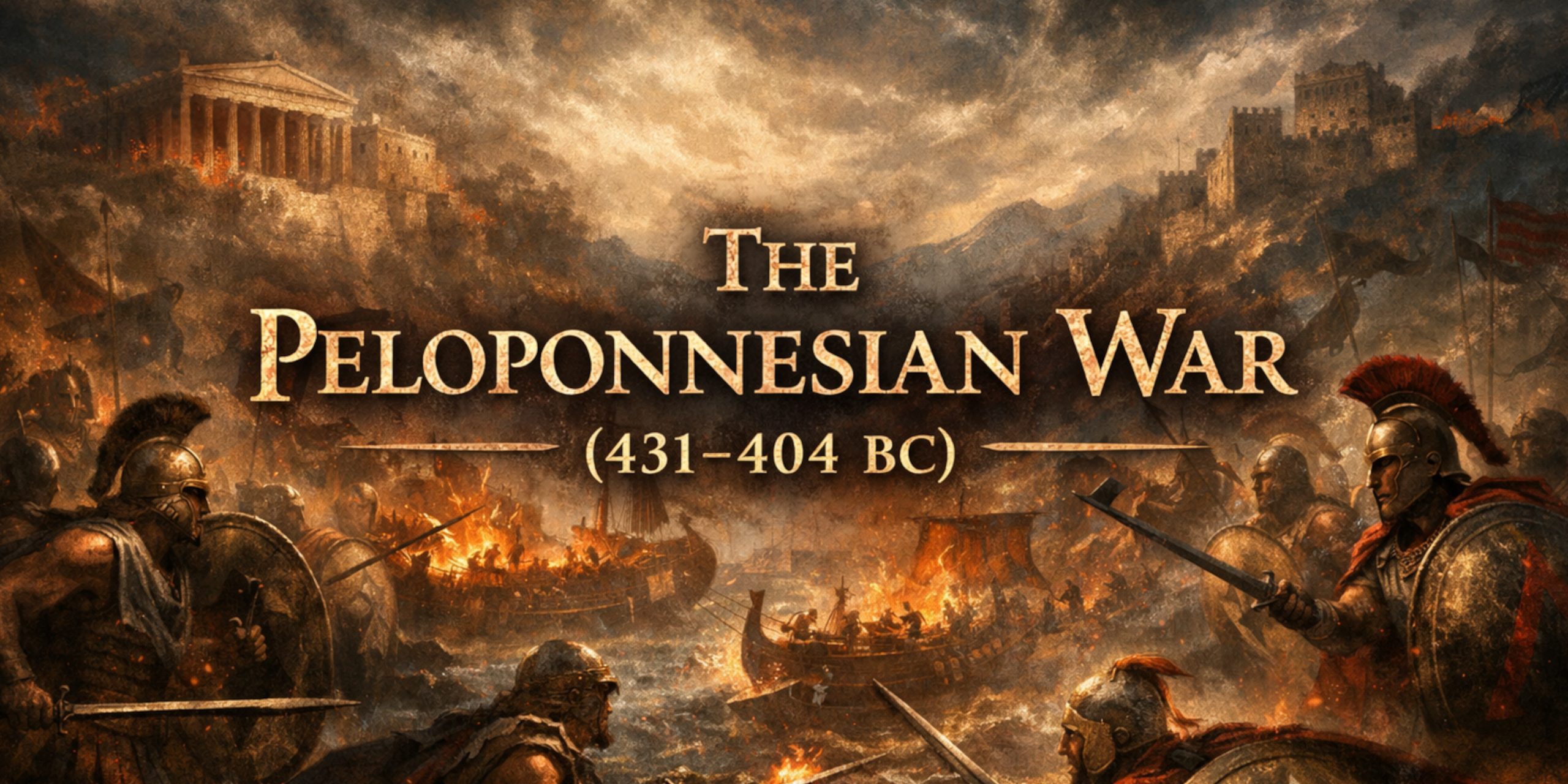
The Peloponnesian War was less a single war and more a long, grinding argument between rivals who refused to back down. On one side stood democratic Athens, wealthy, naval, confident to the point of arrogance. On the other stood oligarchic Sparta, disciplined, cautious, and rather suspicious of anyone enjoying themselves too much.
The conflict ran for nearly three decades and left the Greek world exhausted, poorer, and deeply fractured. If the earlier Persian Wars had united the Greeks, this one carefully undid that work.
Our understanding rests heavily on the account of Thucydides, who wrote with the cool detachment of a general and the quiet irritation of a man watching everything go wrong.
Background and Causes
The roots of the war lie in fear, ambition, and a growing imbalance of power.
Athens had built a maritime empire through the Delian League, drawing tribute from allied states and using it to fund ships, walls, and the sort of civic building projects that made other Greeks uneasy. Sparta, leader of the Peloponnesian League, watched this expansion with increasing concern.
Thucydides was blunt about it. The rise of Athens and the fear this caused in Sparta made war inevitable.
Tensions escalated through proxy conflicts, disputes over colonies such as Corcyra, and trade sanctions like the Megarian Decree. Each incident was manageable on its own. Taken together, they formed a pattern that neither side could ignore.
Phases of the War
The Archidamian War
Named after the Spartan king Archidamus II, this opening phase saw Sparta invade Attica repeatedly while Athens relied on its fleet and fortified walls.
Athens adopted a defensive strategy under Pericles, avoiding pitched land battles. It was a sensible plan on paper. Unfortunately, it assumed the population could endure being crowded behind the Long Walls without consequence.
They could not.
The Sicilian Expedition
This was Athens at its most ambitious and, as it turned out, most reckless.
Encouraged by figures like Alcibiades, Athens launched a massive expedition against Syracuse in Sicily. The aim was expansion. The result was catastrophe.
The entire force was trapped and destroyed. Survivors were sent to stone quarries, where conditions were so grim that even ancient historians seem to wince when describing them.
The Ionian or Decelean War
The final phase saw Sparta adapt. With Persian financial support, it built a navy and challenged Athens at sea.
A decisive Spartan victory came at the Battle of Aegospotami under Lysander. The Athenian fleet was caught off guard and destroyed. Athens, cut off from grain supplies, soon surrendered.
Key Battles
A few engagements shaped the course of the war more than others.
- Battle of Pylos and Sphacteria (425 BC)
Athens captured Spartan soldiers, an event so shocking that Sparta briefly sued for peace. Spartan invincibility, it turned out, had limits. - Battle of Amphipolis (422 BC)
Both Brasidas and Cleon were killed. The result encouraged a temporary peace, more out of exhaustion than goodwill. - Battle of Syracuse (413 BC)
The destruction of the Athenian expedition. One of the most complete military disasters in Greek history. - Battle of Aegospotami (405 BC)
Lysander’s decisive strike against the Athenian fleet effectively ended the war.
Warfare and Strategy
Greek warfare during this period was not limited to hoplite clashes in open fields.
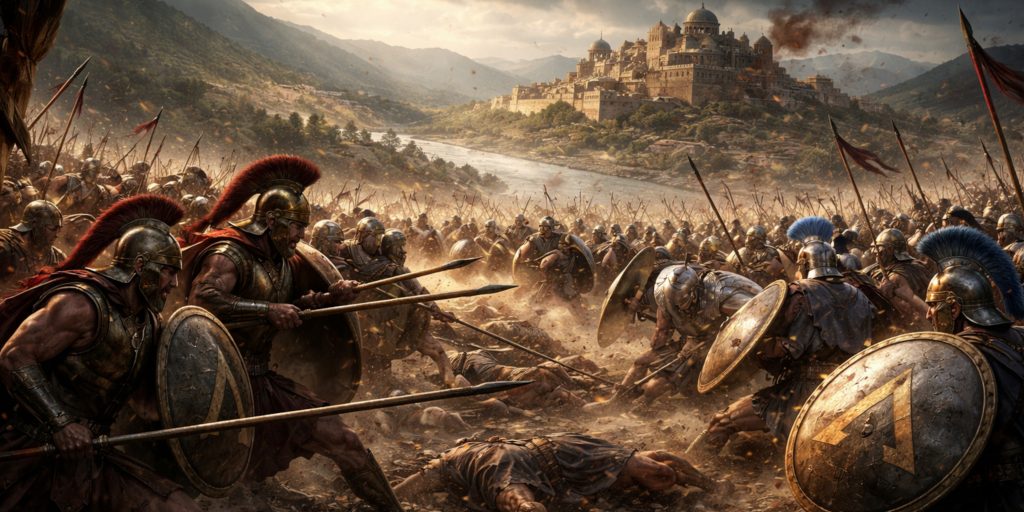
- Hoplite infantry remained central, heavily armed with spear, shield, and short sword such as the xiphos
- Naval warfare became increasingly decisive, especially for Athens with its trireme fleets
- Siegecraft and blockades gained importance as cities relied on fortifications and supply lines
- Alliances shifted frequently, often guided by pragmatism rather than loyalty
There is a certain irony in how both sides gradually adopted each other’s methods. Sparta learned naval warfare, Athens dabbled in more aggressive land campaigns. Neither did so perfectly.
Archaeology
Material evidence of the war is scattered but meaningful.
- The Long Walls of Athens still stand in fragments, a reminder of the strategy that defined the early war
- Ship sheds and naval remains provide insight into Athenian maritime dominance
- The quarries of Syracuse remain associated with the grim fate of captured Athenians
- Sites like Amphipolis reveal layers of conflict and shifting control
Unlike later periods, we lack large-scale battlefield excavations. Much of what we know comes from texts, supplemented by these fragments.
Contemporary Voices
Thucydides provides the clearest voice, though not always a comforting one.
“The strong do what they can and the weak suffer what they must.”
His account of the plague in Athens is equally stark.
“The catastrophe was so overwhelming that men, not knowing what would happen next, became indifferent to every rule of religion or of law.”
Even when paraphrased, the tone carries a quiet disbelief at how quickly order collapsed.
Consequences and Legacy
The war ended with the defeat of Athens and the temporary dominance of Sparta. It did not bring stability.
Instead, it left Greece weakened, divided, and vulnerable to future powers such as Macedon. The political landscape became increasingly unstable, with shifting alliances and internal strife.
From a historian’s perspective, the Peloponnesian War feels less like a clean conclusion and more like the beginning of a slow decline.
Seven Swords Takeaway
There is a temptation to frame this war as a clash of ideals, democracy versus oligarchy. That is partly true, but it risks oversimplifying what was, at its core, a struggle for power, security, and prestige.
What stands out is not just the scale of the conflict, but the steady erosion of restraint. Decisions that seemed reasonable in the moment compounded into disaster. Even the most capable leaders found themselves overtaken by events.
Thucydides wrote his history as a possession for all time. He likely suspected that similar patterns would repeat. Looking at later history, it is difficult to argue with him.
And if there is a lesson buried in all this, it is an uncomfortable one. Great powers rarely collapse in a single moment. They tend to argue themselves into it.