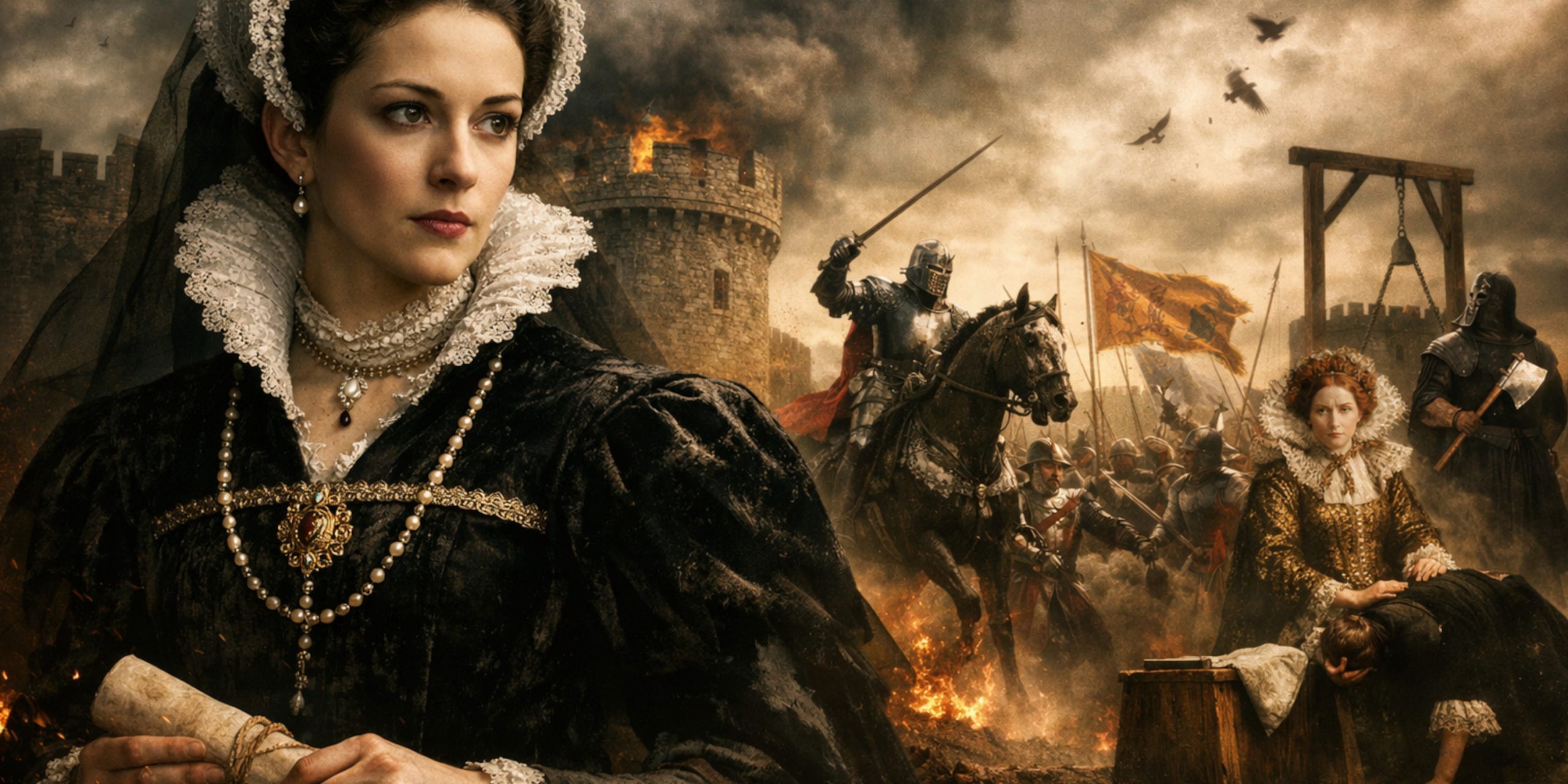
There is a tendency to treat Mary, Queen of Scots as either a romantic victim or a reckless conspirator. The truth sits somewhere more uncomfortable. She was intelligent, politically aware, and often decisive, yet repeatedly undone by timing, trust, and the men around her.
Born into power and raised in one of Europe’s most refined courts, Mary returned to a Scotland that had moved on without her. What followed was less a reign and more a prolonged struggle to hold authority in a country that no longer agreed on what authority looked like.
Early Life and French Upbringing
Mary was born in 1542, the daughter of James V of Scotland. Within days of his death, she became queen as an infant.
Sent to France at five, she was raised in the court of Henry II of France, educated alongside royal children, fluent in languages, music, and diplomacy. Her marriage to Francis II of France briefly made her Queen of France as well.
This upbringing shaped everything. She returned to Scotland as a Renaissance monarch in a country that had just embraced Protestant reform with the intensity of a bonfire.
Return to Scotland and the Problem of Rule
Mary returned in 1561 to a Scotland dominated by Protestant nobles and fiery figures such as John Knox.
To her credit, she initially governed with restraint. She tolerated Protestantism while maintaining her Catholic faith, a balancing act that required constant negotiation. It worked, for a time.
Her downfall began not with religion, but with marriage.
Her union with Henry Stuart Lord Darnley proved disastrous. Darnley was ambitious, unstable, and widely disliked. His murder in 1567, under suspicious circumstances, permanently damaged Mary’s credibility, especially when she married James Hepburn 4th Earl of Bothwell soon after.
That decision, more than any battle, ended her effective rule.
Battles and Military Acumen
Mary was not a battlefield commander in the traditional sense, but her reign intersected directly with armed conflict.
Key Military Events
- Raid of Chaseabout (1565)
A rebellion led by Protestant nobles against Mary’s marriage to Darnley. She responded swiftly, raising forces and forcing the rebels into exile. This was one of her few clear political and military successes. - Battle of Carberry Hill (1567)
Mary’s forces faced Confederate Lords who opposed Bothwell. The standoff ended without a full battle. Mary surrendered, a moment that reads less like strategy and more like resignation. - Battle of Langside (1568)
After escaping imprisonment, Mary attempted to reclaim power. Her army, led by the Earl of Argyll, was defeated by forces loyal to her infant son, James VI of Scotland.
The engagement was brief but decisive. It ended her hopes of restoration.
Assessment
Mary understood the importance of force but lacked reliable commanders and political backing. Her military failures were less about tactical incompetence and more about fractured loyalties. Scotland at this point was a patchwork of rival factions. No queen, however capable, could command unity where it did not exist.
Arms and Armour of Mary’s Reign
Mary herself did not fight, but her reign sat firmly in the transitional phase of warfare between medieval and early modern styles.
Common Weapons
- Swords
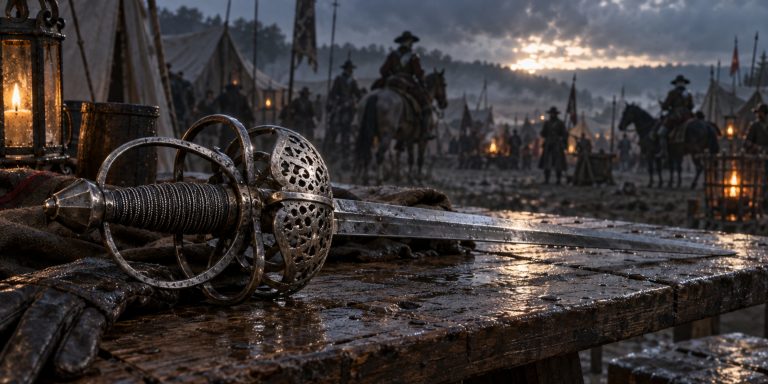
- Early basket-hilted broadswords emerging in Scotland
- Claymores still in use, though increasingly ceremonial or regional
- Arming swords carried by nobles and officers
- Polearms
- Pikes dominating infantry formations
- Halberds used by guards and elite troops
- Firearms
- Arquebuses widely used
- Early muskets appearing, though slow to reload
Armour
- Half-armour for cavalry and officers
- Brigandines and lighter protection for infantry
- Helmets such as morions and burgonets
This was a period where gunpowder had not yet fully replaced traditional arms. Battles were still decided at close range, often brutally so.
Captivity in England
After Langside, Mary fled south, seeking protection from Elizabeth I of England.
This was, with hindsight, a catastrophic miscalculation.
Instead of aid, she received nineteen years of imprisonment. Mary became both a political prisoner and a symbol. Catholic plots repeatedly centred on her as a potential replacement for Elizabeth.
The Babington Plot sealed her fate. Whether Mary was fully complicit remains debated, but enough evidence existed for conviction.
She was executed in 1587 at Fotheringhay Castle.
Artefacts and Where to See Them Today
Mary’s material legacy survives in fragments, often shaped by the drama of her life.
Key Locations
- Palace of Holyroodhouse
Her chambers remain one of the most atmospheric historical interiors in Britain. The site of David Rizzio’s murder still feels uncomfortably close. - National Museums Scotland
Holds objects linked to her reign, including textiles, personal items, and contextual displays. - Westminster Abbey
Mary is buried here, not in Scotland. Her tomb lies near Elizabeth I, which feels almost deliberate. - British Library
Preserves letters attributed to Mary, including those connected to the Bothwell controversy.
Archaeology and Recent Research
Recent work has focused less on battlefield archaeology and more on forensic history.
Key Developments
- Letter Analysis
Advanced imaging techniques have been used to re-examine the so-called Casket Letters. Some findings suggest alterations and layers of writing, though conclusions remain contested. - Fotheringhay Excavations
Limited excavations have clarified the layout of the castle where Mary was executed, reinforcing accounts of the setting rather than rewriting them. - Material Culture Studies
Renewed attention to clothing, embroidery, and personal artefacts has highlighted Mary’s role in courtly identity and symbolism. Her textiles in particular suggest a deliberate use of imagery tied to martyrdom.
Personality, Reputation, and Historical Judgement
Mary divides historians in a way few monarchs do.
She was charismatic, educated, and capable of political nuance. She was also impulsive, particularly in her personal relationships. Her marriage to Bothwell remains the most debated decision of her life, with arguments ranging from coercion to calculated risk.
What stands out is how often she was forced to act within constraints not of her making. A female Catholic ruler in a Protestant kingdom, surrounded by ambitious nobles, and later held captive by a rival queen, she was rarely allowed a stable position from which to govern.
Legacy
Her son, James VI, would eventually unite the crowns of Scotland and England. In that sense, Mary’s bloodline achieved what her reign could not.
Her story has been retold endlessly because it resists a clean conclusion. Was she a victim, a conspirator, or simply unlucky? The answer shifts depending on which evidence you trust and how much weight you give to context.
From a historian’s point of view, she is less a tragic heroine and more a case study in fragile authority. Power without control, loyalty without certainty, and decisions made in rooms where the outcome was already slipping away.
Takeaway
Mary, Queen of Scots does not fit neatly into the categories people prefer. She was neither purely heroic nor disastrously incompetent.
She ruled in a time when survival required compromise, calculation, and sometimes ruthlessness. She managed two of the three.
History tends to remember the third.