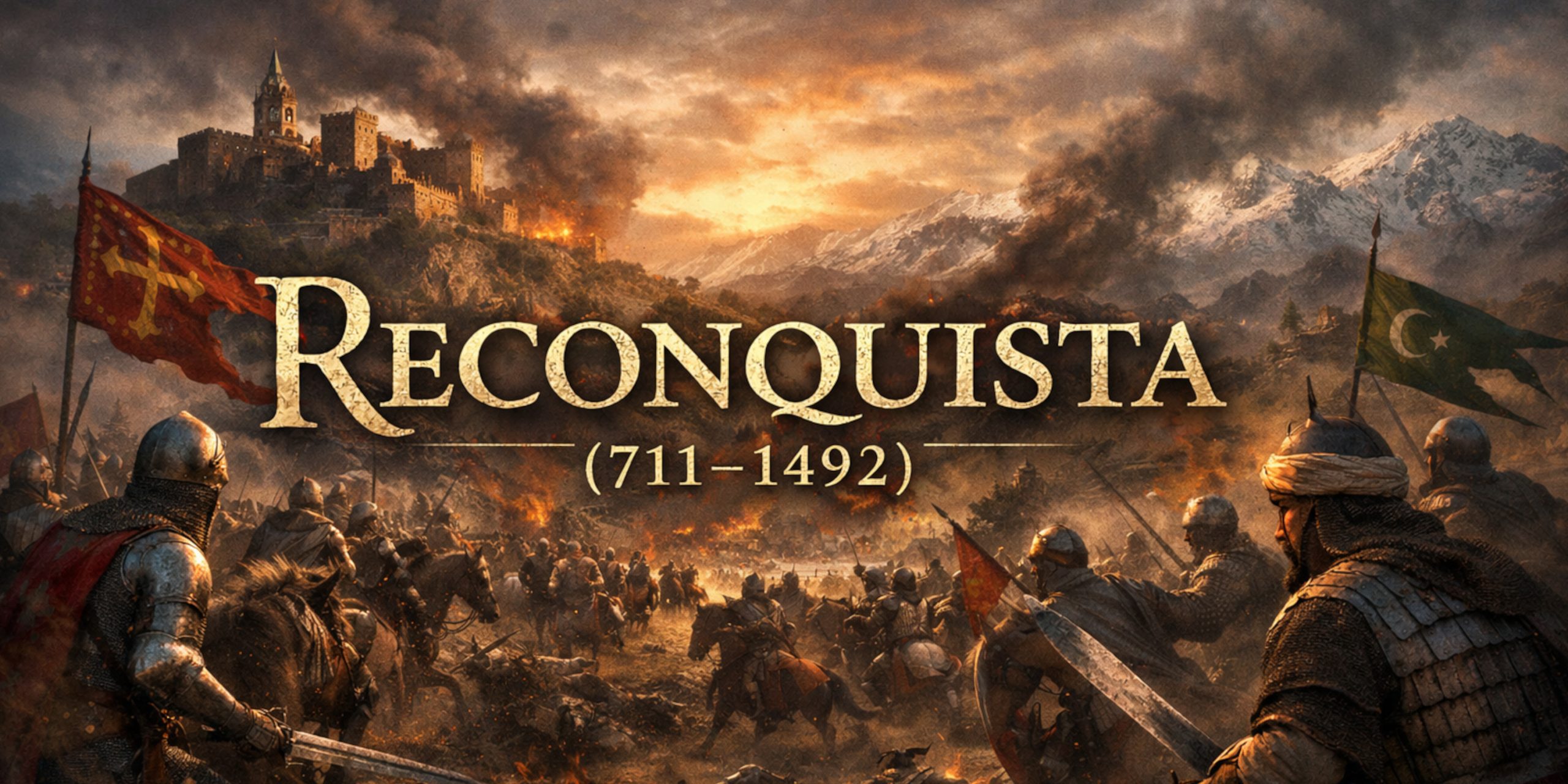
The Reconquista is often presented as a single, sweeping crusade to reclaim Iberia. It was nothing of the sort. It was messy, inconsistent, and frequently opportunistic. Alliances crossed religious lines, kings quarrelled as much with their neighbours as with their supposed enemies, and entire generations lived and died without any sense of a grand, unified mission.
What it does offer, however, is one of the most prolonged and revealing conflicts in European history. From the arrival of Muslim armies in 711 to the fall of Granada in 1492, Iberia became a shifting frontier where faith, ambition, and survival met in uneasy company.
The Islamic Conquest of Iberia
In 711, forces led by Tariq ibn Ziyad crossed the Strait of Gibraltar and defeated the Visigothic king Roderic at the Battle of Guadalete. Within a decade, most of the Iberian Peninsula had fallen under Muslim control.
The conquest was swift not only because of military strength, but because the Visigothic kingdom was already fractured. Internal rivalries and weak central authority left it vulnerable.
Al-Andalus emerged as a sophisticated and wealthy society, centred on cities such as Córdoba. It became one of the intellectual centres of medieval Europe, which rather complicates the tidy narrative of simple religious struggle.
Early Christian Resistance
Resistance did not vanish. In the northern mountains, small Christian polities began to form. The Kingdom of Asturias is often credited as the starting point of organised resistance, though one suspects its founders were more concerned with staying alive than launching a centuries-long reconquest.
The Battle of Covadonga, traditionally dated to around 722, has been treated as a symbolic beginning. Whether it was truly decisive or simply later elevated in importance is still debated. Historians are rarely allowed a simple answer.
Fragmentation and Expansion
From the ninth to the eleventh centuries, both Christian and Muslim territories fractured into smaller states.
The collapse of the Umayyad Caliphate of Córdoba in the early eleventh century led to the emergence of taifa kingdoms, often rivals rather than allies. Christian rulers took advantage of this division, extracting tribute and expanding southwards.
Yet the idea of a clear religious divide remains misleading. Christian kings frequently allied with Muslim rulers, and vice versa. Pragmatism tended to outweigh ideology, especially when land and gold were involved.
Key Battles of the Reconquista
The Reconquista was shaped by a series of hard-fought battles, though none alone decided the outcome. Each marked a shift in momentum rather than a final conclusion.
Battle of Covadonga (c. 722)
- Early Christian resistance under Pelayo
- Symbolic rather than strategically decisive
- Became a foundational myth for later kingdoms
Battle of Sagrajas (1086)
- Almoravid forces defeated Alfonso VI of Castile
- Slowed Christian expansion significantly
- Demonstrated the renewed strength of North African intervention
Battle of Las Navas de Tolosa (1212)
- Turning point in the Reconquista
- Allied Christian forces broke Almohad power in Iberia
- Opened central and southern Spain to further conquest
Fall of Córdoba (1236)
- Major symbolic and strategic victory for Castile
- Former Umayyad capital taken by Ferdinand III
Fall of Seville (1248)
- Secured control of the Guadalquivir valley
- Marked the near completion of Castilian dominance in the south
Fall of Granada (1492)
- Final Muslim stronghold surrendered to Ferdinand and Isabella
- Effectively ended Muslim political authority in Iberia
No single battle ended the conflict. Instead, it was a gradual tightening of pressure over centuries, punctuated by moments of dramatic reversal.
Arms and Warfare
Warfare in the Reconquista reflected a blend of traditions from both Islamic and Christian worlds.
Christian forces relied heavily on:
- Heavy cavalry, particularly knights equipped with lances and swords
- Straight double-edged arming swords and later longswords
- Kite shields evolving into smaller heater shields
- Chainmail armour, gradually supplemented by plate
Muslim forces in Al-Andalus typically favoured:
- Light cavalry and fast-moving infantry
- Curved swords such as early sabres
- Composite bows for ranged combat
- Lamellar and mail armour
This was not a static system. Equipment and tactics evolved as each side learned from the other. One could say the battlefield became a place of cultural exchange, though not the sort one would volunteer for.
Society on the Frontier
Life along the frontier was uncertain. Towns changed hands, populations shifted, and communities adapted as best they could.
There were periods of coexistence, known as convivencia, where Muslims, Christians, and Jews lived under shared systems of governance. These arrangements were rarely perfect and often fragile, but they did exist.
At the same time, raids, reprisals, and forced migrations were common. For many, survival mattered more than ideology.
Archaeology of the Reconquista
Archaeology has added texture to what written sources often simplify or exaggerate.
Key findings include:
- Fortified frontier settlements showing layers of occupation and rebuilding
- Weapon fragments such as sword blades, arrowheads, and armour pieces
- Urban remains in cities like Córdoba and Toledo, revealing cultural and architectural blending
- The Alhambra in Granada, offering insight into late Islamic rule and court life
Excavations often reveal continuity rather than abrupt change. A conquered city did not simply vanish and reappear as something entirely new. People adapted, reused, and carried on.
Contemporary Voices
The Reconquista was recorded by both Christian and Muslim chroniclers, each offering their own perspective.
From the Christian side:
“God granted victory to the faithful, and the enemies of the Cross were scattered.”
From the Muslim historian Ibn Idhari:
“The land of al-Andalus trembled under the blows of its foes, and its people were divided.”
And from later reflections on Granada:
“Weep like a woman for what you could not defend as a man.”
That last remark, attributed to the mother of Boabdil, carries a certain sharpness. Medieval politics rarely lacked for cutting words.
The Fall of Granada and Aftermath
In 1492, Granada surrendered after a prolonged campaign. The Catholic Monarchs, Ferdinand and Isabella, brought the Reconquista to its formal end.
The consequences were immediate and far-reaching:
- The expulsion or forced conversion of Muslim and Jewish populations
- The consolidation of Spain as a unified Christian kingdom
- The redirection of Spanish ambition outward, most notably across the Atlantic
It is tempting to treat 1492 as a neat conclusion. In reality, it marked the beginning of new tensions and transformations that would shape Spain for centuries.
Legacy
The Reconquista has been interpreted in many ways, often shaped by later political and cultural agendas.
For some, it represents a triumph of Christian identity. For others, it highlights a lost world of cultural exchange and coexistence. The truth sits somewhere in between, as it usually does.
What remains clear is that it reshaped Iberia permanently. Borders, identities, and institutions all bear its mark.
And perhaps the most honest conclusion is this. The Reconquista was not a single story with a clear moral. It was a long, complicated argument, conducted in steel and stone, with consequences that outlasted every participant.