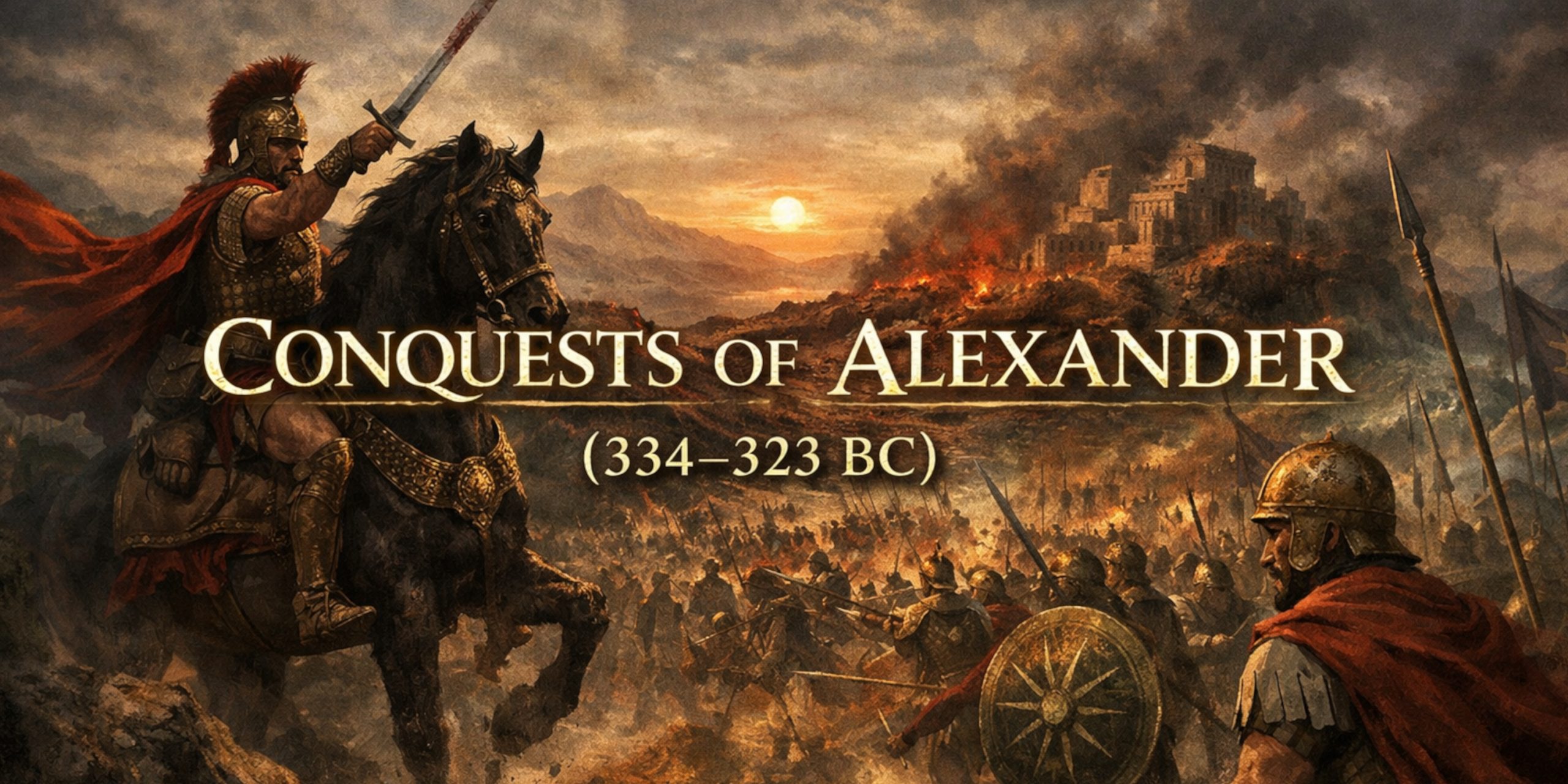
There are few figures in ancient history who inspire quite the same mixture of admiration and suspicion as Alexander III of Macedon. He conquered an empire that stretched from Greece to India before turning thirty three, which sounds impressive until you remember he also managed to leave it in utter chaos almost immediately afterwards.
What we know of his campaigns comes from later historians such as Arrian, Plutarch, and Curtius Rufus, all writing centuries after the events. That leaves us in the slightly awkward position of trusting sources who admired him a little too much, or distrusted him for entirely different reasons. Still, between them, archaeology, and a healthy dose of scepticism, a coherent picture emerges.
Background and Preparation
Before Alexander crossed into Asia in 334 BC, the groundwork had already been laid by his father, Philip II. Philip had transformed Macedon from a peripheral kingdom into a disciplined military power, introducing the famous sarissa pike and restructuring the army into a formidable combined force.
Alexander inherited:
- A professional standing army
- A strong cavalry arm, particularly the Companion Cavalry
- Political control over much of Greece through the League of Corinth
In short, he began his campaign with advantages most conquerors would envy and probably squander.
The Campaign Begins
Alexander crossed the Hellespont in 334 BC, symbolically casting a spear into Asian soil as a gesture of conquest. It was theatrical, but then he had a keen sense for performance.
His objective was simple in theory and absurd in scale: defeat the Persian Empire.
Major Battles of the Conquests
Battle of the Granicus (334 BC)
This first major engagement against Persian satrapal forces took place at a river crossing in Asia Minor.
- Macedonian forces forced a crossing under heavy resistance
- The Companion Cavalry played a decisive role
- Persian leadership suffered heavy losses
The battle secured Asia Minor and demonstrated that Alexander was not inclined towards caution.
Battle of Issus (333 BC)
Here, Alexander faced King Darius III himself.
- The battlefield was narrow, limiting Persian numerical advantage
- Alexander led a direct charge towards Darius
- Darius fled, leaving his family behind
As Arrian records, Darius’ retreat effectively decided the battle. One suspects Alexander never let him forget it.
Siege of Tyre (332 BC)
This was not a battle so much as a stubborn argument with an island city.
- Tyre refused to surrender
- Alexander constructed a causeway to reach the island
- After months of siege, the city fell violently
It was a brutal episode and a reminder that Alexander could be as ruthless as he was ambitious.
Battle of Gaugamela (331 BC)
This was the decisive confrontation.
- Darius assembled a vast army on open ground
- Alexander exploited gaps in the Persian line
- A decisive cavalry charge again forced Darius to flee
Plutarch writes that Alexander declared, “The heavens cannot brook two suns, nor Asia two kings.” It is a line that feels rehearsed, but effective.
Campaigns in the East (330–323 BC)
After Gaugamela, the campaign shifted into something more unpredictable.
- Pursuit of Darius into Persia
- Guerrilla warfare in Bactria and Sogdiana
- Marriage alliances and attempts at cultural integration
- The Indian campaign culminating at the Battle of the Hydaspes
The further east Alexander went, the less conventional his campaign became. His army, quite understandably, grew tired of marching to the edge of the known world.
Arms and Warfare
Alexander’s success rested on a flexible and coordinated army:
- Phalanx infantry with long sarissas
- Companion Cavalry used for decisive charges
- Light infantry and archers for mobility
- Siege engineers capable of complex constructions
It was not just brute force. It was timing, coordination, and a willingness to take personal risks that would make most generals uncomfortable.
Archaeology and Material Evidence
The archaeology of Alexander’s campaigns is uneven but revealing.
Key sites and finds:
- Gaugamela region (modern Iraq): Limited physical remains, though landscape studies support historical descriptions
- Tyre (Lebanon): The remains of the causeway still exist, now part of the mainland
- Ai Khanoum (Afghanistan): A Hellenistic city showing Greek cultural influence deep in Central Asia
- Vergina (Macedon): Royal tombs that illuminate Macedonian elite culture, if not the campaign directly
Coins are among the most valuable sources. Alexander’s coinage spread across his empire, standardising imagery and reinforcing his authority long after his death.
Contemporary and Near-Contemporary Voices
Although most surviving accounts are later, they draw on earlier material.
Arrian, quoting earlier sources, presents Alexander as disciplined and heroic, perhaps too much so.
Plutarch offers more character detail, noting moments of anger and excess.
A fragment attributed to Callisthenes, Alexander’s own historian, suggests a more polished image, though he later fell out of favour, which tends to happen when one stops flattering a king.
One line attributed to Alexander himself survives in various forms:
“I am not afraid of an army of lions led by a sheep, but an army of sheep led by a lion.”
Whether he actually said it is debatable. It sounds exactly like something he would want people to think he said.
The Death of Alexander and Immediate Aftermath
Alexander died in Babylon in 323 BC, aged thirty three. The cause remains uncertain, with theories ranging from illness to poisoning, though the former is more likely.
His final reported words, when asked to whom he left his empire, were “to the strongest.” If true, it was either a moment of dark humour or a catastrophic lack of planning.
The empire quickly fragmented:
- The Diadochi wars divided territories
- No unified succession emerged
- Greek culture spread widely across the eastern Mediterranean and Near East
Legacy of the Conquests
Alexander’s campaigns reshaped the ancient world in several lasting ways:
- The spread of Hellenistic culture across Asia
- The blending of Greek and eastern traditions
- The establishment of cities that remained important for centuries
Yet his empire did not survive him. It is one of history’s great contradictions. He conquered quickly, brilliantly, and with remarkable consistency, but built something that could not endure.
Takeaway
As a historian, I find Alexander slightly exhausting. Brilliant, yes. Charismatic, certainly. But also impulsive, occasionally reckless, and rather too fond of dramatic gestures.
His conquests changed the course of history, though perhaps not in the way he intended. He sought a unified empire. What he left behind was a cultural legacy far more enduring than any political structure.
In the end, that may be the more interesting achievement.