The Medici series gives us power plays, cathedral conspiracies, brooding stares across candlelit halls and more velvet cloaks than strictly necessary. It is glossy, dramatic, and occasionally chaotic. But how close does it get to the real history of Florence’s most influential banking dynasty?
Short answer. Close in spirit, loose in detail.
Let’s separate the silk from the substance.
The Real Medici: Bankers Before Bosses
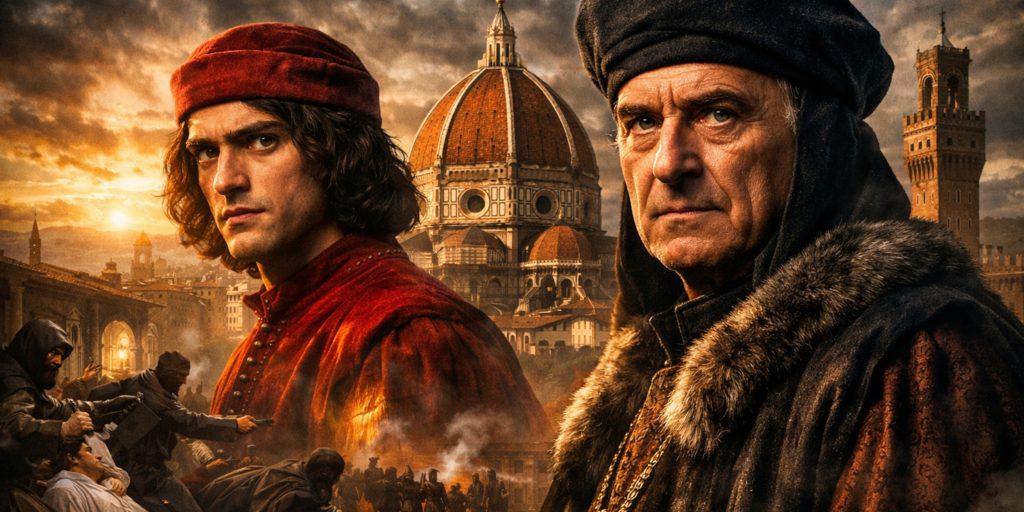
The historical Medici were not born into crowns. They built influence the modern way, through finance.
In the early fifteenth century, Giovanni di Bicci de’ Medici founded what became the most powerful bank in Europe. The Medici Bank handled papal finances, royal accounts, and international trade. Money moved through Florence because the Medici made it move.
His son, Cosimo de’ Medici, known later as Cosimo the Elder, transformed financial influence into political control. Officially, Florence remained a republic. Unofficially, Cosimo controlled it through alliances, patronage, and carefully placed friends.
The show frames Cosimo as a reluctant ruler pulled into power after his father’s murder. In reality, Giovanni died peacefully. Cosimo’s rise was less revenge arc, more calculated chess match.
Still, the series captures something important. Power in Renaissance Florence was subtle. It did not need a crown.
Florence: A Republic With Sharp Edges
Florence in the fifteenth century was not a sleepy art town. It was a political pressure cooker.
Wealthy families such as the Albizzi and Strozzi competed fiercely for influence. Exile was common. Assassination was not unheard of. Political debates could turn vicious very quickly.
Cosimo himself was exiled in 1433 by rivals who feared his growing power. The series compresses timelines and rearranges enemies, but the core truth holds. Florentine politics were ruthless.
When Cosimo returned from exile a year later, he did not rule as a tyrant. He ruled as a master of networks. He financed projects, supported allies, and made sure debts were remembered.
It is the Renaissance version of keeping receipts.
Art, Architecture and Reputation Management
The show rightly emphasises art and architecture. This part is not exaggeration. The Medici invested heavily in culture.
Cosimo supported figures like Filippo Brunelleschi, whose dome for Florence Cathedral was an engineering breakthrough, and Donatello, whose bronze David quietly redefined sculpture.
Patronage was not pure generosity. It was strategy. Supporting artists elevated Florence and, by extension, the Medici name. If you fund beauty, people associate you with civilisation rather than corruption.
The series occasionally simplifies artistic timelines, but its portrayal of Florence as a creative explosion is fair. The city genuinely became the beating heart of the Renaissance.
Lorenzo the Magnificent: Drama Meets Reality
Season two shifts focus to Lorenzo de’ Medici, known as Lorenzo the Magnificent.
He was charismatic, politically sharp, and genuinely passionate about culture. He supported artists such as Sandro Botticelli and helped shape Florence’s golden age.
The series leans into romance and heightened rivalries, especially around the Pazzi conspiracy. That event, however, was very real. In 1478 members of the Pazzi family attempted to assassinate Lorenzo and his brother Giuliano during Mass in Florence Cathedral. Giuliano was killed. Lorenzo survived.
The aftermath was brutal. The Medici response was swift and merciless. Executions followed. Political enemies were crushed.
So yes, the show turns up the intensity. But it did not invent the danger.
What the Series Changes
For dramatic pacing, the show rearranges timelines, merges characters, and invents personal relationships. Some figures who never met share scenes. Some rivalries are simplified into neat good versus bad narratives.
It also amplifies romance. Renaissance politics were intense enough without added love triangles, but television thrives on emotional stakes.
The broader arc, though, is accurate. The Medici rose through banking, controlled Florence indirectly, survived exile and assassination attempts, and shaped European culture.
The spirit is right, even when the dates are flexible.
The Medici Legacy Beyond Netflix
The Medici story did not end with Lorenzo. Later generations produced popes, queens, and grand dukes. Catherine de’ Medici became Queen of France. Two Medici became popes.
Their dynasty stretched across centuries, influencing European politics, religion, and art.
When you watch the series, you are seeing only a slice of a much longer saga. Florence’s golden age eventually faded. The Medici line ended in the eighteenth century. Yet their impact still lingers in museums, churches, and financial history textbooks.
Not bad for a family that started with ledgers and loans.
So, How Accurate Is Medici?
If you want documentary precision, this is not it. If you want a stylish, emotionally charged entry point into Renaissance history, it works surprisingly well.
It captures the tension of Florentine politics, the central role of banking, and the cultural transformation of the city. It embellishes personal stories and rearranges events for narrative flow.
As an introduction to the Renaissance, it is effective. As strict history, it needs footnotes.
That said, if a drama series makes you Google Cosimo at midnight, it has done something right.
Takeaway
The Medici were not saints, not villains, and not quite the leather coated masterminds the screen sometimes suggests. They were pragmatic operators in a volatile republic. They understood money, reputation, and timing better than most of their rivals.
The Netflix series gives us intrigue and atmosphere. The real history gives us something even more interesting. A banking family that reshaped art, politics, and culture without ever formally seizing a throne.
That might be the most Renaissance plot twist of all.