The Flemish guild militias occupy a curious place in medieval military history. They were not professional knights nor romantic rebels. They were butchers, weavers, brewers and merchants who took up arms with alarming competence. In the towns of medieval Flanders, commerce and conflict sat uncomfortably close together. Wealth bred ambition, and ambition required defence.
When princes overreached or foreign kings intruded, these urban communities did not always wait for feudal cavalry to save them. They formed disciplined, organised militia forces drawn from craft guilds. Against expectation and against the prevailing military logic of the age, they sometimes won.
Origins and Political Context
In the thirteenth and early fourteenth centuries, the County of Flanders was among the richest regions in Europe. Cities such as Bruges, Ghent and Ypres thrived on textile production and international trade.
Urban wealth brought political leverage. Guilds organised not only economic life but civic governance. Tensions simmered between:
- The Count of Flanders and the French crown
- Urban elites and rural nobility
- Pro French factions and local autonomy movements
These tensions erupted into open warfare in the early fourteenth century, culminating in one of the most remarkable militia victories of the Middle Ages.
The Battle That Defined Them
Battle of the Golden Spurs
Fought near Kortrijk in 1302, this battle saw Flemish guild militias defeat a powerful French chivalric army. The shock reverberated across Europe.
French knights, heavily armoured and mounted, expected to crush what they considered an inferior urban rabble. Instead they encountered:
- Carefully prepared defensive terrain
- Dense infantry formations
- Determined men fighting for their own towns
The field was reportedly strewn with gilded spurs taken from fallen French knights, hence the name.
A contemporary chronicler, Guillaume de Nangis, wrote with some disbelief that the French were overwhelmed by common townsmen. Flemish accounts were less surprised.
Organisation and Structure
Guild militias were not spontaneous mobs. They were structured and disciplined.
Each guild supplied a contingent. Leadership was often drawn from respected urban figures. Equipment standards could be surprisingly consistent, especially in wealthier towns.
Typical characteristics included:
- Strong internal discipline
- Clear command hierarchies
- Coordination between guild contingents
- Collective financing of arms and equipment
The civic bell tower, not a feudal banner, was their rallying point.
Arms and Armour
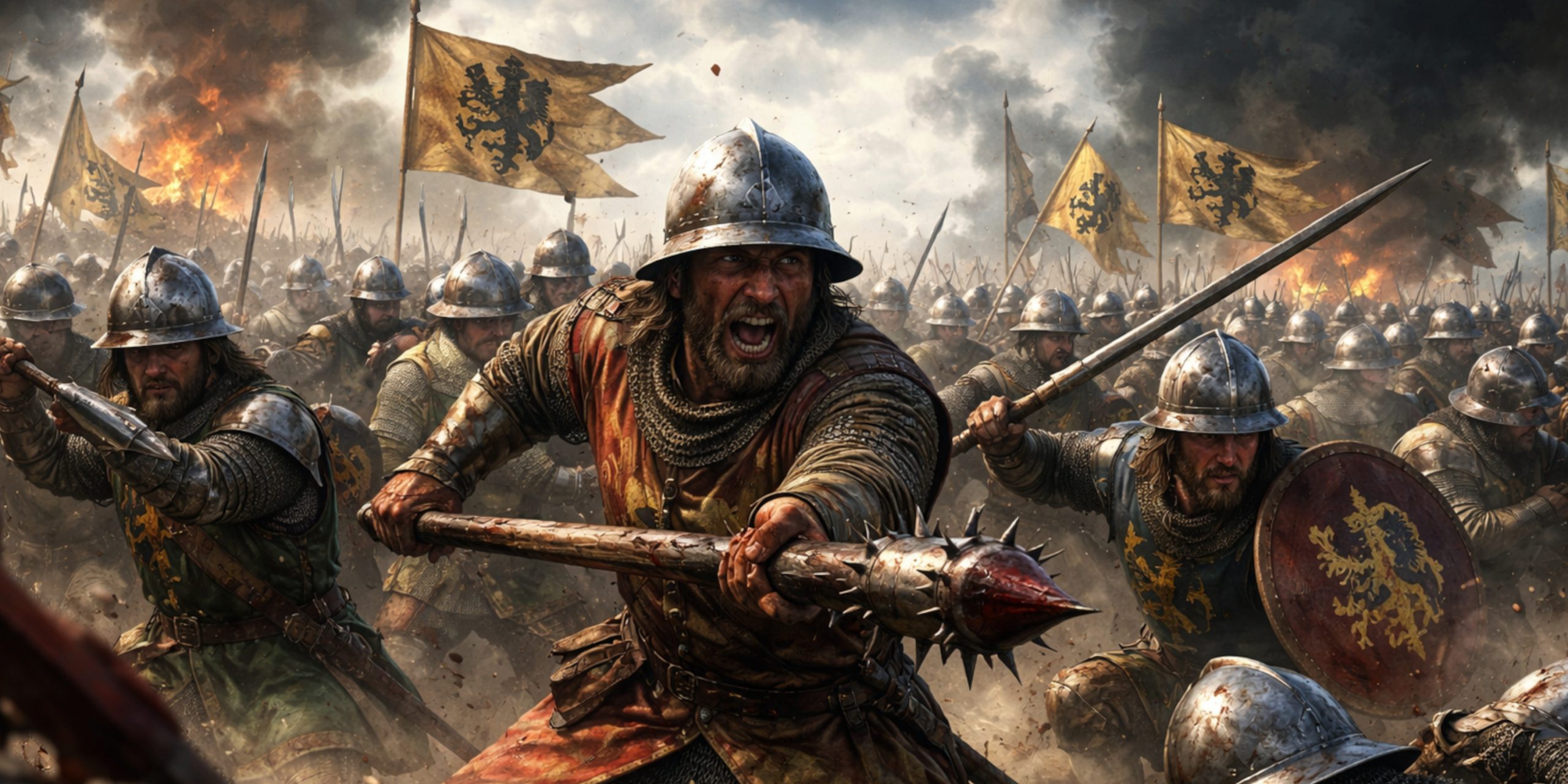
The militias relied primarily on infantry weapons suited to tight formations.
The Goedendag
The most famous weapon associated with the Flemish militia is the goedendag. It was a stout wooden shaft, thickened towards the top and capped with a steel spike.
Its advantages:
- Effective against cavalry
- Simple to produce
- Devastating at close quarters
A charging knight who lost momentum in muddy ground faced a hedge of spikes and clubs. One suspects that many reconsidered their life choices in that moment.
Polearms and Spears
Long spears and pikes formed the backbone of defensive formations. These created a barrier against cavalry and allowed infantry to maintain cohesion.
Swords Used
While the goedendag dominates popular imagination, swords were also carried.
Common types included:
- Arming swords of Oakeshott Type XII or XIII, broad bladed and suited to cutting
- Falchions, single edged and powerful against lightly armoured foes
These were sidearms rather than primary weapons. A guildsman’s sword was often practical rather than ornate, though wealthier citizens could afford respectable blades.
Armour
Armour varied according to means.
Typical protection included:
- Padded gambesons
- Mail shirts or hauberks
- Iron or steel kettle hats
- Simple shields
Wealthier members might wear partial plate elements by the early fourteenth century. Unlike knights, their armour was not designed for mounted shock combat but for resilience in formation fighting.
Tactics and Battlefield Method
The guild militias excelled at defensive infantry tactics.
Key features:
- Dense, disciplined ranks
- Use of marshy or obstructed terrain
- Refusal to break formation
- Coordination between urban contingents
At the Battle of the Golden Spurs, French cavalry struggled in soft ground and ditches prepared by Flemish defenders. Once dismounted or unhorsed, heavily armoured knights were vulnerable to massed infantry.
This was not an accident. It was preparation meeting opportunity.
Archaeology and Material Evidence
Excavations near Kortrijk have uncovered:
- Spurs attributed to fallen French knights
- Fragments of mail and weaponry
- Evidence of battlefield disturbance consistent with close infantry combat
Urban excavations in Bruges and Ghent reveal militia equipment stored in civic arsenals. Surviving helmets and weapon fragments reflect a mixture of locally produced and imported arms.
Material culture supports what chronicles describe. These were not peasants with pitchforks. They were armed townsmen with access to trade networks and metalworking expertise.
Contemporary Views
French chroniclers tended to view the defeat as humiliating and almost unnatural. The notion that commoners could defeat mounted nobility challenged the ideological order.
Flemish sources, by contrast, framed events as a defence of communal liberty.
One account describes the townsmen standing firm “like a wall of iron.” That metaphor, while poetic, captures the essence of disciplined infantry in tight formation.
Even in hostile narratives, there is grudging respect. The militias fought cohesively and without panic. In medieval warfare, that alone set them apart.
Decline and Legacy
The Flemish guild militias did not permanently overturn feudal warfare. Cavalry remained dominant in many contexts. Yet the psychological and tactical impact was significant.
Their success foreshadowed:
- The rise of disciplined infantry in Switzerland
- The growing importance of urban military power
- The erosion of unquestioned knightly supremacy
The militias of Flanders demonstrated that organisation and terrain could neutralise aristocratic shock power. That lesson would be repeated across Europe in the centuries to follow.
Takeaway
Medieval warfare was not solely the preserve of armoured nobles seeking glory. It was also shaped by merchants who understood balance sheets and battle lines with equal clarity.
They did not romanticise war. They prepared for it, financed it and, when necessary, fought it with pragmatic determination. In doing so, they forced Europe to reconsider who truly held power on the battlefield.
Commerce built their cities. Collective will defended them.