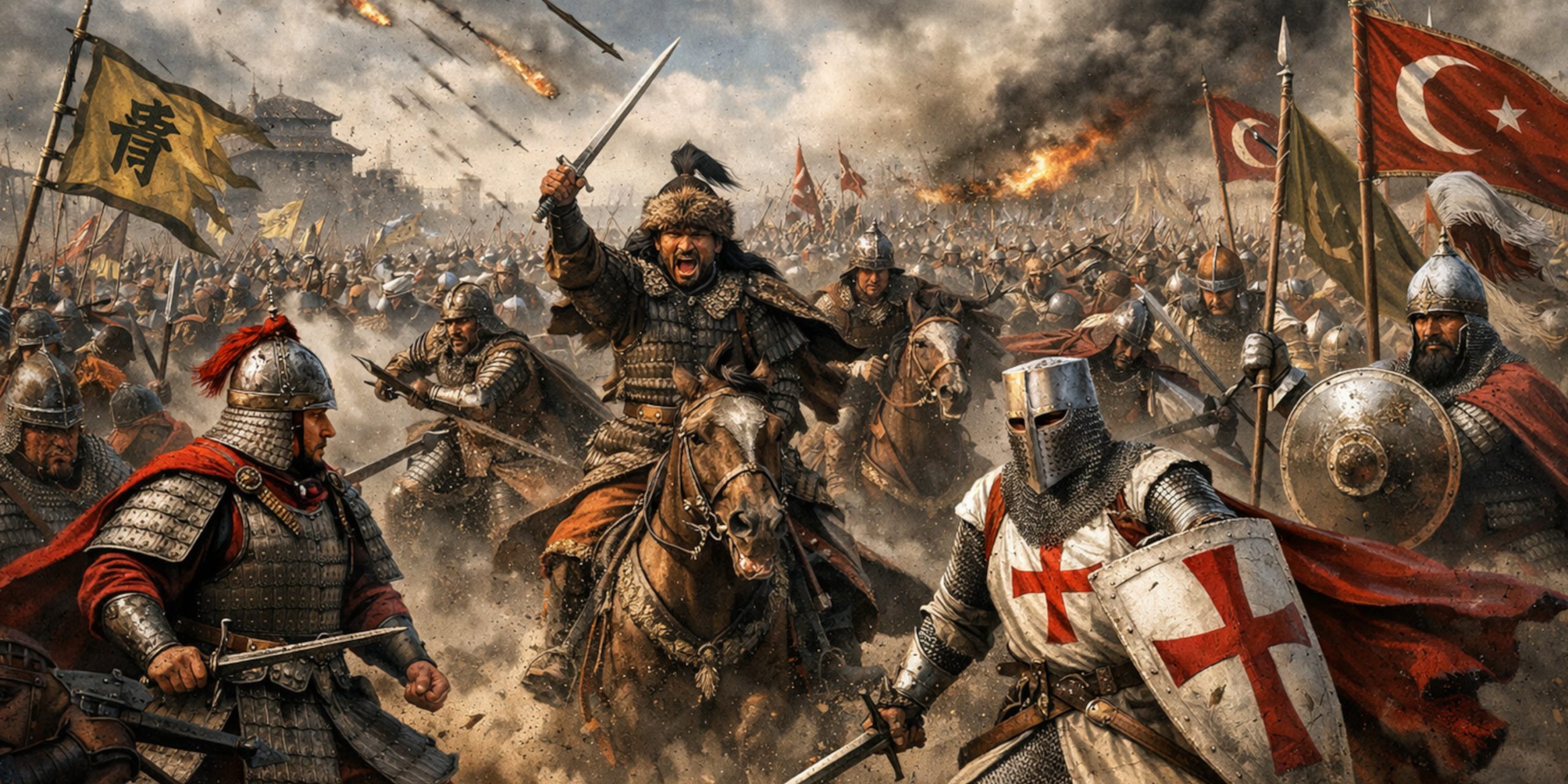
Medieval writers loved scale. The bigger the army, the greater the glory on the battlefield, or the greater the excuse when things went wrong. Strip away the bravado and what remains is still impressive. Some medieval states could raise forces on a scale that would strain even early modern governments. The real story sits at the intersection of manpower, leadership, and the less glamorous matter of feeding tens of thousands of people who all expected to be paid, or at least not starve.
Tang Dynasty China
Key Battles and Campaigns
The Tang dynasty reached its military high point in the seventh and early eighth centuries. One of the clearest examples of its capacity is the campaigns against the Eastern Turkic Khaganate, culminating in 630 under Emperor Taizong. Tang field armies in these frontier wars likely numbered well over 100,000, supported by multiple auxiliary forces.
Another major demonstration came at the Battle of Talas in 751, where a Tang expeditionary army fought Abbasid forces in Central Asia. Although the Tang were defeated, the scale of the campaign shows how far Chinese power could project.
Notable Leaders
- Emperor Taizong: Strategist as much as sovereign, personally involved in military planning
- Gao Xianzhi: Frontier general whose campaigns pushed Tang influence deep into Central Asia
Army Composition
Tang armies were highly structured and diverse:
- Heavy and medium infantry armed with spears, swords, and crossbows
- Massed crossbow units, one of the deadliest missile forces of the medieval world
- Armoured cavalry, often drawn from northern frontier populations
- Allied and subject troops, including Turkic horsemen
- Engineers, logistics personnel, and transport troops, often overlooked in sources but essential
This was an army backed by bureaucracy. Grain shipments and tax registers mattered as much as battlefield bravery.
Song Dynasty China
Key Battles and Campaigns
The Song dynasty rarely fought decisive wars of conquest, but its defensive campaigns reveal enormous manpower. During wars with the Liao dynasty and later the Jin dynasty, Song armies in northern China often exceeded 200,000 men across multiple fronts.
The defence of Kaifeng during the Jin invasion in the early twelfth century shows how these forces were concentrated around fortified cities rather than roaming freely.
Notable Leaders
- Yue Fei: Perhaps the most famous Song general, celebrated for discipline and loyalty
- Han Shizhong: Naval and riverine warfare specialist, critical in southern defences
Army Composition
Song armies leaned heavily toward infantry and specialists:
- Large standing infantry formations
- Extensive use of crossbows and early gunpowder weapons
- Engineers skilled in siege defence, trenching, and fortifications
- Riverine and naval forces, unusually strong for a medieval state
- Cavalry units existed but were limited compared to northern rivals
The Song had numbers, technology, and organisation. What they lacked was strategic freedom.
The Mongol Empire
Key Battles and Campaigns
Mongol armies were smaller but devastatingly effective. At the Battle of Kalka River in 1223, a Mongol force of perhaps 20,000 annihilated a much larger Rus coalition. At Mohí in 1241, Subutai and Batu Khan destroyed the Hungarian army using coordinated manoeuvre and deception.
Notable Leaders
- Genghis Khan: Architect of Mongol command structure and discipline
- Subutai: Possibly the greatest operational commander of the medieval world
- Batu Khan: Leader of western Mongol expansion into Europe
Army Composition
Mongol forces were remarkably uniform but flexible:
- Light and heavy cavalry armed with composite bows and lances
- Strict decimal organisation, from units of ten to tumens of ten thousand
- Auxiliary troops drawn from conquered peoples, including infantry and engineers
- Chinese and Persian specialists for siege warfare
- Minimal baggage trains, relying on mobility and local resources
They did not need vast numbers. They needed obedience, speed, and intelligence.
The Abbasid Caliphate
Key Battles and Campaigns
During its early period, the Abbasid Caliphate fielded enormous forces. The Battle of the Zab in 750, which ended the Umayyad dynasty, involved armies likely numbering well over 100,000 on each side.
Later, large Abbasid forces were used in campaigns against Byzantium and internal revolts, although effectiveness declined as unity weakened.
Notable Leaders
- Abu Muslim al Khorasani: Key military figure behind the Abbasid revolution
- Harun al Rashid: Caliph who personally led major campaigns against Byzantium
Army Composition
Abbasid armies were varied and layered:
- Arab tribal cavalry and infantry
- Persian heavy infantry traditions
- Turkic slave soldiers, increasingly dominant over time
- African and Central Asian contingents
- Elite palace guards alongside provincial levies
The caliphate could raise huge armies, but keeping them loyal proved harder than raising them.
Crusading Armies of Western Europe
Key Battles and Campaigns
The Siege of Antioch and Battle of Ascalon in 1099 during the First Crusade involved some of the largest western armies of the medieval era. Initial forces may have approached 60,000 fighters, not counting camp followers.
Later expeditions such as the Third Crusade again saw massive multinational armies, although they rarely operated as a single coherent force.
Notable Leaders
- Godfrey of Bouillon: First ruler of the Kingdom of Jerusalem
- Richard I of England: Military commander of exceptional energy and aggression
- Saladin: Crusader opponent, commanding equally large Muslim coalitions
Army Composition
Crusading armies were chaotic but formidable:
- Heavily armoured knights forming shock cavalry
- Mounted sergeants and lighter cavalry
- Infantry armed with spears, swords, and bows
- Religious contingents and militias
- Non combatants, pilgrims, and camp followers in vast numbers
These armies were powerful at impact, fragile over time, and astonishingly hard to supply.
The Ottoman Empire in the Late Medieval Period
Key Battles and Campaigns
The Ottoman military machine matured in the fifteenth century. At the Battle of Varna in 1444, Ottoman forces defeated a large crusading army. The Siege of Constantinople in 1453 involved perhaps 80,000 Ottoman troops, a huge force for the era.
Notable Leaders
- Murad II: Consolidator of Ottoman military power
- Mehmed II: Conqueror of Constantinople and master of siege warfare
Army Composition
Ottoman armies combined medieval and early modern elements:
- Janissary infantry, disciplined and salaried
- Sipahi cavalry supported by land grants
- Provincial levies and allied contingents
- Artillery units and siege engineers
- Logistical corps capable of sustained campaigning
This was an army that pointed firmly toward the future.
Perspective from the Historian’s Desk
The biggest medieval armies were not simply crowds with weapons. They were systems. Administration, leadership, and supply mattered more than raw numbers, a lesson repeated across continents. Tang China could mobilise half a million on paper, the Mongols could shatter empires with a fraction of that, and the Ottomans quietly refined a model that would dominate for centuries.
When medieval sources boast of armies beyond counting, it pays to smile, sharpen the pencil, and ask a simple question. Where did they eat, who told them where to go, and why did they listen. Answer those, and the real size of a medieval army comes into focus.