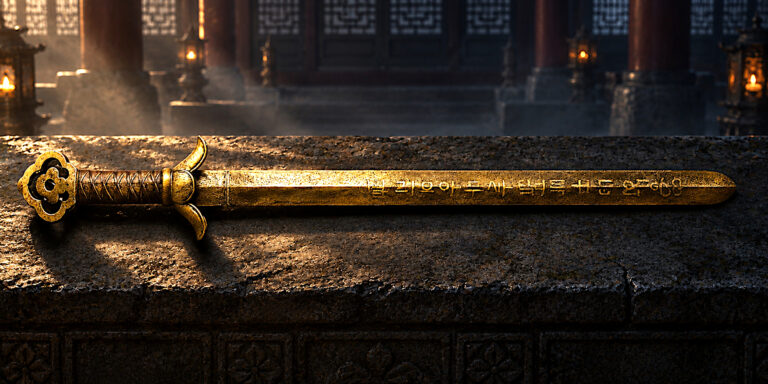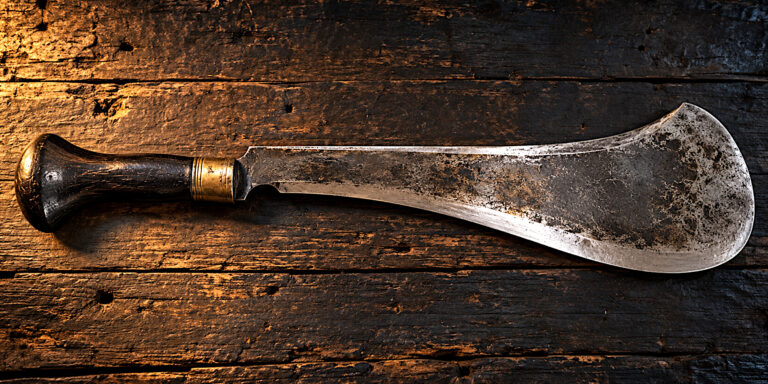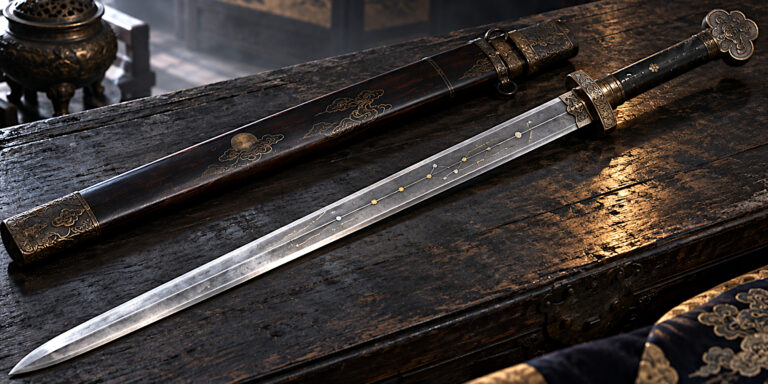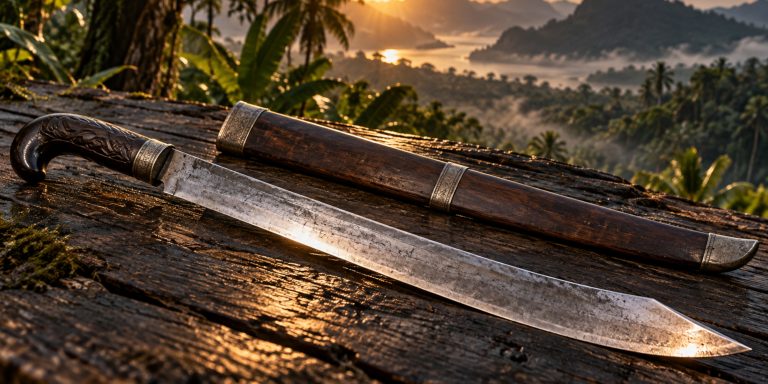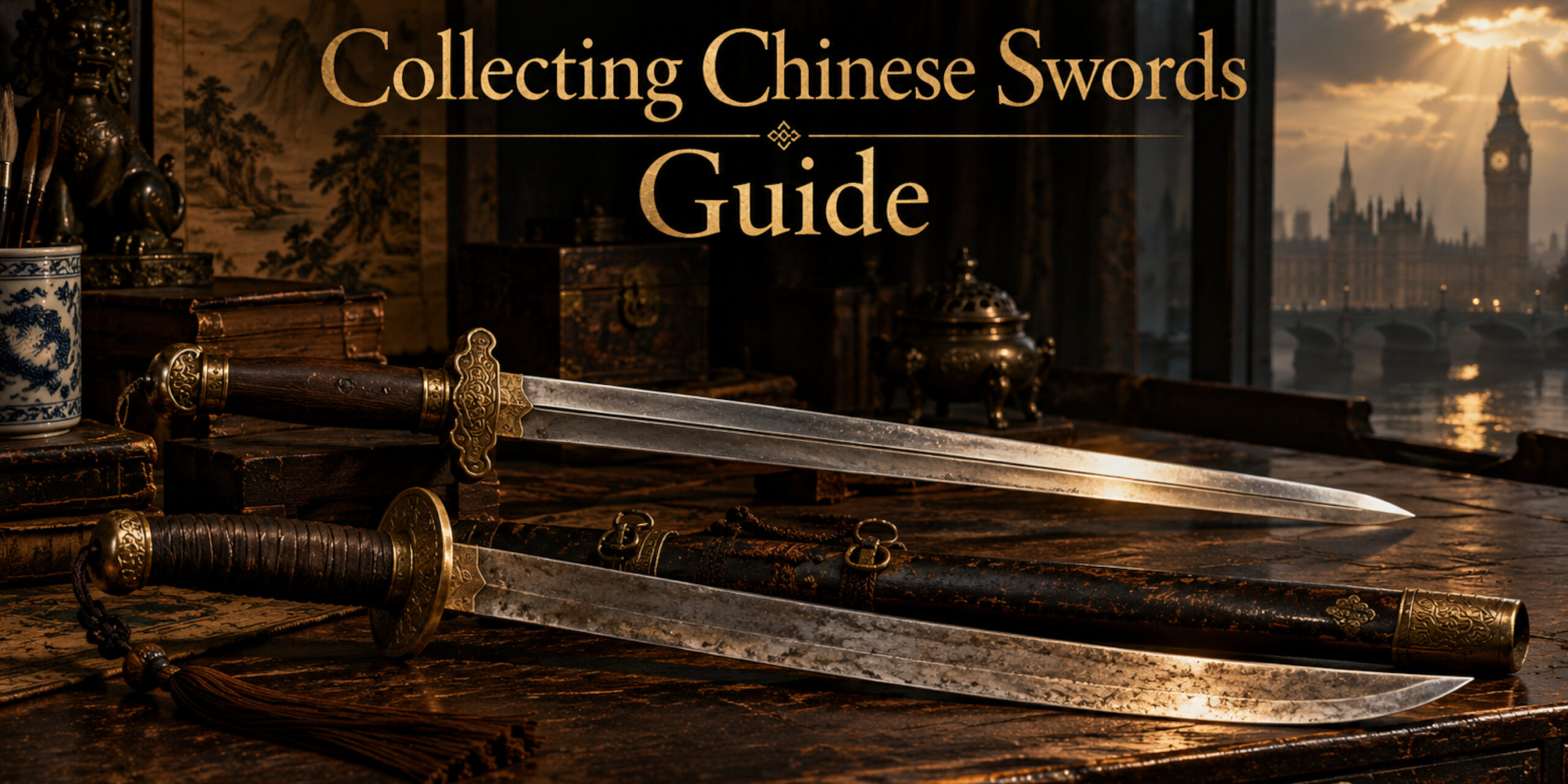
Chinese swords can be rewarding objects to collect, but they demand a little more patience than an auction description usually encourages. A handsome brass hilt, a darkened blade and the word “Qing” are a promising beginning. They are not, by themselves, a convincing identification.
For UK collectors, the central questions are straightforward. What is the sword? How much of it is original? Does the price reflect its condition and attribution? Can it lawfully be bought, owned and imported?
I find the appeal lies in the details: the wear around a guard, the construction of a scabbard, the balance between practical workmanship and decoration. Those details often tell us more than an enthusiastic claim about an unnamed imperial officer.
Understanding the Main Types of Chinese Sword
The two terms most collectors encounter are jian, generally referring to a straight, double-edged sword, and dao, a broad category of single-edged blades. Neither describes one unchanging design.
| Type | General characteristics | What collectors should examine |
|---|---|---|
| Jian | Straight, double-edged blade, with considerable variation in size and fittings | Blade proportions, guard construction, hilt and scabbard compatibility |
| Dao | Single-edged blade, which may be straight or curved | Blade profile, curvature, fullers, guard and mounting style |
| Dadao | Broad-bladed dao, often associated with late imperial and Republican-era examples | Dating evidence and unsupported military associations |
| Paired swords | Two swords made or mounted to share a scabbard | Whether the pair belongs together and whether the scabbard is original |
| Ritual and decorative swords | Objects whose purpose may include religious, symbolic or display use | Intended function, materials and evidence of age |
The familiar contrast between the “scholar’s jian” and the “soldier’s dao” has some cultural value, but it becomes misleading when treated as a complete history. A sword’s appearance, construction and context deserve more attention than its assigned personality.
Antique, Reproduction or Composite?
Before comparing prices, establish which market you are entering.
An antique sword should have a defensible attribution based on its construction, condition, comparable examples and, where available, documentary history.
A modern reproduction can be an excellent purchase for display or appropriate martial practice. Its value depends on its maker, materials, construction and intended use.
A composite sword combines components from different periods or objects. An old blade might have a replacement grip, later fittings or an unrelated scabbard.
Composite does not automatically mean fraudulent. Weapons were repaired during their working lives, and collectors have continued that tradition, sometimes rather enthusiastically. The difficulty arises when alterations disappear from the description while remaining firmly attached to the price.
Ask the seller to distinguish the age of the blade from the age of its mounts.
How Much Do Chinese Swords Cost in the UK?
There is no reliable single price for a “Qing sword”. Condition, completeness, rarity, attribution and provenance can produce substantial differences.
Published auction results provide a firmer starting point than unsold asking prices.
| Catalogued example | Auction date | Published sale result |
|---|---|---|
| Nineteenth-century Qing dao with iron hilt and a later black-painted finish | Olympia Auctions, 30 July 2020 | £190 |
| Nineteenth-century Qing dao with copper-alloy mounts and a hardwood scabbard | Olympia Auctions, 8 December 2024 | £1,300 |
These are individual historical results, not current valuations. They show that antique Chinese swords can sell for hundreds of pounds, while more complete or desirable examples may command substantially more. A CHINESE SWORD (DAO)
When comparing results, check whether the quoted figure includes the buyer’s premium. Add applicable fees, delivery and any import charges before deciding what you can afford.
A modest hammer price can acquire quite a social circle before it reaches your bank statement.
For modern swords, compare specific models and makers separately. A decorative reproduction, a flexible practice sword and a properly constructed cutting sword serve different purposes, even when their photographs look remarkably similar.
What Makes a Chinese Sword Valuable?
Age matters, but it does not settle the question.
| Factor | Why it matters |
|---|---|
| Convincing attribution | A carefully supported date is more useful than an ambitious dynasty label |
| Originality | Surviving original components can make an object more informative and desirable |
| Condition | Deep corrosion, cracks, reshaping and heavy polishing may reduce interest |
| Completeness | A compatible historic scabbard and intact fittings can strengthen a sword’s appeal |
| Workmanship | Blade construction and the quality of mounts deserve close examination |
| Provenance | Documented ownership can support identity, history and lawful collecting |
| Rarity | An unusual form needs convincing identification before rarity becomes meaningful |
Restoration does not reduce every sword’s value by a fixed percentage. A discreet historic repair and an aggressively reground blade are quite different propositions.
My preference is usually for an understandable object with honest wear. A brilliant surface is less comforting when it has taken the evidence with it.
How to Assess Authenticity Before Buying
No single feature proves that a Chinese sword is old. Dark metal can be artificially aged, fittings can be copied, and inscriptions require interpretation.
Request photographs showing:
- Both sides of the complete blade.
- The point, edges, fullers and blade shoulders.
- The guard, grip and pommel from several angles.
- Scabbard mounts, seams and damaged areas.
- Every inscription or mark in sharp close-up.
Ask for blade length, overall length and weight, together with a written description of repairs and replacements.
Particular caution is sensible where a seller offers a precise early date without explaining it, relies heavily on “Damascus” or “folded steel” as proof of quality, or presents an imperial connection without documentary support.
A certificate is only as useful as its author’s expertise and the evidence behind it. Decorative paper has enjoyed a long and successful career in the antiques trade.
For an expensive purchase, commission an independent specialist opinion before paying.
Where to Buy Chinese Swords in the UK
Specialist arms auctions, established antique arms dealers and general auctions can all offer suitable material. Each requires a different approach.
| Buying route | Potential advantage | What to check |
|---|---|---|
| Specialist arms auction | Comparable objects and published results | Condition reports, attribution wording and fees |
| Specialist dealer | Opportunity for detailed discussion and inspection | Written description, return terms and disclosed alterations |
| General auction | Possibility of overlooked material | Whether the cataloguer has relevant expertise |
| Private sale | Direct access to an existing collection | Ownership history, payment protection and an inspection agreement |
| Modern sword retailer | Clearer choice by intended use | Maker, construction, warranty and legal compliance |
Published Olympia Auctions results are useful research material, including for collectors who never intend to bid there.
Avoid treating a familiar trading name as a substitute for assessing the individual sword. Good sellers should welcome specific questions.
Are Chinese Swords Legal in the UK?
Some Chinese swords can be lawfully collected, but the answer depends on the object and the applicable law. “Chinese sword” is not a legal category that grants an exemption.
Government guidance lists swords with a curved blade of 50 centimetres or more among prohibited weapons, subject to exemptions and defences. The measurement is the straight-line distance from the top of the handle to the blade tip. Antique provisions generally concern weapons made more than 100 years before the alleged offence. GOV.UK
Separate provisions concern curved swords made before 1954 or made using traditional methods by hand. “Before 1954” and “over 100 years old” are different tests. Retain evidence supporting whichever provision applies. Government import guidance also explains relevant permitted circumstances and documentation requirements. GOV.UK
Do not assume that every straight sword is automatically unrestricted. Other prohibited weapon definitions may apply. Equally, lawful ownership does not provide unrestricted permission to carry a sword in public. GOV.UK
Rules differ across UK jurisdictions. Check the current position for your location and the particular sword before buying, importing or transporting it. A seller’s phrase “UK legal” should begin the enquiry, rather than conclude it.
Importing a Chinese Sword: What to Check First
Buying abroad adds practical and legal questions that a domestic purchase may avoid.
Before payment, establish:
- Whether the specific sword can lawfully be imported.
- What evidence supports its age or method of manufacture.
- Whether the seller can lawfully export it.
- Whether the carrier accepts swords and provides suitable cover.
- Which taxes, handling charges and other costs may apply.
- Who bears responsibility if delivery or clearance fails.
Government guidance makes clear that restricted imports require supporting evidence and that admissibility is assessed when the item is examined. A seller’s willingness to post something is not confirmation that it can enter the country.
For historic objects, investigate the ownership and export history as carefully as the blade. Unexplained origins are a problem to resolve before purchase.
Where Are the Genuine Bargains?
A bargain is an object priced below a reasonable assessment of its identity and condition. Cheapness alone is a less demanding achievement.
Plain fittings, cosmetic scabbard damage or an unfashionable collecting category may make a sword more affordable. An incomplete example can also be worthwhile as a study piece, provided its limitations are understood.
Be more cautious about blade cracks, severe corrosion, extensive reshaping and unexplained replacement parts. These can affect both historical interest and future resale.
I would generally choose a modest sword with a clear description over a supposedly magnificent one surrounded by qualifications. “Possibly”, “believed to be” and “in the style of” are small phrases with considerable financial consequences.
Caring for an Antique Chinese Sword
The first rule is restraint.
Avoid abrasive polishing, powered tools, sharpening and attempts to make every component look new. Do not dismantle a fragile hilt simply because an online video made the process appear agreeable.
Keep the sword in a stable, dry environment, handle exposed metal as little as possible and inspect it periodically. Any protective treatment should suit the materials involved, including wood, lacquer, cord, leather and metal.
Seek conservation advice for active corrosion, unstable grips or deteriorating scabbards. Historical objects rarely benefit from being approached with the confidence normally reserved for garden furniture.
Photograph the sword on arrival and retain its invoice, description, measurements, correspondence and conservation records.
Choosing Your First Chinese Sword
Start with a narrow interest: a particular period, a sword form or a construction feature. Compare enough examples to recognise what is typical before paying extra for what is supposedly exceptional.
For a first antique, prioritise a defensible attribution, disclosed condition and a seller prepared to answer questions. Buy a separate modern sword if you want to practise martial arts or cutting. An antique’s survival is not evidence that it remains suitable for use.
The most satisfying collections develop through careful observation. One well-understood sword can teach you more than a wall full of doubtful purchases, and it requires considerably less explaining when the next invoice arrives.