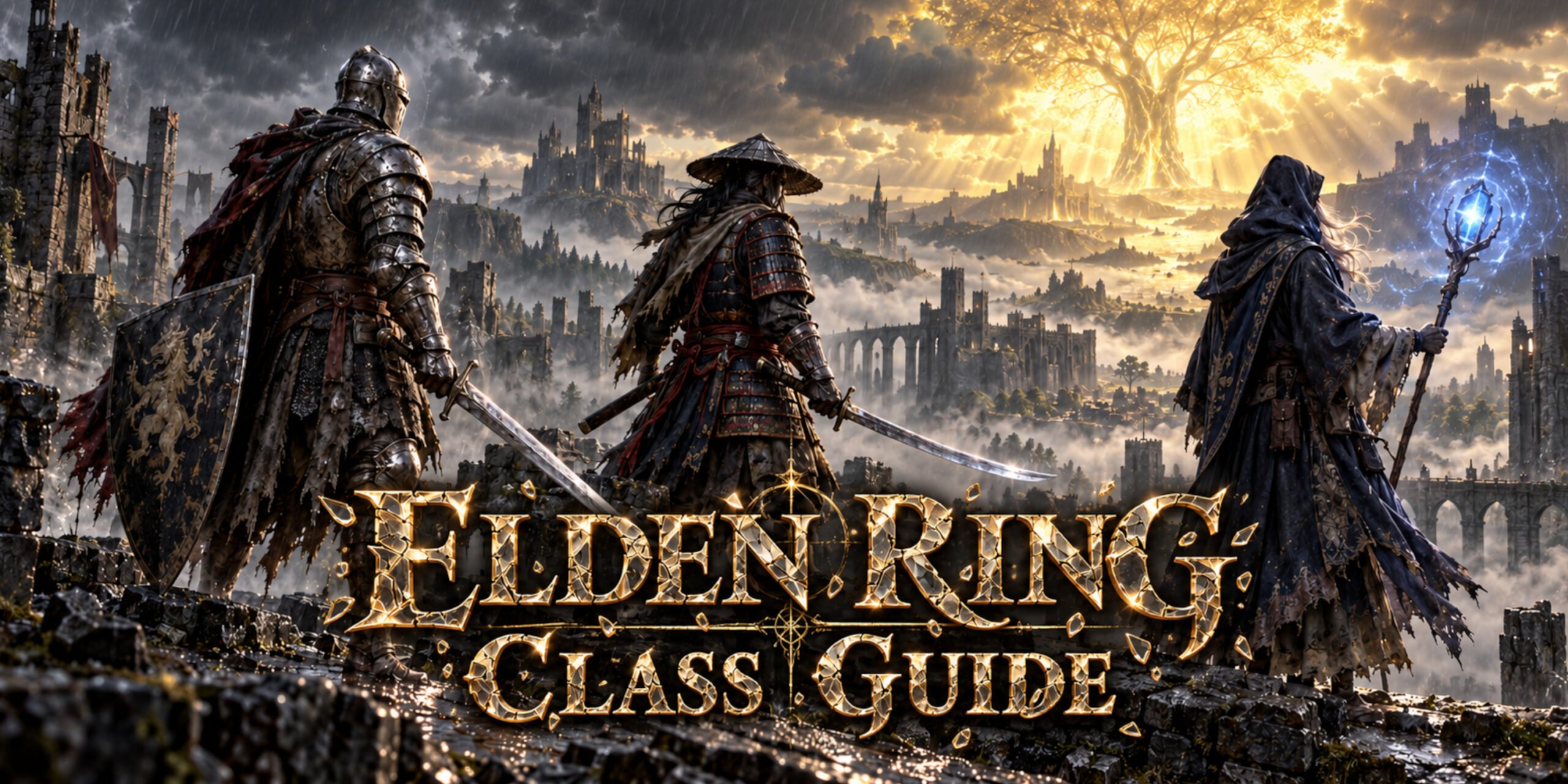
Vagabond is my recommendation for most first-time Elden Ring players. Samurai is an excellent alternative if you prefer an aggressive start, while Astrologer is the clearest choice for ranged sorcery.
That sounds straightforward until the character screen presents you with an iron-masked prisoner, a suspiciously stylish church operative and someone whose entire financial portfolio consists of a club.
The good news is that your starting class does not dictate your entire playthrough. It determines your initial attributes and equipment, giving you a particular starting point rather than a permanent role. You can develop a knight into a spellcaster or teach your astrologer to solve problems with an enormous hammer.
The useful question is which class makes the kind of combat you want to learn feel comfortable from the beginning.
Best Elden Ring Classes at a Glance

These are my recommendations for general exploration and boss fights, rather than a ranking for competitive multiplayer.
| Your preferred approach | Recommended class | Why choose it? |
|---|---|---|
| Learning melee combat | Vagabond | Strong health, useful armour and a dependable shield |
| Aggressive swordplay | Samurai | Excellent katana, bleed and a bow |
| Ranged sorcery | Astrologer | An immediately useful spellcasting setup |
| Strength-focused melee | Hero | A direct starting point for heavy physical weapons |
| Fast dual-wielding | Warrior | Two scimitars from the beginning |
| Faith spellcasting | Prophet | A focused introduction to incantations |
| Sword and healing magic | Confessor | Comfortable melee equipment with supporting spells |
| Sword and sorcery | Prisoner | A natural foundation for a spellblade |
| Parries and an Arcane direction | Bandit | Buckler, dagger and an Arcane-leaning start |
| A deliberately rough beginning | Wretch | Minimal equipment and the pleasure of finding almost anything useful |
Version note: the original game has ten starting classes. Heavy Knight and Idus Knight are additional options included with Tarnished Edition and available through the Tarnished Pack on other platforms. They are covered separately below.
Best Class for Beginners: Vagabond
Vagabond gives new players a forgiving foundation for learning Elden Ring’s melee combat. Its high starting Vigor provides some breathing room, while the longsword, halberd and Heater Shield offer different ways to approach an enemy.
The shield is particularly useful. Blocking lets you observe attacks without having to dodge everything immediately, and guard counters introduce a satisfying rhythm of defence followed by retaliation. Stamina still matters, though. Holding your shield up indefinitely is a temporary arrangement with consequences.
Why I recommend it:
- Strong starting health helps you survive mistakes.
- The longsword has a straightforward, versatile moveset.
- The halberd offers extra reach.
- Its physical attributes leave several melee build directions open.
The important catch: check your equipment load before setting off. With its starting equipment equipped, Vagabond begins at heavy load. Unequipping a spare weapon is an easy way to reach medium load and improve your dodge.
This is my first choice for someone who wants to understand spacing, blocking and attack openings before adding spell management to the mix.
Best Class for an Aggressive Start: Samurai
Samurai makes a persuasive argument through equipment alone. The Uchigatana is useful immediately, its Unsheathe skill rewards well-timed openings, and the longbow gives you a way to draw enemies away from groups.
The katana’s innate blood loss is another advantage against susceptible enemies. It can produce substantial damage once enough buildup has accumulated, although resistant or immune opponents require a different plan.
Choose Samurai if you want:
- A starting weapon you can keep using well beyond Limgrave.
- Responsive melee combat with a useful weapon skill.
- A bow for pulling individual enemies.
- A natural route towards Dexterity-focused sword builds.
Its small shield is less reassuring than Vagabond’s defensive setup, so dodging and positioning deserve attention early.
My preference would be Samurai if the katana already appeals to you. There is little sense choosing a shield-focused knight when you know perfectly well you are going to spend the next hour looking for a Japanese sword.
Best Class for Sorcery: Astrologer
Astrologer is the clearest starting point if your ideal response to a dangerous creature is to shoot magic at it from a sensible distance.
Its starting sorceries give you immediate ranged options. Glintstone Pebble handles individual targets, while Glintstone Arc can catch several enemies when they line up conveniently.
Distance helps, but sorcery still requires judgement. You need time to cast, enough FP to continue fighting and somewhere to move when an enemy decides the conversation should happen up close.
Early priorities:
- Raise Vigor rather than putting every level into Intelligence.
- Develop Intelligence alongside your chosen staff and spells.
- Add Mind when your FP supply becomes restrictive.
- Keep a melee weapon available for weaker enemies and awkward situations.
I would choose Astrologer over Prisoner for a character whose main ambition is casting sorceries. Its opening toolkit makes that intention clear from the start.
Best Class for Strength Builds: Hero
Hero offers a direct introduction to physical melee combat through its high starting Strength and Battle Axe.
The appeal is simple: learn an enemy’s opening, move into range and make the hit count. That approach translates well into heavier weapons later, although the starting axe does not force you into slow attacks or colossal equipment.
Hero suits players who want to:
- Build towards Strength-scaling weapons.
- Make frequent use of two-handed attacks.
- Experiment with axes, hammers and larger blades.
- Keep spellcasting as a secondary concern.
Vagabond remains worth comparing if your intended weapon has meaningful Dexterity requirements. For a carefully optimised build, the best origin depends on the full attribute spread you need, not simply which class starts with the highest Strength.
Best Class for Dual-Wielding: Warrior
Warrior begins with two scimitars, making it a natural choice for players who want fast, flowing melee attacks.
Using the paired moveset is enjoyable, but committing to an extended sequence costs stamina and leaves you vulnerable if the enemy recovers sooner than expected. Elden Ring is remarkably good at noticing when you have pressed attack once too often.
Choose Warrior because you enjoy curved swords and dual-wielding. A high starting Dexterity value is useful, but the weapon moveset should be the deciding factor.
Samurai is a strong alternative for a Dexterity-focused character if you would rather start with a katana and bow.
Best Classes for Faith: Prophet or Confessor?
Prophet and Confessor both introduce incantations, but they offer different opening experiences.
| Class | Best reason to choose it | Main consideration |
|---|---|---|
| Prophet | You want Faith casting to be central | Its early equipment requires more care |
| Confessor | You want a sword, shield and supporting magic | Its broader attributes are not ideal for every specialised build |
Prophet is my preference for a deliberate Faith caster. Catch Flame provides an effective close-range offensive spell, while healing introduces the utility side of incantations.
Confessor is easier to recommend to someone who wants conventional melee combat with magical support. Its Broadsword and shield provide a comfortable foundation while you explore healing, buffs and later offensive incantations.
Do not choose Confessor expecting every part of the fantasy to arrive immediately. The black cloak is ready. Your elaborate holy-warrior build will need some work.
Best Class for a Spellblade: Prisoner
Prisoner suits players who want to combine thrusting sword attacks with Intelligence-based sorcery.
Its Estoc and Magic Glintblade offer complementary ways to create pressure. The delayed spell gives you room to reposition before it fires, while the sword provides a practical answer when an enemy closes the gap.
The challenge is deciding where your early levels should go. Health, FP, weapon requirements and spell damage all make reasonable demands.
My advice is to give the character a clear emphasis. Establish a dependable melee weapon and a small selection of useful spells before trying to become competent at every possible form of violence.
Choose Prisoner for a spellblade from the outset. Choose Astrologer if melee is mainly your backup plan.
Is Bandit the Best Class for Bleed Builds?
Bandit has a sensible foundation for some Arcane builds, but it is a less comfortable opening choice than Samurai for many new players.
The Great Knife encourages close-range fighting, while the Buckler rewards learning parry timings. Both can be effective, but neither offers much reassurance when you are still working out which enemy movements are attacks.
There is also an important mechanical distinction: raising Arcane does not automatically improve every weapon’s blood loss buildup. The weapon needs appropriate Arcane scaling for that investment to help its bleed buildup. A standard Uchigatana has innate bleed, but that alone does not make Arcane the correct early investment.
Choose Bandit if you specifically want its parrying tools or an Arcane-focused development path. For accessible early bleed through katana combat, I would usually recommend Samurai.
Should You Choose Wretch?
Wretch is appealing because equipment becomes exciting again. Finding a basic piece of armour feels like progress when your previous defensive strategy involved exposed skin and optimism.
It begins at level one with 10 in every attribute and a club. That gives you an open-ended start, but Wretch is not automatically the best class for optimising a build.
A specialised character may benefit from another origin having fewer points in attributes it never intends to use. Starting with an even spread can therefore be less efficient than starting with a deliberately uneven one.
I recommend Wretch for returning players who enjoy scavenging and uncertainty. New players can absolutely choose it, but the opening will demand more patience.
What About Heavy Knight and Idus Knight?
Tarnished Edition and the Tarnished Pack add two more starting origins.
Heavy Knight offers bulky steel armour and a substantial scimitar. It is worth considering if the appeal of your character begins with heavy equipment and forceful melee combat. Armour still needs to be balanced against mobility and stamina.
Idus Knight favours lighter equipment and dexterous weapon handling. It is an appealing alternative for players drawn to an agile knight rather than the Samurai or Warrior’s opening style.
These are additional starting options, not essential purchases for a viable character. The original classes remain capable foundations for completing the game. Check which content you own before planning around either new origin.
Can You Change Your Class in Elden Ring?
You cannot change your starting origin, but you can change the direction of your build.
After defeating Rennala at the Academy of Raya Lucaria, you can use Rebirth to redistribute your earned attribute points by spending a Larval Tear.
The restriction is that you cannot lower an attribute below your starting class’s original value. That is why origin matters to players optimising a character for a fixed level. For a normal first playthrough, it rarely justifies restarting a character you already enjoy. Push Square
A Samurai can learn sorcery. An Astrologer can develop into a melee fighter. You may need extra levels to meet your new requirements, but choosing a class does not close those routes.
Early Decisions That Matter More Than Your Class
A good starting class helps. These habits will often help more:
- Invest in Vigor. Surviving an extra hit gives you another chance to learn.
- Upgrade your main weapon. Do not judge it entirely by its unupgraded damage.
- Watch equipment load. Adding armour and spare weapons can make your dodge less useful.
- Learn your stamina limits. Leave enough to defend or escape after attacking.
- Give your build an early focus. Meet useful requirements rather than spreading levels across every damage attribute.
- Explore when you get stuck. Another cave, upgrade material or manageable encounter can change your next attempt.
The game gives you blocking, guard counters, stealth, ranged attacks and summons for a reason. Use the options that make the fight manageable and enjoyable. Even the publisher’s starter advice encourages retreating from an opponent you cannot yet defeat.
Which Elden Ring Class Would I Choose?
For a first playthrough with no firm build in mind, I would choose Vagabond. It gives you useful tools for learning the combat and enough flexibility to follow whichever weapon catches your attention.
If you already want a katana, choose Samurai. If you want sorcery to define the experience, choose Astrologer. Those are clearer reasons than a tier list promising that one origin will carry you through every boss.
Pick a starting kit that interests you, make sure your character can roll properly and begin exploring. The character screen has had quite enough of your evening.