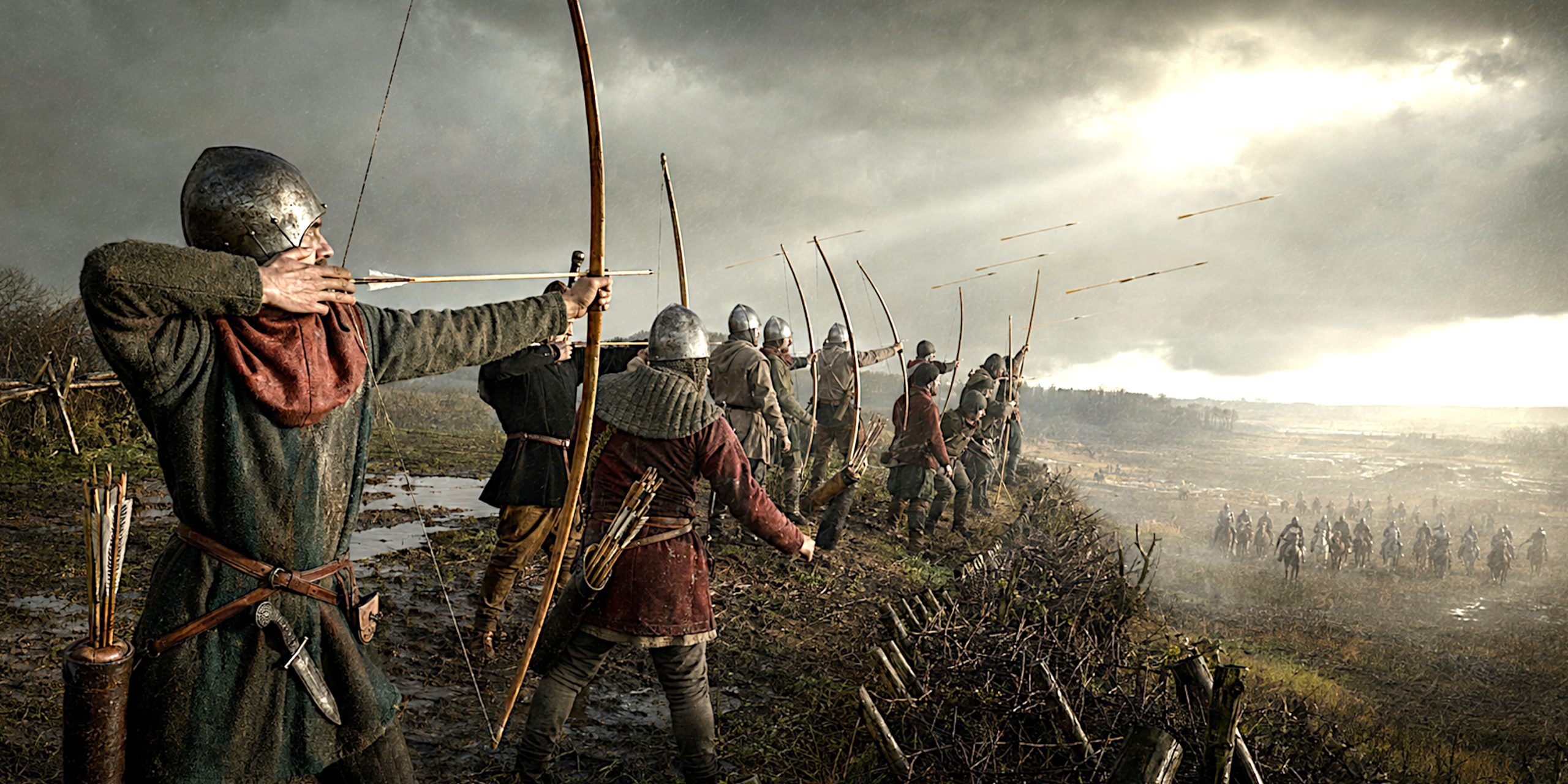
Medieval Wales produced formidable archers. English kings recruited Welsh soldiers in considerable numbers, while Welsh bowmen served in Scotland, France and the bitter conflicts fought within Wales itself.
The familiar story is rather neat. According to that version, the Welsh invented the longbow, taught the English how to use it and then won Crécy and Agincourt almost single-handedly. There are grains of truth here, buried beneath several cartloads of national mythology.
The evidence points towards a more interesting development. Powerful bows were used in south-east Wales by the twelfth century. Following the conquest of Wales, Edward I incorporated Welsh infantry into royal armies on an unprecedented scale. During the fourteenth and fifteenth centuries, Welsh archers became part of a wider military system based upon disciplined shooting, dismounted men-at-arms, careful use of terrain and brutal close combat.
The bow was central to their identity, but it was not a magical weapon. Longbowmen marched, dug defences, endured cavalry attacks and entered the mêlée with swords, daggers, axes and mallets. Medieval archery was skilled work, but it was never comfortable work.
Welsh Longbowmen at a Glance
| Feature | Historical evidence |
|---|---|
| Main period | Late twelfth to early sixteenth century |
| Earliest detailed account | Gerald of Wales, writing about Gwent during the 1180s |
| Early bow wood | Elm is specifically recorded in south-east Wales |
| Later war-bow wood | Yew became the preferred material |
| Typical later length | Approximately 1.8 to 2.1 metres |
| Estimated later draw weight | Roughly 65 to 175 lb, based on surviving Tudor bows |
| Battlefield role | Massed shooting, skirmishing, flank protection and close combat |
| Secondary weapons | Arming sword, falchion, baselard, dagger, axe and mallet |
| Important campaigns | Welsh wars, Scottish wars, Crécy, Poitiers, Agincourt and the Wars of the Roses |
| Principal caution | The early Welsh elm bow cannot automatically be identified with the later yew war bow |
Who Were the Welsh Longbowmen?
There was no permanent medieval regiment formally known as the Welsh Longbowmen. The name describes generations of archers recruited from Wales under very different political conditions.
Before Edward I’s conquest of 1282–83, Welsh archers fought for native princes, local lords and Marcher rulers. After the conquest, thousands of Welsh infantrymen were drawn into English royal service. Some volunteered for wages and plunder, while others were raised through varying degrees of legal obligation and coercion.
Welsh soldiers might serve:
- A native prince such as Llywelyn ap Gruffudd
- The English Crown
- An Anglo-Welsh Marcher lord
- The Prince of Wales
- Owain Glyndŵr and the Welsh rebellion
- A local retinue fighting in France
- A Yorkist or Lancastrian commander during the Wars of the Roses
Identity was not always straightforward. A Welsh-speaking soldier living in a Marcher lordship might serve an English magnate, appear beneath an anglicised name in an account and fight alongside men from Cheshire or Herefordshire. Medieval officials were primarily interested in whether a soldier appeared, obeyed and could be paid. Their paperwork was not designed to settle arguments about national identity six centuries later.
Did the Welsh Invent the Longbow?
The honest answer is that we do not know.
Tall self bows existed in northern Europe long before the medieval period. Archaeological examples from Scandinavia and elsewhere demonstrate that long wooden bows were not a uniquely Welsh invention.
What Wales undoubtedly possessed was an established tradition of powerful military archery. Gerald of Wales recorded its presence during the late twelfth century, well before the longbow became famous in English royal armies.
It is reasonable to suggest that English and Marcher commanders recognised the value of Welsh archers and recruited them accordingly. It is much harder to demonstrate that the later English war bow was copied directly from one distinctly Welsh weapon.
The mature longbow system involved far more than bow design. It required:
- Generations of trained archers
- Large-scale manufacture of bows and arrows
- Reliable access to suitable timber
- Royal laws encouraging archery practice
- Retinue and contract recruitment
- Carts and ships carrying ammunition
- Combined tactics involving archers and men-at-arms
The Welsh contributed significantly to this military culture. A single moment of invention, however, belongs to legend rather than secure history.
Gerald of Wales and the Earliest Evidence
The most famous early account comes from Gerald of Wales, also known as Giraldus Cambrensis. Gerald travelled through Wales with Archbishop Baldwin in 1188, gathering support for the Third Crusade.
When describing the archers of Gwent, Gerald wrote that their bows were made from elm rather than horn, ash or yew. He characterised the weapons as:
“stiff and strong”
Gerald also recounted an attack upon Abergavenny Castle during which Welsh arrows:
“penetrated with their arrows the oaken portal of the tower”
The door was supposedly four fingers thick.
In another episode, Gerald claimed that an arrow passed through a mounted soldier’s mail-clad thigh, continued through his clothing and saddle, and entered the horse beneath him. When the man turned his horse, another arrow reportedly struck the opposite side.
These descriptions establish that:
- Archery was important in south-east Welsh warfare by the late twelfth century.
- Elm was used to produce powerful bows.
- Welsh archers impressed opponents familiar with armour and cavalry.
- The bow was effective at relatively close battlefield ranges.
- Archers were adept at using broken terrain and ambush.
Gerald’s evidence must still be handled carefully. He provided no bow lengths, draw weights or technical measurements. His work combined observation, reported testimony and a healthy appetite for a dramatic story. I remain rather fond of him, but he never knowingly allowed precision to weaken a good anecdote.
The Early Welsh Bow
The bow Gerald described was probably a simple self bow made from a single piece of elm. Elm has an interlocking grain and can produce a strong, durable weapon when worked competently.
It may have been tall, but Gerald never called it a longbow in the later technical sense. Nor do we know whether it possessed the deep D-shaped cross-section found on many surviving Tudor war bows.
The early Welsh bow appears to have been:
- Made from locally available elm
- Functional rather than highly finished
- Capable of delivering heavy arrows
- Used at practical combat distances
- Suited to warfare in wooded and broken country
No securely identified twelfth-century Welsh bow survives. Reconstructions are therefore informed experiments rather than exact reproductions.
Warfare in Medieval Wales
The terrain of Wales rewarded mobility, local knowledge and surprise. Mountain routes, river valleys, woodland and uneven ground could restrict heavy cavalry while creating opportunities for ambush.
Archers were particularly useful during:
- Raids into enemy territory
- Attacks upon marching columns
- Castle assaults and defence
- Fighting around river crossings
- Harassment of foraging parties
- Withdrawal through broken ground
- Ambushes against mounted troops
Welsh armies did not consist entirely of archers. Contemporary descriptions and archaeological evidence point towards a mixed military culture involving spears, javelins, shields, swords and bows.
Native Welsh warfare depended upon household retainers, local levies and territorial obligations. The surviving chronicles rarely provide reliable troop compositions. Medieval writers generally preferred speeches, omens and violent deaths to administrative detail. This was splendid for literature and rather inconvenient for military historians.
Edward I and the Recruitment of Welsh Soldiers
Edward I’s conquest of Wales transformed the organisation of Welsh military service. The Crown gained access to a substantial pool of infantrymen who could be raised through royal officials, local communities and Marcher lords.
Welsh troops were particularly important during Edward’s wars in Scotland. Records sometimes refer broadly to “Welsh foot”, making it difficult to determine how many men carried bows and how many carried spears.
Recruitment was not always voluntary. Men could be compelled to serve, marched far from home and supplied badly. Pay frequently arrived late, provisions were inadequate and desertion was common.
During the Falkirk campaign of 1298, tensions caused by hunger and poor supply contributed to fighting between Welsh infantry and Gascon troops within Edward’s army. The medieval war machine could organise thousands of men across several countries, yet still struggle with the apparently advanced concept of feeding them.
Welsh Archers at the Battle of Falkirk
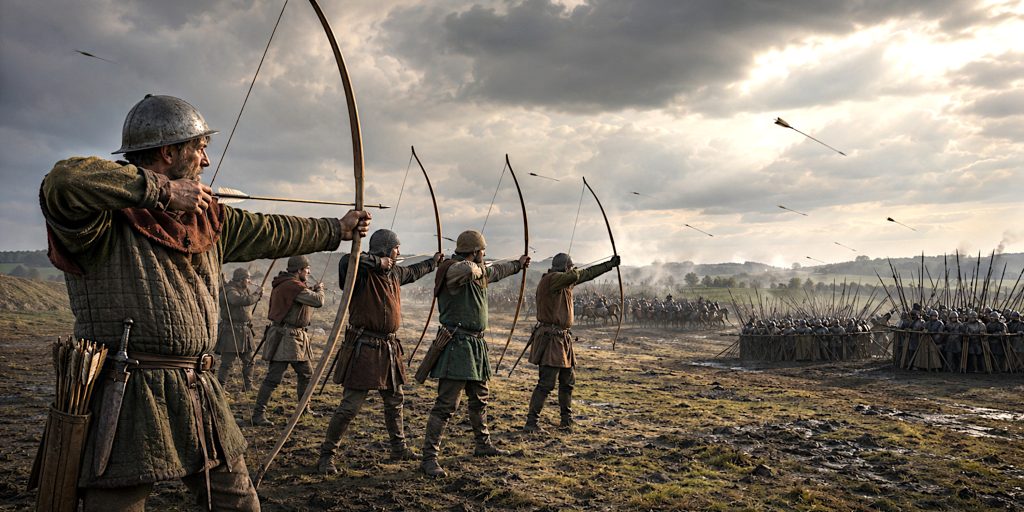
At Falkirk in 1298, William Wallace’s Scottish infantry formed dense spear formations known as schiltrons. English cavalry attacks failed to break them decisively.
Edward’s archers and crossbowmen then subjected the Scottish formations to missile fire. Welsh archers are traditionally credited with an important role in weakening the schiltrons before renewed attacks overwhelmed them.
Falkirk demonstrated the effectiveness of combined arms:
- Archers disrupted the packed spear formations.
- Missile fire created casualties and opened gaps.
- Cavalry and infantry exploited the resulting disorder.
- Scottish archers lacked sufficient protection and were driven away.
- Terrain and command decisions influenced the result.
The bow did not win the battle in isolation. It created conditions in which other troops could finish the work.
Welsh Archers in the Hundred Years’ War
By the reign of Edward III, archery had become deeply embedded in English royal warfare. Welsh soldiers served in the armies of the king, the Black Prince and powerful Marcher families.
Archers were usually deployed beside or around dismounted men-at-arms. Depending upon the terrain, they might occupy the wings, intervals between divisions or forward positions.
Their shooting served several purposes:
- Wounding or killing horses
- Breaking the cohesion of advancing formations
- Forcing armoured men to lower their heads
- Driving away less protected missile troops
- Creating noise, confusion and fear
- Exhausting attackers before close combat
- Restricting movement across narrow ground
Once an enemy reached the defensive line, archers fought with sidearms. They also pursued defeated troops, guarded prisoners and searched the battlefield for valuables.
The Battle of Crécy
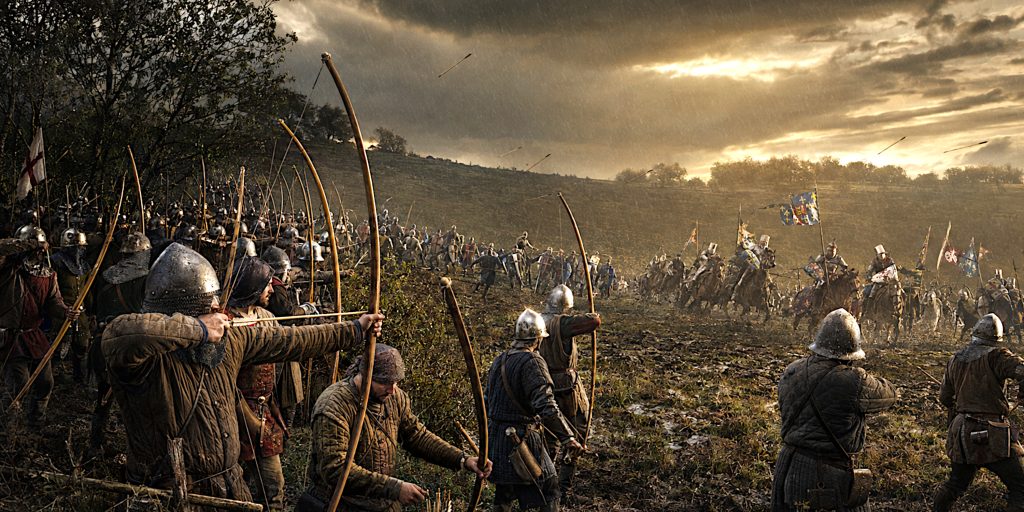
Welsh and English archers played a central role at Crécy on 26 August 1346.
Edward III selected a strong defensive position, with his army deployed on rising ground. French attacks were poorly coordinated and made increasingly difficult by congestion, damaged ground and the retreat of their own Genoese crossbowmen.
The archers could shoot more rapidly than the crossbowmen, particularly because the Genoese appear to have been separated from some of their protective equipment and ammunition.
Success at Crécy depended upon several factors:
- A prepared defensive position
- Disciplined archers
- Dismounted men-at-arms holding the line
- French attacks delivered in separate waves
- Vulnerable horses
- Confusion caused by retreating crossbowmen
- Continued command and ammunition supply
Crécy did not prove that every arrow could penetrate plate armour. Arrows could strike faces, limbs, joints and horses, while repeated shooting disrupted movement and morale. Even an arrow that failed to pierce a breastplate could still make the wearer’s afternoon distinctly less agreeable.
The Battle of Poitiers
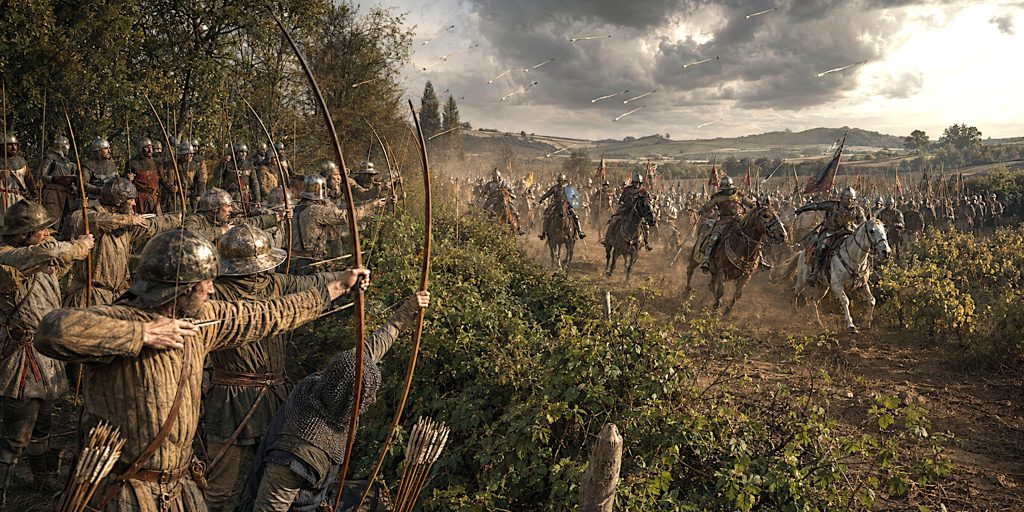
At Poitiers in 1356, the army of Edward the Black Prince again used archers alongside dismounted men-at-arms.
The English and Gascon position made use of hedges and restricted approaches. Archers positioned on the flanks shot at French horses, where armour was generally less complete than that worn by elite men-at-arms.
A mounted counter-attack then struck the French from the flank and rear. King John II of France was captured, turning the victory into both a military and financial triumph.
Welshmen served within the prince’s forces, although exact national totals remain uncertain. Medieval armies were assembled through personal retinues and contracts rather than modern national formations.
Welsh Longbowmen at Agincourt
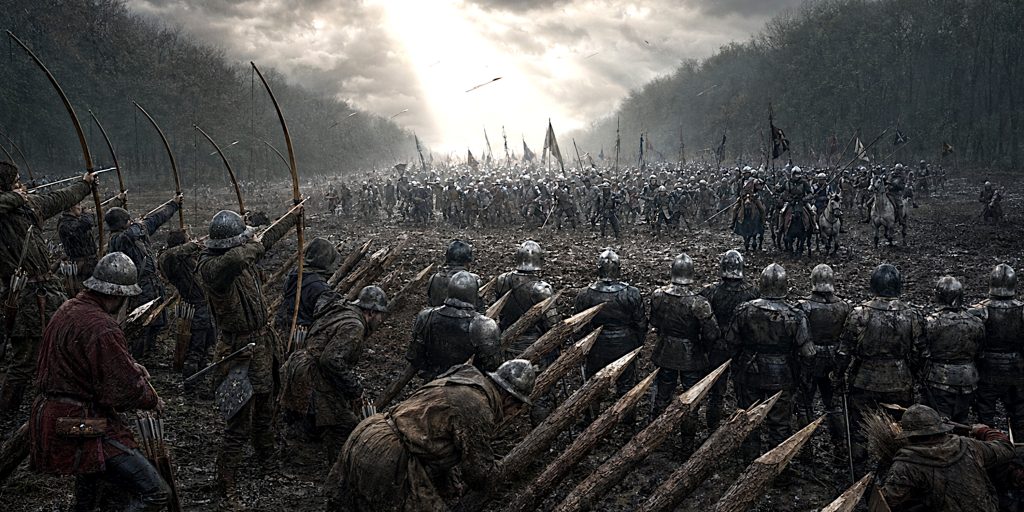
Agincourt has acquired more Welsh mythology than the surviving evidence can comfortably support.
Henry V’s army probably contained around 5,000 archers and approximately 900 to 1,000 men-at-arms by the time battle was joined on 25 October 1415. Welsh soldiers were present, but identifiable Welsh contingents may have included only about 400 men.
That was a meaningful contribution, particularly because Wales had only recently emerged from the Glyndŵr rebellion. It does not support claims that most of Henry’s archers were Welsh.
The English and Welsh archers:
- Planted sharpened wooden stakes against cavalry.
- Advanced when the French refused to attack.
- Shot into crowded formations approaching through mud.
- Protected the wings of the dismounted men-at-arms.
- Entered close combat once the French reached the line.
- Used swords, daggers, axes and mallets during the mêlée.
Mud alone did not defeat the French, nor did the longbow. The narrow battlefield compressed the French advance, archery inflicted and channelled pressure, and the English men-at-arms held their position. The archers then joined the hand-to-hand fighting.
Agincourt was a combined military achievement, not a longbow recital with supporting infantry.
Dafydd Gam and the Agincourt Legend
Dafydd ap Llywelyn ap Hywel, better known as Dafydd Gam, was a Welsh supporter of Henry V who died at Agincourt.
Later tradition claimed that Dafydd saved Henry’s life and was knighted as he lay dying. There is no secure contemporary evidence for either story.
Dafydd was an important Welsh landowner and Lancastrian loyalist. Near-contemporary sources identify him among the dead, but they do not present him as commander of the Welsh archers.
The suggestion that he inspired Shakespeare’s Fluellen is also uncertain. Fluellen represents a broader Elizabethan idea of loyal Welsh military service rather than a reliable portrait of one individual.
Welsh Archers During the Glyndŵr Revolt
The rebellion led by Owain Glyndŵr began in 1400 and developed into the most serious challenge to English government in Wales since the conquest.
Welsh rebel forces employed raids, ambushes, sieges and larger field operations. Archery was part of their military repertoire, although surviving accounts provide remarkably little technical information about deployment or equipment.
Not every Welshman supported Glyndŵr. Welsh soldiers also served:
- In royal garrisons
- Under Marcher lords
- Within local loyalist forces
- In English expeditions against the rebellion
The revolt demonstrates why ethnic labels must be used carefully. Family allegiance, local rivalries, employment, coercion and personal ambition could all determine which side a man joined.
At Pwll Melyn in 1405, royal forces defeated a Welsh army attempting to relieve Usk Castle. The rebels were caught in an unfavourable position and suffered heavily. A celebrated tradition of archery could not compensate for poor ground and a well-prepared opponent.
How the Later Longbow Was Made
The mature medieval war bow was usually made from a single stave of yew.
Bowyers exploited the different properties of the wood:
- Pale sapwood formed the back of the bow and resisted tension.
- Darker heartwood formed the belly and resisted compression.
- The stave was carefully shaped to bend along its working length.
- Horn nocks could be fitted to protect the ends and hold the string.
- The finished bow often possessed a deep, rounded cross-section.
Suitable yew was difficult to obtain in sufficient quantities. England imported bow staves from continental Europe, particularly during the later medieval and Tudor periods.
Bowstrings could be made from hemp, flax or silk. They required protection from moisture and regular replacement. An archer might carry spare strings beneath his clothing or in a container.
Longbow Dimensions and Draw Weight
No surviving bow can be securely identified as the weapon of a medieval Welsh campaign archer. The best physical evidence comes from the Mary Rose, which sank in 1545.
Its surviving war bows range from approximately 1.84 to 2.11 metres in length. Estimated draw weights vary considerably, from around 65 to 175 lb, with many examples clustering near 110 lb.
These measurements demonstrate the power of later British war bows. They should not be applied automatically to the elm weapons described by Gerald more than three centuries earlier.
A bow’s draw weight also depended upon the draw length. Comparing estimates without specifying that length can produce impressive but misleading figures, a long-standing tradition in discussions of the longbow.
Arrows and Arrowheads
A longbow was only as useful as its ammunition supply. Medieval armies required thousands of arrows, produced to broadly consistent standards and transported by cart, pack animal or ship.
The Mary Rose collection contains more than 3,500 arrows. Most surviving shafts are made from poplar, although ash, beech and hazel were also used.
| Arrowhead | Likely function | Qualification |
|---|---|---|
| Narrow bodkin-like head | Concentrated impact against mail, textile armour and vulnerable gaps | Not guaranteed to penetrate good plate |
| Compact war head | General military use against men and horses | Performance depended upon range and construction |
| Broadhead | Created a wide wound, particularly useful against unarmoured targets | Less suited to defeating metal armour |
| Barbed head | Hunting and some military purposes | Shape alone does not establish battlefield use |
| Incendiary head | Attacking structures, ships or materials | Much less common than ordinary war heads |
Archers received arrows in sheaves. The traditional English sheaf contained 24 arrows, although battlefield supply could involve multiple sheaves.
Rapid shooting consumed ammunition alarmingly quickly. An archer loosing six arrows per minute would empty a sheaf in four minutes. Longbow warfare therefore depended upon an administrative tail of craftsmen, carters, clerks and suppliers. None looks particularly heroic in a painting, but battles tend to notice when they are absent.
Training and Physical Development
A heavy war bow could not be mastered during a few weeks of military preparation. Archers needed sustained practice from youth to develop strength, technique and judgement.
The draw involved the muscles of the back, shoulders and arms. Experienced war-bow archers did not merely pull with one arm while holding the other rigid. Their upper bodies worked through the movement.
Physical evidence from possible archers includes:
- Enlarged attachment points around the shoulder
- Asymmetrical arm development
- Stress injuries affecting the spine
- Changes around the wrist and elbow
- Repeated strain on the drawing side
Such changes cannot always identify an archer with certainty because medieval labour was physically demanding. Nevertheless, skeletal evidence and practical reconstruction both demonstrate that powerful archery changed the body.
Claims that every longbowman could loose ten or twelve aimed arrows per minute should be treated carefully. Rapid shooting was possible for short periods, but pace depended upon range, ammunition, fatigue and tactical need.
Battlefield Tactics
Longbowmen performed best as part of a disciplined formation.
Successful deployment usually required:
- A clear field of fire
- Protection from direct cavalry attack
- Dismounted men-at-arms nearby
- Suitable terrain or artificial obstacles
- Reliable ammunition supplies
- Coordination between different divisions
- Discipline under pressure
By the early fifteenth century, archers could carry sharpened wooden stakes. These were driven into the ground at an angle to discourage mounted attacks.
Archers did not necessarily fire blindly into the sky. They could aim at formations, horses or particular sections of the enemy line. At longer ranges, arrows descended more steeply and produced a cumulative disruptive effect. At shorter ranges, trajectories became flatter and impact greater.
The longbow was especially effective when enemies had to cross wet, narrow or broken ground. It was less secure when archers were surprised, outflanked or caught before preparing their position.
The French victory at Patay in 1429 demonstrated this vulnerability. French cavalry attacked before the English archers had fully established their defences. The result was a rout rather than another Agincourt.
Arms and Armour
A Welsh longbowman’s equipment depended upon his wealth, employer and century. There was no single uniform covering the entire medieval period.
| Equipment | Description |
|---|---|
| Powerful self bow | Elm is recorded in twelfth-century Gwent; yew became standard for later war bows |
| Arrow sheaves | Carried at the belt, in bags or transported with army supplies |
| Padded jack | Textile body armour offering practical and relatively affordable protection |
| Worn by wealthier archers or supplied from military stores | |
| Brigandine | Fabric garment lined with overlapping metal plates |
| Kettle hat | Broad-brimmed iron helmet offering useful protection |
| Sallet | Common fifteenth-century helmet, sometimes worn with mail or a bevor |
| Buckler | Small shield used during close combat |
| Dagger | Essential personal sidearm and camp tool |
| Axe or hatchet | Used for preparing stakes, camp work and fighting |
| Wooden mallet | Used to drive stakes and as an improvised close-combat weapon |
Later archers could be surprisingly well protected. Muster requirements and military accounts show that successful bowmen were not invariably dressed in little more than wool and optimism.
Specific Sword Types Used by Longbowmen
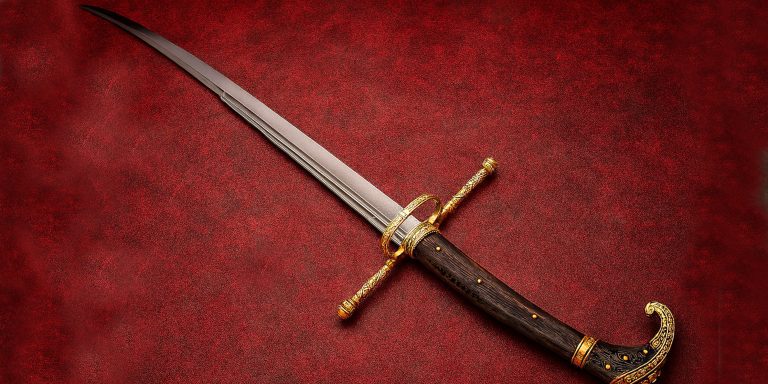
There was no uniquely Welsh longbowman’s sword. Archers used sidearms available throughout Britain and northern Europe.
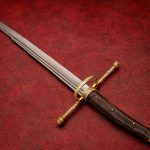
Arming sword
The arming sword was a straight, double-edged, one-handed weapon with a cruciform hilt. Better-equipped archers and professional soldiers could carry one at the waist.
Typical examples from the fourteenth and fifteenth centuries possessed blades suited to both cutting and thrusting. As plate armour improved, narrower and more strongly tapered points became increasingly useful for attacking gaps.
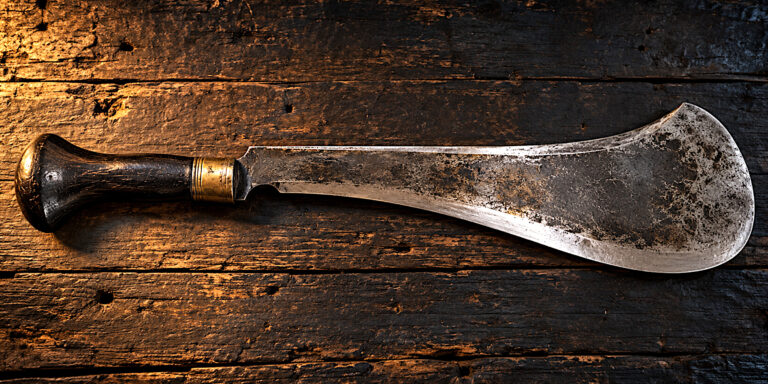
Falchion
The falchion was a single-edged cutting sword. Surviving forms vary from relatively slender blades to broad, forward-weighted weapons.
A falchion could deliver powerful cuts against lightly protected opponents. It was not a Welsh speciality, but it would have been a practical military sidearm.
Baselard
The baselard occupied the uncertain ground between a large dagger and a short sword. It usually featured an I-shaped hilt and a strong double-edged blade.
Baselards were widely carried during the fourteenth century and would have suited an archer who needed a compact weapon without the cost or inconvenience of a full sword.
Rondel dagger
The rondel dagger became common among soldiers during the later Middle Ages. Its stiff point was designed for thrusting into gaps in armour. In close combat, it could also be used to finish or compel the surrender of a fallen opponent.
Bollock dagger
The bollock dagger, named with the characteristic restraint of medieval weapon terminology, was widespread in Britain. It served as both a working knife and personal weapon.
For many ordinary archers, a substantial dagger, axe or knife was more realistic than an expensive sword.
Could the Longbow Penetrate Armour?
The longbow was dangerous to armoured men, but its performance depended upon:
- Distance
- Arrowhead design
- Shaft weight
- Angle of impact
- Bow strength
- Quality and hardness of the armour
- Whether the arrow struck a plate or a gap
Mail worn over a padded garment could stop or reduce many blows. Narrow arrowheads might break individual rings or force them into the padding beneath, producing injury without complete penetration.
Good fifteenth-century plate was considerably harder to defeat. Curved surfaces encouraged arrows to glance away, while hardened steel breastplates protected the torso effectively.
Archers did not need to punch through the centre of every breastplate. They could shoot horses, strike faces and limbs, find armour gaps and exhaust an advancing formation.
Modern experiments can answer specific questions, but only when the equipment and conditions are clearly explained. A test involving one replica bow, one arrowhead and one steel plate cannot settle every argument about medieval armour. It can, however, produce several hours of enthusiastic disagreement on the internet.
Strengths and Limitations
| Strengths | Limitations |
|---|---|
| Faster shooting than most medieval crossbows | Required years of practice |
| Effective against horses and exposed troops | Physically exhausting |
| Could disrupt formations before contact | Depended upon large ammunition supplies |
| Relatively simple mechanical construction | Suitable bow timber required careful selection |
| Archers remained mobile | Vulnerable if caught without protection |
| Useful in both missile and close combat | Good plate resisted many direct hits |
| Particularly effective on defensive ground | Less dominant when outflanked or surprised |
Archaeology
The archaeological record for Welsh longbowmen is frustratingly incomplete. Wood, feathers, fibres and leather rarely survive in ordinary soil. Iron arrowheads survive more frequently, but they are often corroded and difficult to classify.
Arrowheads from Welsh Castles
Medieval arrowheads have been recovered from castles and settlements across Wales. Significant weapon assemblages have been studied at sites including Dryslwyn and Criccieth.
These finds demonstrate that archery formed part of warfare around Welsh strongholds, but interpretation is difficult. An arrowhead discovered inside a castle might have belonged to:
- An attacker
- A defender
- A member of the garrison
- A hunter
- A later visitor
- Disturbed soil from another period
The number of finds can also reflect preservation and excavation practices rather than the original intensity of fighting.
The Absence of Surviving Welsh Bows
No collection comparable to the Mary Rose bows has been recovered from medieval Wales. This prevents historians from establishing the exact size, shape or strength of Gerald’s elm bows.
Images in manuscripts and sculpture provide some evidence, but artists could simplify equipment or follow established conventions. A bow shown in a manuscript is not an engineering drawing.
The Mary Rose Evidence
The Mary Rose was an English Tudor warship rather than a specifically Welsh site. Its collection remains vital because it preserves the mature war-bow tradition in which English and Welsh archers participated.
The wreck produced:
- 137 complete longbows
- More than 3,500 arrows
- Bracers and archery equipment
- Wooden chests and ammunition containers
- Human remains showing possible archery-related physical changes
The evidence confirms that Tudor war bows were substantial military weapons rather than slightly enlarged sporting bows.
It does not prove that twelfth-century Welsh bows possessed identical measurements or draw weights.
Human Remains
Some skeletons recovered from the Mary Rose show changes consistent with prolonged heavy archery. These include stress around the shoulders and asymmetry in the upper body.
Identifying an archer solely through skeletal changes remains difficult. Rowing, lifting, craftwork and injury could create similar patterns. The evidence is strongest when anatomy is considered alongside personal equipment and archaeological context.
Contemporary Sources and Quotations
| Source | Evidence provided | Main limitation |
|---|---|---|
| Gerald of Wales | Powerful elm bows used in Gwent | Regional, anecdotal and technically imprecise |
| Royal army accounts | Recruitment, pay, equipment and provisions | Often describe men simply as Welsh infantry |
| Jean Froissart | Accounts of battles and massed archery | Written after events and revised several times |
| Gesta Henrici Quinti | Near-contemporary description of Agincourt | Strongly favourable towards Henry V |
| Muster rolls | Names, captains, origins and military roles | Incomplete and occasionally ambiguous |
Gerald’s descriptions remain the clearest early testimony. His account of Welsh arrows passing through defensive timber and striking armoured horsemen shows the fear these weapons inspired.
Later chroniclers describe arrows falling in great numbers during battles such as Crécy and Agincourt. Their language captures the experience of massed archery, although exact figures and dramatic details must be checked against administrative records.
No single source tells the entire story. Chronicles provide narrative, accounts provide quantities, archaeology provides objects and reconstruction tests what those objects might have achieved.
Common Myths About Welsh Longbowmen
The Welsh invented the longbow
Powerful Welsh bows are documented early, but long self bows existed elsewhere. There is no evidence identifying one inventor or a single birthplace.
Edward I adopted the longbow after being defeated by it
Edward exploited existing Welsh military skills and recruited Welsh archers extensively. The idea of one decisive encounter followed by immediate adoption is a later simplification.
Welsh archers won Agincourt
Welsh troops participated, possibly numbering around 400 identifiable men. Most of Henry’s approximately 5,000 archers were not Welsh.
Longbows easily pierced every suit of plate armour
Good plate provided excellent protection. Arrows remained dangerous through repeated impact, vulnerable gaps, exposed limbs and attacks upon horses.
Archers stayed safely behind the fighting
Longbowmen entered close combat and used daggers, swords, axes and mallets. At Agincourt, their participation in the mêlée was important.
Captured archers had two fingers removed
There is no credible medieval evidence that the famous two-finger gesture originated with longbowmen displaying intact drawing fingers before battle. The story appeared much later.
Decline of the War Bow
The longbow did not disappear immediately when firearms entered European warfare. Bows and handguns served beside one another for generations.
The longbow still offered:
- A comparatively rapid rate of shooting
- Reliability in poor conditions
- Established manufacturing systems
- A large body of experienced archers
- Useful accuracy at practical ranges
Firearms gradually gained advantages in penetration, training and battlefield organisation. A competent gunner could be trained more quickly than a heavy-bow archer, while improvements in gunpowder weapons increased their reliability.
The decline resulted from several connected changes:
- Fewer men possessed lifelong archery training.
- Firearms became increasingly powerful.
- Pike and shot formations changed battlefield tactics.
- Armour and cavalry methods continued to evolve.
- Maintaining national archery practice became difficult.
- Governments invested more heavily in gunpowder supply.
Welsh archers continued to serve into the Tudor period. By then, the legal and administrative integration of Wales into the English state was reducing distinctions between Welsh and English military recruitment.
Legacy
The importance of Welsh longbowmen does not depend upon proving that they invented the longbow.
Archery was already a respected feature of warfare in parts of Wales during the twelfth century. Welsh soldiers then became a major source of military manpower for the English Crown. They campaigned across Britain and France, contributing to one of the most effective combined-arms systems of the medieval period.
Their story also reflects the consequences of conquest. Royal service offered wages, advancement and opportunities for plunder, but Welsh recruitment existed within a political system imposed after Edward I’s conquest. Welsh soldiers could fight for an English king abroad while communities at home lived with legal discrimination and the memory of rebellion.
Later writers transformed this complicated history into a national legend. Shakespeare’s Fluellen, antiquarian enthusiasm and modern popular culture encouraged the image of an essentially Welsh weapon carrying English kings to victory.
The truth is less convenient and rather more human. Welsh longbowmen were skilled, adaptable and frequently hard-used soldiers. They deserve recognition without requiring them to carry several centuries of mythology alongside a six-foot bow.
Where to See Longbow History
- Mary Rose Museum, Portsmouth: The finest surviving collection of war bows, arrows and associated equipment.
- Royal Armouries, Leeds: Medieval weapons and armour showing what archers carried and faced.
- National Museum Cardiff: Welsh archaeological collections, although specific displays should be checked before visiting.
- St Fagans National Museum of History: Useful for understanding the wider social and material world of Welsh soldiers.
- Abergavenny Castle and Museum: Closely connected with Gerald’s account of the archers of Gwent.
- Dryslwyn Castle: An important native Welsh castle with archaeological evidence relating to medieval conflict.
- Criccieth Castle: A major Welsh stronghold associated with warfare and weapon finds.
- Agincourt 1415 Museum, Azincourt: Interpretation of the battle within its French landscape.
Organic weapons are fragile and displays change. Check with the museum before travelling to see a particular bow or archaeological object.
Frequently Asked Questions
Were Welsh longbows made from elm or yew?
Gerald of Wales states that bows used in twelfth-century Gwent were made from elm. Later war bows were commonly made from yew. The accounts refer to different periods and possibly different bow-making traditions.
How powerful was a Welsh longbow?
No surviving medieval Welsh bow can provide a direct measurement. Later bows from the Mary Rose have estimated draw weights ranging from approximately 65 to 175 lb.
How far could a longbow shoot?
A powerful longbow could send a specialised or relatively light arrow beyond 200 metres. Heavy war arrows were normally used at shorter practical ranges, where accuracy and impact were greater.
How many Welsh archers fought at Agincourt?
Possibly around 400 identifiable Welsh soldiers or archers took part. Incomplete records prevent an exact total, but claims that most of Henry V’s archers were Welsh are unsupported.
Could a longbow arrow penetrate plate armour?
An arrow could penetrate some plates under favourable conditions, particularly thinner or poorer-quality pieces. Good hardened plate offered strong protection. Horses, faces, limbs and gaps remained vulnerable.
What swords did Welsh longbowmen use?
There was no standard Welsh archer’s sword. Better-equipped men might carry an arming sword, falchion or large baselard. Daggers and axes were probably more common among ordinary archers.
Sources and Further Reading
- Gerald of Wales, The Journey Through Wales and The Description of Wales
- Adam Chapman, Welsh Soldiers in the Later Middle Ages, 1282–1422
- Matthew Strickland and Robert Hardy, The Great Warbow
- Anne Curry’s research into Henry V and the Agincourt campaign
- The Medieval Soldier Database
- Mary Rose Museum research into longbows, arrows and human remains
- Royal Armouries studies of medieval weapons and armour
- Archaeological research into the weaponry of medieval Wales