When people picture the armies that conquered much of Italy and the Americas during the sixteenth century, the image that usually springs to mind is the towering pike or the smoking arquebus. Both deserve their fame. Yet between those formations moved another kind of soldier, one carrying little more than a sword, a steel shield and an alarming amount of confidence.
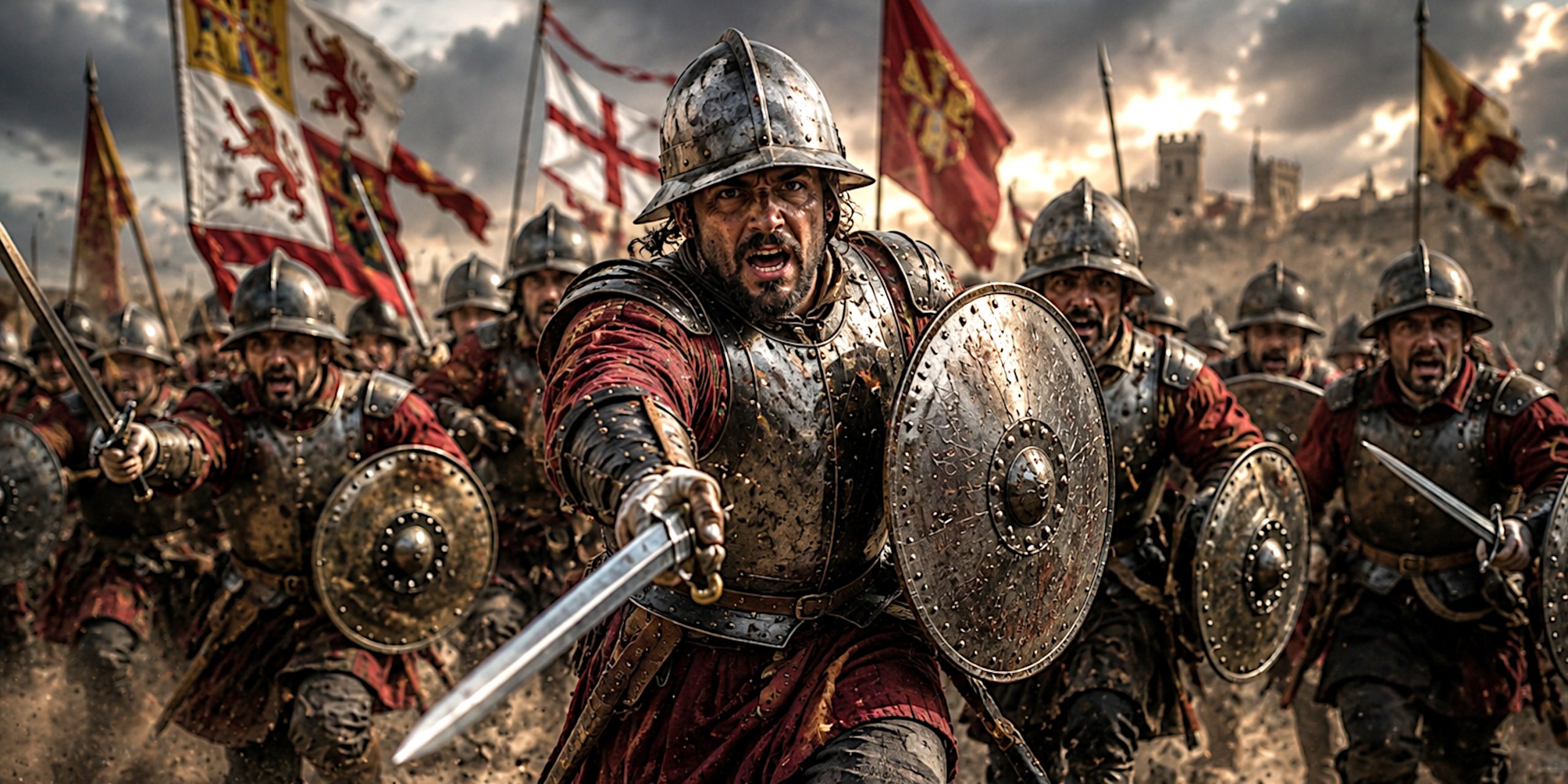
These were the Rodeleros, specialist Spanish infantry armed with the rodela, a round shield from which they took their name. Agile rather than heavily armoured, they were trained to exploit gaps in enemy formations, protect missile troops and engage opponents at close quarters where long pikes became awkward liabilities.
Although their battlefield prominence lasted only a few decades, the Rodeleros occupy a fascinating chapter in military history. They represented the final flowering of medieval sword-and-shield warfare before firearms and disciplined pike formations reshaped European battlefields forever.
As a historian, I cannot help admiring their sheer optimism. Looking at a forest of fifteen-foot pikes and deciding that the correct response was to charge into them with a sword required either exceptional courage or a complete disregard for personal wellbeing. Quite possibly both.
Who Were the Spanish Rodeleros?
The Rodeleros emerged during the late fifteenth century under the military reforms of the Catholic Monarchs, Ferdinand II of Aragon and Isabella I of Castile.
Spain had recently completed the Reconquista, and its armies possessed centuries of experience fighting in rough terrain, conducting sieges and engaging in brutal close combat. Swordsmanship remained central to military culture.
Unlike many contemporary European infantry, Spanish armies developed specialist troops carrying:
- A steel buckler or rodela
- A one-handed sword
- Sometimes a dagger
- Light armour suitable for rapid movement
They became particularly valuable during the Italian Wars, where Spain faced Swiss pikemen, French gendarmes and German Landsknechts.
Origins of the Rodeleros
The Rodeleros evolved naturally from medieval Iberian infantry traditions.
Several influences shaped their development:
- Moorish warfare during the Reconquista
- Urban militias accustomed to sword fighting
- Professional mercenary service
- The increasing organisation of standing royal armies
Spanish commanders recognised that pike formations were formidable from the front but vulnerable once their order collapsed.
The solution was simple in theory.
Send men carrying shields directly into the enemy formation.
Whether it remained simple after the first several hundred sharpened pike heads is another matter.
Why Were They Called Rodeleros?
The name derives from the Spanish word rodela, meaning a small round shield.
Unlike the large medieval kite shields or heater shields, the rodela measured roughly:
| Feature | Typical Size |
|---|---|
| Diameter | 45 to 65 cm |
| Material | Steel |
| Weight | 3 to 6 kg |
| Grip | Central handle behind boss |
The shield was designed to:
- Deflect sword blows
- Push aside pikes
- Protect against missiles
- Create openings during close combat
Many surviving examples display elaborate decoration, indicating they were valued as much as practical equipment as symbols of professional status.
Organisation
Rodeleros formed part of the evolving Spanish infantry that would later become the famous Tercios.
A typical Spanish force included:
| Troop Type | Battlefield Role |
|---|---|
| Pikemen | Defensive backbone |
| Arquebusiers | Missile fire |
| Crossbowmen | Supporting fire |
| Rodeleros | Shock assault |
| Cavalry | Flank attacks |
The exact proportion varied between campaigns.
Early sixteenth-century armies sometimes fielded several thousand sword-and-buckler men.
Battlefield Role
The Rodeleros specialised in aggressive close combat.
Their primary missions included:
- Exploiting breaks in enemy formations
- Attacking exposed flanks
- Protecting arquebusiers
- Storming breaches during sieges
- Fighting inside fortifications
- Pursuing broken troops
Against tightly packed Swiss formations they attempted to slip beneath projecting pikes before striking at the front ranks.
Success depended entirely upon timing, discipline and remarkable bravery.
Famous Campaigns
Italian Wars
The Italian Wars provided the Rodeleros with their greatest stage.
Spanish commanders such as Gonzalo Fernández de Córdoba, known as “The Great Captain”, refined combined-arms tactics that integrated swordsmen with pikes and firearms.
The Rodeleros gained a fearsome reputation for aggressive assaults against Swiss infantry.
Battle of Cerignola (1503)
Often regarded as one of the first battles won primarily through firearms and field fortifications, Cerignola still saw sword-and-shield troops play an important supporting role.
They protected defensive positions and exploited enemy disorder once French attacks faltered.
Battle of Ravenna (1512)
At Ravenna Spanish infantry endured heavy casualties but demonstrated the effectiveness of coordinated infantry tactics.
Rodeleros repeatedly engaged in brutal close fighting amid collapsing formations.
The Conquest of the Americas
The Rodelero proved exceptionally effective during campaigns in Mexico and Peru.
Their equipment suited:
- Dense urban fighting
- Jungle terrain
- Mountain warfare
- Siege assaults
Spanish chroniclers frequently describe sword-and-buckler men fighting alongside arquebusiers against numerically superior indigenous armies.
Arms and Armour
Primary Weapons
The Rodelero carried weapons suited to swift, aggressive combat.
| Weapon | Purpose |
|---|---|
| Espada ropera (early military form) | Sidearm |
| Arming sword | Primary battlefield weapon |
| Cut-and-thrust sword | Close combat |
| Dagger | Secondary weapon |
| Rodela | Defence and offensive shield work |
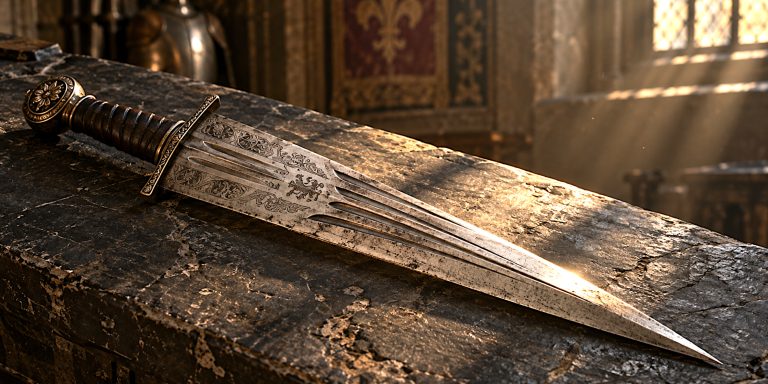
Unlike later civilian rapiers, military swords remained broad enough to cut effectively while retaining strong thrusting capability.
Sword Types
Common swords included:
- Late Medieval arming swords
- Early Spanish cut-and-thrust swords
- Side swords
- Transitional espada ropera intended for military service
Many featured:
- Straight double-edged blades
- Cruciform hilts
- Wheel or scent-stopper pommels
- Blades between 75 and 90 cm
Armour
Protection varied according to wealth and campaign.
Typical equipment included:
| Armour | Use |
|---|---|
| Morion helmet | Common during later service |
| Sallet | Early campaigns |
| Burgonet | Later campaigns |
| Breastplate | Standard for many professionals |
| Backplate | Additional protection |
| Mail sleeves | Flexible defence |
| Gauntlets | Hand protection |
Many Rodeleros deliberately wore lighter armour to preserve mobility.
Tactics
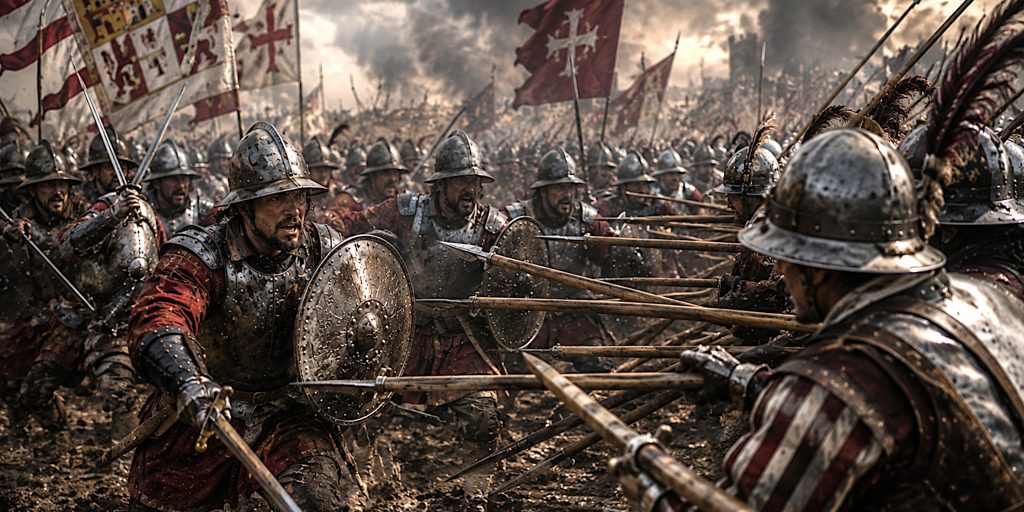
The Rodeleros relied on speed rather than brute force.
Their methods included:
- Closing rapidly before pikes could be reset
- Using shields to knock pikes aside
- Cutting exposed pike shafts
- Attacking officers and standard bearers
- Exploiting confusion created by arquebus fire
These tactics demanded exceptional training.
A poorly coordinated assault simply resulted in determined men becoming memorable cautionary tales.
Training
Spanish infantry developed a reputation for discipline across Europe.
Training focused upon:
- Swordsmanship
- Shield drills
- Unit manoeuvres
- Physical conditioning
- Formation fighting
Experienced veterans often became instructors for newer recruits.
Contemporary Accounts
Several chroniclers praised Spanish swordsmen.
The Italian historian Francesco Guicciardini described the determination of Spanish infantry during the Italian Wars, noting their willingness to close aggressively with enemy formations.
The soldier and memoirist Bernal Díaz del Castillo, writing of the conquest of Mexico, frequently praised Spanish swordsmen for their effectiveness in close combat against overwhelming odds.
Niccolò Machiavelli observed the changing nature of infantry warfare during the Italian Wars and recognised the effectiveness of disciplined Spanish formations that successfully combined different troop types.
Archaeology
Although individual Rodeleros are rarely identifiable archaeologically, numerous discoveries illuminate their equipment.
Important finds include:
- Steel rodela shields recovered from museums across Spain and Italy
- Military sword blades from sixteenth-century battlefields
- Morion helmets excavated from fortifications
- Breastplates recovered from river crossings
- Artefacts from battlefields associated with the Italian Wars
Excavations at sites connected with the conquest of the Americas have also uncovered fragments of Spanish military equipment including sword fittings, mail links and armour plates.
Museum collections in Madrid, Toledo and other European cities preserve examples remarkably close to those described in contemporary inventories.
Decline
By the mid-sixteenth century, battlefield conditions had changed.
Several factors reduced the importance of the Rodeleros:
- Longer pikes
- Improved infantry drill
- More arquebusiers
- Increasing battlefield firepower
- Better combined-arms tactics
Eventually commanders concluded that additional firearms provided greater flexibility than large numbers of specialist swordsmen.
The sword remained an essential sidearm, but dedicated sword-and-shield units gradually disappeared.
Legacy
The Rodeleros represent one of the final great chapters in the history of sword-and-shield warfare.
Their influence survives through:
- Spanish military tradition
- Historical European Martial Arts research
- Renaissance military studies
- Museum collections
- Historical re-enactment
Modern historians increasingly appreciate that they were not relics clinging to outdated methods, but innovative specialists filling a tactical niche during a period of rapid military evolution.
Timeline
| Date | Event |
|---|---|
| Late 1400s | Rodeleros emerge during Spanish military reforms |
| 1494 | Italian Wars begin |
| 1503 | Distinguished service at Cerignola |
| 1512 | Fight at Ravenna |
| 1525 | Spanish victory at Pavia demonstrates combined-arms superiority |
| Mid 1500s | Firearms increasingly replace specialist swordsmen |
| Late 1500s | Dedicated Rodelero formations largely disappear |
Quick Facts
| Feature | Details |
|---|---|
| Period | Late fifteenth to mid sixteenth century |
| Region | Spain |
| Primary Weapon | One-handed sword |
| Shield | Steel rodela |
| Armour | Breastplate, helmet, light armour |
| Battlefield Role | Shock infantry |
| Famous Campaigns | Italian Wars, Conquest of Mexico, Conquest of Peru |
| Opponents | Swiss pikemen, Landsknechts, French infantry, Indigenous American armies |
Frequently Asked Questions
What was a Rodelero?
A Spanish infantryman armed with a sword and round steel shield who specialised in close combat during the late fifteenth and early sixteenth centuries.
What sword did Rodeleros use?
Most carried military arming swords or early cut-and-thrust side swords rather than the long civilian rapiers that developed later in the Renaissance.
Were Rodeleros effective?
Yes. They proved highly successful in specific tactical situations, particularly during the Italian Wars and siege fighting, although advances in firearms eventually reduced their battlefield importance.
Why did they disappear?
The steady growth of arquebusiers and increasingly disciplined pike formations made specialist sword-and-shield infantry less effective than combined pike and shot tactics.