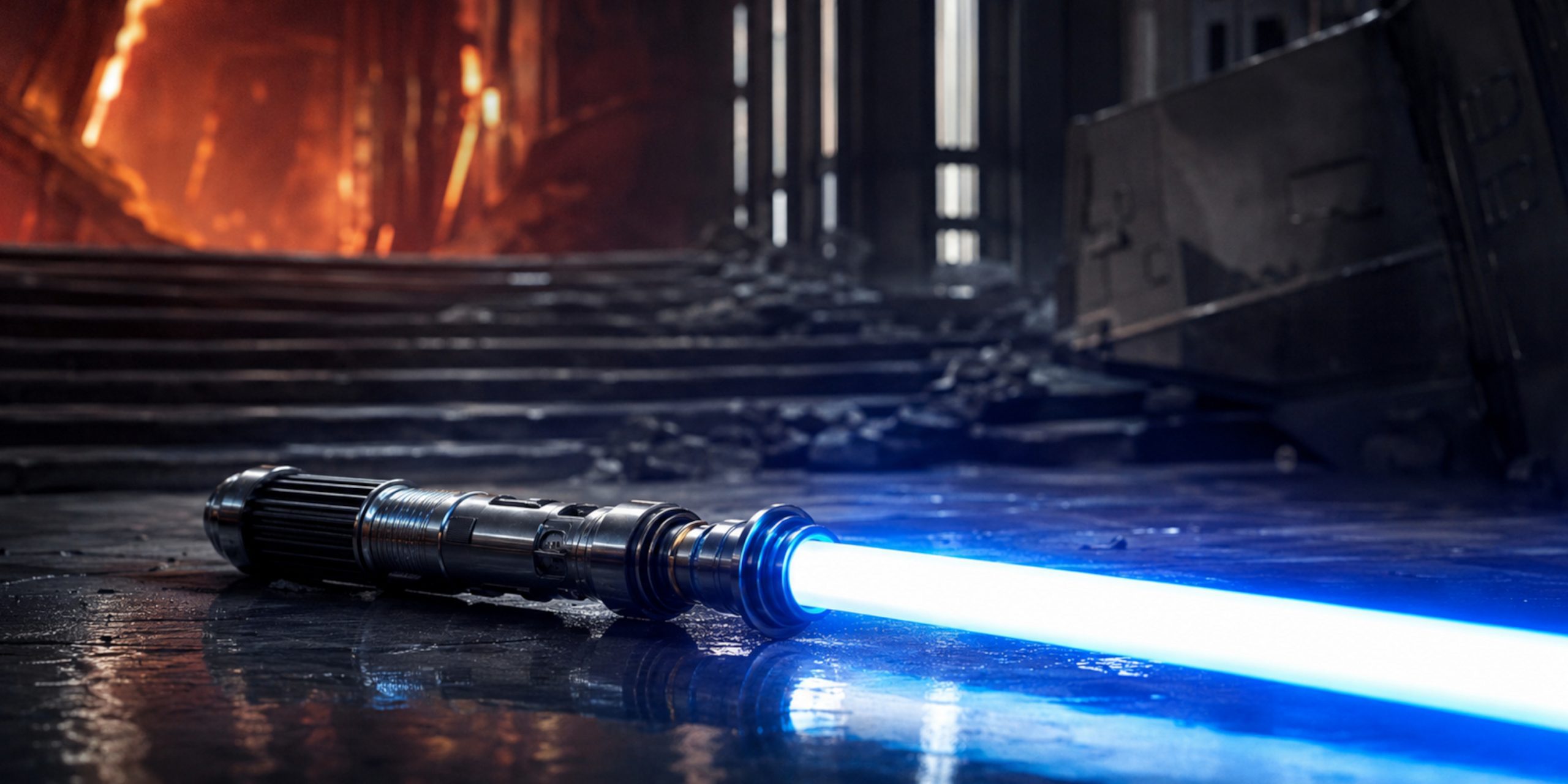
Few fictional weapons have reached the same legendary status as the lightsaber. You can show someone a glowing blade and a distinctive humming sound, and they’ll recognise it instantly. That is incredibly rare in popular culture.
What makes the lightsaber fascinating is that it is much more than a laser sword. It represents philosophy, discipline, identity and responsibility. Every Jedi and Sith develops a personal relationship with their weapon, and no two lightsabers tell exactly the same story.
Across films, television, novels and especially video games, lightsabers have evolved from mysterious relics into deeply customisable weapons with rich lore. Games like Star Wars Jedi: Survivor even let players rebuild, repaint and reconfigure them almost obsessively. Honestly, it is the sort of feature where you promise yourself you’ll spend five minutes tweaking your hilt, then somehow an hour disappears.
Lightsaber Specifications
| Feature | Details |
|---|---|
| Weapon Type | Energy sword |
| Power Source | High-output power cell |
| Core Component | Kyber crystal |
| Blade Length | Approximately 1 metre (varies) |
| Weight | Surprisingly light, but difficult to master |
| Users | Jedi, Sith and Force-sensitive warriors |
| Primary Materials | Metal hilt housing focusing systems and emitter |
| First Appearance | Star Wars (1977) |
| Notable Variants | Double-bladed, crossguard, curved hilt, shoto, lightwhip, pike |
What Is a Lightsaber?
A lightsaber is an energy weapon powered by a kyber crystal. Instead of a metal blade, it projects a contained beam of plasma held in shape by magnetic fields.
The result is a weapon capable of cutting through most materials with extraordinary efficiency. Blast doors, armour and even other weapons rarely survive contact.
Its greatest strength, however, is precision.
A skilled Force user can deflect blaster bolts, disarm opponents without killing them and perform movements that would be impossible with conventional swords.
That combination of elegance and overwhelming power explains why Obi-Wan Kenobi famously described it as “an elegant weapon for a more civilised age.”
The History of the Lightsaber
Ancient Origins
The earliest lightsabers appeared thousands of years before the Skywalker Saga.
Ancient Jedi experimented with Force-powered weapons before developing portable hilts that housed kyber crystals and compact energy cells. Over centuries, engineering improvements transformed lightsabers into practical sidearms.
As Jedi knowledge spread throughout the galaxy, lightsabers became symbols of peacekeepers rather than soldiers.
Ironically, they would later become famous because of war.
The Jedi Order
Every Jedi traditionally built their own lightsaber after discovering a kyber crystal through meditation and personal trials.
This process was not simply engineering.
It represented growth, patience and self-discovery.
The finished weapon reflected the Jedi’s personality and connection to the Force.
The Sith
Sith approached lightsaber construction very differently.
Instead of bonding naturally with kyber crystals, many Sith forced crystals to submit through the Dark Side, a process known as bleeding.
This caused the crystal to turn red, creating the iconic crimson blades associated with Darth Vader, Darth Maul and Darth Sidious.
Imperial Era
Following Order 66, lightsabers became exceptionally rare.
The Empire hunted surviving Jedi, collected their weapons and viewed lightsabers as dangerous reminders of the old Republic.
This scarcity helped transform the weapon into an almost mythical object during the reign of the Galactic Empire.
Anatomy of a Lightsaber
Although designs vary dramatically, most lightsabers share common components.
| Component | Purpose |
|---|---|
| Kyber Crystal | Focuses and amplifies energy |
| Power Cell | Supplies energy |
| Emitter Matrix | Projects the plasma blade |
| Activation Switch | Ignites the blade |
| Focusing Lens | Stabilises blade shape |
| Cooling Systems | Prevents overheating |
| Grip | Allows secure handling during combat |
Many Jedi personalise their hilts with unique grips, emitters and decorative elements.
Games have expanded this even further, allowing players to mix components from dozens of different styles.
Lightsaber Colours Explained
Blade colour has become one of the most recognisable aspects of Star Wars.
Blue
Traditionally associated with Jedi Guardians.
Blue lightsabers prioritise martial skill and battlefield excellence.
Notable users include:
- Obi-Wan Kenobi
- Anakin Skywalker
- Luke Skywalker
Green
Common among Jedi Consulars who focus on wisdom, diplomacy and deeper Force knowledge.
Notable wielders include:
- Yoda
- Qui-Gon Jinn
- Luke Skywalker
Purple
Extremely rare.
Purple often represents an unconventional balance between aggressive combat and Jedi discipline.
Most famously wielded by Mace Windu.
Yellow
Often associated with Jedi Sentinels and Temple Guards.
Recent canon has expanded yellow lightsabers significantly.
White
White blades symbolise purified kyber crystals.
Ahsoka Tano famously uses paired white lightsabers after cleansing previously corrupted crystals.
Red
Created through the bleeding of kyber crystals.
Almost exclusively associated with Sith and Dark Side users.
Orange and Other Colours
Modern Star Wars games have introduced orange, cyan, magenta, indigo and many cosmetic variations.
While some exist mainly for player customisation, others have gradually become accepted within canon.
Types of Lightsaber
Standard Lightsaber
The classic single-bladed weapon.
Balanced, versatile and suitable for almost every combat situation.
Double-Bladed Lightsaber
Two blades extend from opposite ends of the hilt.
This dramatically increases offensive pressure but requires exceptional skill.
Darth Maul made this design famous.
Crossguard Lightsaber
Features two smaller side vents that stabilise excess plasma.
Kylo Ren’s unstable blade became one of the sequel trilogy’s defining visual designs.
Curved-Hilt Lightsaber
Designed for elegant fencing movements.
Count Dooku’s weapon perfectly complemented his refined duelling style.
Shoto
A shorter lightsaber often used alongside a standard blade.
Excellent for dual wielding.
Lightsaber Pike
Combines an extended shaft with an energy blade.
Offers superior reach while maintaining lightsaber cutting power.
Lightwhip
One of the strangest variants.
Instead of a rigid blade, the weapon projects flexible plasma strands that behave more like an energy whip.
Rare, dangerous and notoriously difficult to master.
The Seven Forms of Lightsaber Combat
Lightsaber combat developed into seven recognised disciplines.
| Form | Focus |
|---|---|
| Form I: Shii-Cho | Basic fundamentals |
| Form II: Makashi | Precision duelling |
| Form III: Soresu | Defensive mastery |
| Form IV: Ataru | Acrobatics and speed |
| Form V: Shien and Djem So | Power and counterattacks |
| Form VI: Niman | Balanced approach |
| Form VII: Juyo and Vaapad | Aggressive and unpredictable combat |
Different Jedi often blended several forms to suit their strengths.
Video games frequently incorporate these philosophies into different combat stances.
Lightsabers in Star Wars Games
Gaming has arguably done more than any other medium to let fans truly appreciate lightsabers.
Early games focused on spectacle.
Modern titles focus on weight, timing and mastery.
Notable appearances include:
| Game | Contribution |
|---|---|
| Jedi Knight series | Advanced lightsaber combat |
| Knights of the Old Republic | RPG customisation |
| The Force Unleashed | Powerful Force abilities |
| Jedi: Fallen Order | Precision melee combat |
| Jedi: Survivor | Extensive weapon customisation |
| Battlefront II | Hero-focused lightsaber gameplay |
| LEGO Star Wars | Accessible family-friendly combat |
Jedi: Survivor arguably offers the richest interpretation so far, allowing players to swap components, choose stances and experiment with multiple fighting styles.
Advantages
- Exceptional cutting power
- Can deflect blaster bolts
- Highly versatile
- Symbol of Jedi identity
- Countless customisation options in games
- Extremely effective in skilled hands
Disadvantages
- Requires years of training
- Dangerous to inexperienced users
- Limited effectiveness against certain specialised materials
- Close-range weapon in a galaxy dominated by ranged combat
- Force sensitivity greatly improves effectiveness
Most Famous Lightsabers
Some lightsabers have become characters in their own right.
Among the most iconic are:
- Luke Skywalker’s green lightsaber
- Anakin Skywalker’s blue lightsaber
- Darth Vader’s red lightsaber
- Darth Maul’s double-bladed lightsaber
- Obi-Wan Kenobi’s blue lightsaber
- Yoda’s green lightsaber
- Mace Windu’s purple lightsaber
- Ahsoka Tano’s white lightsabers
- Kylo Ren’s crossguard lightsaber
Each reflects its owner’s personality almost as much as their clothing or dialogue.
Legacy
The lightsaber has become one of the defining symbols of modern science fiction.
It has inspired replica manufacturers, toy companies, fencing clubs, choreography communities and generations of filmmakers. Advances in visual effects have continually reinvented how lightsabers look on screen, while games have allowed fans to experience the weapon in increasingly authentic ways.
Perhaps the most impressive achievement is that the lightsaber remains exciting after nearly fifty years. Most fictional weapons eventually become familiar. The lightsaber somehow still feels special every time it ignites. That unmistakable snap-hiss sound is enough to make almost any Star Wars fan sit up a little straighter.
Whether wielded by a wise Jedi Master, an ambitious Sith Lord or a player creating their own adventure, the lightsaber continues to represent the heart of Star Wars. It is equal parts weapon, symbol and storytelling device, and very few fictional creations can claim to have left such a lasting mark on popular culture.