There are few commanders in British history whose reputation has survived quite as strongly as John Churchill, 1st Duke of Marlborough. Wellington admired him. Napoleon studied him. Historians continue to debate whether he was Britain’s greatest general, but remarkably few dismiss the claim outright.
His victories during the War of the Spanish Succession transformed Britain’s standing in Europe. Before Marlborough, England had produced brave soldiers and capable commanders. After Marlborough, Britain possessed a military legend whose campaigns became textbooks for generations.
What makes him fascinating is not simply that he won battles. Plenty of generals have done that. Marlborough repeatedly outmanoeuvred experienced opponents, maintained fragile alliances between competing nations, kept armies supplied across vast distances, and somehow managed to remain politically influential despite living through one of Britain’s most turbulent political eras.
Even today, reading his campaigns feels surprisingly modern. Speed, intelligence gathering, logistics and deception mattered as much to him as courage.
Who Was John Churchill?
John Churchill was born on 26 May 1650 into a Royalist family that had suffered during the English Civil War.
His rise was anything but guaranteed.
As a young man he entered the service of James, Duke of York, later King James II. Churchill proved himself during campaigns against the Dutch and the French, quickly earning a reputation for calmness under pressure and remarkable personal bravery.
The Glorious Revolution of 1688 placed him in an awkward position. Churchill abandoned James II and supported William of Orange. Critics called it betrayal. Supporters described it as political realism.
History has largely sided with the latter.
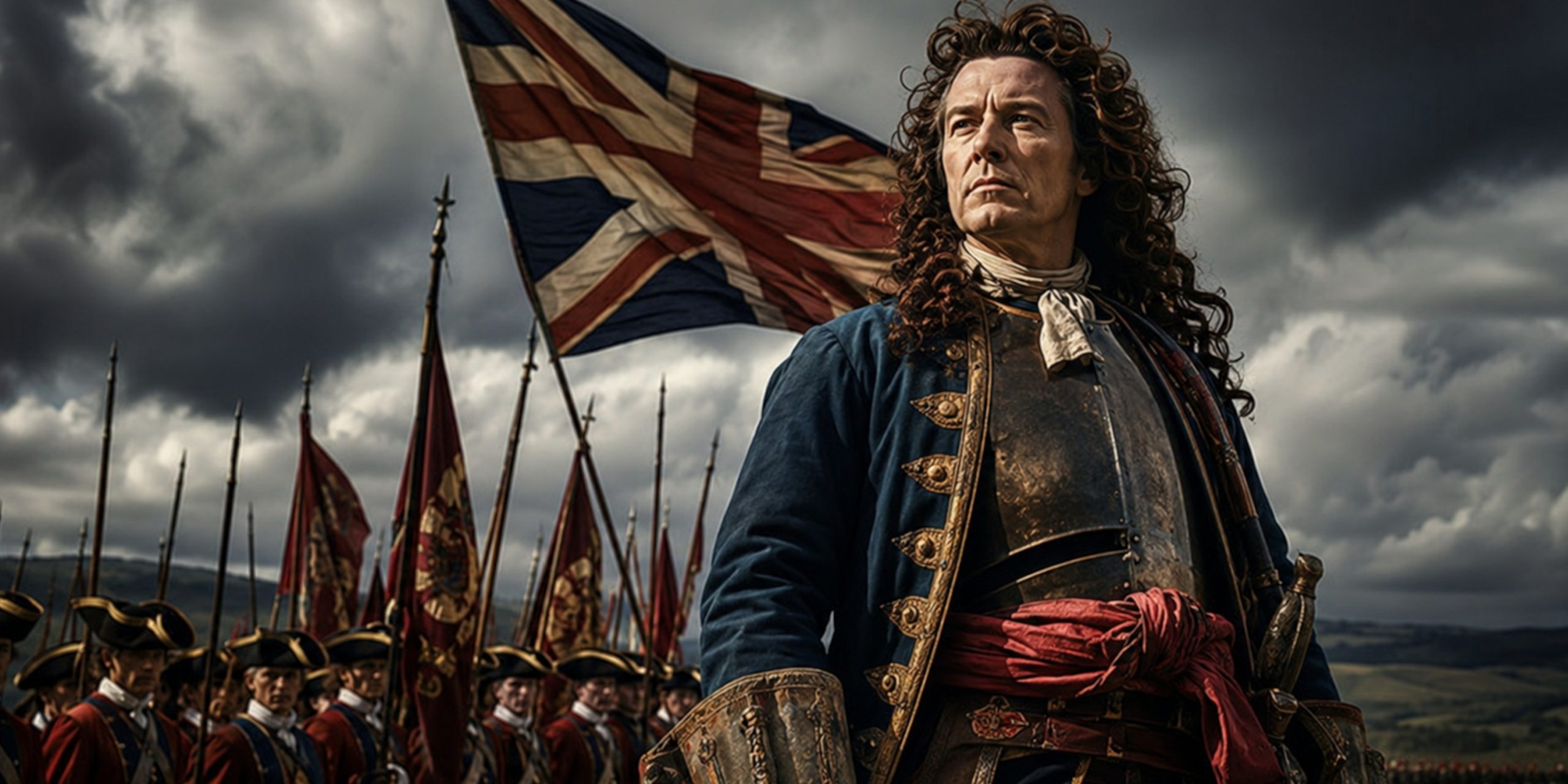
By the reign of Queen Anne he had become Captain General of Britain’s armies and the driving military force behind the Grand Alliance against Louis XIV.
Early Military Career
Churchill’s military education came through practical experience rather than formal academies.
He fought under Marshal Turenne, one of France’s finest commanders, absorbing lessons that later appeared in his own campaigns.
Unlike many aristocratic officers, Churchill developed a genuine understanding of battlefield management.
He learned:
- logistics
- siege warfare
- cavalry tactics
- coalition command
- reconnaissance
- operational movement
These lessons became the foundation of his later brilliance.
The War of the Spanish Succession
The death of Charles II of Spain without an heir threatened to unite France and Spain under Bourbon rule.
Europe feared Louis XIV becoming too powerful.
Britain, Austria and the Dutch Republic formed the Grand Alliance to stop him.
Marlborough became its principal commander.
Between 1702 and 1711 he conducted one of the most extraordinary series of campaigns in European history.
Greatest Battles
Battle of Blenheim (1704)
Blenheim remains one of Britain’s greatest military victories.
Marlborough marched roughly 250 miles in weeks, deceving French intelligence before striking deep into Bavaria.
The Franco-Bavarian army expected a defensive campaign.
Instead they found Marlborough attacking.
His coordinated assault shattered Marshal Tallard’s army.
Around 30,000 French soldiers became casualties or prisoners.
The victory ended Louis XIV’s hopes of knocking Austria from the war.
Many historians consider Blenheim the moment Britain emerged as a true European military power.
Battle of Ramillies (1706)
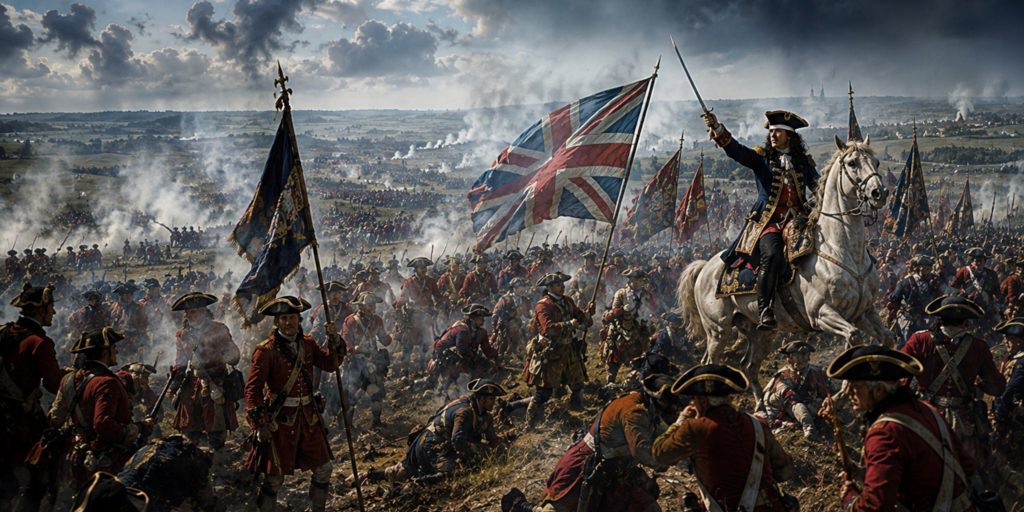
Ramillies demonstrated Marlborough’s tactical flexibility.
Rather than relying on overwhelming force, he shifted troops during battle to exploit a weakening French flank.
The movement remained hidden long enough to create decisive local superiority.
The French line collapsed.
Almost the entire Spanish Netherlands fell into Allied hands shortly afterwards.
Battle of Oudenarde (1708)
Oudenarde showcased rapid decision making.
Marlborough and Prince Eugene coordinated remarkably well despite commanding multinational armies speaking several languages.
French forces struggled to react quickly enough.
Victory came through superior manoeuvre rather than sheer numbers.
Battle of Malplaquet (1709)
Malplaquet remains controversial.
Technically an Allied victory.
Strategically useful.
Humanly dreadful.
The Allies won the field but suffered enormous casualties.
The battle illustrated the growing lethality of eighteenth century warfare.
Even Marlborough’s critics acknowledged that the losses reflected the strength of French defensive positions more than poor leadership.
Military Genius
Modern military historians often identify several recurring characteristics.
Operational Mobility
Marlborough moved armies faster than opponents believed possible.
Forced marches repeatedly created surprise.
Coalition Leadership
Perhaps his greatest achievement.
Keeping British, Dutch, Austrian and German commanders working together required almost diplomatic genius.
Winning battles was arguably easier than keeping everyone talking.
Logistics
His armies remained remarkably well supplied.
Supply lines often determined victory long before armies met.
Intelligence
Marlborough relied heavily on reconnaissance, spies and local information.
He rarely entered battle blindly.
Calculated Risk
He accepted risk only after reducing uncertainty.
His offensives looked bold because preparation had already tilted the odds.
Arms and Armour
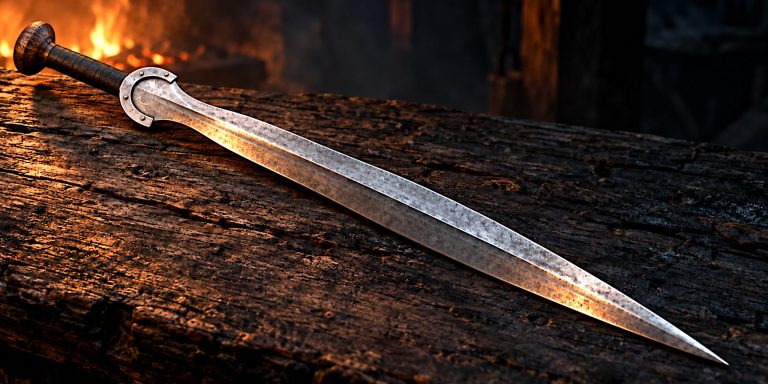
Although gunpowder dominated eighteenth century battlefields, swords remained symbols of command and practical fighting weapons.
Sword Types
Marlborough himself most likely carried high quality military smallswords during formal occasions and command.
On campaign he almost certainly favoured a stronger cavalry or officer’s sword suitable for mounted combat.
Common examples included:
- English military smallsword
- Basket hilted broadsword, especially among Scottish officers
- Mortuary hilt swords in the late seventeenth century
- Early cavalry backswords
- Heavy cavalry swords with broad cutting blades
His cavalry officers frequently carried robust backswords capable of both cutting and thrusting.
Infantry officers generally preferred elegant smallswords, reflecting both status and practicality.
Firearms
Weapons within Marlborough’s armies included:
- Flintlock muskets
- Plug and later socket bayonets
- Flintlock pistols
- Carbines for cavalry
- Field artillery ranging from light battalion guns to heavy siege cannon
Armour
Heavy armour had largely disappeared.
Officers generally wore:
- Buff leather coats
- Steel breastplates among cavalry
- Iron helmets for cuirassiers
- Tricorn hats
- Sashes indicating rank
Protection increasingly gave way to mobility.
Leadership Style
One striking aspect of Marlborough’s command was his ability to remain calm.
Contemporary accounts frequently describe him riding close to enemy fire while quietly issuing orders.
He inspired confidence rather than theatrical heroics.
Unlike some commanders, he rarely allowed pride to dictate strategy.
He withdrew when necessary.
He waited patiently when advantageous.
He attacked decisively when opportunity appeared.
Those habits sound obvious.
History suggests they are surprisingly rare.
Contemporary Views
The Duke attracted admiration across Europe.
Voltaire later wrote:
“He never besieged a town which he did not take, nor fought a battle which he did not win.”
Although slightly exaggerated, it captures Marlborough’s remarkable reputation.
The Duke of Saint-Simon, despite often criticising foreign commanders, acknowledged:
“Nature had formed him to be the greatest general.”
Even political opponents admitted his military brilliance while questioning his ambitions.
Relationship with Queen Anne
Few military careers became so entangled with court politics.
Marlborough enjoyed Queen Anne’s trust for many years.
His wife, Sarah Churchill, was one of Anne’s closest companions.
Eventually political rivalries, party conflict and personal disagreements damaged these relationships.
By 1711 Marlborough lost his command and temporarily left Britain.
It remains one of history’s more curious endings.
A commander who had defeated France across Europe was undone by Westminster.
Military campaigns rarely prepare one for palace intrigue.
Personal Life
John married Sarah Jennings in 1677.
Their marriage became one of the most influential political partnerships in Britain.
Sarah proved exceptionally intelligent and politically active.
Their correspondence reveals genuine affection alongside discussions of finance, diplomacy and war.
They amassed enormous wealth through royal favour, military rewards and careful estate management.
Blenheim Palace
Following victory at Blenheim, Parliament granted Marlborough land at Woodstock.
The result became Blenheim Palace.
Designed by Sir John Vanbrugh and Nicholas Hawksmoor, it remains one of Britain’s greatest Baroque houses.
Its scale reflected both military triumph and national gratitude.
Ironically, costs and politics ensured it also generated endless arguments.
Some traditions never change.
Archaeology and Material Evidence
Archaeological work continues to improve our understanding of Marlborough’s campaigns.
Battlefield archaeology at Blenheim has uncovered:
- Musket balls
- Grapeshot
- Cannon shot
- Uniform fittings
- Buttons from French, Bavarian and Allied troops
- Horse equipment
Metal detector surveys have helped reconstruct troop movements by plotting concentrations of ammunition.
Excavations around Ramillies and Malplaquet have also revealed battlefield debris consistent with historical accounts.
These discoveries increasingly allow historians to compare written sources with physical evidence.
Interestingly, archaeology occasionally challenges eyewitness testimony, reminding us that memory is not always as reliable as lead shot buried beneath a field.
Artefacts and Where to See Them
Many important Marlborough objects survive.
Blenheim Palace
The finest collection includes:
- Portraits
- Military correspondence
- Weapons
- Personal possessions
- Campaign maps
- Gifts presented after major victories
National Army Museum, London
Displays relating to:
- The War of the Spanish Succession
- Uniforms
- Firearms
- Officer equipment
- Campaign history
British Museum
Contains medals, prints and material connected with the wider European conflict.
Royal Collection
Includes portraits and diplomatic gifts associated with Queen Anne’s reign.
Influence on Later Commanders
Wellington admired Marlborough’s operational thinking.
Napoleon studied his campaigns carefully.
Carl von Clausewitz discussed aspects of his command style.
Modern military academies continue examining:
- operational movement
- coalition warfare
- logistics
- battlefield decision making
- strategic deception
Many concepts considered modern have surprisingly deep roots in Marlborough’s campaigns.
Historical Reputation
Historians generally place Marlborough alongside Britain’s greatest commanders.
Arguments for his supremacy include:
- Never suffering a major battlefield defeat during his greatest campaigns.
- Exceptional coalition leadership.
- Outstanding logistical organisation.
- Strategic victories that reshaped Europe.
- Long lasting influence on military doctrine.
Critics sometimes argue that political circumstances aided his success.
There is truth in that.
Great generals require capable governments.
Yet governments also require capable generals.
Marlborough happened to excel at both war and politics, at least for most of his career.
Legacy
John Churchill died in 1722.
More than three centuries later his campaigns remain required reading for military historians.
His victories prevented French domination of Europe.
He helped establish Britain as a leading military power.
His methods anticipated operational warfare that would become familiar centuries later.
As a historian, I find Marlborough particularly compelling because he rarely relied on dramatic gestures. He trusted planning, discipline and relentless preparation. It lacks the romantic flourish of a cavalry charge or a heroic last stand, but it wins wars. There is something quietly satisfying about a commander whose greatest weapon was often a well organised supply column.
His story reminds us that history’s finest generals are not always the loudest. Sometimes they are simply the ones who think two moves ahead while everyone else is still admiring the parade.
Timeline
| Year | Event |
|---|---|
| 1650 | Born in Devonshire |
| 1677 | Marries Sarah Jennings |
| 1688 | Supports William of Orange during the Glorious Revolution |
| 1702 | Appointed Captain General |
| 1704 | Victory at Blenheim |
| 1706 | Victory at Ramillies |
| 1708 | Victory at Oudenarde |
| 1709 | Victory at Malplaquet |
| 1711 | Removed from command |
| 1722 | Dies aged 72 |
Quick Facts
| Detail | Information |
|---|---|
| Full Name | John Churchill |
| Title | 1st Duke of Marlborough |
| Born | 26 May 1650 |
| Died | 16 June 1722 |
| Allegiance | England, later Great Britain |
| Famous Battles | Blenheim, Ramillies, Oudenarde, Malplaquet |
| Greatest Strength | Operational manoeuvre and coalition warfare |
| Residence | Blenheim Palace |
| Lasting Legacy | One of Britain’s greatest military commanders |