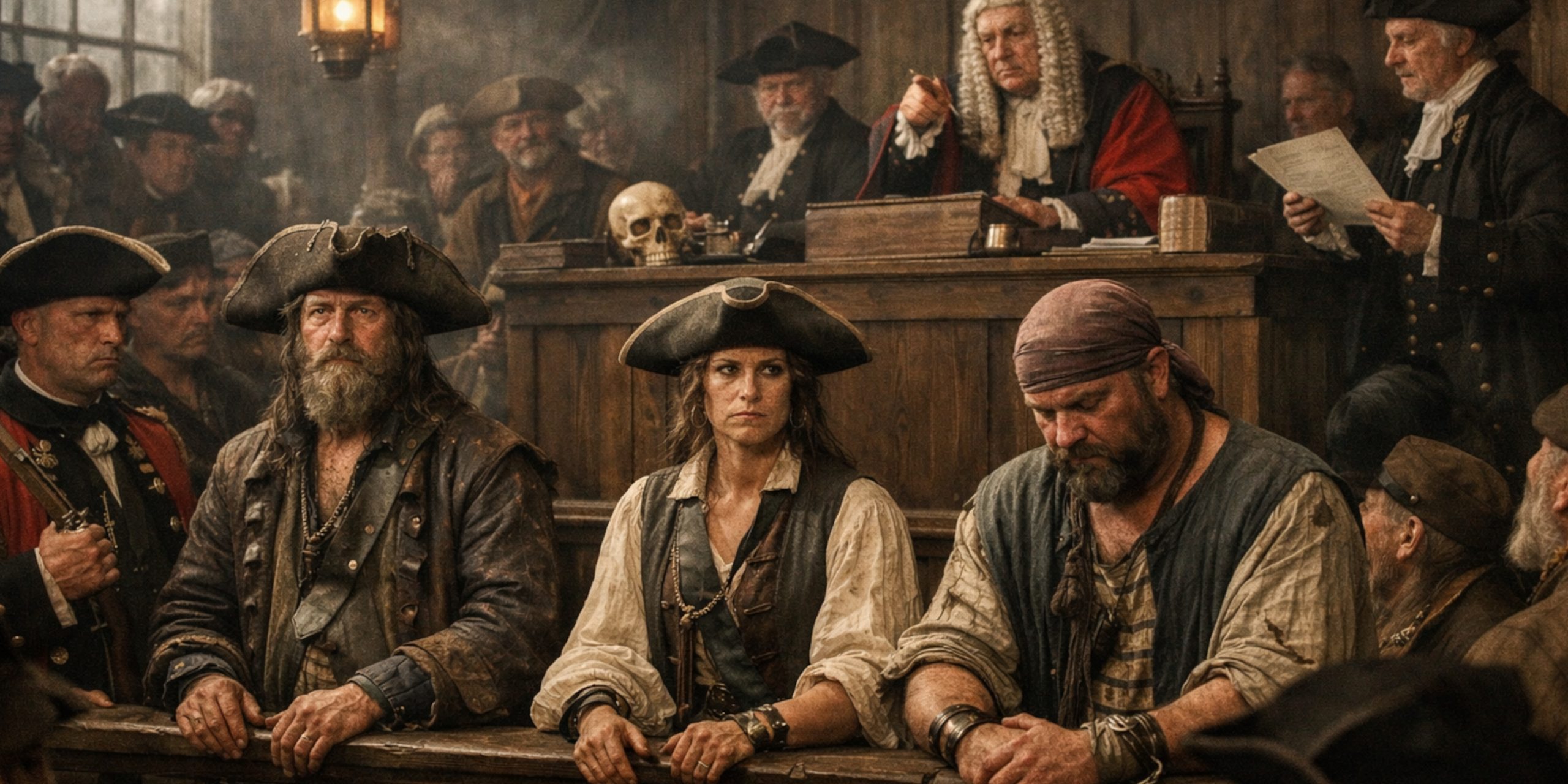
Piracy has always been theatrical. The raids, the flags, the exaggerated reputations. Yet the true drama often arrived later, in cramped courtrooms that smelt of damp wool and ink, where men who had ruled the sea found themselves arguing over technicalities before judges who had never set foot on a rolling deck.
Pirate trials were rarely fair by modern standards. They were swift, political, and at times little more than a formality before the rope. Still, they left behind records, testimony, and the occasional flash of dark wit that tells us far more about the age than any treasure map ever could.
The Trial of Captain William Kidd
Few pirate trials carry quite the same mix of embarrassment and intrigue as that of William Kidd. Kidd began as a respectable privateer, commissioned to hunt pirates. It did not take long for that mission to unravel.
By the time he returned to England in chains, the political winds had shifted. His powerful backers were suddenly less interested in defending him.
Kidd’s trial at the Old Bailey in 1701 was brisk, almost uncomfortably so. Crucial evidence, including exculpatory documents, was not presented in his favour. He protested with a tone that suggests both desperation and disbelief.
“I am the innocentest person of them all.”
It did not help. Kidd was found guilty of piracy and murder. His execution was botched, the rope snapping on the first attempt, which must have felt like a cruel rehearsal. The second try held. His body was later gibbeted along the Thames, a warning to others and, perhaps, a rather grim piece of public decor.
The Trial of Stede Bonnet, The Gentleman Pirate
Stede Bonnet remains one of the more baffling figures in piracy. A landowner of comfortable means, he abandoned his estate for a life at sea, which he pursued with limited competence and considerable enthusiasm.
Captured in 1718, Bonnet faced trial in Charleston. Unlike many of his contemporaries, he attempted to argue his case with a certain civility, as though the court might appreciate his manners.
It did not.
Bonnet tried to distance himself from the more violent acts committed under his command, though the court was unimpressed by any suggestion that a captain could be selectively responsible.
“I am sorry for what I have done.”
A polite regret, delivered too late. He was sentenced to death and hanged shortly after. One suspects the court found his story less romantic than later generations would.
The Trials of Blackbeard’s Crew
After the death of Edward Teach in 1718, his surviving crew were rounded up and brought to trial in Williamsburg, Virginia.
These proceedings offer a rare window into pirate life, largely because many of the accused were quite willing to talk. Some attempted to portray themselves as reluctant participants, pressed into service under threat.
The court, understandably, had heard this before.
“They compelled me to go with them.”
The phrase appears in several depositions, a curious chorus of reluctant villains. It did little to sway the outcome. Most were convicted and hanged.
The trials also reveal something quieter. Piracy was not always a brotherhood of equals. Coercion, fear, and opportunism sat alongside the more familiar tales of freedom and plunder.
The Trial of Anne Bonny and Mary Read
The trial of Anne Bonny and Mary Read in 1720 stands apart, if only because it unsettled expectations at every turn.
Captured alongside the crew of Calico Jack Rackham, both women were tried in Jamaica. Their conduct during the trial was reportedly composed, almost defiant.
When sentenced, they delivered a plea that was as practical as it was effective. They claimed to be pregnant, a legal argument known as “pleading the belly”, which delayed execution.
“We plead our bellies.”
It worked, at least for a time. Mary Read died in prison, likely of fever. Anne Bonny’s fate is less certain. Some accounts suggest she was released, which feels almost merciful by the standards of the age.
The Trial of Charles I of England for Piracy Support
This one sits slightly awkwardly in the category, but it deserves mention. During the trial of Charles I of England, accusations were raised that he had tolerated or even encouraged piracy through lax enforcement and questionable commissions.
While not a pirate trial in the strict sense, it reflects how seriously maritime law was taken. Control of the seas was not merely economic. It was moral, political, and occasionally personal.
“A king cannot be tried by any superior jurisdiction on earth.”
Charles’ objection was noted, then ignored. He was executed in 1649, though for reasons rather broader than piracy alone.
The Trial of Bartholomew Roberts’ Crew
After the death of Bartholomew Roberts in 1722, his crew faced one of the largest pirate trials in history, held at Cape Coast Castle.
The scale is striking. Over 150 men were tried. The outcomes varied, though many met the same end.
Some were acquitted, particularly those who could convincingly argue they had been forced into service. Others were transported. A large number were hanged.
One remark, recorded during the proceedings, carries a blunt honesty.
“A merry life and a short one shall be my motto.”
It reads less like a defence and more like a summary.
The Machinery of Pirate Justice
Pirate trials were shaped by the Admiralty law, which allowed for proceedings without a jury in many cases. This alone tells you something about how seriously the authorities wished to avoid acquittals.
Evidence could be thin. Witnesses were often fellow sailors with their own reasons for cooperation. The outcome, more often than not, was predictable.
Punishments were public and deliberate. Hanging at Execution Dock in London, or its colonial equivalents, was designed to send a message that could be understood from a distance.
The message was simple. The sea might feel lawless, but the shore would not be.
Making the theatre grim
What strikes me most about these trials is not their severity, though that is undeniable. It is the way they strip away the myth.
Pirates, in court, become ordinary. They argue, deflect, apologise, and occasionally attempt humour that lands rather poorly. Their legends shrink to the size of a witness statement.
And yet, even in defeat, a few lines endure. A protest, a motto, a plea. Small fragments of voice, carried forward long after the rope has done its work.
History is rarely tidy. Pirate trials are a fine example of that.