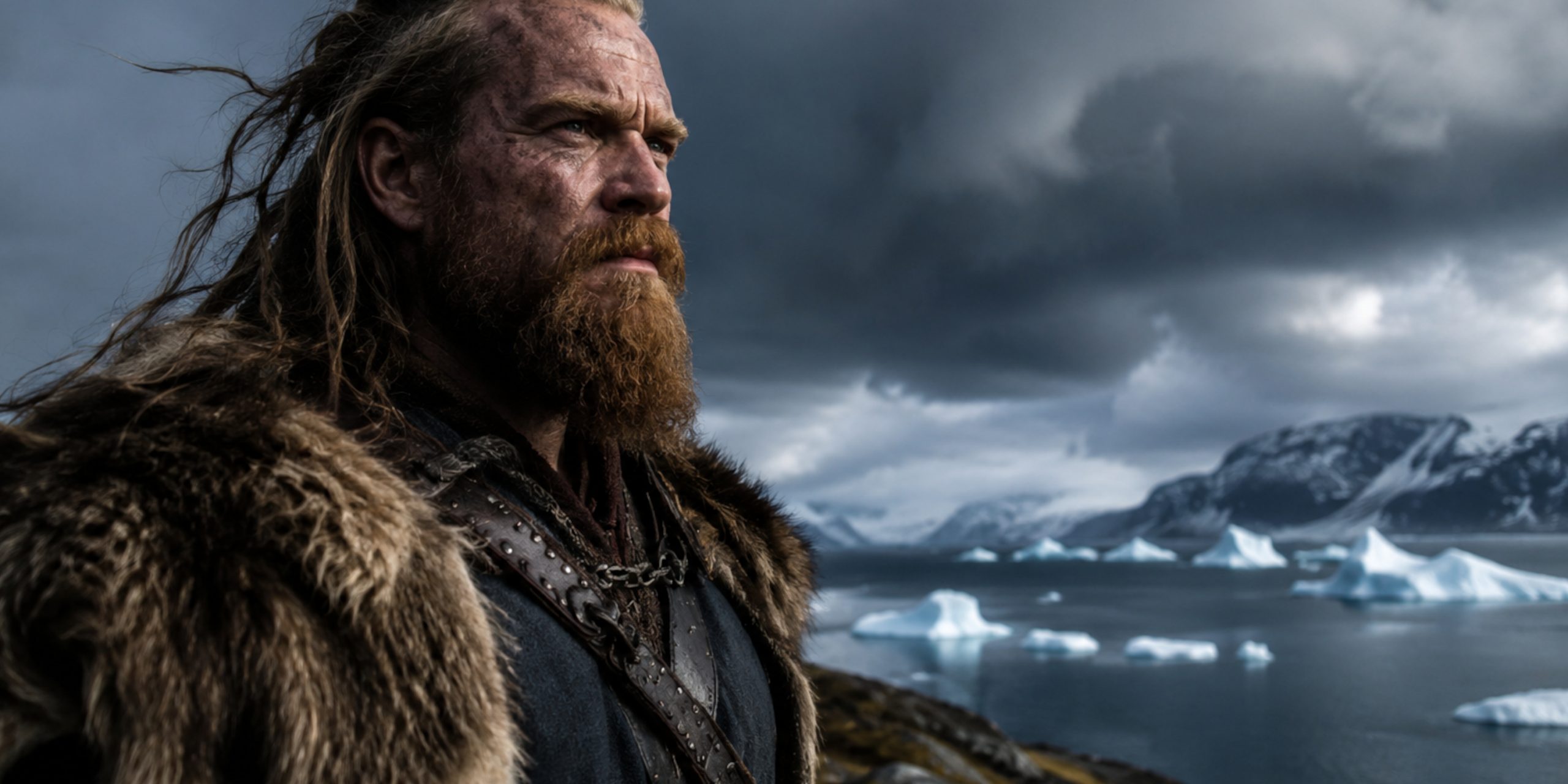
Erik the Red is a fascinating figure because he sits at the point where history and legend overlap. The Icelandic sagas present him as larger than life, while archaeology quietly confirms that his greatest achievement was very real. He did not simply discover Greenland. He built a colony that survived for centuries in one of the most unforgiving landscapes on Earth. That alone deserves admiration, even if his temper suggests he was not the easiest neighbour.
Quick Facts
| Fact | Details |
|---|---|
| Full Name | Erik Thorvaldsson (Eiríkr Þorvaldsson) |
| Better Known As | Erik the Red (Eiríkr inn rauði) |
| Born | c. 950 |
| Died | c. 1003 |
| Birthplace | Rogaland, Norway (traditionally accepted) |
| Father | Thorvald Asvaldsson |
| Wife | Þjóðhildr Jörundsdóttir |
| Children | Leif Erikson, Thorvald, Thorstein and Freydís (according to the sagas) |
| Known For | Founding the first Norse settlements in Greenland |
| Residence | Brattahlíð, Greenland |
Who Was Erik the Red?
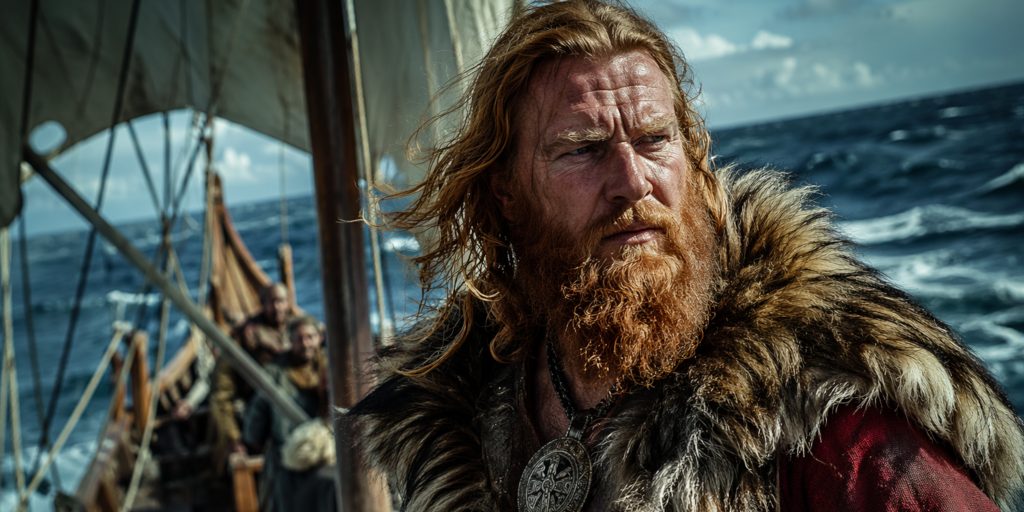
Few Viking names have travelled as far through history as Erik the Red. Explorer, exile, settler and occasional killer, Erik was responsible for establishing the first permanent European communities in Greenland during the late tenth century.
His story survives largely through the Icelandic sagas, particularly the Saga of Erik the Red and the Saga of the Greenlanders. Like all medieval sagas, they blend historical memory with literary embellishment, meaning historians must separate colourful storytelling from credible evidence.
What remains beyond reasonable doubt is that Erik successfully led hundreds of settlers across the North Atlantic and established a colony that endured for almost five centuries. That is an extraordinary achievement by any standard.
Early Life and Family
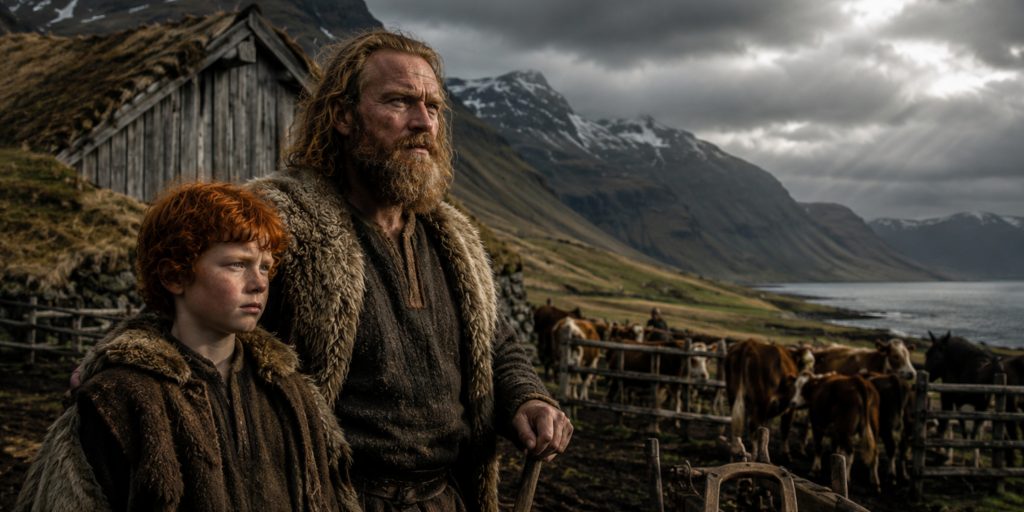
Erik was born around 950, probably in southwestern Norway.
His father, Thorvald Asvaldsson, was convicted of manslaughter and exiled from Norway. The family sailed west to Iceland, then a relatively new Norse settlement where ambitious families could begin again.
Unfortunately, exile appears to have become something of a family tradition.
Erik grew into a capable farmer and respected leader, yet he also inherited a remarkably short fuse. Contemporary Icelandic law offered plenty of opportunities to resolve disputes peacefully. Erik had a noticeable tendency to choose the less peaceful option.
The Icelandic Exile
Life in Iceland eventually unravelled after disputes with neighbours over property and household equipment escalated into violence.
Several men were killed during the conflict.
The Icelandic assembly declared Erik an outlaw and sentenced him to three years of exile around 982.
Rather than disappear quietly, Erik looked west toward rumours of land sighted decades earlier by the explorer Gunnbjörn Ulfsson.
It proved to be one of the most significant decisions in Viking history.
Discovering Greenland
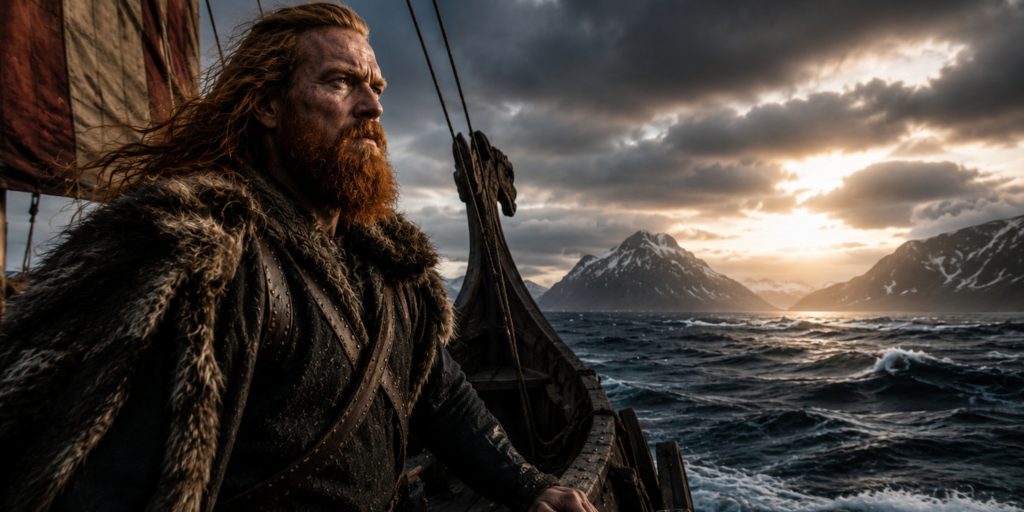
During his exile Erik explored Greenland’s vast southern coastline.
He mapped fjords, identified fertile valleys and searched for sheltered locations where livestock could survive harsh winters.
Although earlier sailors had glimpsed Greenland, none had attempted organised colonisation.
Erik recognised something others had overlooked. While much of Greenland was covered by ice, its southern coastal regions offered enough grazing land to support permanent farms.
His greatest discovery was not simply Greenland itself.
It was recognising that people could actually live there.
Why Was It Called Greenland?
Perhaps Erik’s cleverest decision had nothing to do with navigation.
When he returned to Iceland after completing his exile, he deliberately named the new territory Greenland.
According to the sagas, he believed that “people would be more attracted to go there if the land had a favourable name.”
Modern estate agents would probably approve.
The name worked remarkably well.
Despite the obvious shortage of tropical beaches, settlers signed up.
Founding the Greenland Colonies
In 985 Erik organised an expedition of approximately twenty-five ships carrying families, livestock and supplies.
The Atlantic quickly reminded everyone who was in charge.
Storms and sea ice scattered the fleet.
Only fourteen ships successfully reached Greenland.
Those survivors established two major communities.
| Settlement | Description |
|---|---|
| Eastern Settlement | Largest colony, centred on Brattahlíð |
| Western Settlement | Smaller farming community located further north |
Together these colonies eventually supported several thousand inhabitants through farming, hunting and trade.
Brattahlíð, Erik’s Home
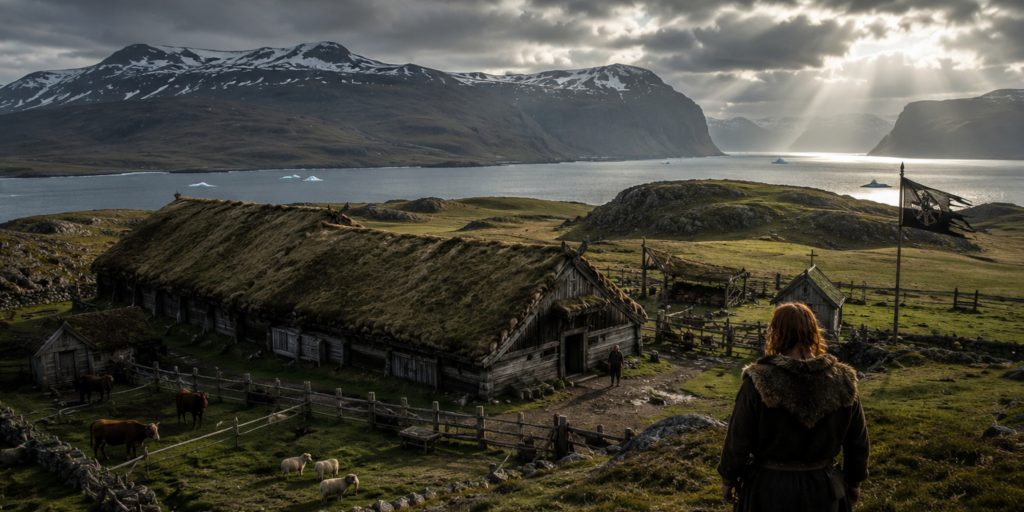
Erik established his own estate at Brattahlíð, near modern Qassiarsuk.
It became the political and economic centre of Norse Greenland.
The estate included:
- Large turf-built longhouses
- Barns and livestock shelters
- Workshops
- Boat landings
- Storage buildings
- Agricultural fields
Later, Erik’s wife Þjóðhildr converted to Christianity and commissioned one of Greenland’s earliest churches.
The surviving archaeological remains closely match many details described in the sagas.
Leadership Rather Than Conquest
Unlike many famous Viking leaders, Erik is not remembered for great battlefield victories.
His greatest skill was leadership.
He persuaded families to abandon comfortable lives in Iceland for an unknown land thousands of kilometres away.
Once there, he organised farming, divided land, managed disputes and maintained connections with Iceland and Norway through trade.
Keeping a remote colony alive for generations required patience, planning and resilience.
Those qualities rarely receive the same attention as swinging an axe, but they mattered far more.
Arms and Armour
No weapon can be confidently identified as belonging to Erik himself.
Nevertheless, he almost certainly carried equipment typical of wealthy Norse chieftains.
| Equipment | Description |
|---|---|
| Sword | Double-edged iron blade with pattern-welded or steel edge construction, often featuring a Petersen Type H or Type S hilt |
| Axe | Broad-bearded or fighting axe suitable for combat and practical work |
| Spear | Leaf-shaped spearhead designed for thrusting or throwing |
| Seax | Utility knife used daily and in emergencies |
| Shield | Round wooden shield with iron boss, approximately 80 to 90 cm across |
| Helmet | Simple iron helmet, probably conical with a nasal guard if owned |
| Armour | Mail hauberk for wealthy warriors, though many settlers relied on padded clothing or leather |
Weapons in Greenland were as much survival tools as instruments of war. Hunting seals, polar bears and caribou demanded reliable equipment.
Viking Ships and Navigation
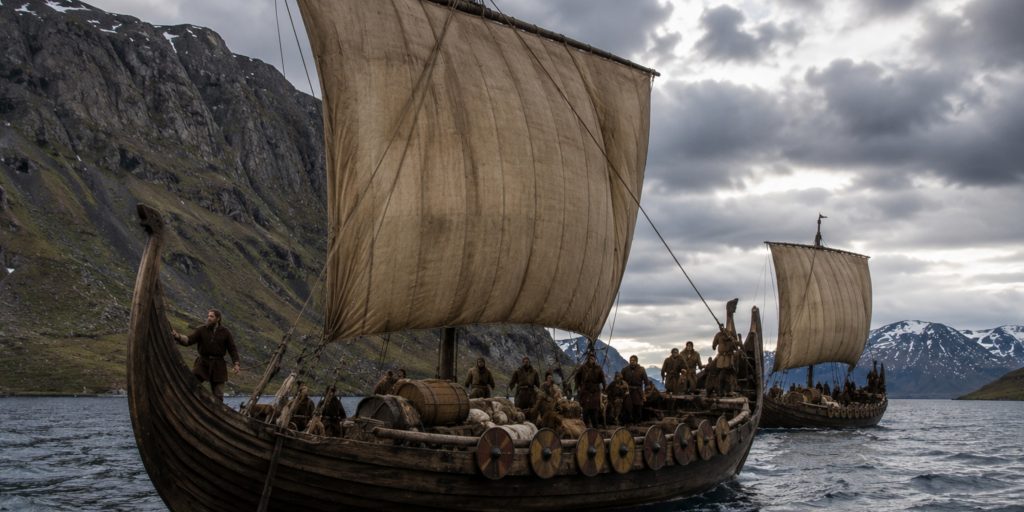
Erik’s expedition relied on ocean-going knarr merchant vessels rather than sleek longships.
These broader ships carried:
- Livestock
- Timber
- Iron tools
- Grain
- Families
- Household possessions
Navigation depended upon:
- Coastal landmarks
- Sun position
- Stars
- Wind direction
- Sea birds
- Whale migrations
- Experience passed through generations
Crossing the North Atlantic without maps or compasses remains one of the greatest maritime achievements of the medieval world.
Archaeological Evidence
Modern archaeology has transformed our understanding of Erik’s Greenland.
Brattahlíð (Qassiarsuk)
Excavations have uncovered:
- Turf longhouses
- Stone foundations
- Farm buildings
- Livestock enclosures
- Smithing evidence
- Early church remains
Herjolfsnes (Ikigait)
This remarkable site has produced:
- Exceptionally preserved medieval clothing
- Church ruins
- Burials
- Imported European goods
- Mineral-dyed textiles
These discoveries reveal a sophisticated farming society connected to medieval Europe through trade rather than an isolated frontier settlement.
Leif Erikson and the Family Legacy
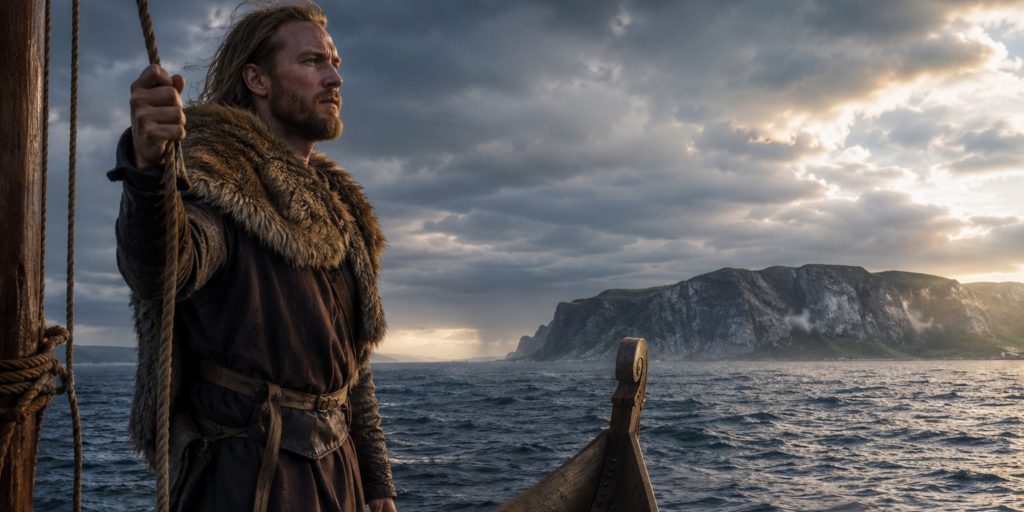
Erik’s greatest legacy may not have been Greenland.
His son, Leif Erikson, sailed even further west, reaching North America around the year 1000.
Excavations at L’Anse aux Meadows in Newfoundland have confirmed that Norse explorers established a temporary settlement there.
Ironically, Erik himself never joined the expedition.
According to the sagas, he intended to sail but was thrown from his horse on the way to the ship.
He interpreted the accident as a bad omen and stayed behind.
History occasionally turns on surprisingly awkward moments.
Contemporary Sources
Most information about Erik comes from medieval Icelandic literature.
The principal written sources include:
- The Saga of Erik the Red
- The Saga of the Greenlanders
- Landnámabók (The Book of Settlements)
These texts were written around two centuries after Erik lived.
Although they cannot be accepted uncritically, archaeology has confirmed many of their geographical descriptions and settlement details.
Myth Versus Reality
| Myth | Historical Reality |
|---|---|
| Erik discovered Greenland | Earlier Norse sailors had already sighted it |
| Greenland was lush and green | Only the southern coastal regions were suitable for farming |
| Erik conquered Greenland | He colonised rather than conquered an inhabited kingdom |
| Vikings only raided | Erik’s career demonstrates that colonisation and farming were equally important aspects of Viking expansion |
Where to See Erik the Red’s Legacy
Visitors interested in Erik’s world should consider:
- Qassiarsuk, Greenland, reconstructed Brattahlíð longhouse and church
- Eiríksstaðir, Iceland, reconstructed family farm and interpretation centre
- National Museum of Denmark, Copenhagen, containing finds from Norse Greenland
- Greenland National Museum, Nuuk, housing artefacts recovered from Norse settlements
Legacy
Erik the Red transformed an isolated coastline into Europe’s western frontier.
The Greenland colonies endured for nearly five hundred years before disappearing during the fifteenth century through a combination of climate change, economic decline and isolation.
His descendants extended Norse exploration into North America and permanently altered the geographical horizons of medieval Europe.
Archaeology continues to strengthen his reputation. Every excavation at Brattahlíð reinforces the picture of a determined leader who succeeded where many others would have failed.
He was undoubtedly violent, occasionally ruthless and probably difficult company after an argument. Yet he also possessed remarkable vision. Few people look at a frozen coastline and think, “Yes, this seems like an excellent place to raise cattle.”
Against all odds, Erik the Red proved that it could be done.
Timeline
| Year | Event |
|---|---|
| c. 950 | Born in Norway |
| c. 960s | Family exiled to Iceland |
| c. 982 | Erik declared outlaw and exiled from Iceland |
| 982 to 985 | Explores Greenland |
| 985 | Leads colonising expedition to Greenland |
| c. 1000 | Leif Erikson sails west to Vinland |
| c. 1003 | Death of Erik the Red |
Frequently Asked Questions
Was Erik the Red a real person?
Yes. Although many details of his life come from later Icelandic sagas, archaeological evidence strongly supports the existence of the Greenland settlements he founded.
Why was Erik called “the Red”?
Most historians believe the nickname referred to his distinctive red hair and beard, although his fiery temperament may also have contributed.
Did Erik discover America?
No. His son Leif Erikson is credited with leading the Norse voyage to North America.
Did Erik discover Greenland?
Not exactly. Earlier Norse sailors had already sighted Greenland, but Erik was the first to organise successful permanent settlements.
Why is Erik the Red important?
He established the first enduring European colonies in Greenland and laid the foundations for Norse exploration across the North Atlantic. His achievements helped shape one of the greatest chapters in Viking expansion.