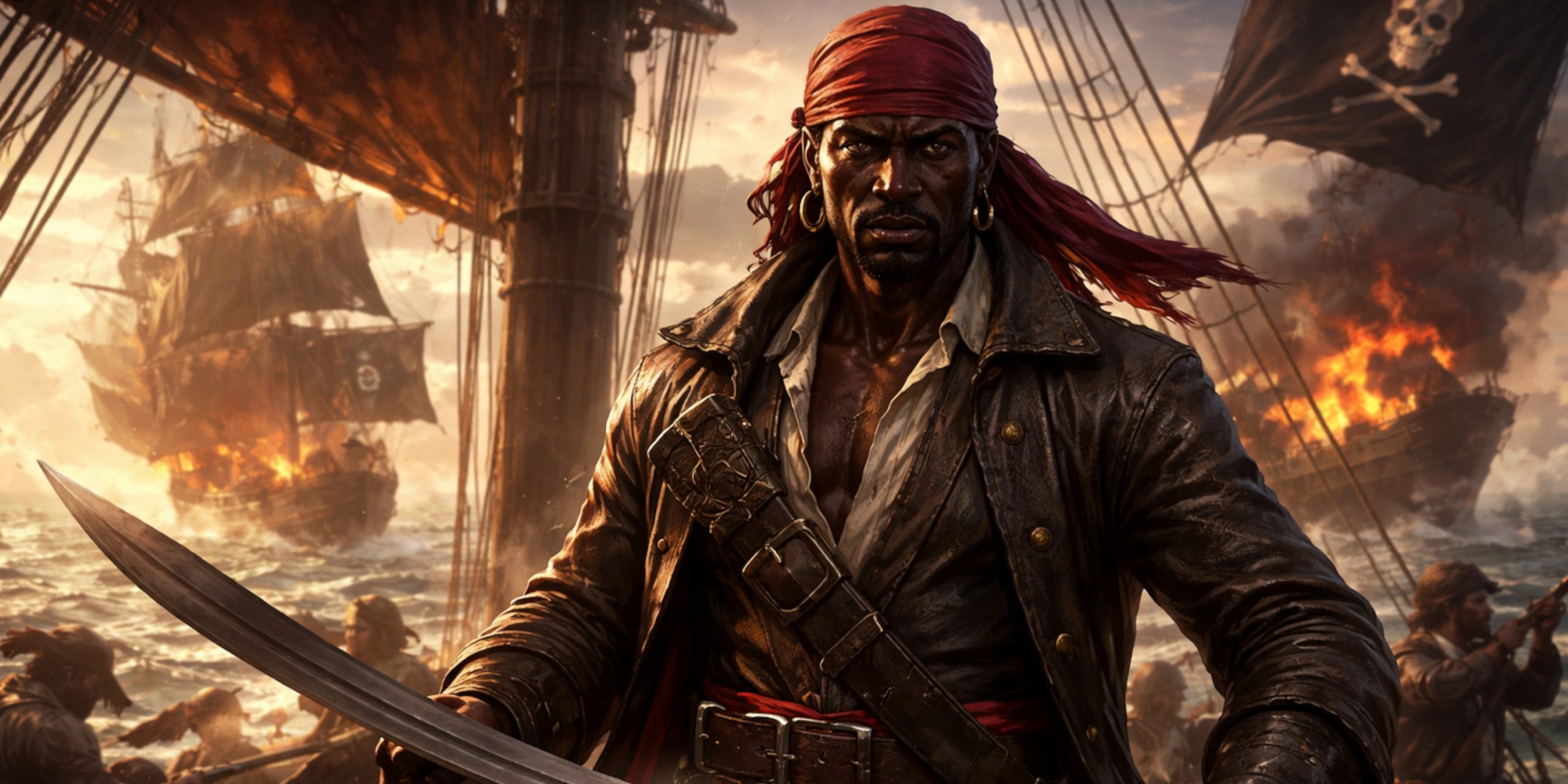
Black Caesar is one of those pirate figures who sits between fact and legend, rather like a man trying to balance on a barrel of gunpowder after too much rum. He appears in accounts of the Golden Age of Piracy, is linked to Blackbeard himself, and supposedly buried treasure in the Florida Keys. Yet much of his story was written down long after his death, by people who rather enjoyed making pirates larger than life.
Still, behind the rumours of hidden silver, kidnapped prisoners and buried treasure there was almost certainly a real man. He was an African sailor or captive who became a pirate, fought alongside Blackbeard, and met a grim end in 1718. That alone would have been remarkable enough.
Who Was Black Caesar?
Black Caesar was a pirate active in the early eighteenth century, during the height of Atlantic piracy. Most surviving accounts place his origins in West Africa. Later stories claim he was a chief or local ruler before being captured by slave traders.
Whether he was truly a chief is impossible to prove. Pirate biographies from the period had an unfortunate habit of turning every successful pirate into either a fallen nobleman or an escaped genius with shoulders like an ox and the mind of a chess master.
What seems more likely is that Black Caesar was captured and enslaved before escaping somewhere near the coast of Florida. By the 1710s he was operating in the Florida Keys, and by 1718 he had joined the crew of Blackbeard.
Early Life and Escape
According to the traditional account, Black Caesar was lured aboard a slave ship after being shown luxury goods, jewellery and a watch. Once on board, he and his companions were trapped and carried away.
Several versions of the story claim that a hurricane struck the slave ship near Florida. During the confusion, Caesar escaped with the help of a sympathetic sailor. The pair seized a small boat, along with food, weapons and ammunition, and somehow managed to survive while the rest of the ship was lost.
If true, it was a dramatic beginning to a pirate career. It was also a deeply bitter one. Black Caesar’s piracy seems to have grown directly from the violence and betrayal of the slave trade itself.
Black Caesar in the Florida Keys
For several years Black Caesar supposedly operated from the Florida Keys, especially around Elliott Key and Caesar Creek.
His favourite trick was simple and rather nasty. He and his companion would pose as shipwrecked sailors in distress. When a passing vessel came close enough to offer help, they produced pistols and muskets and relieved their rescuers of money, food and supplies.
Later stories claim that Caesar gathered a larger crew and turned from small robberies into full piracy.
Base of Operations
- Elliott Key
- Caesar Creek
- Old Rhodes Key
- Mangrove inlets along the Florida coast
The waters around the Keys were perfect for piracy. They were shallow, full of hidden channels, reefs and narrow creeks. A large naval ship could not easily pursue a small sloop through them. Local geography did more for Black Caesar than any fortification.
Ships Used by Black Caesar
Black Caesar does not appear to have commanded a great pirate frigate in the style of Blackbeard. Most accounts suggest he preferred smaller, faster craft.
| Ship Type | Likely Use |
|---|---|
| Longboat | Used during his original escape and early robberies |
| Sloop | Fast raiding vessel ideal for shallow coastal waters |
| Captured merchant craft | Occasionally used after seizing a prize |
When he later joined Blackbeard, he served aboard the famous Queen Anne’s Revenge.
| Ship | Details |
| Queen Anne’s Revenge | Blackbeard’s flagship, formerly a French slave ship |
| Armament | Around 40 guns |
| Role of Black Caesar | Trusted crewman and possibly lieutenant |
There is a certain grim irony in the fact that Caesar eventually served aboard a former slave ship that had been turned into a pirate vessel. The Atlantic world had an unpleasant talent for reusing its cruelties.
Weapons
Black Caesar probably used the same weapons favoured by most pirates of the period.
Common Weapons Associated with Black Caesar
- Flintlock pistols
- Cutlasses
- Boarding axes
- Daggers
- Muskets
- Powder grenades
| Weapon | Why Pirates Favoured It |
| Cutlass | Short, heavy and ideal for fighting aboard crowded decks |
| Flintlock pistol | Powerful at close range, though rarely accurate beyond a few yards |
| Boarding axe | Useful for both combat and hacking through doors or rigging |
| Musket | Better suited to intimidation and longer-range fighting |
Some accounts from Blackbeard’s final battle suggest Caesar was placed in the powder room with a lit match, ready to blow up the ship rather than surrender. That job required nerve, loyalty and perhaps a slight disregard for one’s own continued existence.
Treasure and Hidden Wealth
Black Caesar is often associated with buried treasure. According to local legends, he hid silver bars, gold and valuables on Elliott Key.
One story claims he buried twenty-six silver bars. Another says he accumulated a vast fortune from robbed merchant ships.
Reported Treasure Locations
- Elliott Key
- Caesar’s Rock
- Caesar Creek
- Nearby islands in Biscayne Bay
No confirmed treasure has ever been found.
This is perhaps unsurprising. Pirate treasure stories have a habit of growing larger every time they are retold. If every pirate who supposedly buried treasure had actually done so, half of Florida would now resemble a badly organised excavation site.
Black Caesar and Blackbeard
By 1718 Black Caesar had joined the crew of the notorious pirate Edward Teach, better known as Blackbeard.
He served aboard the Queen Anne’s Revenge and may have been one of Blackbeard’s most trusted men. Some later writers even describe him as Blackbeard’s lieutenant.
Black Caesar was present during Blackbeard’s last battle at Ocracoke Inlet in November 1718.
The Battle of Ocracoke
In November 1718 Lieutenant Robert Maynard of the Royal Navy cornered Blackbeard and his men off the coast of North Carolina.
Forces
| Side | Strength |
| Blackbeard and crew | Roughly 20 to 25 pirates |
| Maynard’s force | Around 60 sailors and marines |
Black Caesar’s Role
According to later accounts, Blackbeard ordered Caesar to remain below deck with a slow match beside the powder magazine. If the pirates were overwhelmed, Caesar was to ignite the powder and destroy the ship.
He reportedly came very close to doing so before being stopped by captured sailors.
That is one of the few moments in his story that feels entirely believable. It has the bleak, practical logic of the pirate world. Better to vanish in smoke than dangle from a rope in Virginia.
Contemporary Quotes
Very few contemporary descriptions of Black Caesar survive. Most of what we know comes from later retellings.
The 1724 book A General History of the Pyrates refers to one of Blackbeard’s Black crewmen as:
“a Negro, whom he had bred up”
The same account describes the man being prepared to blow up the ship rather than surrender.
Later descriptions of Black Caesar portray him as:
“a very large and very cunning man”
Another account from Florida folklore remembered him as:
“huge in size, immense in strength and keen in intelligence”
These descriptions may be exaggerated, though pirates were rather like fish caught by enthusiastic fishermen. Every retelling made them bigger.
Bounty and Reputation
There is no surviving evidence for a formal government bounty placed specifically on Black Caesar himself.
However, as a member of Blackbeard’s crew in 1718, he would have fallen under the large rewards offered for the capture or killing of Blackbeard and his associates.
| Pirate | Approximate Reward in 1718 |
| Blackbeard | £100 |
| Senior members of crew | Smaller but significant rewards |
For context, £100 in 1718 represented several years of wages for an ordinary labourer. It was enough to encourage betrayal, enthusiastic hunting and an unfortunate number of people suddenly becoming amateur pirate experts.
Capture and Fate
After Blackbeard’s death, Black Caesar was captured by colonial authorities.
His ultimate fate is uncertain.
The traditional version states that he was taken to Williamsburg, Virginia, tried for piracy and hanged in 1718.
A more recent interpretation suggests he may actually have been acquitted and returned to slavery or servitude instead.
Neither outcome is particularly cheerful.
Possible Endings
- Executed at Williamsburg in 1718
- Acquitted but returned to forced labour
- Survived under another identity
Most historians still favour the first explanation, that Black Caesar was hanged shortly after Blackbeard’s defeat.
How Much of the Story Is True?
Black Caesar almost certainly existed. There are contemporary records proving that a Black pirate named Caesar served with Blackbeard in 1718.
The more colourful stories are far harder to prove:
- African chieftain origins
- Treasure buried on Elliott Key
- A prison camp and kidnapped women
- Years of piracy in the Florida Keys
Many of these details first appeared decades after his death and may have been shaped by novels, plays and local folklore.
The likely truth sits somewhere in the middle. Black Caesar was a real pirate, a formerly enslaved man who found power in a violent world and briefly stood beside the most famous pirate in history.
That alone is enough to make him memorable.
Legacy
Black Caesar remains one of the best-known Black pirates of the Golden Age.
He has appeared in documentaries, novels and pirate folklore. His name survives in the Florida Keys at Caesar Creek and Caesar’s Rock.
More importantly, his story reminds us that piracy was not only a world of rum, treasure maps and men shouting dramatically from rigging. It was also tied to slavery, colonial violence and desperate people trying to survive by any means they could.
Black Caesar’s life was brutal, uncertain and probably much shorter than he deserved. Yet he left behind a legend that has lasted more than three centuries.