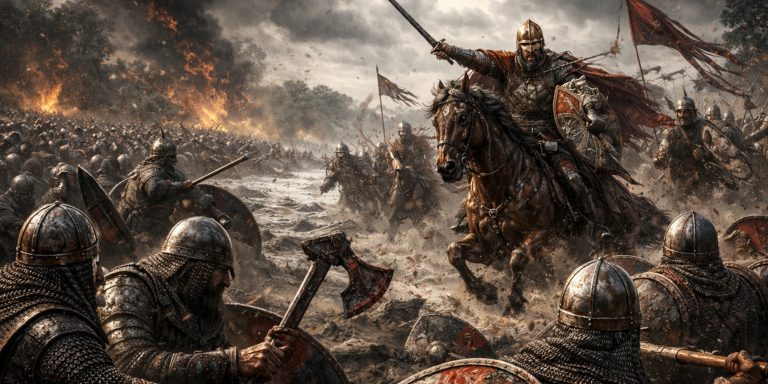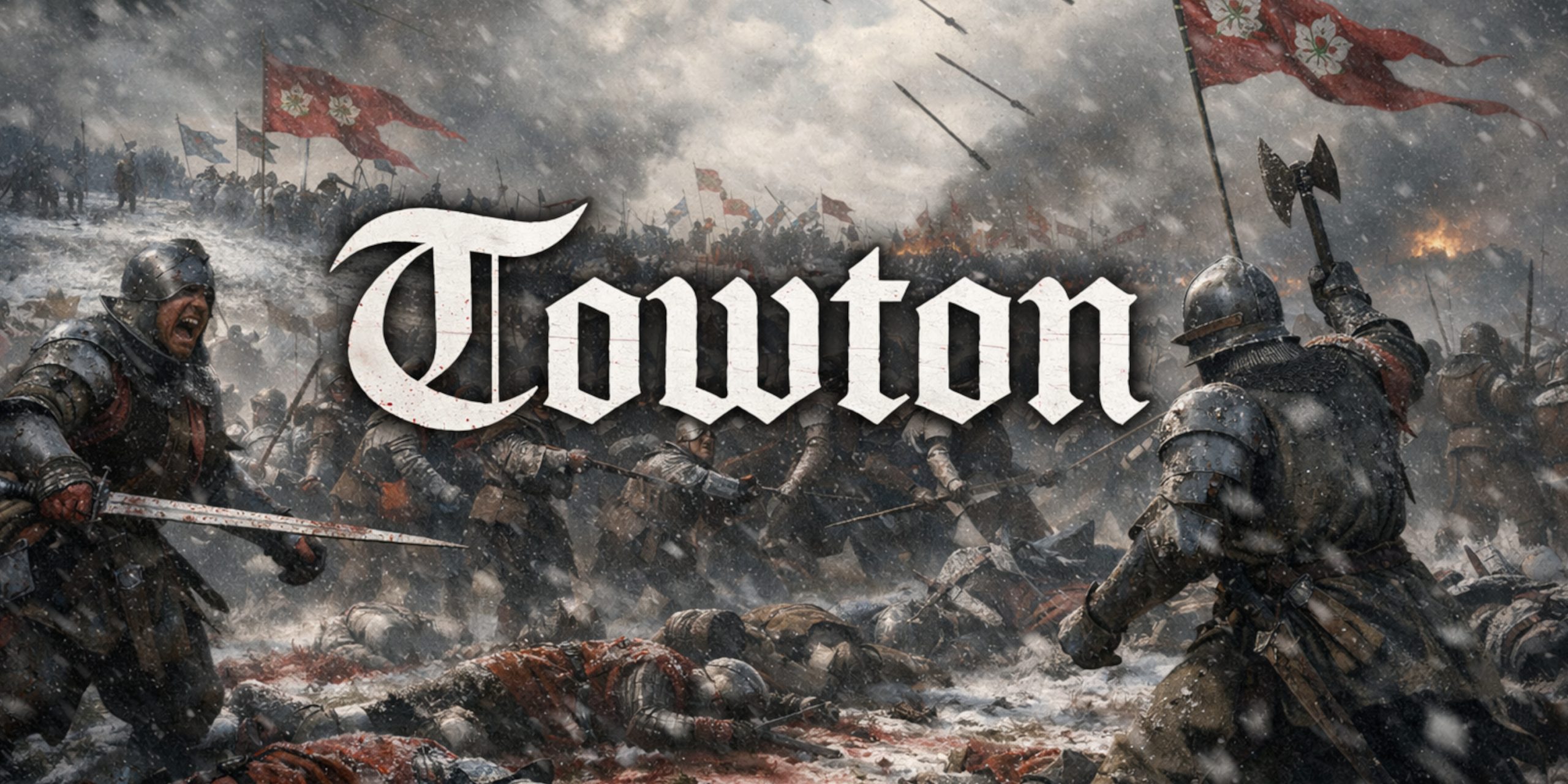
Few battles in English history carry the same grim reputation as the Battle of Towton, fought on Palm Sunday in March 1461. Chroniclers struggled to describe the scale of the slaughter. Modern historians still debate the numbers, yet the consensus remains clear. Towton was the most violent battle ever fought on English soil.
Two rival kings claimed the throne. The House of York, led by the young and newly proclaimed Edward IV, faced the forces of Henry VI and the House of Lancaster. Snow fell across the Yorkshire countryside, the wind howled directly into the Lancastrian line, and tens of thousands of men marched into a fight that lasted most of the day.
By nightfall, the fields and lanes around Towton and Saxton were covered with bodies.
It was not a battle so much as a prolonged and brutal collapse of an army.
Background to the Battle
The Wars of the Roses had already been raging for several years before Towton. The conflict revolved around rival branches of the Plantagenet dynasty claiming the English throne.
The Yorkist leader Richard, Duke of York had been killed the previous winter at the Battle of Wakefield. His head was famously displayed on Micklegate Bar in York with a paper crown. The Lancastrians expected the Yorkist cause to collapse.
Instead, York’s eldest son stepped forward.
Edward, Earl of March, was only nineteen years old but already a capable commander. In February 1461 he defeated a Lancastrian army at the Battle of Mortimer’s Cross, strengthening his claim to leadership.
Meanwhile another Yorkist army under Richard Neville, Earl of Warwick attempted to block the Lancastrians at the Second Battle of St Albans. Warwick was defeated, leaving the road to London open.
The Lancastrians entered the capital but discipline quickly collapsed. Looting and disorder frightened the city authorities, who soon swung their support toward Edward. He was proclaimed King Edward IV in early March.
There was only one way to settle the matter.
Both sides marched north.
Location and Battlefield
The battle took place near the village of Towton in North Yorkshire, between the settlements of Saxton and Towton. The ground forms a broad plateau that drops sharply into a deep ravine carved by Cock Beck.
Several factors shaped the battle:
• Open farmland exposed to winter winds
• A narrow crossing point over Cock Beck
• Muddy fields and melting snow
• Limited routes for retreat
The geography would prove disastrous for the defeated army.
Forces at Towton
Towton brought together the largest armies ever assembled during the Wars of the Roses. Medieval chroniclers often exaggerated numbers, yet modern estimates still place the combined forces between 50,000 and 80,000 men.
Yorkist Army

| Commander | Role | Estimated Troops |
|---|---|---|
| Edward IV | King and overall commander | Core Yorkist host |
| Richard Neville, Earl of Warwick | Senior commander | Reinforcements from the south |
| John Mowbray, Duke of Norfolk | Late arriving flank force | Several thousand |
Estimated strength: 35,000 to 42,000
Lancastrian Army

| Commander | Role | Estimated Troops |
|---|---|---|
| Henry Beaufort, Duke of Somerset | Field commander | Main Lancastrian army |
| Henry Percy, Earl of Northumberland | Northern magnate | Regional levies |
| Lord Clifford and Lord Roos | Senior nobles | Supporting contingents |
Estimated strength: 30,000 to 38,000
Both armies consisted largely of feudal levies supported by professional retinues of knights, men at arms, and experienced archers.
Arms and Armour
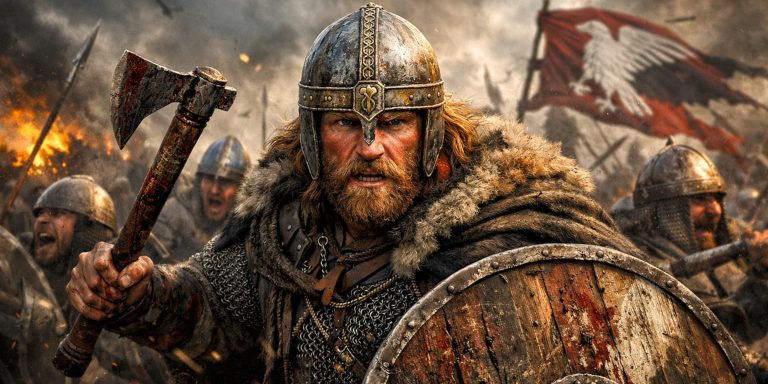
Despite the dynastic nature of the conflict, equipment on both sides was broadly similar. English warfare during the mid fifteenth century relied heavily on disciplined archers supported by heavily armoured infantry.
Common Weapons
• Longbow
The dominant missile weapon of the battle. English and Welsh archers could fire rapidly and accurately even in harsh weather.
• Poleaxe
A favoured weapon of armoured knights. Designed to crush, pierce, and hook opponents in close combat.
• Bills and halberds
Polearms carried by infantry levies. Their hooked blades were useful for pulling riders from horseback.
• War hammers and maces
Effective against plate armour.
Sword Types Present
Several sword forms typical of late medieval England would have been carried at Towton.
• Arming sword (Oakeshott Type XV and XVIII)
A single handed knightly sword suited to thrusting through armour gaps.
• Hand and a half sword (bastard sword)
Increasingly common among men at arms. Offered reach and power in melee.
• Falchion
A broad chopping blade used by infantry and some archers.
Armour
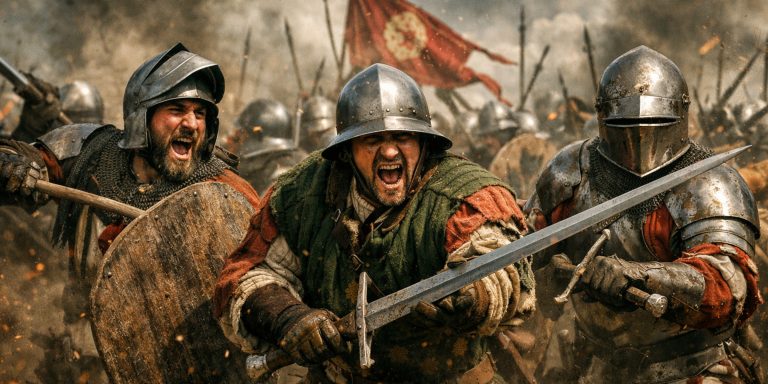
Typical equipment for men at arms included:
• Full plate harness or partial plate with brigandine
• Sallet or bascinet helmets
• Mail voiders protecting vulnerable joints
• Shields were increasingly rare among heavily armoured troops
Most infantry wore lighter protection such as padded jacks or brigandines.
Opening Phase of the Battle

Palm Sunday began with heavy snow falling across the battlefield. The wind blew strongly toward the Lancastrian line.
Edward IV ordered his archers forward.
Yorkist bowmen loosed volleys that travelled farther thanks to the wind at their backs. Lancastrian archers returned fire but their arrows fell short. Many of them landed harmlessly in the snow between the armies.
The Yorkists then stepped forward, collected the fallen arrows, and shot them back.
The Lancastrians suddenly realised they were losing the missile exchange.
Somerset ordered an advance.
The Main Engagement
Once the armies closed, the battle turned into a grinding struggle of infantry fighting in tight formations. Contemporary accounts describe hours of brutal hand to hand combat.
Edward IV fought in the front ranks alongside his men. Chroniclers noted his height and physical strength, qualities that helped inspire the Yorkist army.
At several moments the Yorkist line wavered.
The Lancastrians pressed forward steadily, pushing their enemies back toward the plateau edge. Had the battle ended there, Towton might have become a Lancastrian victory.
Then events shifted.
Arrival of the Duke of Norfolk
Late in the afternoon the long awaited Yorkist reinforcements finally appeared.
John Mowbray, Duke of Norfolk arrived with fresh troops and struck the Lancastrian flank. The effect was immediate. Somerset’s line, already exhausted from hours of fighting, began to buckle.
Once panic set in the situation deteriorated rapidly.
The Lancastrian army collapsed into retreat.
The Rout and the Massacre
Retreat at Towton quickly became catastrophe.
The main escape route led toward the narrow crossing of Cock Beck. Thousands of fleeing soldiers attempted to cross the stream at once. Some were cut down on the banks while others drowned in the freezing water.
Later tradition claimed the water ran red with blood.
Whether exaggerated or not, the death toll during the pursuit was enormous. Yorkist troops showed little mercy. Prisoners were rare.
By evening the Lancastrian army had effectively ceased to exist.
Battle Timeline
| Time | Event |
|---|---|
| Morning | Snowstorm covers the battlefield. Yorkist archers open the battle. |
| Late morning | Lancastrian army advances after ineffective arrow exchange. |
| Midday | Intense hand to hand combat across the plateau. |
| Afternoon | Lancastrians push the Yorkist line back. |
| Late afternoon | Duke of Norfolk arrives with reinforcements. |
| Evening | Lancastrian line collapses and rout begins. |
| Nightfall | Mass killings during pursuit toward Cock Beck. |
Archaeology and Physical Evidence
Towton is unusual among medieval battlefields because physical evidence has been discovered in significant quantities.
The most famous discoveries occurred in 1996, when construction workers uncovered a mass grave near Towton Hall.
The grave contained the remains of over forty men, many showing horrific injuries.
Forensic analysis revealed:
• Multiple sword and poleaxe wounds
• Blunt force trauma to the skull
• Injuries inflicted after helmets had been removed
• Evidence of repeated blows to already fallen victims
Some skulls showed several separate strikes, suggesting prolonged killing rather than quick battlefield deaths.
The findings confirmed what chroniclers had hinted at for centuries. The fighting and subsequent pursuit were exceptionally brutal.
Contemporary Accounts
Medieval writers struggled to describe the scale of the slaughter.
The Arrivall of Edward IV recorded the grim outcome:
“The greatest and most cruel battle ever fought within this realm.”
Another chronicler wrote:
“Many were slain, and many drowned in the water.”
A later tradition claimed that 28,000 men died, though modern historians treat that figure cautiously.
Even if the true number was smaller, Towton still ranks among the bloodiest battles of the medieval period.
Aftermath and Political Consequences
The victory secured the English throne for Edward IV.
Henry VI and Queen Margaret fled into exile in Scotland. Lancastrian resistance continued for several years but never again assembled an army comparable to the one destroyed at Towton.
For Edward, the battle established his reputation as a warrior king.
For the country, it marked the most violent moment of the Wars of the Roses.
And for the fields around Towton, it left a legacy that archaeology continues to uncover six centuries later.
Legacy of the Battle
Towton has become a symbol of how vicious civil wars can become. These were not foreign invaders or distant enemies.
They were Englishmen killing Englishmen on a freezing Sunday in March.
Standing on the battlefield today, the land appears quiet. Farms and hedgerows cover the old killing ground. It takes some effort to imagine what happened here.
Then one remembers the mass graves.
History rarely whispers louder than that.
Watch the documentary: