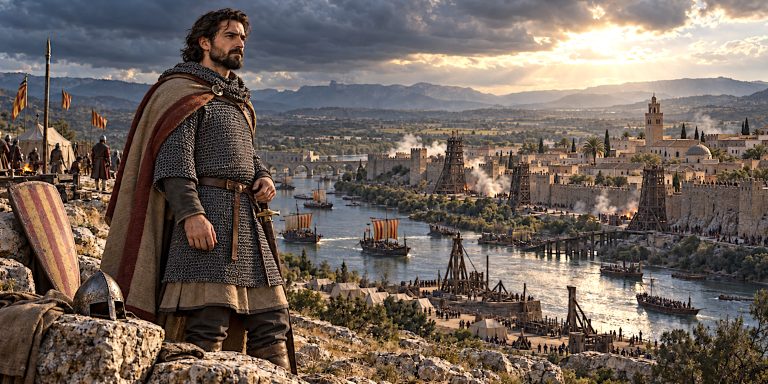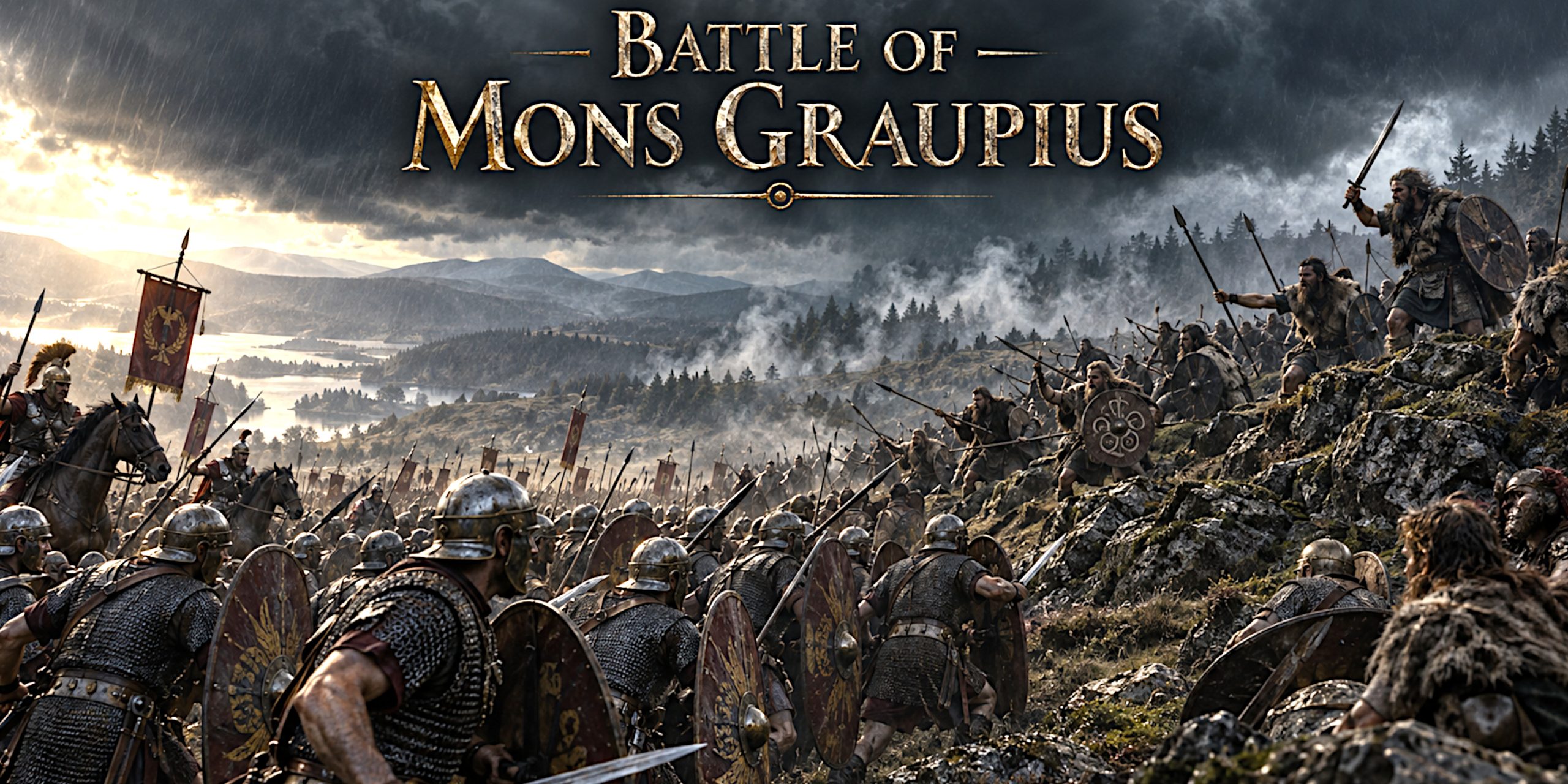
The Battle of Mons Graupius was fought in northern Britain in late 83 or 84 CE between the Roman army of Gnaeus Julius Agricola and a confederation of Caledonian peoples. According to the Roman historian Tacitus, Agricola won a crushing victory while his legionaries watched from reserve.
That wonderfully tidy account is also our only detailed account.
Tacitus was Agricola’s son-in-law, and his biography of the governor was written partly as history, partly as commemoration and partly as a lesson in Roman virtue. Mons Graupius therefore comes to us through the pen of a gifted writer with an excellent reason to make Agricola look magnificent.
The battle probably happened. The wider Roman campaign is firmly supported by forts, temporary camps and supply bases across Scotland. Its precise location, troop numbers and extraordinary casualty figures remain disputed.
| Battle facts | Details |
|---|---|
| Date | Late 83 or 84 CE |
| Location | Unknown, probably northern or north-eastern Scotland |
| Result | Roman tactical victory |
| Roman commander | Gnaeus Julius Agricola |
| Caledonian leader | Calgacus, according to Tacitus |
| Main source | Tacitus, Agricola |
Why Did the Battle Happen?
Rome invaded Britain in 43 CE, but the conquest of the island developed unevenly. By the late first century, Roman authority extended across most of England and Wales. Northern Britain remained a more difficult proposition.
Agricola became governor of Britannia in 77 or 78 CE. Over several campaigning seasons, he pushed Roman forces northwards, established forts and supply routes, and secured the Forth-Clyde isthmus. Roman troops then advanced into what is now Perthshire, Angus and Aberdeenshire.
The Caledonian peoples did not need to defeat Rome in a conventional battle. They could avoid Agricola’s main army, attack isolated units and exploit woodland, marshes and broken ground. Tacitus describes a night assault on the camp of the Ninth Legion during the campaign preceding Mons Graupius. Agricola arrived with reinforcements and drove the attackers away, but the incident exposed the vulnerability of a Roman army operating deep in hostile territory.
By the following campaigning season, Agricola wanted a decisive encounter. His fleet moved along the coast while the land army advanced with light equipment. The Caledonians, perhaps threatened by Roman penetration into their territory and the destruction of crops and settlements, assembled for battle.
Who Were the Caledonians?
“Caledonian” is a useful label, but it should not be mistaken for the name of a unified Scottish nation. Tacitus presents Agricola’s opponents as a confederation of northern British peoples drawn together by a common threat.
They lived in communities connected through kinship, local power networks and regional alliances. Archaeology reveals hillforts, enclosed settlements, roundhouses and sophisticated metalworking, but not a centralised Caledonian state.
Nor should the warriors at Mons Graupius automatically be called Picts. The name “Picti” appears in Roman sources much later, towards the end of the third century. There may have been cultural and ancestral continuity, but the two terms are not interchangeable.
Tacitus names Calgacus as the most distinguished of the Caledonian leaders. He is otherwise unknown. We cannot confirm whether he commanded the entire army, acted as one leader among several or was shaped into a convenient spokesman by Tacitus.
Forces
Tacitus provides precise figures, although precision in an ancient source does not guarantee accuracy. He claims that more than 30,000 Caledonians assembled against Agricola.
The Roman battle line reportedly contained 8,000 auxiliary infantry in the centre and 3,000 cavalry on the wings. Legionaries remained in front of the Roman camp as a reserve. Tacitus does not reveal their number.
Roman forces
| Troop type | Reported role | Probable equipment |
|---|---|---|
| Auxiliary infantry | Main battle line | Spears, swords, shields and body armour |
| Cavalry | Wings and flanking attacks | Spathae, spears and oval shields |
| Legionaries | Tactical reserve | Gladii, pila, scuta and armour |
The attacking infantry included four cohorts of Batavians and two cohorts of Tungrians. Both peoples came from the Rhine frontier and had strong military reputations. Tacitus describes these units closing rapidly for hand-to-hand fighting.
The Roman army was multicultural. Many of the troops who actually fought at Mons Graupius came from communities that Rome had previously conquered. Empire has always possessed a talent for making yesterday’s enemies deal with today’s.
Caledonian forces
| Troop type | Reported role | Probable equipment |
|---|---|---|
| Tribal infantry | Main body on the slopes | Spears, swords and shields |
| Charioteers | Skirmishing on the plain | Javelins, spears and light shields |
| Mounted warriors | Mobile support | Spears, swords and shields |
Tacitus claims the Caledonians were arranged on rising ground, with their formations climbing up the slopes behind the front line. Chariots moved across the open ground between the two armies.
The figure of more than 30,000 warriors may have been exaggerated to enhance the scale of Agricola’s victory. Organising and feeding such a large tribal force would have been a considerable undertaking, although a major confederation facing an existential threat could potentially have raised thousands of fighters.
Leaders
Gnaeus Julius Agricola
Agricola was an experienced Roman soldier and administrator. He had previously served in Britain during the revolt of Boudica and later commanded the Twentieth Legion.
At Mons Graupius, he appears to have understood the strengths of his auxiliaries. Rather than commit his legionaries immediately, he placed the Batavian and Tungrian cohorts at the centre of the action. His cavalry remained available to deal with attempts to envelop the Roman line.
Keeping the legions in reserve also carried political value. A victory won by auxiliaries preserved Roman citizen troops while demonstrating the reach of imperial power.
Calgacus
Tacitus describes Calgacus as “distinguished among the leaders for valour and birth”. Beyond that sentence and the speech attributed to him, history falls silent.
Even his name presents difficulties. It may represent a Celtic personal name connected with the idea of a swordsman, but attempts to construct a detailed biography are speculative.
Calgacus is important because Tacitus uses him to express a powerful criticism of Roman imperialism. Whether the real man said anything resembling the surviving speech is another matter.
Arms and Armour
Roman weapons
Roman troops were not uniformly equipped, particularly among the auxiliaries. Nevertheless, several weapons can be identified with reasonable confidence.
- Gladius: Legionaries carried a short double-edged sword designed for thrusting and cutting. By the late first century, the compact Pompeii-style gladius was widespread, although older Mainz-derived forms had not necessarily disappeared overnight.
- Spatha: Roman cavalry used the longer spatha, which offered greater reach from horseback. Some auxiliary infantry may also have carried longer swords.
- Pilum: Legionaries carried heavy javelins capable of penetrating shields and disrupting an enemy formation. Since the legions remained in reserve, pila may have played little or no part in the recorded fighting.
- Hasta and lighter spears: Auxiliary infantry and cavalry used thrusting and throwing spears in several forms.
- Pugio: Some Roman soldiers carried a military dagger as a secondary weapon, though it was not the principal arm of the battle line.
Roman legionaries may have worn lorica segmentata, lorica hamata or other forms of body protection. Auxiliary infantry are commonly associated with mail shirts and oval shields, but equipment varied between units.
Caledonian weapons
Tacitus offers a hostile and rather theatrical description of the Caledonian equipment. He claims that their swords were large and lacked effective points, while their shields were small.
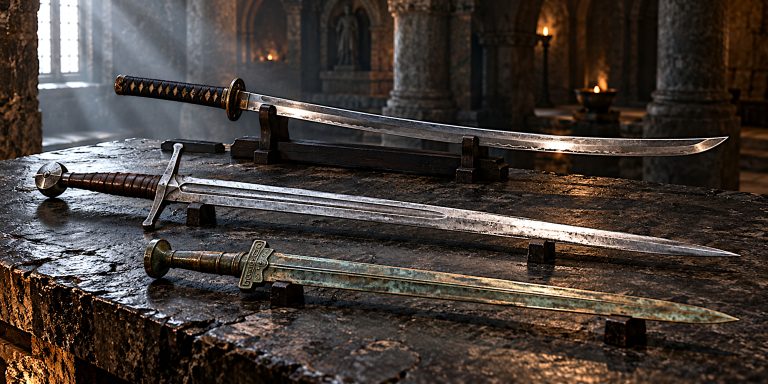
- Iron Age long sword: Some Caledonian elites probably carried long, double-edged swords descended from later La Tène traditions. These were capable cutting weapons, despite Tacitus’s suggestion that they were clumsy.
- Shorter double-edged swords: Archaeological material from Iron Age Britain also shows regional and chronological variation. There was no single regulation “Caledonian sword”.
- Spears: The spear was probably the most common battlefield weapon. It required less iron than a sword and could be used for thrusting or throwing.
- Javelins: Light throwing spears would have suited skirmishing and chariot warfare.
- Shields: Wooden and hide-covered shields offered the main protection for many warriors. Organic materials rarely survive, so their full variety is difficult to reconstruct.
- Chariots: Chariots remained symbols of status and mobile warfare in parts of Britain. At Mons Graupius, Tacitus portrays them creating noise and confusion rather than breaking the disciplined Roman formation.
We should be wary of treating Tacitus’s description as a technical weapons report. Roman authors regularly explained victory by contrasting Roman discipline with the supposedly inferior arms and methods of their opponents.
The Speeches Before Battle
Tacitus gives lengthy speeches to both Calgacus and Agricola. Ancient historians commonly composed such speeches to express what they believed was appropriate to the occasion. They were literary devices, not transcripts hurriedly taken down beside the shield wall.
Calgacus delivers the most memorable judgement on Roman conquest:
“To robbery, slaughter and plunder they give the lying name of empire; they make a solitude and call it peace.”
The precise wording varies between translations. The thought belongs to Tacitus’s account, even if he places it in the mouth of a Caledonian leader.
Calgacus also presents his people as the last free inhabitants of Britain, trapped between Roman power and the sea. It is stirring material, but it tells us at least as much about Roman anxieties over empire as it does about Caledonian political thought.
Agricola’s speech offers the opposing argument. He reminds his men of their long campaigns and portrays the enemy as a final, desperate barrier to complete victory:
“Endurance and marching have put us in possession of the very limits of Britain.”
Neither address should be quoted as the authenticated words of either commander. They are contemporary literary evidence for how Tacitus wanted the battle to be understood.
How the Battle Was Fought

Agricola positioned approximately 8,000 auxiliary infantry in the centre, with 3,000 cavalry divided between the wings. The legions stood behind them near the camp.
The Caledonian front ranks occupied the plain or lower ground. Further warriors formed up along the rising slopes, creating what Tacitus presents as a great tiered mass. Their chariots manoeuvred noisily across the space in front.
The opening phase involved exchanges of missiles. Agricola became concerned that the Caledonians’ long swords and small shields gave them an advantage while fighting at a distance. He ordered the Batavian and Tungrian cohorts to close with the enemy.
Tacitus says these auxiliaries used their shield bosses and short swords at close quarters. The description is plausible in general terms. A compact Roman formation could deny longer weapons room to move, particularly once the fighting became crowded.
The auxiliary advance forced the Caledonian front line back towards the slopes. Other Roman units joined the attack. Chariots became entangled in the struggle, and riderless horses reportedly added to the disorder.
Some Caledonian warriors attempted to move around the Roman army and attack from the rear. Agricola responded by sending four cavalry squadrons against them. The Roman cavalry then turned into the rear or flank of the main Caledonian force.
The Caledonian army broke apart. Groups fled towards nearby woodland, where some reportedly regrouped and ambushed careless pursuers. Agricola ordered a more organised sweep of the area, after which the survivors dispersed.
Battle Timeline
| Stage | Development |
|---|---|
| Roman approach | Agricola advances with support from the fleet |
| Armies deploy | Caledonians hold rising ground; auxiliaries form the Roman front |
| Missile exchange | Both sides fight at range while chariots manoeuvre |
| Auxiliary assault | Batavian and Tungrian cohorts close for hand-to-hand combat |
| Fight on the slopes | Roman auxiliaries push into the Caledonian formation |
| Flanking attempt | Caledonian troops try to reach the Roman rear |
| Cavalry response | Agricola commits reserve cavalry against the manoeuvre |
| Caledonian collapse | Roman cavalry and infantry drive the army from the field |
| Pursuit | Survivors retreat into woodland and scatter overnight |
Casualties and the Problem with Tacitus
Tacitus claims that approximately 10,000 Caledonians were killed, while the Roman army lost only 360 men. These figures should be treated with considerable caution.
Ancient battle accounts frequently inflate enemy casualties and minimise losses suffered by the winning army. A ratio approaching 28 Caledonians killed for every Roman dead turns victory into something almost miraculous, which is usually when a historian should reach for the salt.
This does not mean Agricola failed to win. A disciplined force combining infantry, cavalry and reserves could inflict severe losses on an army caught during a rout. The exact totals, however, cannot be independently verified.
Tacitus also states that the Roman dead included Aulus Atticus, the young prefect of an auxiliary cohort. His death, attributed partly to youthful enthusiasm and a spirited horse, provides one of the few individual details from the fighting.
Where Was Mons Graupius?
The battlefield has never been securely identified. Suggested locations range from Perthshire to Aberdeenshire and beyond.
| Candidate area | Reason proposed |
|---|---|
| Durno and Bennachie | Large Roman camp and terrain resembling Tacitus’s description |
| Meikle Carewe | Near Roman routes and marching camps |
| Duncrub or Dunning | Possible fit with the southern campaign route |
| Earn Valley | Open ground and access through Perthshire |
| Knock Hill | Landscape near routes into north-eastern Scotland |
Durno, north of Bennachie, is often presented as the strongest candidate. Its large temporary Roman camp could have accommodated a substantial field army, while the surrounding terrain includes slopes and open ground that can be made to fit Tacitus’s account.
“Can be made to fit” is the important phrase. Roman camps prove that Roman soldiers operated in an area. They do not automatically identify the location of a particular battle.
Historic Environment Scotland excluded Mons Graupius from the Inventory of Historic Battlefields because neither the location nor the details of the engagement can be established with sufficient confidence.
Archaeology
No weapon, mass grave, piece of armour or concentration of military debris has been conclusively connected with the Battle of Mons Graupius.
That absence is frustrating, but not especially surprising. The battlefield remains unidentified, acidic soils can destroy bone and metal may have been recovered after the fighting. Large areas of potential terrain have also never been investigated using modern battlefield archaeological methods.
The wider Flavian campaign is much better represented. Roman forts, fortresses and temporary camps reveal a sustained military push into northern Scotland. Important sites include:
- Inchtuthil: A major legionary fortress in Perthshire, probably constructed during the Flavian occupation.
- Durno: An exceptionally large marching camp near Bennachie.
- Raedykes: A Roman marching camp south of Aberdeen.
- Gask Ridge: A network of Roman forts, fortlets and watchtowers controlling movement through central Scotland.
- Stracathro and other temporary camps: Evidence for Roman forces moving and operating beyond the Forth-Clyde line.
These sites support the broad setting of Tacitus’s story. They do not confirm his speeches, casualty figures or battlefield location.
A securely identified site might produce Roman missile points, fittings from shields and armour, horse equipment, hobnails, damaged weapons or fragments associated with chariots. Until such a pattern is found and convincingly dated, Mons Graupius remains a battle without an agreed battlefield.
What Happened After the Victory?
Tacitus presents Mons Graupius as the culmination of Agricola’s campaigns. The Roman fleet continued its voyage around northern Britain, while the army withdrew into winter quarters.
Agricola was recalled to Rome soon afterwards. Tacitus hints that Emperor Domitian felt threatened by his military reputation, although this interpretation forms part of the biography’s political drama.
Rome did not convert the victory into permanent control of northern Scotland. Troops were transferred from Britain as imperial priorities changed, particularly during warfare on the Danube. Roman forces gradually abandoned their northern positions and withdrew towards the Tyne-Solway line.
Hadrian’s Wall was begun in 122 CE. A later Roman advance produced the Antonine Wall across central Scotland, but that frontier was also relinquished.
Mons Graupius was therefore a tactical Roman victory without a lasting conquest. Agricola could defeat a Caledonian army in battle. Holding the landscape year after year was a different and far more expensive business.
Why Mons Graupius Still Matters
Mons Graupius stands at the meeting point of history, archaeology and political storytelling.
It reveals the military reach of Rome at the end of the first century. It also shows the limits of Roman power. The empire could move a large army into northern Scotland, support it with a fleet and win a major engagement, yet it could not make the region securely Roman.
The battle also leaves us with an awkward source problem. Without Tacitus, we would know almost nothing about the encounter. Because of Tacitus, we possess an account rich in detail but shaped by family loyalty, Roman literary convention and political argument.
That does not make the Agricola useless. It makes it interesting. Historians must use it carefully, testing its narrative against the physical evidence and admitting where certainty ends.
Mons Graupius may eventually be found. For now, it remains one of Roman Britain’s most compelling lost battlefields, remembered through the voice of its victor’s son-in-law and the defiant speech he composed for the defeated.
Frequently Asked Questions
When was the Battle of Mons Graupius fought?
It was probably fought in late 83 or 84 CE during the governorship of Gnaeus Julius Agricola.
Where did the battle take place?
The exact location is unknown. Durno and Bennachie in Aberdeenshire are prominent candidates, but sites in Perthshire and elsewhere have also been proposed.
Did Calgacus really give his famous speech?
A Caledonian leader may have addressed the assembled warriors, but the surviving speech was almost certainly composed or heavily shaped by Tacitus.
Did Rome conquer Scotland after Mons Graupius?
No. Rome won the battle according to Tacitus, but it did not establish permanent control over northern Scotland.
Were the Caledonians Picts?
They should not simply be called Picts. The term “Pict” entered Roman writing much later, although some of the later Pictish population may have descended from northern Iron Age communities.
How many people died?
Tacitus claims that 10,000 Caledonians and 360 Roman troops were killed. These figures cannot be independently confirmed and were probably shaped to magnify the Roman victory.