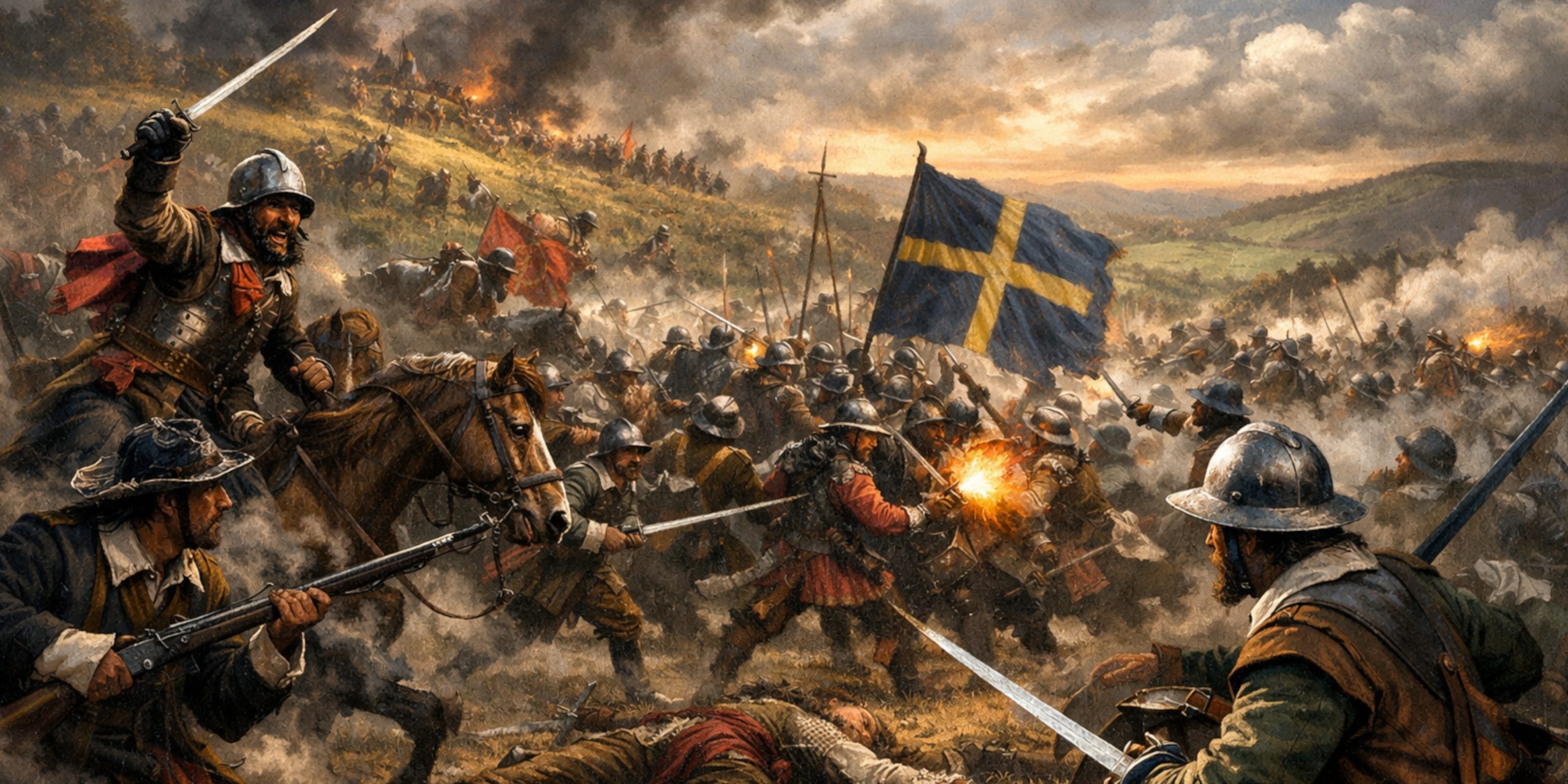
The Battle of Lansdowne, fought on 5 July 1643 near Bath, was one of the most vicious and costly encounters of the First English Civil War. It had no grand walls to storm, no great city at stake and no dramatic cavalry charge that swept everything before it. Instead, it was a grim, exhausting struggle up a steep hillside in the summer heat, fought at close quarters by men who often knew exactly who they were fighting. In the west of England, loyalties split families, neighbours and parishes. Lansdowne was one of those battles where the bitterness was almost as sharp as the swords.
The Royalists under Sir Ralph Hopton eventually forced the Parliamentarian army from the hill, but the victory was painfully expensive. Hopton’s Cornish infantry suffered terrible losses and the Royalist commander Sir Bevil Grenville, perhaps the finest fighting officer in the west, was killed. One contemporary remarked that the Royalists won the field but lost the flower of their army. That was not far from the truth.
Background
By the summer of 1643 the Royalists had seized the initiative in the west. Sir Ralph Hopton’s Cornish army had already secured a string of victories and was moving eastward into Somerset and Wiltshire. The Parliamentarian commander Sir William Waller, meanwhile, had built a reputation as one of Parliament’s most capable officers. Waller had little choice but to stop Hopton before the Royalists pushed further towards London.
The two armies manoeuvred around Bath and the surrounding hills in early July. Waller chose a strong defensive position on Lansdowne Hill, north of Bath. It was a natural fortress, with steep slopes, hedges, lanes and walls protecting the approaches. From the summit the Parliamentarians could see the Royalists advancing below them. That is always a comforting position to occupy. It is considerably less comforting when you are the one climbing.
Hopton understood the danger but decided he had to attack. Retreat would have damaged Royalist momentum and morale. Besides, Hopton’s Cornish infantry had already gained a fearsome reputation for stubbornness and aggression. If anyone could storm a hill under fire, it was probably them.
Forces
Royalist Army
| Commander | Estimated Strength | Notes |
|---|---|---|
| Sir Ralph Hopton | 4,000 to 5,000 men | Overall commander |
| Sir Bevil Grenville | Cornish infantry | Led the famous Cornish foot |
| Prince Maurice | Royalist cavalry | Supported the right flank |
| Sir Nicholas Slanning | Infantry | Veteran Cornish officer |
The Royalist army consisted largely of Cornish infantry supported by cavalry and a modest number of guns.
- Around 3,000 to 3,500 infantry
- Around 1,000 cavalry and dragoons
- Several light artillery pieces
- Many soldiers were experienced after months of campaigning in the west
Parliamentarian Army
| Commander | Estimated Strength | Notes |
| Sir William Waller | 5,000 to 6,000 men | Overall commander |
| Sir Arthur Haselrig | Cavalry | Commanded the famous cuirassiers |
| Sir James Chudleigh | Infantry and horse | Important subordinate commander |
| Major-General James Holborne | Infantry | Held part of the ridge |
The Parliamentarian army occupied the higher ground and was slightly larger.
- Around 4,000 infantry
- Around 1,500 cavalry
- More artillery than the Royalists
- Defended strong positions along the ridge and fieldworks
Leaders and Troop Composition
| Side | Troop Type | Description |
| Royalist | Cornish infantry | Tough, aggressive pikemen and musketeers with considerable local loyalty |
| Royalist | Cavalry | Cavalry under Prince Maurice, useful but less decisive on steep ground |
| Royalist | Dragoons | Mounted infantry used to skirmish and support attacks |
| Parliamentarian | Infantry | Better positioned and supported by field defences |
| Parliamentarian | Cuirassiers | Heavily armoured horsemen under Haselrig |
| Parliamentarian | Artillery | Positioned on the ridge to fire downhill into advancing Royalists |
One of the most unusual sights at Lansdowne was the appearance of Haselrig’s cuirassiers, nicknamed the Lobsters because of their heavy armour. They wore metal cuirasses and helmets that covered much of the body. To the Cornish infantry, who were trudging uphill in the July heat with pikes and muskets, they must have looked less like cavalry and more like a row of iron cooking pots charging across the battlefield.
Arms and Armour
The battle took place during a transitional period in warfare. Traditional pikes and swords still dominated close combat, but firearms increasingly shaped the course of the fighting.
| Weapon or Armour | Used By | Details |
| Matchlock musket | Both sides | Main firearm, effective but slow to reload |
| Pike | Both sides | Used to protect musketeers and push enemy formations |
| Basket-hilted broadsword | Royalist officers and cavalry | Common among Cornish and western Royalist officers |
| Mortuary sword | Parliamentarian officers | Popular among Parliamentarian commanders and cavalry |
| Backsword | Cavalry on both sides | Single-edged sword used in close fighting |
| Buff coat | Both sides | Thick leather coat worn beneath armour |
| Breastplate and helmet | Cavalry | Standard protection for mounted troops |
| Full cuirass | Haselrig’s horse | Heavy armour covering chest, back and limbs |
Specific Sword Types Seen at Lansdowne
- Mortuary swords carried by Parliamentarian officers and cavalry. These were practical basket-hilted weapons often associated with Parliament’s armies.
- Basket-hilted broadswords carried by Royalist cavalry and Cornish gentlemen.
- Backswords used by ordinary cavalrymen, valued because they were robust and easier to maintain than more fashionable rapiers.
- A few older cut-and-thrust swords from the late Elizabethan period were probably still in use, especially among locally raised troops. Civil wars are rarely tidy affairs and people often fight with whatever is hanging in the hall cupboard.
The Battle Timeline
| Time | Event |
| Early morning, 5 July 1643 | Waller’s army takes up position on Lansdowne Hill |
| Late morning | Hopton arrives and begins probing attacks |
| Midday | Royalist infantry assaults the slopes under heavy fire |
| Early afternoon | Cornish infantry slowly gains ground and fierce fighting breaks out around hedges and walls |
| Mid-afternoon | Sir Bevil Grenville is mortally wounded while leading the attack |
| Late afternoon | Royalists finally drive Parliamentarian troops from the summit |
| Evening | Waller withdraws towards Bath in good order |
| Night | A Royalist ammunition cart explodes, causing confusion and more casualties |
The final explosion after the battle almost turned victory into disaster. A Royalist ammunition wagon blew up near the camp, possibly by accident. Several men were killed and panic spread briefly through the exhausted army. After a day of gunfire, shouting and swordplay, the Royalists ended the evening by blowing themselves up. Civil War battlefields had a talent for producing endings that would seem implausible in a novel.
How the Battle Was Fought
The battle unfolded in stages as the Royalists attacked uphill. Hopton sent repeated assaults against the Parliamentarian position. Musketeers fired from behind hedges and earthworks while pikemen and swordsmen pushed forward.
The Cornish infantry proved decisive. They advanced despite terrible casualties and eventually reached the Parliamentarian line. Close combat followed, with pikes, sword blows and musket butts used at arm’s length. Many accounts suggest that the fighting on the summit was confused and brutal, more like a series of brawls than an orderly battle.
Waller’s men eventually withdrew. They were not routed, however. Waller managed to pull back much of his army towards Bath. The Royalists held the field but were in no condition to launch an immediate pursuit.
Contemporary Quotes
“The enemy maintained the hill with great resolution, and we won it with no less courage.”
Sir Ralph Hopton wrote these words after the battle. It is a restrained description of an exceptionally bloody day.
“Sir Bevil Grenville was slain, whose loss all Cornwall lamented.”
This lament appeared in several Royalist accounts and captures the grief felt at Grenville’s death.
“The Cornish men performed wonders.”
A Royalist observer used this phrase to describe the infantry assault. It is perhaps the closest a seventeenth-century officer came to sounding genuinely astonished.
Casualties
| Side | Estimated Losses |
| Royalist | 500 to 800 killed and wounded |
| Parliamentarian | 300 to 700 killed, wounded or captured |
The death of Sir Bevil Grenville was the greatest Royalist loss. Grenville had become one of the leading figures of the Royalist cause in the west. His death badly weakened Hopton’s army and damaged morale.
Archaeology and the Battlefield Today
The battlefield survives remarkably well. Lansdowne Hill still retains much of its landscape, although roads and modern development have altered parts of the area.
Archaeological investigations have uncovered:
- Musket balls from both sides
- Fragments of seventeenth-century weapons and equipment
- Evidence of fieldworks and defensive positions
- Concentrations of shot showing where the fiercest fighting took place
Many of the musket balls found on the slopes are distorted from impact, which is a small but vivid reminder of how violent the fighting was. A flattened lead ball is an oddly sobering object. It is difficult to hold one without thinking about the poor soul who was standing at the wrong end of it.
Near the battlefield stands the Lansdown Monument, erected in memory of Sir Bevil Grenville. The monument still dominates the ridge and is perhaps the most visible reminder of the battle.
Why the Battle Mattered
Lansdowne was technically a Royalist victory. Waller withdrew and Hopton held the field. Yet it was a costly triumph. The Royalists lost some of their best troops and their most capable subordinate commander.
The battle also showed that the war in the west would not be decided quickly. Parliament’s armies could be beaten, but not easily. A few days later the two sides met again at Roundway Down, where the Royalists finally secured a far more decisive victory.
Without Lansdowne there might never have been a Roundway Down. The battered Royalist army survived just long enough to regroup and fight again. That was often enough in the English Civil War. One difficult victory could lead to another, provided the army still had enough men left to hold a musket and enough officers left who had not been inconveniently shot.
Visiting the Battlefield
The battlefield lies north of Bath and can still be explored today.
Visitors can see:
- The Lansdown Monument to Sir Bevil Grenville
- Surviving ridges and slopes where the battle took place
- Views across the surrounding countryside that help explain the tactics
- Nearby Bath, which played an important role in the campaign
The site is particularly striking in the early morning or late evening, when the shape of the ground becomes clear. Standing on the ridge, it is immediately obvious why Waller chose the position. Standing at the bottom and looking up, it becomes equally obvious why so many Royalists failed to enjoy the experience.
Takeaway
The Battle of Lansdowne was one of the hardest-fought actions of the First English Civil War. It combined tactical skill, extraordinary courage and an almost reckless determination on both sides. The Royalists won, but at a price that left them badly weakened.
For historians, Lansdowne remains fascinating because it reveals the reality of the civil war in the west. This was not simply a contest between kings and parliaments. It was a struggle fought by local communities, neighbours and families on a windy hill outside Bath. The battlefield still carries that sense of closeness and bitterness. Few places capture the raw, personal nature of the English Civil War quite so well.