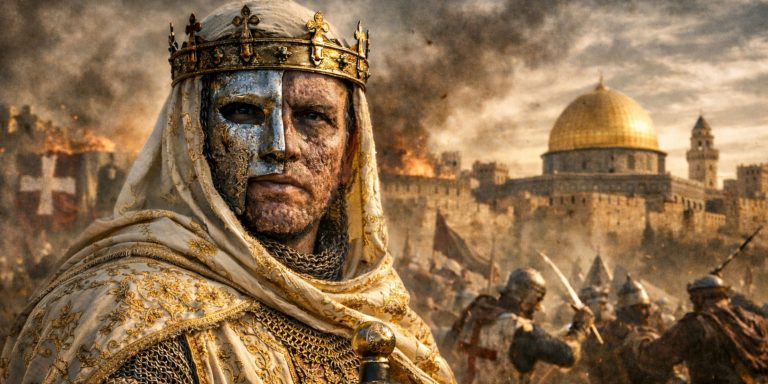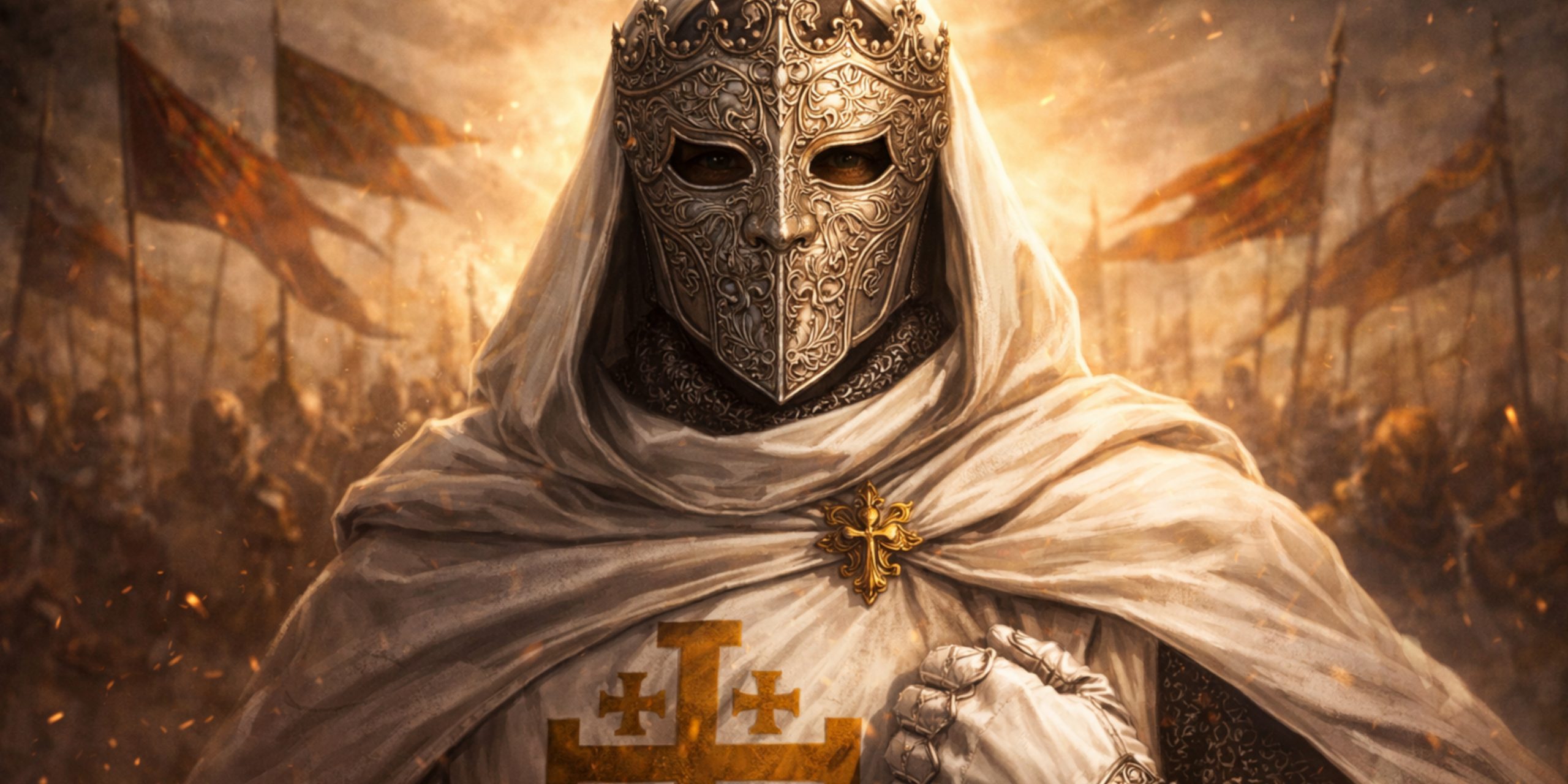
There is something quietly astonishing about Baldwin IV. A king who ruled while his body failed him, yet refused to step back when it mattered most. Medieval chroniclers did not quite know what to do with him. Some framed him as tragic, others as divinely tested. From a historian’s perspective, he stands as something more grounded and more compelling, a capable ruler navigating a fragile kingdom with limited time and fewer allies than he deserved.
He was not supposed to be effective. That is what makes his reign so interesting.
Early Life and Diagnosis
Baldwin IV was born in 1161, the son of Amalric I of Jerusalem. His childhood should have followed a familiar path for a prince of the Latin East, education, training in arms, preparation for rule. Instead, it took a sharp and rather cruel turn.
His tutor, William of Tyre, noticed something odd. Baldwin could not feel pain in his arm. It was not a moment of drama, just a small detail that pointed to a much larger truth. Leprosy.
William later wrote:
“He felt no pain at all in his right arm, even when it was pinched or bitten.”
From that point on, Baldwin’s life became a balancing act between expectation and physical decline. Yet he was crowned king in 1174, still a teenager, already carrying more weight than most rulers twice his age.
The Political Landscape of Jerusalem
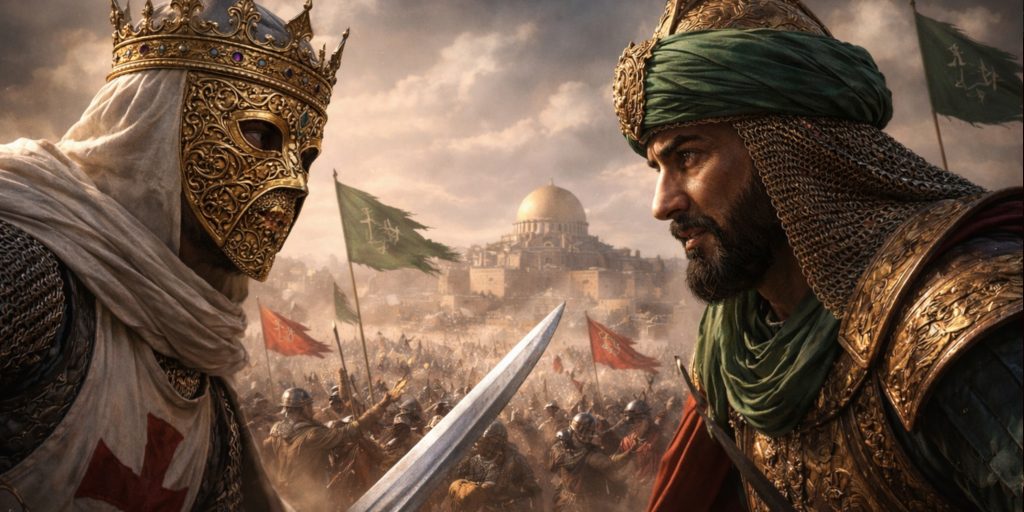
The Kingdom of Jerusalem in Baldwin’s time was not a stable entity. It was a patchwork of alliances, rival nobles, and constant pressure from surrounding Muslim powers, most notably under Saladin.
Internally, factions formed quickly. The regency question, succession disputes, and competing noble interests meant Baldwin had to govern as much with diplomacy as with authority.
He did not always win those political contests. Few kings do. But he managed to hold the kingdom together longer than most would have predicted.
Arms and Armour of Baldwin IV

Baldwin IV would have been equipped in the standard fashion of a high-ranking crusader king, though his illness likely forced adjustments over time.
Typical Equipment
- Mail hauberk covering torso, arms, and upper legs
- Coif integrated with the mail for head protection
- Nasal helmet or early great helm in later years
- Kite shield, often bearing the Jerusalem cross
- Arming sword, likely Oakeshott Type XI or XII
- Lance for mounted combat
As his condition worsened, especially with loss of strength and sensation, it is likely he relied more heavily on attendants to assist with mounting and handling equipment. Some accounts suggest he had to be physically supported during campaigns.
Weapons in His Army
- Knightly lances and swords
- Infantry spears and shields
- Crossbows, increasingly important in Levantine warfare
- Turcopole light cavalry using composite bows
Baldwin’s forces were not large by European standards, but they were experienced, and often fighting on familiar ground.
Battles and Military Acumen

Baldwin IV’s military reputation rests on a handful of engagements, but one stands far above the rest.
The Battle of Montgisard (1177)
Against all expectation, Baldwin faced Saladin near Ramla with a smaller force. He was physically weakened, reportedly carried on a litter at times, yet he chose to engage.
The result was decisive.
- Baldwin led a surprise attack
- Crusader cavalry broke Saladin’s forces
- The Ayyubid army retreated in disorder
It remains one of the most striking crusader victories of the period. Not because of scale, but because of circumstance. A young king, visibly ill, defeating one of the most formidable commanders of the age.
Later Campaigns
Baldwin continued to lead or direct military operations despite his declining health.
- Defensive campaigns against repeated incursions
- Strategic use of fortifications such as Kerak
- Delegation to trusted commanders as his condition worsened
By the early 1180s, he could no longer fight in person. Leadership shifted, and with it, the fragile balance he had maintained began to slip.
Personality and Leadership
It is tempting to frame Baldwin as purely tragic. That misses the point.
He was pragmatic. He knew his limitations and worked around them. He relied on capable men when needed, but he also asserted authority when factional disputes threatened stability.
William of Tyre again provides a telling impression:
“He bore his illness with patience beyond his years.”
From a modern viewpoint, Baldwin’s leadership feels unusually grounded. Less concerned with glory, more focused on survival.
Artefacts and Where to See Them
Very few objects can be directly tied to Baldwin IV himself. This is not unusual. Medieval kings often left behind less personal material than people expect.
Key Locations
- Church of the Holy Sepulchre
Associated with royal burials of the Kingdom of Jerusalem - Tower of David Museum
Displays artefacts and context from the crusader period - Israel Museum
Houses coins, weaponry, and material culture from the era - Louvre Museum
Contains crusader-era objects, including items linked to the Latin East
Coins minted during his reign are among the most tangible surviving links. They reflect both economic activity and the assertion of royal authority in a contested region.
Archaeology and Latest Findings
Archaeology has added texture rather than dramatic revelation to Baldwin’s story.
Excavations in Jerusalem and surrounding fortifications have revealed:
- Reinforced walls and defensive structures dating to his reign
- Evidence of siege damage and rapid repair cycles
- Material culture showing a blend of European and Near Eastern influences
Sites such as Kerak and Jerusalem itself continue to yield findings that help clarify how the kingdom functioned on a practical level. Supply lines, fortifications, and urban development all point to a state under constant pressure.
Recent work has focused less on individuals and more on systems. That may sound less exciting, but it gives a clearer sense of the world Baldwin had to manage.
Decline and Death
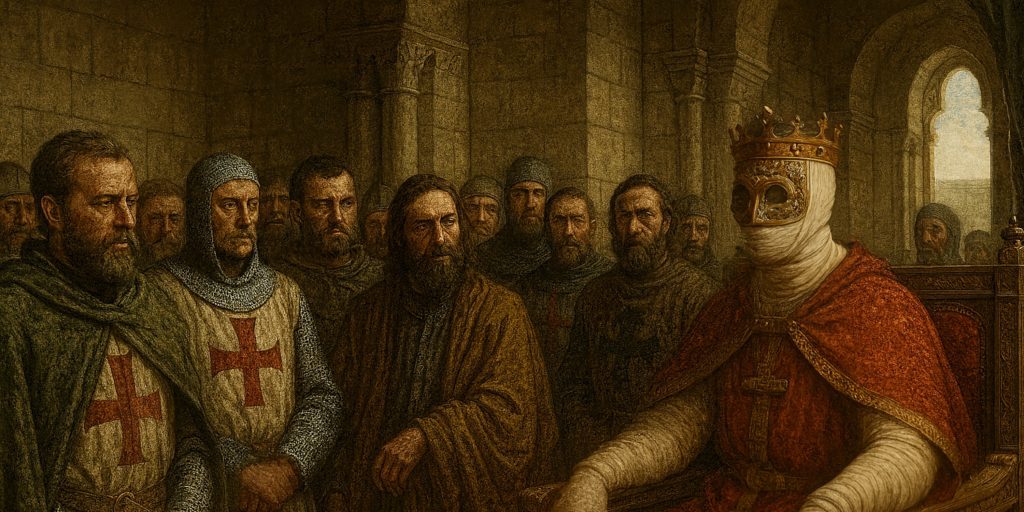
By 1185, Baldwin’s condition had worsened significantly. Governance passed increasingly to regents, and succession became the central issue.
He died at the age of around 24.
It is a short life, even by medieval standards. Yet it left a lasting impression, largely because of how much he managed within those constraints.
Legacy
Baldwin IV did not secure the long-term survival of the Kingdom of Jerusalem. Within a few years of his death, the kingdom suffered catastrophic defeat at Hattin and the loss of Jerusalem itself.
Yet his reign delayed that outcome.
He held the line, quite literally at times, when collapse seemed likely. Without him, the timeline of the crusader states might have been far shorter.
From a historian’s perspective, he is not a figure of myth, but of resilience. A ruler who understood the situation clearly and acted within it, even as his own body failed him.
There is something quietly stubborn about that. And perhaps that is why Baldwin IV continues to stand out in a period crowded with larger personalities.
Watch the documentary: