The ghilmān were elite military retainers who served the caliphs, emirs and sultans of the medieval Islamic world. Many began their careers as enslaved boys or young men acquired beyond the empire’s frontiers, trained for war, converted to Islam and attached personally to a ruler or commander.
They are often described as “Arab slave soldiers”, but that label needs care. The institution flourished under Arabic-speaking Muslim dynasties, particularly the Abbasids, yet many of its recruits were Turkic, Iranian, Armenian, Slavic, Greek or Central Asian. Ghilmān were therefore soldiers of the Arab caliphates, not necessarily Arabs themselves.
Their rise transformed Islamic warfare. It also transformed government, frequently in ways the caliphs had not intended. Men purchased to provide dependable military service became commanders, governors and political brokers. Some protected their masters with impressive loyalty. Others selected, deposed or murdered caliphs. Medieval court politics had very few quiet performance reviews.
What does ghilmān mean?
The Arabic word ghulām originally meant a boy, youth, servant or young male attendant. Its plural is ghilmān. The term could be used in several contexts and did not always imply military service or enslavement.
Within military history, a ghulām was usually a dependent soldier attached to a ruler, court or senior commander. Many had been enslaved, although some were later freed while retaining the personal and political obligations created by their training.
| Term | Meaning |
|---|---|
| Ghulām | A youth, servant or military retainer |
| Ghilmān | Plural of ghulām |
| Mamlūk | Literally “owned”; an enslaved military servant |
| Mawlā | A client or dependent, often but not always a freed person |
| Khādim | A servant or court attendant, sometimes a eunuch |
| Ḥaras | A ruler’s guard or bodyguard |
| Shākiriyya | Armed retainers personally attached to a ruler or magnate |
The words ghulām and mamlūk overlap, but they should not be treated as perfect synonyms. Medieval authors were rarely considerate enough to standardise their vocabulary for modern readers.
“Mamlūk” placed greater emphasis upon legal ownership. “Ghulām” could describe a slave, freed retainer, page, court servant or professional soldier. The precise meaning depends upon the author, region and period.
Quick facts about the ghilmān
| Category | Details |
|---|---|
| Main period of influence | Ninth to thirteenth centuries |
| Political setting | Abbasid, Tulunid, Samanid, Buyid, Ghaznavid and Seljuk territories |
| Principal recruitment regions | Central Asia, the Eurasian steppe, the Caucasus and eastern Europe |
| Common backgrounds | Turkic, Iranian, Armenian, Georgian, Slavic and Greek |
| Typical battlefield role | Mounted archer, armoured cavalryman, guard or household retainer |
| Principal weapons | Composite bow, lance, straight sword, early sabre, mace and dagger |
| Armour | Mail, lamellar, scale, helmets and shields |
| Relationship to ruler | Personal military dependence maintained through pay, patronage and household ties |
| Political importance | Guards, commanders, governors, kingmakers and sometimes rulers |
Why Islamic rulers recruited ghilmān
The early Islamic caliphates had relied heavily upon tribal Arab armies. These forces had conquered an enormous territory, but their political loyalties were not always confined to the caliph. Soldiers might remain attached to a tribe, region, provincial commander or religious faction.
The Abbasid Revolution of the eighth century brought large numbers of Khurasani troops into the centre of the empire. They helped place the Abbasids in power, which naturally gave them opinions about how that power should be used.
Caliphs consequently sought soldiers who depended directly upon the palace. A ghulām lacked a local tribal constituency within Iraq and normally owed his position, income and advancement to his patron. In theory, that created loyalty.
It was an intelligent solution to a genuine problem. Unfortunately, it created another problem wearing armour and commanding several thousand horsemen.
The system offered rulers several advantages:
- A professional force available throughout the year
- Soldiers trained from youth in riding, archery and court discipline
- Reduced dependence upon tribal levies
- A bodyguard without strong local family connections
- Military commanders whose careers depended upon royal favour
- Access to the traditions of Central Asian mounted warfare
The weakness was equally obvious. Once the ghilmān controlled the palace, payroll and approaches to the capital, the ruler could become dependent upon his own guards.
Were the ghilmān really slaves?
Many were, particularly at the beginning of their careers. They were purchased, presented as gifts, captured in war or supplied through frontier trading networks. Some were acquired as adolescents, while others arrived as young adults already possessing riding or martial skills.
The system was still slavery, even where it offered training, wealth or eventual promotion. Describing successful ghilmān as an elite should not conceal the coercion that brought many of them into service.
Their position was nevertheless unusual. Military slaves could receive:
- High-quality training
- Regular pay and clothing
- Horses and military equipment
- Accommodation near the court
- Gifts of land or revenue
- Marriage connections
- Freedom and promotion
- Commands over free-born soldiers
Manumission did not necessarily end the bond between soldier and patron. A freed ghulām often remained within his former master’s military household. Loyalty could be reinforced through patronage, shared training and membership of a regiment whose soldiers had grown up together.
This mixture of enslavement, education and privilege produced a military class that does not fit neatly into modern social categories. They were exploited people who could also become formidable beneficiaries of the system.
The ghilmān before al-Muʿtaṣim
Caliphs employed guards, clients and enslaved retainers before the ninth century. The Umayyads and early Abbasids both used household troops drawn from different ethnic and regional backgrounds.
Caliph al-Maʾmūn, who reigned from 813 to 833, employed Turkic and eastern Iranian soldiers during and after the Abbasid civil war. His brother, Abū Isḥāq, the future al-Muʿtaṣim, assembled a personal force of Turkic military slaves before becoming caliph.
Al-Muʿtaṣim did not invent military slavery. His importance lies in expanding and institutionalising it at the centre of Abbasid government.
Al-Muʿtaṣim and the creation of a new army
Al-Muʿtaṣim became caliph in 833. He increasingly relied upon Turkic commanders and ghilmān, including Ashinās, Ītākh, Bughā the Elder and Bughā the Younger.
The numbers given in medieval chronicles vary considerably. Some accounts suggest that al-Muʿtaṣim possessed several thousand Turkic soldiers before his accession and expanded the force once he became caliph. Precise figures should be treated cautiously. Medieval writers enjoyed a large round number almost as much as modern military press offices do.
These troops were not the whole Abbasid army. They served alongside several other formations:
- Khurasani troops
- Arab contingents
- Iranian soldiers
- The Farāghina from the Fergana Valley
- The Ushrūsaniyya from Ushrusana
- The Maghāriba, whose exact composition remains debated
- Tribal and provincial forces
- Volunteers raised for particular campaigns
The caliphal army was therefore ethnically and organisationally mixed. The Turkic ghilmān became especially influential because of their proximity to the ruler and their strength as mounted troops.
The move from Baghdad to Samarra
Relations between the new troops and the people of Baghdad deteriorated. Medieval accounts describe clashes in the streets, complaints about horses knocking down pedestrians and attacks upon soldiers who had become deeply unpopular.
In 836 al-Muʿtaṣim moved his court north to Samarra. The decision allowed him to build a capital around the requirements of the palace and army.
Samarra contained separate quarters and cantonments for different military groups. Commanders received large estates, while troops were deliberately settled in defined districts. Al-Yaʿqūbī records that some Turkic formations were kept apart from the surrounding population and discouraged from mixing with local communities.
The policy tells us a great deal. The caliph wanted his soldiers close enough to protect him but socially separated enough to preserve their identity and dependence.
Samarra was not merely a royal residence. It was a planned military landscape of palaces, barracks, avenues, parade grounds, racecourses and enormous enclosures. It is perhaps the clearest archaeological expression of the ghilmān system.
Training and military culture
There was no single training manual used by every ghulām across every dynasty. Practice varied according to region, date and the intended role of the recruit. Nevertheless, Turkic and Central Asian ghilmān were particularly valued for mounted archery and horsemanship.
Training probably included:
- Riding at speed and over difficult ground
- Shooting the composite bow from horseback
- Controlling a horse through changes of direction
- Using the lance in mounted combat
- Swordsmanship on horse and foot
- Formation manoeuvres
- Hunting as military exercise
- Guard duties and court protocol
- Care of horses, saddles and equipment
Al-Jāḥiẓ, writing during the ninth century, praised the extraordinary horsemanship of Turkic soldiers. In one English translation he observes:
“If the Turk’s life were to be reckoned up, it would be found that he had sat on the back of his mount more than he had sat upon the earth.”
The wording varies between translations, but the point is clear. To al-Jāḥiẓ, the Turkic soldier’s relationship with his horse was not an occasional military skill. It was a way of life.
He also credited them with being able to shoot while retreating, advancing, turning or wheeling. His account is openly admiring and partly rhetorical, yet it reflects the reputation these troops enjoyed at the Abbasid court.
Arms and armour of the ghilmān
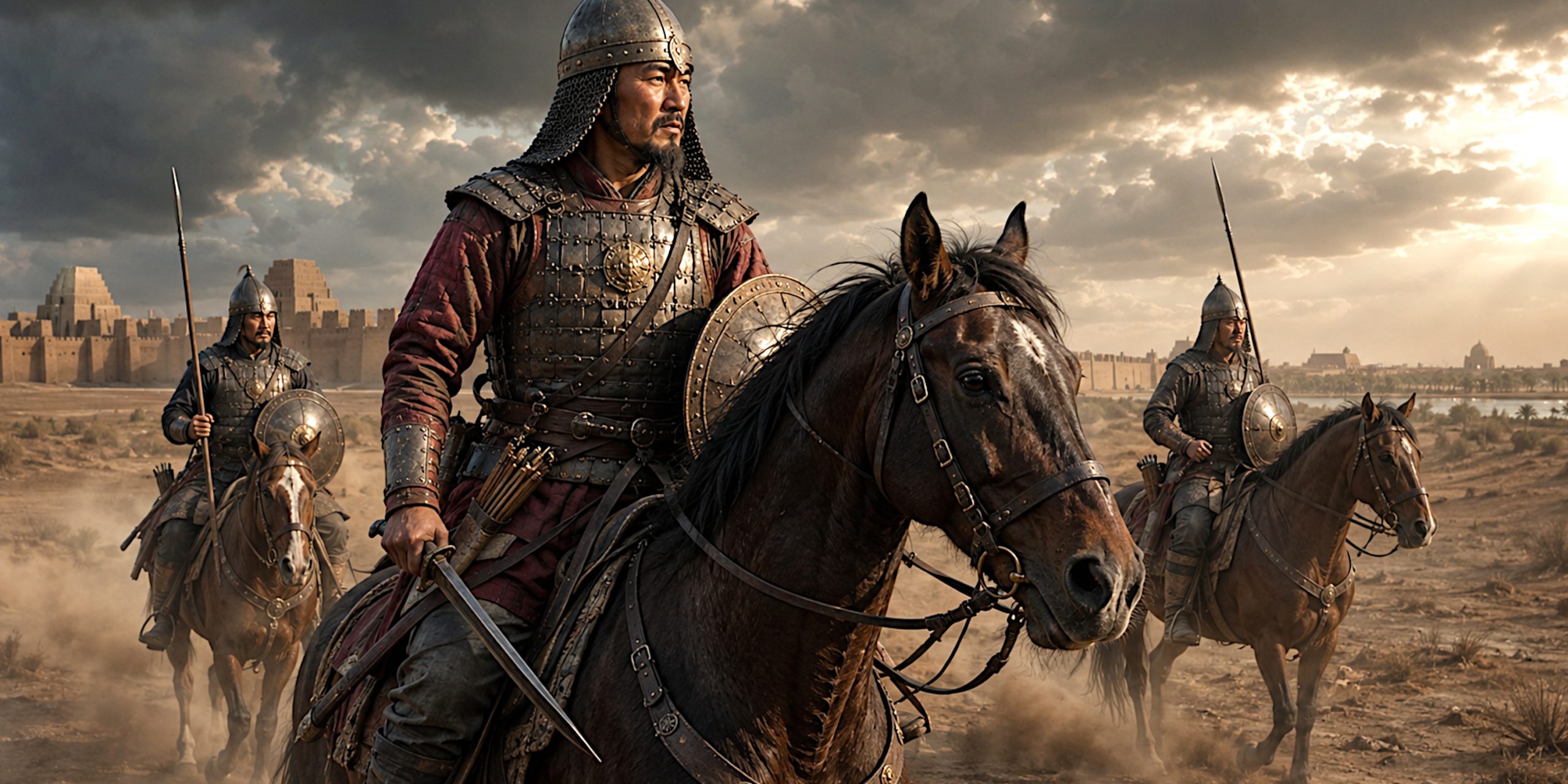
The equipment of the ghilmān changed across four centuries. An Abbasid guard in ninth-century Samarra did not look exactly like a Seljuk ghulām in twelfth-century Iran.
The best-equipped men served as armoured cavalry. Others fought as lighter horse archers, scouts or mounted retainers.
The composite bow
The composite reflex bow was the defining weapon of Turkic and Central Asian mounted warfare. Constructed from wood, horn and sinew, it delivered considerable power from a relatively short frame suitable for use on horseback.
A trained horse archer could:
- Harass enemy formations
- Attack exposed flanks
- Shoot during a withdrawal
- Disrupt cavalry before close combat
- Pursue broken troops
- Avoid slower infantry formations
Arrows were carried in quivers attached to the belt or saddle. A separate bow case protected the weapon when it was not in use.
Lances and spears
The lance gave the ghulām a weapon for direct shock combat. It could be used overarm, underarm or thrust during a mounted approach, depending upon period and technique.
Heavier ghilmān could close with an enemy after weakening him with arrows. This combination of archery and close combat made them more flexible than cavalry trained for a single type of attack.
Swords used by the ghilmān
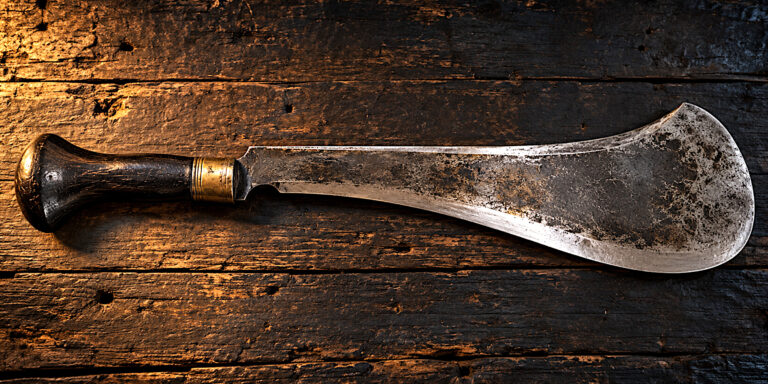
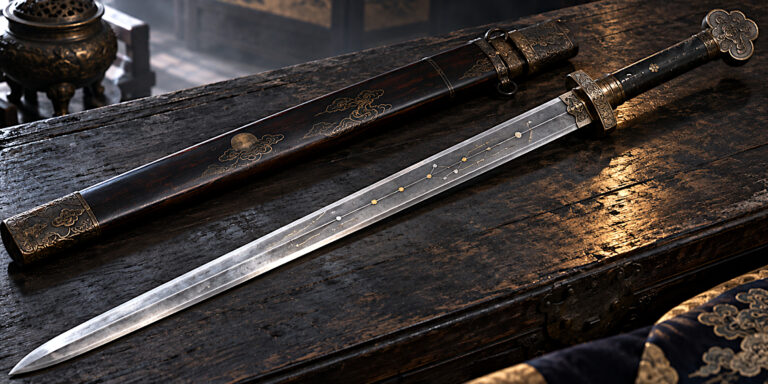
The generic Arabic word sayf simply means sword. It does not identify one fixed blade shape.
Specific sword forms associated with ghilmān included:
- Straight, double-edged swords: These remained common throughout the early Abbasid period. They descended from late antique Iranian, Central Asian and eastern Mediterranean traditions.
- Straight, single-edged swords: Such blades were also known across Iran and Central Asia and formed part of the wider development of the cavalry sabre.
- Early Turkic sabres: Moderately curved, single-edged blades suited to mounted cutting appeared among steppe peoples and gradually became more visible within Islamic armies.
- Nīshāpūr and Khurasani swords: Al-Kindī’s ninth-century treatise associated certain blades with production centres and regions, although these labels describe manufacture or steel more readily than a single universal shape.
- Indian or hindī blades: Medieval Arabic sources valued swords and steel imported from the Indian subcontinent.
- Qalajūr and other named varieties: Al-Kindī recorded numerous sword categories based upon origin, construction and quality.
The deeply curved Persian shamshīr familiar from later museum collections should not be casually placed in the hands of ninth-century Abbasid ghilmān. Early sabres usually had gentler curves, while straight swords remained important. Historical illustration has a habit of giving every medieval Muslim cavalryman a seventeenth-century sword. The blade looks elegant, but the calendar objects.
Maces, axes and daggers
A mace was useful against an armoured opponent because its effectiveness did not depend upon cutting through mail or lamellar plates. Iron-headed maces appear in textual, archaeological and artistic evidence from the Islamic world.
Axes were used, although they were less central to the popular image of the ghulām than the bow, lance and sword. Daggers and large knives served as secondary weapons.
Body armour
Ghilmān could wear several forms of armour:
| Armour | Description |
|---|---|
| Interlinked iron rings protecting the torso and sometimes the limbs | |
| Lamellar | Small rigid plates laced together in horizontal rows |
| Scale armour | Overlapping plates attached to a textile or leather backing |
| Quilted armour | Layered textile protection worn alone or beneath metal armour |
| Arm guards | Metal, splinted or hardened protection for the forearms |
| Greaves | Protection for the lower legs |
| Horse armour | Textile, lamellar, scale or mail protection for valuable cavalry mounts |
Mail shirts were widely used across the Islamic world. Lamellar armour had especially strong associations with Iranian and Central Asian military traditions. In practice, mixed construction was entirely possible.
Helmets and shields
Helmets were commonly conical or rounded and might include:
- A nasal guard
- Mail protecting the neck
- Cheek pieces
- Decorative finials
- Reinforcing bands
Shields could be circular and made from wood, hide, cane or layered materials. Mounted archers required equipment that did not interfere excessively with the bow, so protection had to be balanced against mobility.
The campaign against Amorium
The ghilmān emerged as an important part of the Abbasid field army during al-Muʿtaṣim’s reign. His most celebrated campaign was the invasion of Byzantine Anatolia in 838.
The expedition targeted Ancyra and Amorium, the latter associated with the reigning Byzantine dynasty. Abbasid forces advanced in separate columns and defeated Emperor Theophilos at the Battle of Anzen before besieging Amorium.
Turkic and eastern troops played a prominent role in the army, although the victory cannot be credited to the ghilmān alone. The force also included traditional Abbasid regiments and provincial contingents.
Amorium fell after a vulnerable section of its fortifications was revealed to the attackers. The city was sacked and large numbers of captives were taken. The campaign became one of the great military statements of al-Muʿtaṣim’s reign.
Abū Tammām celebrated the victory in a famous poem:
“The sword is truer in tidings than books; in its edge is the boundary between earnestness and play.”
The line is poetry rather than neutral reportage, but it captures the political theatre surrounding the campaign. Al-Muʿtaṣim had not merely won a siege. He had advertised the power of his new military order.
From servants to kingmakers
Al-Muʿtaṣim’s immediate successors inherited both the army and the political risks attached to it.
Under al-Wāthiq, Turkic commanders continued to receive power and wealth. Under al-Mutawakkil, relations between the caliph and the military leadership became increasingly dangerous.
In December 861 al-Mutawakkil was assassinated inside his palace by Turkic guards, probably with the involvement of his son al-Muntaṣir. The murder began the period often called the Anarchy at Samarra.
Between 861 and 870, military factions dominated the caliphate. Caliphs were installed, pressured, deposed or killed. Troops mutinied when their pay failed to arrive, while commanders fought over access to state revenue.
The sequence exposed the central weakness of the system. Ghilmān might lack hereditary power when first recruited, but senior commanders accumulated followers, property and influence. Personal dependence upon the caliph could become collective control over him.
This was not simply a tale of foreign soldiers destroying a stable state. Abbasid princes, bureaucrats, court families and provincial elites all participated in the struggles. The ghilmān were powerful actors within a wider political crisis, not a magical explanation for everything that went wrong.
The spread of the system
The military household model spread well beyond Samarra. Regional dynasties adopted it because it offered disciplined troops and a means of reducing dependence upon local aristocracies.
The Tulunids
Aḥmad ibn Ṭūlūn, himself the son of a Turkic military slave, established an autonomous regime in Egypt and Syria during the ninth century. His army included Turkic ghilmān as well as African, local and other contingents.
The Tulunids demonstrated how a commander produced by the Abbasid system could use provincial office to create an effectively independent state.
The Samanids
The Samanid rulers of Transoxiana and Khurasan developed a sophisticated military household containing Turkic ghilmān. Young recruits were trained and promoted through a hierarchy of court and military offices.
The eleventh-century author Niẓām al-Mulk later described an idealised progression in which a military slave received equipment and promotion gradually over several years. His account reflects later administrative thinking and should not be accepted as an exact handbook for every Samanid recruit, but it shows how carefully structured the system could become.
The Ghaznavids
Alptigin and Sebüktegin began their careers within the Samanid military world. Sebüktegin’s son Maḥmūd created the powerful Ghaznavid Empire, which stretched across parts of Iran, Central Asia and northern India.
The dynasty offers one of the clearest examples of military slaves and their descendants becoming sovereign rulers.
The Buyids
The Iranian Buyids employed Turkic ghilmān alongside Daylamite infantry. Rivalry between these groups became a recurring feature of Buyid politics.
Rulers often tried to balance one military faction against another. This could preserve authority, but it could also turn court politics into a heavily armed argument over unpaid salaries.
The Seljuks
Seljuk rulers combined tribal Turkic forces with ghilmān attached to the sultan and senior officials. These household troops provided a counterweight to nomadic commanders whose loyalty could be conditional.
Under the Seljuks, ghilmān served as guards, provincial governors and high-ranking commanders. Their personal attachment to patrons remained fundamental, but the institution was now embedded within a mature Persianate administrative system.
Ghilmān and the later Mamluk sultanates
The ghilmān helped establish the political and military traditions from which later mamluk systems developed. There was, however, no simple uninterrupted line from al-Muʿtaṣim’s guards to the Mamluk Sultanate of Egypt.
By the thirteenth century, military slavery had evolved through centuries of experimentation under the Abbasids, Samanids, Ghaznavids, Seljuks, Ayyubids and other dynasties.
In 1250 mamluk officers seized power in Egypt. Their state institutionalised military slavery on a scale that made the word “Mamluk” the standard modern label for the phenomenon.
The Abbasid ghilmān were important predecessors, but they belonged to a more varied and less uniform military environment.
Life inside the military household
A ghulām’s immediate world was often the household of his patron. Fellow recruits could share language, training, residence and experience. These relationships created powerful group loyalties.
A successful ghulām might acquire:
- His own household and retainers
- Estates or tax revenues
- A senior military command
- Marriage into an influential family
- A provincial governorship
- Access to the ruler
- A role in determining the succession
Not every ghulām enjoyed such a career. Many remain invisible in the sources, which naturally concentrate upon commanders, rebellions and court scandals. Ordinary guards who served, aged and disappeared from the record were less interesting to chroniclers.
The surviving narrative therefore has an elite bias. We know far more about men who killed caliphs than those who spent thirty uneventful years standing beside a palace door.
Archaeology and material evidence
Archaeology cannot usually identify the legal status of an individual soldier. A sword does not announce whether its owner was enslaved, freed or free-born. For that reason, the archaeology of the ghilmān is mainly the archaeology of military settlements, equipment and court culture.
Samarra
Samarra provides the most important physical evidence for the early Abbasid military system. Founded as the caliphal capital in 836, its remains stretch for many kilometres along the Tigris.
Archaeological and aerial surveys have identified:
- The great caliphal palace
- Regimented residential quarters
- Military cantonments
- Broad ceremonial avenues
- Polo grounds and racecourses
- Hunting enclosures
- Mosques, markets and baths
- Separate estates associated with commanders
Al-Karkh and al-Dūr, north of central Samarra, have been associated with Turkic troops. Al-Maṭīra to the south was connected with al-Afshīn and his followers from Ushrusana. Other quarters housed the Farāghina, Maghāriba, Arab, Khurasani and additional military groups.
The planned separation of these communities supports the written evidence that the Abbasid state organised troops through ethnic, regional and command-based regiments.
Weapons and armour
Iron corrodes badly, while valuable weapons were repaired, reused and carried elsewhere. Securely dated swords directly linked to named ghilmān are therefore rare.
Evidence is assembled from:
- Sword and arrowhead finds
- Metal fittings from belts, quivers and harnesses
- Armour fragments
- Artistic representations
- Contemporary technical texts
- Excavated military architecture
- Comparative finds from Central Asia, Iran and the Caucasus
This evidence suggests continuity between late antique straight swords and early Islamic weapons alongside the gradual adoption of steppe-style sabres. It does not support the idea that curved swords immediately replaced straight blades when Turkic troops entered Abbasid service.
Nishapur and eastern Iran
Excavations at Nishapur have revealed domestic and artistic evidence from the military culture of eastern Iran. A ninth or tenth-century wall painting from Sabz Pushan depicts a mounted figure in Central Asian-style dress with weapons suspended from an elaborate belt.
Such images cannot be labelled as portraits of individual ghilmān with certainty. They nevertheless show the clothing, belts, swords and elite equestrian imagery circulating through the regions from which military retainers were recruited.
Problems with the evidence
Much of Samarra remains unexcavated, and sections of the archaeological landscape have been damaged by modern construction, conflict and looting.
The material record also gives us the environment of military power rather than the personal experiences of enslaved soldiers. Architecture tells us where regiments lived. It rarely tells us what a recruit thought when he arrived there.
Contemporary descriptions of the ghilmān
Several medieval authors discussed the military households of the Abbasid world, although their accounts came with political and literary agendas.
Al-Jāḥiẓ praised Turkic soldiers for their mobility and instinctive horsemanship:
“The Turk shoots at wild beasts, birds, targets, men, stationary figures and moving figures.”
The precise wording differs between editions and translations, but his portrait repeatedly presents the Turk as a versatile mounted archer.
Al-Yaʿqūbī’s description of Samarra records the deliberate allocation of land to military commanders and regiments. His urban geography confirms that the army’s organisation was written into the city itself.
Later, Niẓām al-Mulk expressed the political ideal behind household troops:
“A slave should be advanced according to his service and merit.”
This is a translated summary of the principle expressed in the Siyāsatnāma, rather than evidence that promotion was always fair. Court service was never quite the meritocracy its administrators liked to describe.
These sources should be read critically. Al-Jāḥiẓ was constructing an argument about military virtues. Al-Yaʿqūbī was describing an imperial city. Niẓām al-Mulk was prescribing good government long after the first Samarran ghilmān. Together, however, they reveal how contemporaries understood the institution.
Strengths and weaknesses of the ghilmān system
| Strengths | Weaknesses |
|---|---|
| Created professional standing troops | Required enormous and reliable funding |
| Reduced reliance upon tribal levies | Troops could mutiny when pay failed |
| Encouraged advanced cavalry training | Commanders accumulated political power |
| Linked soldiers personally to a ruler | Personal loyalty could shift to senior officers |
| Supplied effective mounted archers | Foreign recruitment created social tensions |
| Offered advancement based partly upon service | Succession disputes encouraged military intervention |
| Integrated frontier military traditions | The system depended upon continued enslavement |
The ghilmān were not inherently disloyal. Their service was often highly effective, and many remained devoted to patrons or dynasties. The political difficulty arose because rulers placed organised military power in the hands of men whose loyalty had to be continuously maintained through money and advancement.
When the treasury weakened, the personal bond weakened with it.
Common myths about the ghilmān
All ghilmān were Turkic
Turkic soldiers were especially prominent, but ghilmān could come from many backgrounds. Armenian, Georgian, Iranian, Greek and Slavic recruits also served in military households.
They were all eunuchs
Military ghilmān were generally distinct from palace eunuchs. Eunuchs could exercise considerable court power, but castration was not a normal requirement for an elite cavalryman.
They all fought with curved swords
Straight swords remained widespread during the early Abbasid period. Moderately curved sabres entered Islamic military culture through steppe connections, but the change was gradual.
Al-Muʿtaṣim invented military slavery
He expanded and institutionalised an existing practice. Enslaved guards and military retainers had served earlier rulers within and beyond the Islamic world.
The ghilmān destroyed the Abbasid Caliphate
Their political intervention weakened individual caliphs and contributed to instability, particularly during the Anarchy at Samarra. Yet fiscal problems, civil wars, provincial separatism, succession disputes and administrative rivalries were equally important.
A ghulām remained powerless because he was enslaved
Some did remain vulnerable and obscure. Others became commanders, governors and founders of dynasties. Legal dependence and practical power could exist in the same person.
The legacy of the ghilmān
The ghilmān changed the political structure of the Islamic world. They helped replace armies dominated by tribal and regional levies with more professional forces centred upon the ruler’s household.
Their military influence included:
- The spread of mounted archery
- Greater use of Central Asian cavalry techniques
- The development of permanent guard regiments
- Closer integration of military training and court service
- The growing importance of armoured cavalry
- The transmission of steppe weapons and equipment
Their political influence was even greater. Military households produced commanders who founded states, governed provinces and controlled succession. The Tulunid, Ghaznavid and later Mamluk experiences all emerged from worlds in which dependent soldiers could rise to sovereignty.
There is a profound contradiction at the centre of their history. Rulers purchased outsiders because they appeared politically isolated and personally dependent. Training, wealth and collective identity then turned those outsiders into the most organised political force in the state.
The ghilmān were never merely guards standing behind a throne. Increasingly, they decided who was allowed to sit on it.
Frequently asked questions
Were the ghilmān Arabs?
Usually not in the early Abbasid context. Many were Turkic or came from Iran, Central Asia, the Caucasus and eastern Europe. They served Arabic-speaking Islamic governments, which explains the misleading phrase “Arab ghilmān”.
What was the difference between a ghulām and a mamlūk?
Both terms could refer to a military slave. Mamlūk emphasised ownership, while ghulām had a wider range of meanings, including youth, servant, page and military retainer.
Did ghilmān receive their freedom?
Many successful ghilmān were manumitted. They normally remained tied to their patron through loyalty, pay and membership of the military household.
What swords did ghilmān use?
Early ghilmān used straight, double-edged swords, straight single-edged blades and increasingly early Turkic sabres with modest curvature. The deeply curved shamshīr belongs mainly to later developments.
Why was Samarra built?
Al-Muʿtaṣim moved the Abbasid court there in 836 partly to separate his new military forces from the population of Baghdad and to create a capital designed around the palace and army.
Did the ghilmān become rulers?
Some did. Military slaves and their descendants founded or controlled several dynasties, including the Ghaznavids. Later mamluk officers established their own sultanate in Egypt.