The most famous explorers in history include Marco Polo, Ibn Battuta, Zheng He, Christopher Columbus and James Cook. Their journeys connected distant societies, widened geographical knowledge and, in some cases, helped unleash conquest and colonisation. Others, such as Roald Amundsen and Ernest Shackleton, became famous for what people could endure at the edges of the inhabited world.
I find these lives most interesting where the familiar heroic portraits begin to fray. An explorer might be a gifted navigator and a disastrous governor. A celebrated expedition might depend on knowledge supplied by people whose names never reached the title page.
There is also a persistent problem with the word ‘discovery’. A coastline could be new to a European chart and thoroughly familiar to generations of its inhabitants. History becomes rather more useful when we ask who learnt what, from whom, and at whose expense.
Famous Explorers at a Glance
| Explorer | Main regions travelled | Best known for |
|---|---|---|
| Leif Erikson | North Atlantic and Vinland | Norse voyages to North America around 1000 |
| Marco Polo | Central Asia and China | An influential account of the Mongol world |
| Ibn Battuta | Africa, the Middle East and Asia | A remarkable record of fourteenth-century travel |
| Zheng He | Indian Ocean and its surrounding coasts | Seven major Ming maritime expeditions |
| Christopher Columbus | Caribbean and parts of Central and South America | Voyages that began sustained European colonisation of the Americas |
| Amerigo Vespucci | Atlantic coast of South America | Accounts associated with recognising a ‘New World’ |
| Ferdinand Magellan | Atlantic, Pacific and Southeast Asia | Leading the expedition that achieved the first circumnavigation |
| Hernán Cortés | Mexico and neighbouring regions | Conquest of the Mexica empire and later expeditions |
| James Cook | Pacific and Southern Ocean | Hydrographic surveys and three major Pacific voyages |
| David Livingstone | Southern and Central Africa | African journeys, missionary work and opposition to the slave trade |
| Roald Amundsen | Arctic and Antarctic | First complete navigation of the Northwest Passage and first expedition to the South Pole |
| Ernest Shackleton | Antarctica and the South Atlantic | The survival of the Endurance ship’s party |
These are twelve influential figures, rather than a league table of human curiosity. Fame reflects publishing, patronage and national memory as much as miles travelled.
Leif Erikson: North America Before Columbus
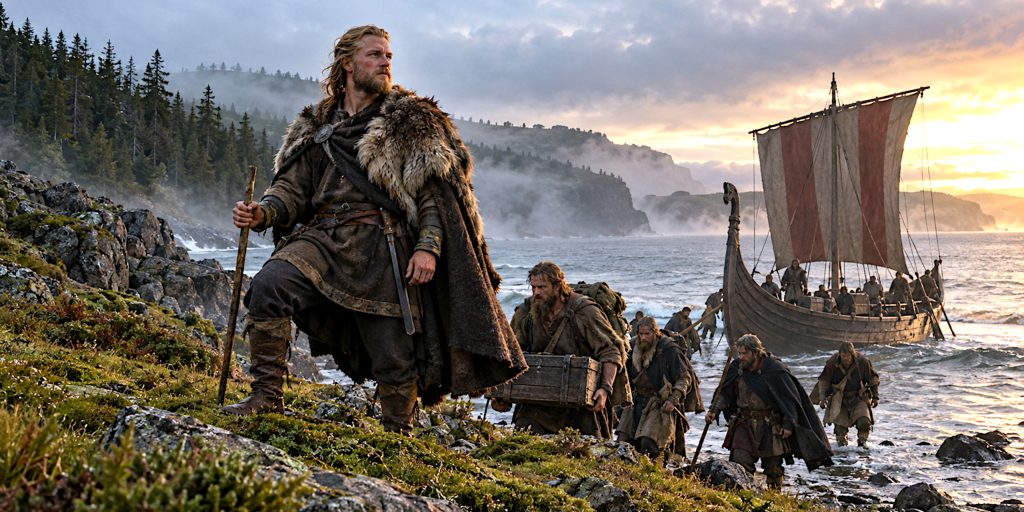
Lived: c. 970 to c. 1020
Principal achievement: Norse exploration of Vinland around 1000.
Leif Erikson belongs to the history of the North Atlantic world, where voyages connected Norway, Iceland and Greenland long before Columbus crossed the ocean.
The Vinland sagas associate him with journeys west of Greenland. They were written down centuries after the events, however, and disagree over important details. They are valuable evidence, but they are not a ship’s log with the coffee stains still attached.
Archaeology supplies the firmer foundation. The Norse remains at L’Anse aux Meadows in Newfoundland establish a European presence in North America in the early eleventh century. They do not identify Leif as the occupant of a particular building or settle every question about the extent of Vinland.
His significance is therefore precise: he is associated with an extraordinary Norse expansion across the Atlantic. That history neither begins the human history of the Americas nor diminishes the Indigenous societies already living there.
Marco Polo: The Traveller Who Made Asia Compelling
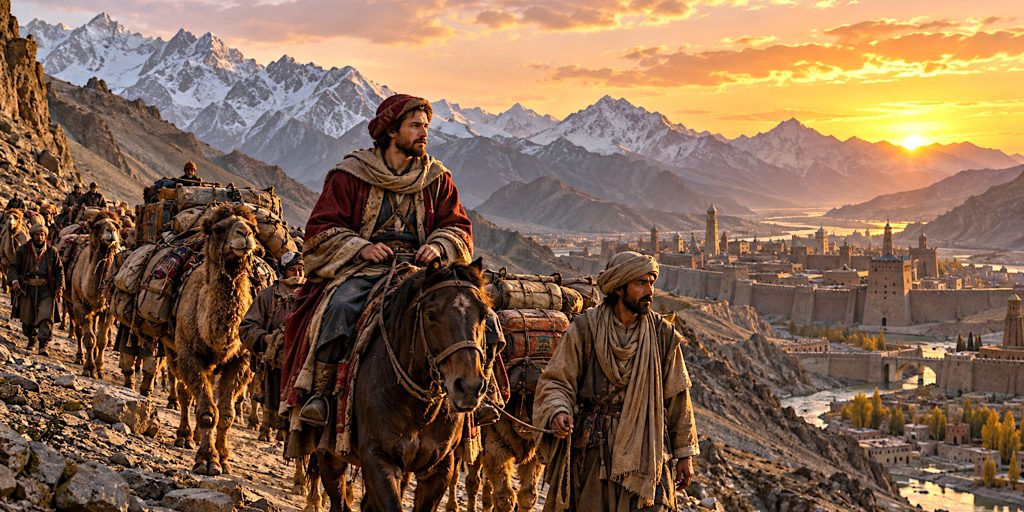
Lived: 1254 to 1324
Principal achievement: An influential description of Asia and the Mongol empire.
Marco Polo travelled east with his father and uncle in 1271 and returned to Venice in 1295. His account describes the court of Kublai Khan, commercial cities, long-distance trade and institutions unfamiliar to many European readers.
The book emerged through his collaboration with Rustichello of Pisa while Polo was imprisoned in Genoa. Its surviving versions differ, and the narrative mixes reported observation with stories learnt from others. Some claims, including the precise nature of his service to Kublai Khan, remain debated.
Yet dismissing the whole work as fantasy is no more convincing than treating every page as a sworn deposition. Its descriptions helped Europeans imagine an Asian world of considerable wealth, administrative sophistication and commercial reach.
Polo did not introduce Europe to an otherwise unknown Asia. Merchants, missionaries and earlier travellers had already crossed those routes. He produced one of the accounts that proved hardest to forget.
Ibn Battuta: A Pilgrimage That Lasted Nearly Three Decades
Lived: 1304 to c. 1368 or 1369
Principal achievement: An extensive account of travel across Africa and Asia.
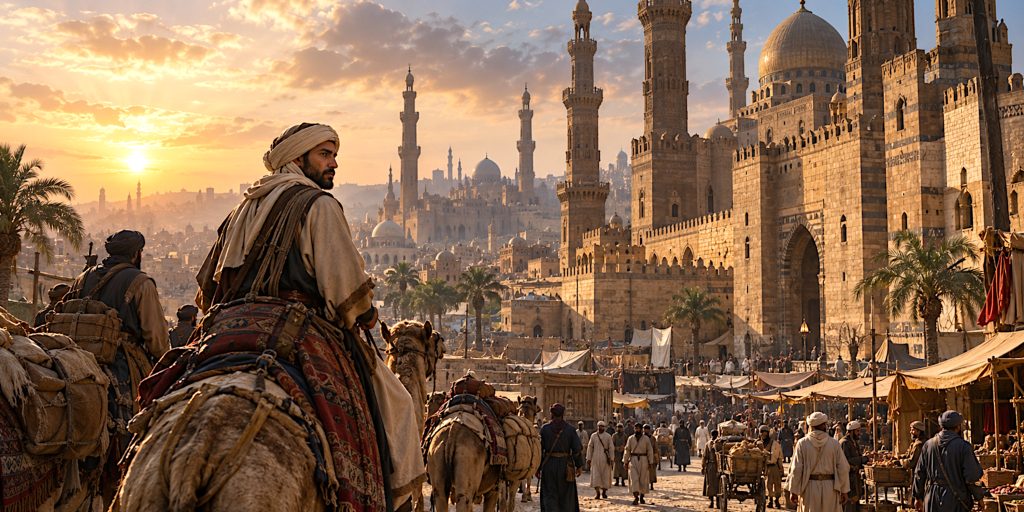
Ibn Battuta left Tangier in 1325 to perform the pilgrimage to Mecca. He subsequently travelled through much of the Islamic world, reached India and the Maldives, and described journeys into Southeast Asia and China. Later travels took him to Mali.
His opening recollection is unusually human:
‘I set out alone, finding no companion to cheer the way with friendly intercourse.’
The wording comes from H. A. R. Gibb’s English translation, reproduced in Fordham University’s excerpts from his Travels.
His Rihla, dictated after his return and shaped by the writer Ibn Juzayy, records courts, ports, religious life, hospitality and danger. It also carries the assumptions of a learned Muslim jurist judging unfamiliar customs.
Exact mileage estimates should be treated cautiously, as should some parts of the itinerary. What interests me most is the connected world his narrative reveals: a traveller could move enormous distances through networks of merchants, scholars, pilgrims and patrons. Medieval societies were quite capable of being cosmopolitan without waiting for a European ship.
Zheng He: Exploration as Imperial Diplomacy
Lived: 1371 to c. 1433
Principal achievement: Commanding seven major Ming expeditions between 1405 and 1433.
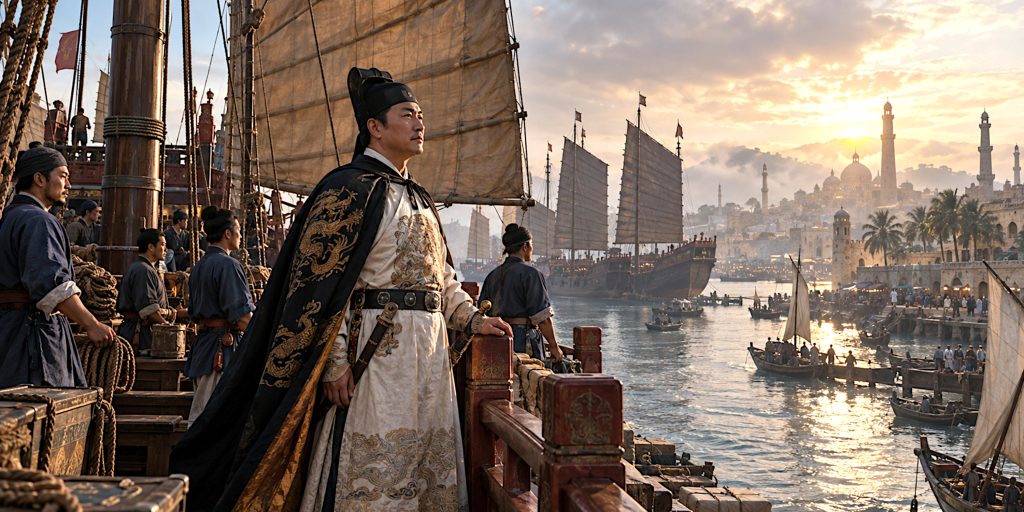
Zheng He’s fleets travelled through Southeast Asia and across the Indian Ocean, reaching ports in India, Arabia and East Africa. Their purpose included diplomacy, trade and the assertion of Ming imperial authority.
He had been captured as a child during the Ming conquest of Yunnan and entered court service as a eunuch. His later command illustrates how closely maritime expeditions could depend on the politics of a royal household.
These voyages used established trading routes and encountered experienced seafaring societies. They were not peaceful cultural exchanges on every occasion: the fleets also fought, intervened in local politics and used force to enforce imperial interests.
The enormous dimensions traditionally attributed to the largest treasure ships remain debated. The scale of the enterprise is impressive enough without requiring certainty about every spectacular measurement.
After the expeditions ended, official priorities shifted. China did not simply stop trading overseas, and the familiar story of a civilisation abruptly ‘turning inward’ conceals a more complicated maritime history.
Christopher Columbus: An Atlantic Turning Point with a Terrible Cost
Lived: 1451 to 1506
Principal achievement: Four Atlantic voyages that helped initiate sustained European expansion into the Americas.
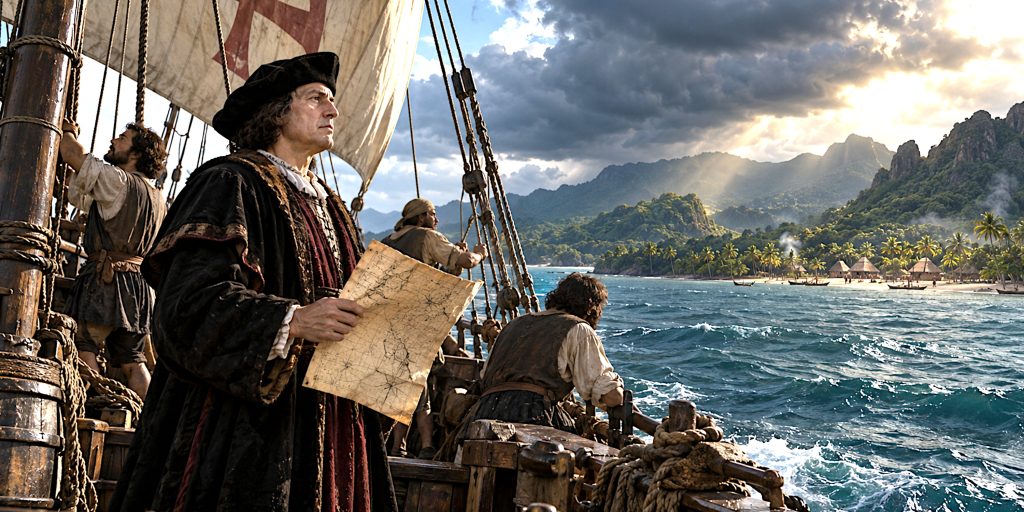
Columbus crossed the Atlantic in 1492 under the patronage of the Spanish monarchs, seeking a westward route to Asia. He reached the Caribbean and continued to interpret the lands he encountered within an Asian geographical framework.
His achievement lay in navigation and in establishing a crossing that Europeans would repeatedly exploit. It did not prove that the Earth was round, something educated Europeans already understood.
Nor did he discover an uninhabited world. His encounters took place within Indigenous societies with their own histories, political relationships and knowledge of the region. Subsequent voyages reached the mainland of South America and Central America, though not what is now the continental United States.
His colonial rule involved enslavement, coercion and violence. The wider expansion that followed brought devastating disease, dispossession and forced labour. Those consequences belong in the central account of his career, alongside the seamanship, rather than in a discreet paragraph after the applause.
Amerigo Vespucci: How a Traveller’s Name Became a Continent
Lived: 1454 to 1512
Principal achievement: Helping publicise the idea that lands across the Atlantic formed a world distinct from Asia.
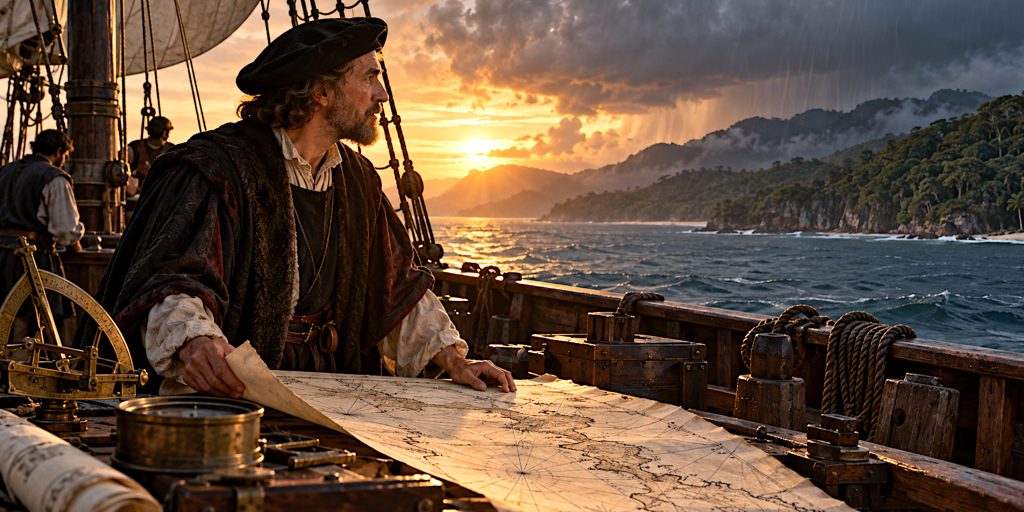
Vespucci participated in voyages along the Atlantic coast of South America around the turn of the sixteenth century. Accounts circulated under his name encouraged European readers to understand these lands as a ‘New World’.
The evidence requires care. Scholars have long disputed the authenticity and details of some letters, particularly claims about a voyage beginning in 1497. A tidy itinerary can make a messy documentary record look more certain than it is.
In 1507, the cartographer Martin Waldseemüller’s world map applied the name ‘America’ to the southern landmass, drawing on the Latin form of Vespucci’s first name.
Vespucci’s lasting fame demonstrates the power of publication. Crossing an ocean mattered, but so did persuading the people who wrote the labels.
Ferdinand Magellan: The Expedition He Did Not Live to Complete
Lived: c. 1480 to 1521
Principal achievement: Leading the opening stages of the first expedition to circumnavigate the Earth.
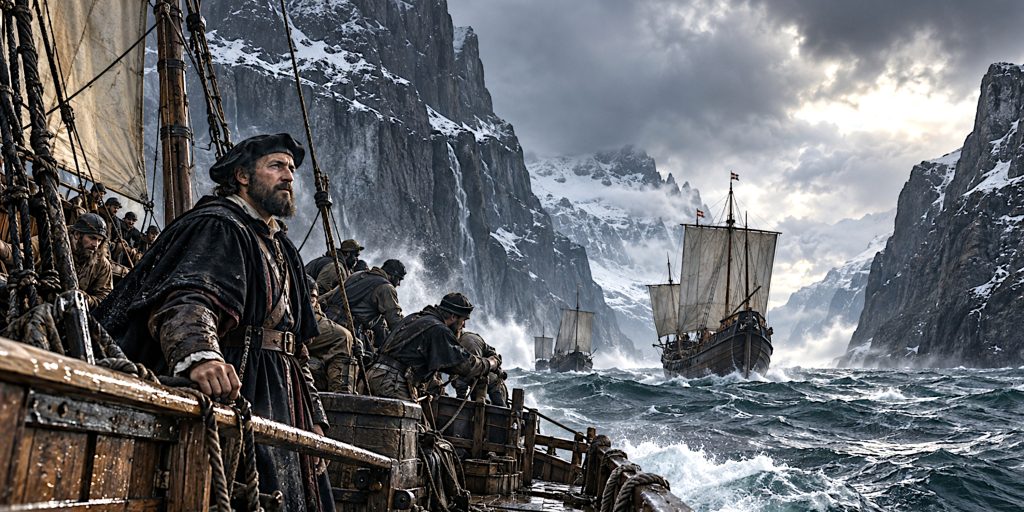
Ferdinand Magellan departed Spain in 1519 with five ships, seeking a westward route to the Spice Islands. His expedition passed through the strait now bearing his name and entered the Pacific.
The crossing exposed the vastness of that ocean through hunger, illness and dwindling supplies. The name ‘Pacific’ describes the conditions Magellan initially encountered, rather than a promise the sea has felt obliged to honour.
Magellan died at Mactan in the Philippines in 1521 after becoming involved in local political and military struggles. He never completed the voyage.
Juan Sebastián Elcano commanded the Victoria on its return to Spain in 1522, with eighteen men aboard. Credit for the circumnavigation belongs to the surviving expedition as well as its original commander. Its significance was practical demonstration of a global sea circuit, not the discovery that the planet was spherical.
Hernán Cortés: Why ‘Explorer’ Is an Incomplete Description
Lived: 1485 to 1547
Principal achievement: Leading the Spanish campaign that overthrew the Mexica empire.
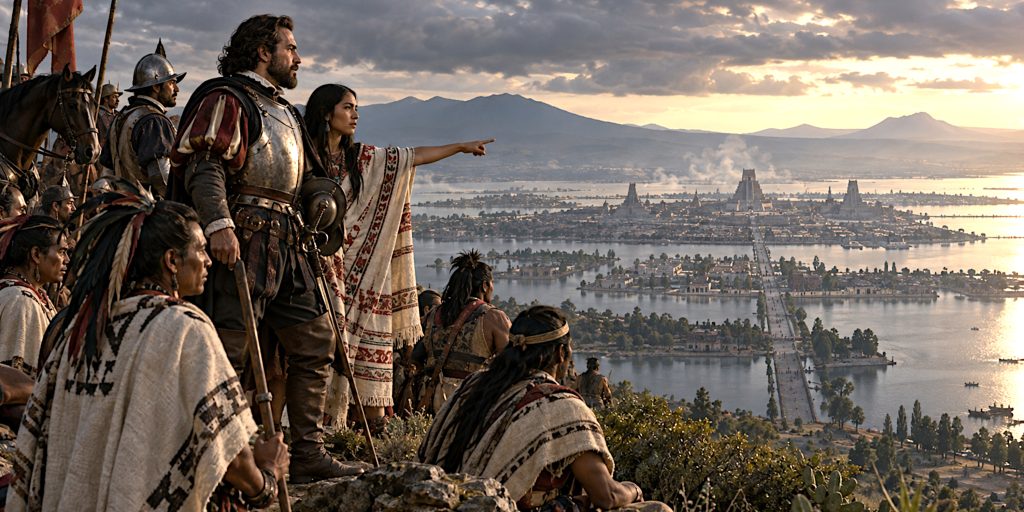
Hernán Cortés reached Mexico in 1519 and became central to the campaign that ended with the fall of Tenochtitlan in 1521. He later supported and undertook further expeditions, including ventures towards the Pacific coast and Baja California.
Nevertheless, conquest is the defining fact of his career. Calling him an explorer without that qualification makes the violence sound like an unfortunate interruption to a walking holiday.
The Spanish victory depended heavily on Indigenous allies, including the Tlaxcalans, whose aims cannot be reduced to serving Cortés. Malintzin, also known as Doña Marina, played a crucial role as an interpreter and intermediary. Epidemic disease further transformed the balance of power.
The familiar image of a tiny Spanish force defeating an empire by itself is inadequate. This was a war involving rival Indigenous powers, political calculation, siege warfare and catastrophic suffering. Cortés’s own accounts were also arguments for royal favour, which gives us a good reason to read them critically.
James Cook: Precision, Science and Imperial Power
Lived: 1728 to 1779
Principal achievement: Three major Pacific voyages combining surveying, navigation and scientific investigation.
James Cook produced detailed surveys of New Zealand and Australia’s eastern coast, travelled extensively through the Pacific and crossed the Antarctic Circle.
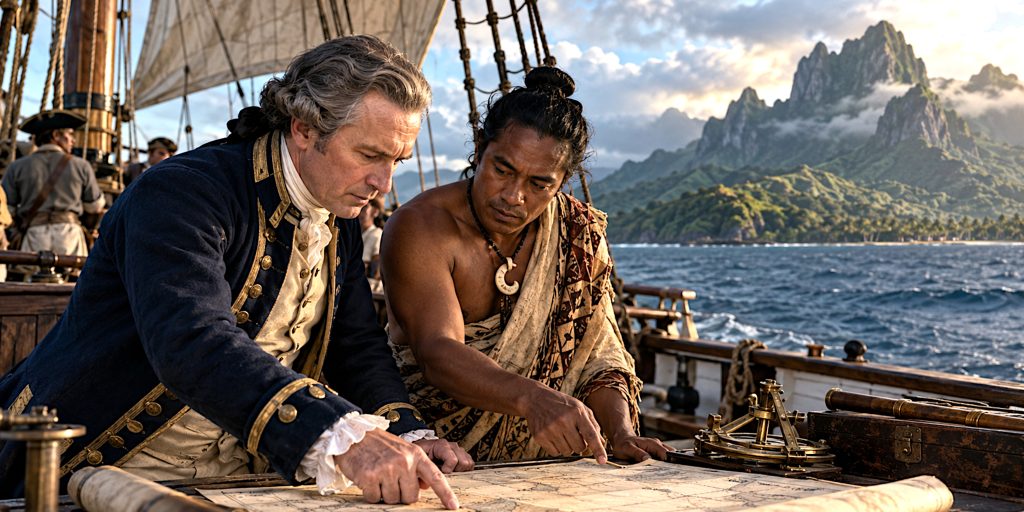
His expeditions advanced European geographical knowledge and carried naturalists and artists whose records remain significant. They also depended on knowledge supplied by Pacific peoples. Tupaia, the Ra‘iatean navigator and priest who joined the first voyage, deserves particular recognition.
Cook expressed his ambition in his journal:
‘as far as I think it possible for a man to go’
The passage is quoted by Te Papa, the Museum of New Zealand.
His surveys and territorial claims served British imperial interests. Encounters involved negotiation and exchange, but also coercion and violence. He was killed at Kealakekua Bay in Hawai‘i in 1779 during a confrontation that followed his attempt to seize the Hawaiian ruler Kalani‘ōpu‘u.
Cook’s technical ability is clear. Assessing his legacy requires equal attention to the societies whose shores became entries in British charts.
David Livingstone: The Explorer Behind the Victorian Reputation
Lived: 1813 to 1873
Principal achievement: Extensive journeys in Southern and Central Africa and campaigning against the slave trade.
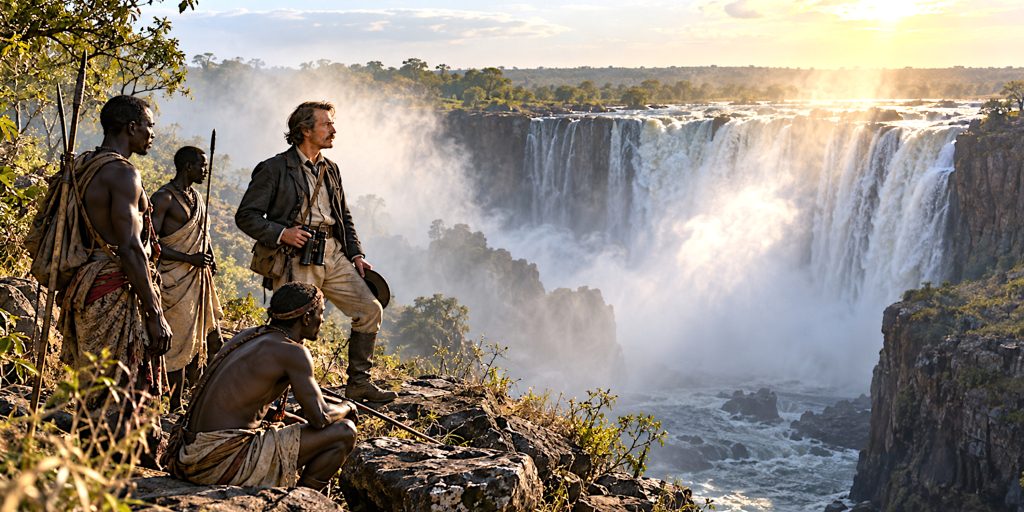
Livingstone combined missionary ambitions with geographical investigation. His travels helped bring African rivers, lakes and routes to wider European attention. In 1855 he visited the falls known locally as Mosi-oa-Tunya, naming them Victoria Falls.
He opposed the slave trade and hoped commerce and Christianity would help undermine it. Those convictions coexisted with paternalistic assumptions and a programme that encouraged greater European involvement in Africa.
His expeditions relied on African guides, interpreters and travelling companions. Susi and Chuma were particularly important during his final years and after his death. The solitary Victorian hero is a poor description of work made possible by so many other people.
Livingstone’s search for the Nile’s sources also produced mistaken geographical conclusions. I find that worth retaining: influence and persistence do not make an explorer’s every inference correct.
Roald Amundsen: Polar Success Built on Preparation
Lived: 1872 to 1928
Principal achievement: Leading the first expedition to reach the South Pole on 14 December 1911.
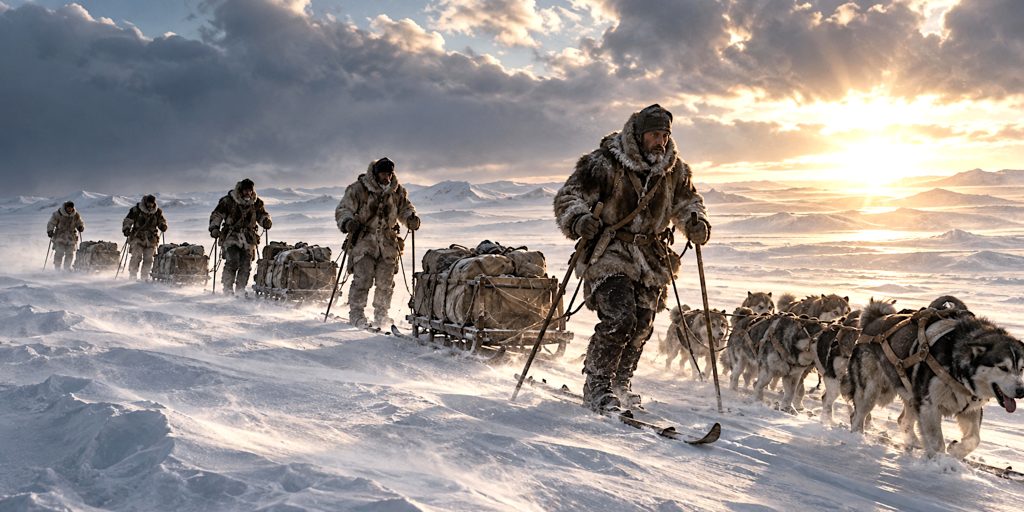
Amundsen had already completed the first navigation of the Northwest Passage aboard the Gjøa between 1903 and 1906. During his Arctic travels, he learnt from Inuit expertise in clothing, transport and survival.
His Antarctic expedition combined skilled skiing, dog teams, carefully established supply depots and disciplined planning. Four companions reached the Pole with him, and all five returned safely.
Robert Falcon Scott’s party arrived on 17 January 1912 and died during the return journey. The comparison should not become an easy morality tale. Weather, food, transport and physical exhaustion all mattered, and the circumstances of Scott’s disaster deserve their own examination.
Amundsen’s career is a reminder that learning from experienced people can be more valuable than displaying heroic determination. Cold is notably indifferent to national prestige.
Ernest Shackleton: When Survival Became the Achievement
Lived: 1874 to 1922
Principal achievement: Bringing all twenty-eight men of the Endurance ship’s party home alive.
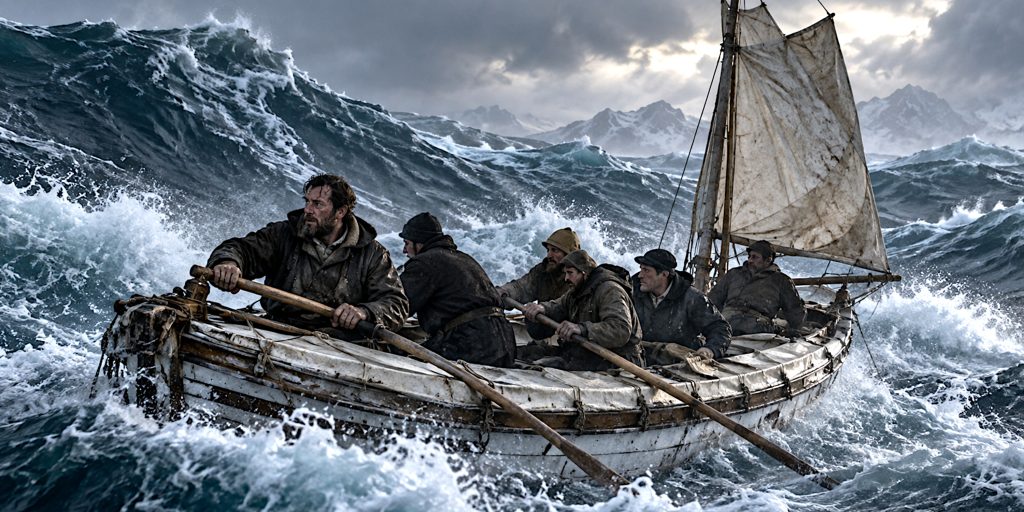
Shackleton’s Imperial Trans-Antarctic Expedition aimed to cross Antarctica. Instead, Endurance became trapped in the Weddell Sea and was crushed by ice in 1915.
The men eventually reached Elephant Island. Shackleton and five companions then sailed the small boat James Caird to South Georgia. He, Frank Worsley and Tom Crean crossed the island’s mountainous interior to reach help. The remaining men on Elephant Island were rescued in August 1916.
In his 1919 account, South, Shackleton wrote:
‘We had pierced the veneer of outside things.’
The achievement remains extraordinary, although the wider expedition was not without fatalities. Three members of its separate Ross Sea party died, a fact often lost when the story is reduced to the survival of Endurance’s crew.
Shackleton failed to accomplish the planned crossing. His fame rests on recognising that keeping people alive had become the more urgent task.
What These Explorers Changed, and What the Famous Names Conceal
These lives span medieval travel, imperial expansion, scientific surveying and polar expeditions. They should not all be judged by the same measure. Ibn Battuta’s account of established societies, Cortés’s conquest and Amundsen’s journey across Antarctic ice represent very different kinds of undertaking.
For the wider setting of European maritime expansion, see our guide to the Age of Exploration.
What connects the twelve is their influence on how journeys were recorded and remembered. Their names reached books, maps and monuments. Many of the sailors, guides, interpreters and local experts who made those journeys possible received considerably less space.
I would rather keep that imbalance visible than replace the old heroic portraits with equally flat condemnations. Seamanship can be remarkable, a travel narrative illuminating, and an imperial project destructive. The evidence permits us to recognise all three without pretending the people involved were simple.