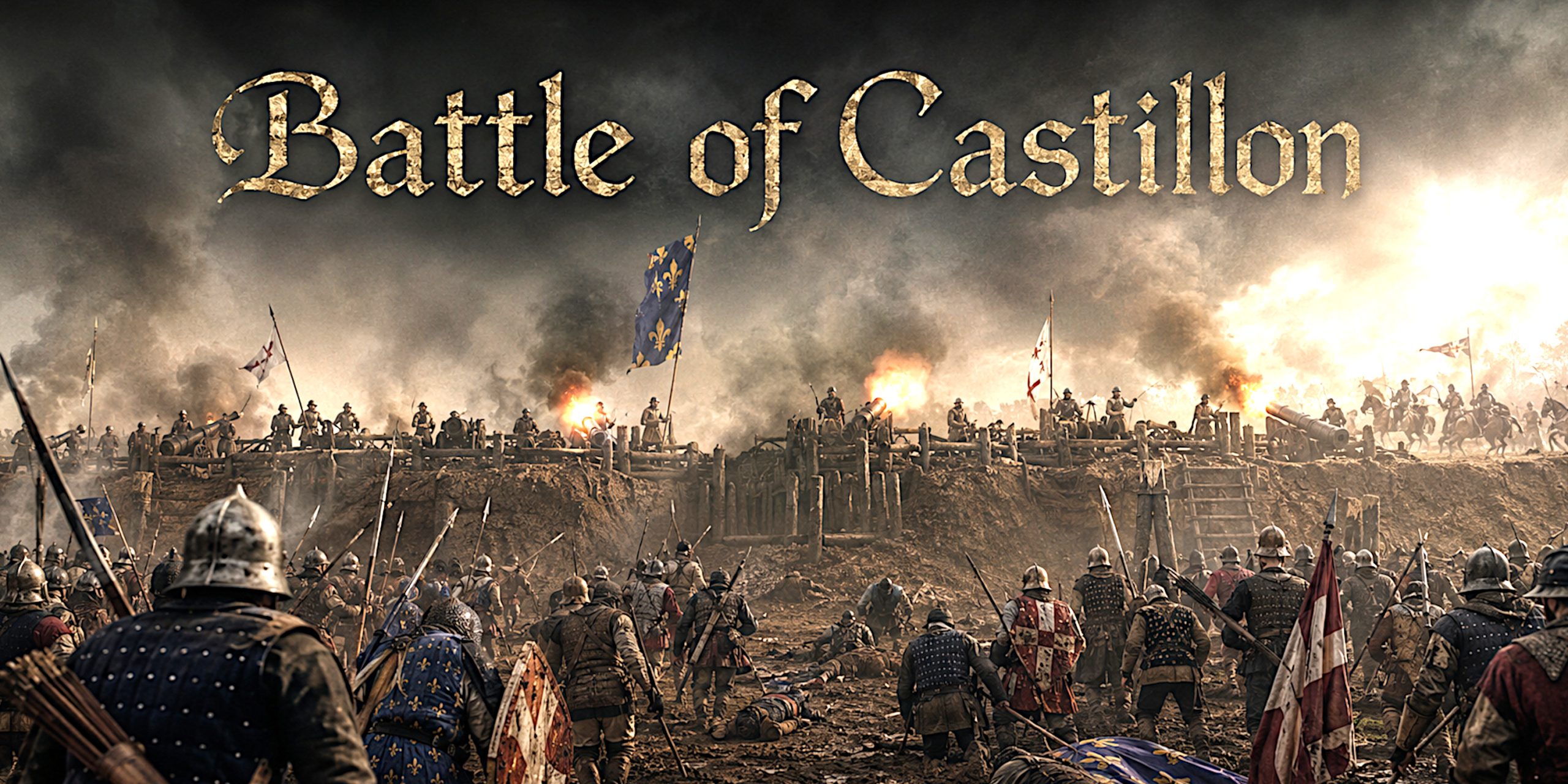
On 17 July 1453, an Anglo-Gascon army led by John Talbot attacked a fortified French position outside Castillon in Gascony. The assault was courageous, hurried and catastrophically misjudged.
Behind earthworks and trenches, French gunners commanded by the Bureau brothers waited with one of the largest concentrations of artillery yet assembled on a European battlefield. Their cannon tore into Talbot’s advancing troops while French archers, crossbowmen and men-at-arms defended the perimeter. A Breton cavalry attack eventually struck the exposed Anglo-Gascon flank and turned defeat into rout.
Talbot and his son were killed. English military power in Gascony collapsed with them.
Castillon is conventionally described as the final battle of the Hundred Years’ War. No peace treaty followed and England retained Calais, but the loss of Bordeaux three months later ended more than three centuries of Plantagenet rule in south-western France.
It was also a persuasive demonstration that gunpowder artillery had become more than a siege weapon. The age of the longbow was not suddenly over, but the French had built a battlefield around cannon and invited their enemy to enter it. Talbot duly obliged.
Battle of Castillon at a Glance
| Detail | Information |
|---|---|
| Date | 17 July 1453 |
| Location | Near Castillon-sur-Dordogne, now Castillon-la-Bataille, France |
| Wider conflict | Hundred Years’ War |
| Belligerents | Kingdom of France and Breton allies against England and its Gascon supporters |
| French commanders | Jean Bureau, Gaspard Bureau, André de Lohéac, Jean de Bueil and other royal captains |
| Breton commander | Peter II, Duke of Brittany, with field command associated with senior Breton nobles |
| Anglo-Gascon commander | John Talbot, 1st Earl of Shrewsbury |
| Result | Decisive French victory |
| Estimated French strength | Commonly placed between 7,000 and 10,000, including Breton reinforcements |
| Estimated Anglo-Gascon strength | Probably several thousand in total, although only part of the army was present when the attack began |
| Artillery | Possibly several hundred pieces of varying type and size |
| Anglo-Gascon losses | Heavy, with Talbot and many senior commanders killed or captured |
| French losses | Reportedly much lighter, although precise totals are not secure |
| Historical importance | Destroyed England’s field army in Gascony and prepared the way for the final French recovery of Bordeaux |
Medieval army figures are rarely obedient enough to sit neatly in a table. The numbers above should be treated as informed estimates, not audited returns from a fifteenth-century quartermaster.
Why Was the Battle of Castillon Fought?
The roots of the campaign reached back far beyond 1453. English kings had ruled extensive territories in south-western France since the marriage of Henry II and Eleanor of Aquitaine in 1152. By the fifteenth century, those possessions had contracted considerably, but Bordeaux and much of Gascony retained strong commercial, political and cultural connections with England.
The wine trade mattered enormously. Bordeaux exported large quantities of wine to England, while local elites had grown accustomed to governing themselves beneath a distant English crown. Their loyalty was not simply imposed by foreign occupation. Many Gascons believed English rule protected their privileges and prosperity.
During the final years of the Hundred Years’ War, Charles VII transformed the French war effort. Royal finances became more dependable, permanent companies of troops were established and artillery was organised with growing professionalism. French armies recovered Normandy in 1450 and conquered English-held Gascony in 1451.
Bordeaux surrendered to the French in June 1451. The new settlement proved unpopular with sections of the local population, who appealed to Henry VI for assistance.
England answered by sending John Talbot.
Talbot’s Return to Gascony
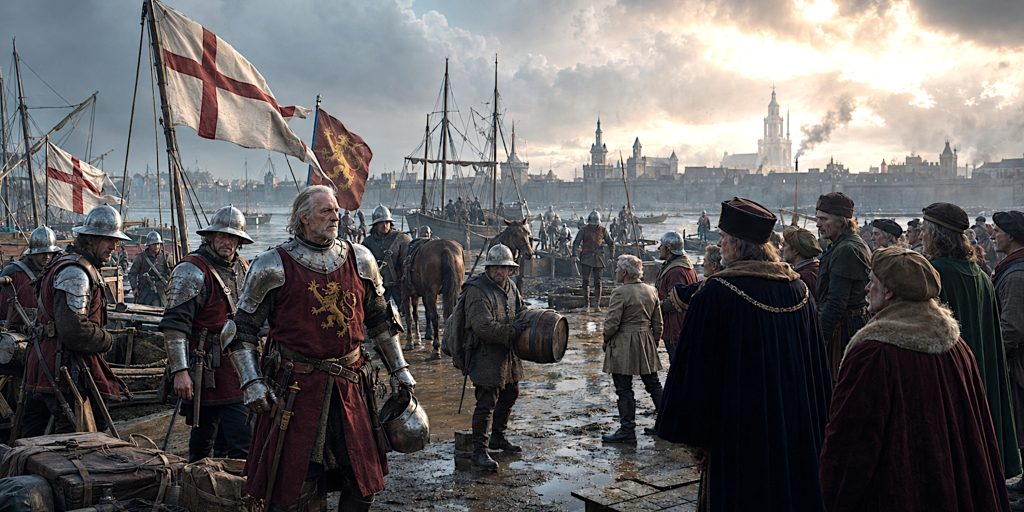
Talbot landed near Bordeaux in October 1452 with an expeditionary force usually estimated at around 3,000 men. His arrival encouraged a local uprising, and Bordeaux opened its gates to him. Much of western Gascony soon returned to Anglo-Gascon control.
It was an impressive recovery, but the position remained precarious. England lacked the money and manpower needed to match the resources Charles VII could now command. Talbot had regained Bordeaux through speed, reputation and local support. Holding it against a coordinated French counteroffensive would be another matter.
Charles VII prepared three armies for the campaign of 1453. They approached Gascony from different directions, reducing the possibility that Talbot could defeat them individually or defend every threatened town.
One French force advanced upon Castillon, an important settlement east of Bordeaux on the River Dordogne. The siege began in early July. Appeals for relief reached Talbot, who left Bordeaux rather than wait for all the reinforcements available to him.
The decision was understandable. Castillon’s defenders needed help and Talbot’s aggressive methods had served him well for decades. Yet the French position outside the town was unlike the field armies he had repeatedly harassed and outmanoeuvred. This time, the enemy had chosen the ground and prepared it carefully.
The Battlefield and French Artillery Park
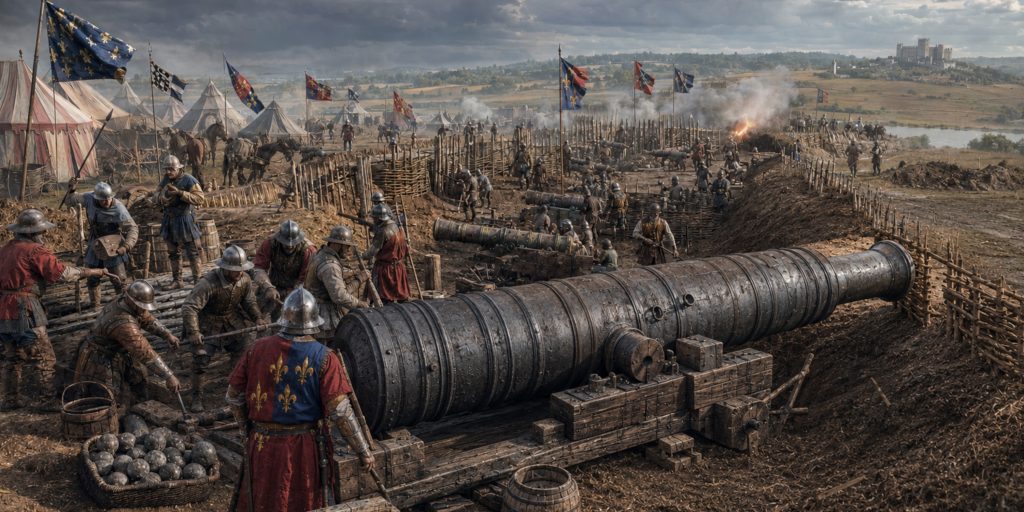
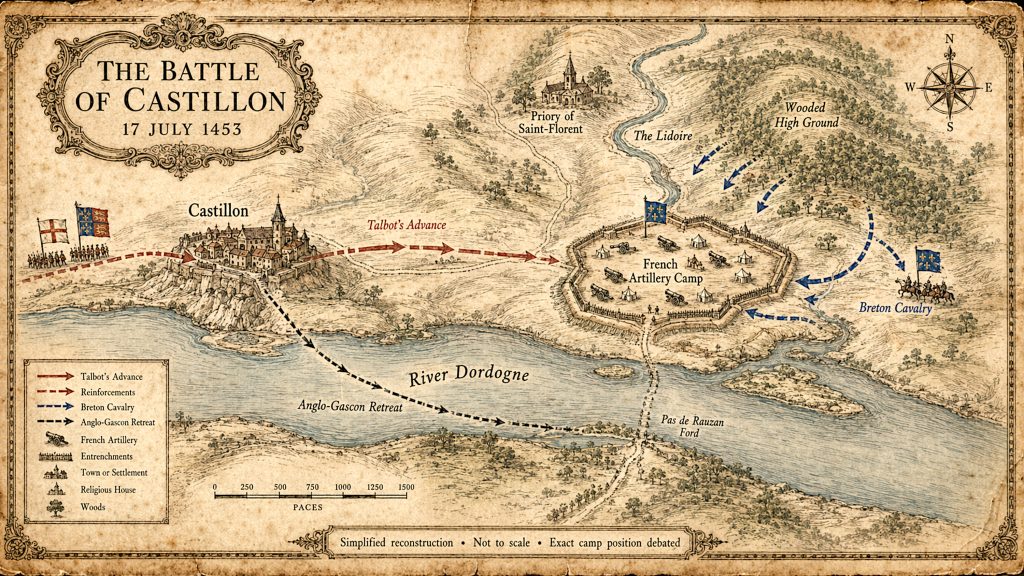
The battle was fought close to the Dordogne and its tributary, the Lidoire. The exact position and shape of the French camp remain subjects of debate because the local waterways and landscape have changed since the fifteenth century.
The traditional reconstruction places the French artillery park east of Castillon, protected by the Lidoire on one side and by artificial defences elsewhere. Trenches, earthen banks, timber obstacles and a palisade enclosed the position. Its irregular outline may have allowed cannon to cover neighbouring sections of the perimeter with flanking fire.
Inside stood a formidable collection of gunpowder weapons:
- Large bombards capable of firing heavy stone or iron projectiles
- Medium-sized cannon suited to sustained bombardment
- Smaller breech-loading guns
- Serpentines and other relatively mobile pieces
- Handguns operated by individual soldiers
- Powder wagons, ammunition stores and specialist equipment
The celebrated figure of 300 guns appears frequently in accounts of Castillon. It may include handguns and small pieces as well as substantial cannon. Whatever the exact total, the French possessed enough artillery to cover the approaches to their camp and maintain an intense volume of fire.
This was not a row of cannon left exposed in a field. Jean and Gaspard Bureau integrated the guns with fortifications, infantry and cavalry support. The artillery park was effectively a temporary fortress designed to conduct a siege while surviving an enemy relief attempt.
Leaders and Commanders
French and Breton Commanders
| Commander | Position and role |
|---|---|
| Jean Bureau | Charles VII’s senior artillery specialist and a central figure in arranging the French guns |
| Gaspard Bureau | Master of the royal artillery and closely involved in its deployment and operation |
| André de Lohéac | Marshal of France and an experienced commander in the Gascon campaign |
| Jean de Bueil | Veteran French captain sometimes called the “scourge of the English” |
| Jacques de Chabannes | Senior French commander and experienced soldier |
| Peter II, Duke of Brittany | Supplied a substantial Breton contingent to the French campaign |
| Jean de Montauban | Breton commander associated with the cavalry reserve |
| Gilles de la Hunaudaye | Breton noble connected with the mounted force deployed beyond the main camp |
It is tempting to present Jean Bureau as the sole French commander, particularly because the artillery dominates modern accounts. Command in royal armies was often shared between senior captains, however, and recent scholarship has questioned how far Bureau exercised overall authority. His importance is beyond doubt. His precise position in the chain of command is less certain.
Anglo-Gascon Commanders
| Commander | Position and role |
|---|---|
| John Talbot, 1st Earl of Shrewsbury | Commander of the English expedition and one of the most experienced soldiers of the war |
| John Talbot, Viscount Lisle | Talbot’s son, who arrived with reinforcements and died in the battle |
| John de Foix, Earl of Kendal | Gascon noble and English commander involved in the relief force |
| Thomas Evringham | Veteran retainer and military associate of Talbot |
| Gaillard IV de Durfort | Prominent pro-English Gascon noble involved in raising resistance, although his presence in the battle itself is uncertain |
| Local Gascon captains | Supplied troops and intelligence in support of Talbot’s expedition |
Talbot’s reputation was immense. He had spent decades campaigning in France and was feared for his speed, aggression and willingness to strike before an opponent was prepared. At Castillon, those qualities helped carry him towards a position prepared expressly to punish a rapid attack.
Forces and Troop Composition
French and Breton Army
| Troop type | Approximate role |
|---|---|
| Men-at-arms | Defended the earthworks and formed reserves for close combat |
| Francs-archers and other bowmen | Provided missile support around the camp |
| Crossbowmen | Engaged attackers from protected positions |
| Handgunners | Supplemented the artillery with close-range gunpowder fire |
| Artillery crews | Operated bombards, cannon and smaller guns |
| Pioneers and labourers | Built trenches, banks, gun platforms and siege works |
| Breton cavalry | Held away from the main enclosure before attacking the Anglo-Gascon flank |
| Camp followers and support personnel | Managed transport, supplies, animals and camp services |
Modern estimates commonly place the main French force between 7,000 and 9,000 men, with perhaps another 1,000 Bretons nearby. The totals vary considerably between accounts.
Anglo-Gascon Army
| Troop type | Approximate role |
|---|---|
| English men-at-arms | Formed the armoured centre of Talbot’s force |
| Gascon men-at-arms | Local mounted or dismounted troops loyal to the English crown |
| Longbowmen | Provided missile support and close protection |
| Other archers | Included Gascon and locally recruited bowmen |
| Infantry | Followed the initial mounted column and reinforced the assault |
| Mounted retainers | Allowed Talbot’s advance force to move rapidly from Bordeaux |
| Town levies and local supporters | Joined the campaign in varying numbers |
Talbot reportedly reached the vicinity with an advance force of roughly 500 men-at-arms and 800 mounted archers. The remainder followed in separate bodies. This staggered march became a serious liability once battle began. Reinforcements arrived without the time or space needed to form a single coordinated army.
The total Anglo-Gascon strength may have reached between 5,000 and 7,000, although larger estimates exist. The more important point is that Talbot did not have all of them assembled when he committed to the attack.
Arms and Armour
Castillon stood at the meeting point of mature late-medieval arms and increasingly effective gunpowder technology. Cannon decided the tactical contest, but most soldiers still carried weapons that would have been familiar to earlier generations.
Men-at-Arms
Wealthy men-at-arms wore plate armour over an arming doublet, supplemented by mail at vulnerable joints. Equipment varied according to status and personal means.
Typical protection included:
- Sallets, armets or other enclosed helmets
- Breastplates and backplates
- Plate pauldrons and arm defences
- Gauntlets
- Cuisses, poleyns and greaves
- Mail voiders protecting the armpits and other gaps
- Padded garments beneath the plate
- Shields, though these had become less common among fully armoured men fighting on foot
Their principal weapons included lances, poleaxes, maces, war hammers and swords.
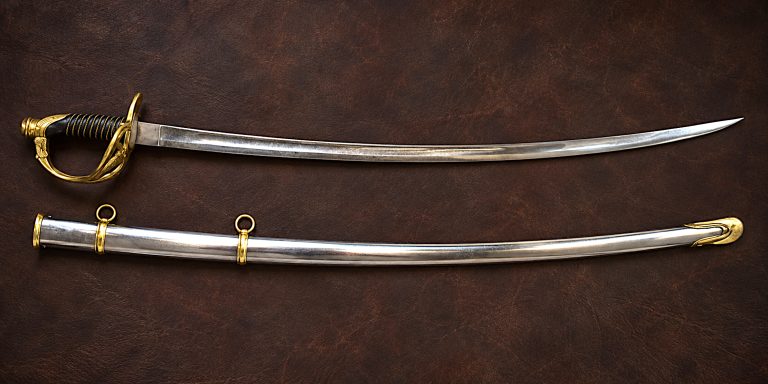
Swords Used at Castillon
| Sword type | Characteristics and likely use |
|---|---|
| Arming sword | A one-handed, double-edged weapon carried by men-at-arms and wealthier soldiers |
| Oakeshott Type XV | Strongly tapered blade with an acute point, well suited to thrusting into gaps in plate armour |
| Oakeshott Type XVIII | Tapering, often stiff diamond-section blade combining effective cutting with a strong point |
| Longsword | Two-handed or hand-and-a-half weapon used for cutting, thrusting and armoured close combat |
| Falchion | Single-edged cutting sword, less prestigious than some knightly swords but formidable in close action |
| Messer-type weapon | Single-edged sidearm used in parts of continental Europe |
| Estoc | Stiff, narrow thrusting weapon designed to attack the openings and joints of armour |
Swords were essential sidearms but not necessarily the first choice against a fully armoured opponent. A poleaxe, hammer or mace delivered greater force. The sword remained valuable once formations broke down, when combat moved into trenches or when a soldier lost his primary weapon.
English and Gascon Archers
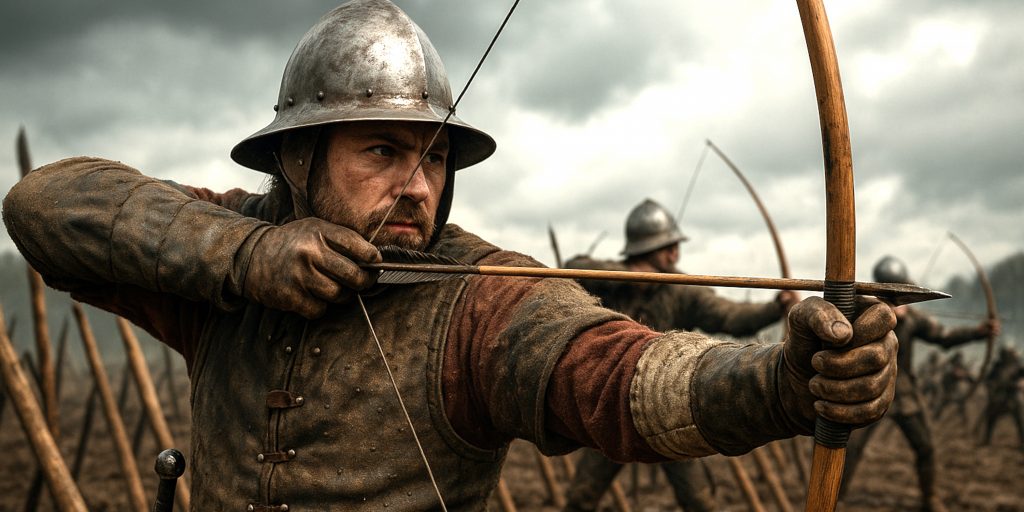
Longbowmen carried powerful self bows, usually of yew where good material was available. Their equipment could include:
- Longbow and arrows
- Sword, falchion or large knife
- Buckler
- Brigandine or padded jack
- Sallet or kettle hat
- Mail collar or limited plate protection
The English longbow had helped win earlier victories at Crécy, Poitiers and Agincourt. At Castillon, the archers were advancing against entrenched guns rather than receiving cavalry from a prepared defensive line. History has a rather unsentimental way of changing the conditions of the examination.
French Missile Troops and Gunners
French archers and crossbowmen operated from behind fieldworks. Crossbows offered powerful, accurate fire, while handguns added noise, smoke and lethal close-range shot.
Artillery crews used tools for loading, aiming, cooling and clearing their weapons. Rates of fire varied considerably. Larger guns were slow, but smaller pieces could fire more frequently. Working together, they created overlapping zones of danger in front of the earthworks.
The Advance from Bordeaux
Talbot left Bordeaux on 16 July and moved towards Libourne. His mounted advance guard outpaced much of the army. Early on 17 July, the Anglo-Gascons attacked a French detachment near the Priory of Saint-Florent, driving it away and killing or scattering many of its troops.
This first success had an unfortunate effect. It encouraged the belief that the French were already withdrawing.
Reports then reached Talbot that dust was rising beyond the French position. Observers interpreted it as evidence that the army was abandoning its camp. The dust may instead have come from camp followers, wagons and non-combatants being moved out of danger before the expected battle.
Talbot pressed forward without waiting for the whole of his army. Reconnaissance appears to have been inadequate, although the precise sequence is difficult to reconstruct from the surviving accounts. When the Anglo-Gascons reached the French camp, they found an entrenched army rather than a retreating one.
Talbot now faced an unpleasant choice. He could attempt to disengage in front of an enemy that had seen him approach, or attack before the French could respond beyond their earthworks. He chose to attack.
The Battle Begins
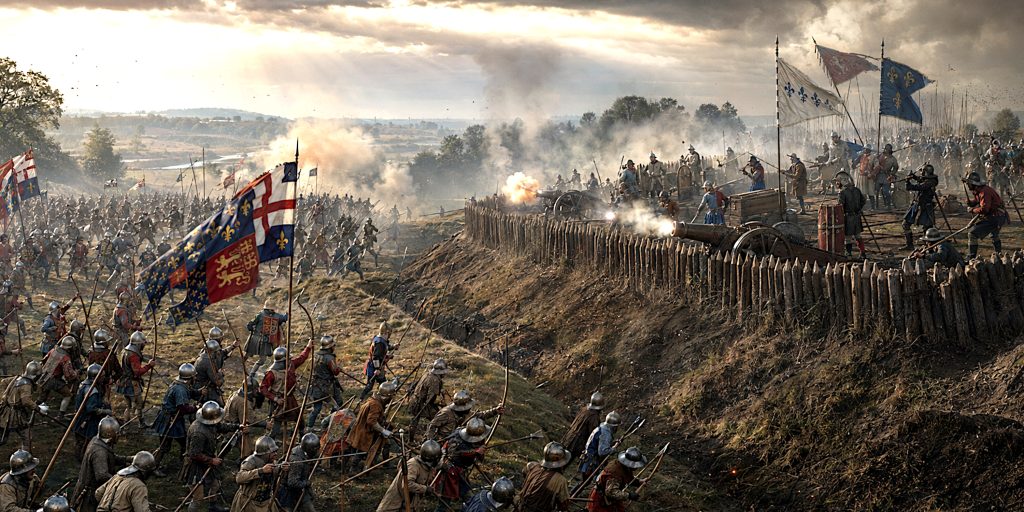
The Anglo-Gascons advanced across open ground towards the French perimeter. Cannon opened fire from behind the earthworks.
Heavy shot smashed through men and horses. Smaller guns, handguns, bows and crossbows added to the barrage. Smoke drifted across the position while noise and dust made control increasingly difficult.
The attackers continued towards the trenches. Some may have reached the outer defences and fought at the parapet, which suggests the assault was not simply a helpless march into gunfire. English and Gascon troops were experienced, aggressive and capable of pressing an attack under appalling conditions.
Yet the French position gave its defenders every advantage:
- The attackers had to cross exposed ground
- Trenches disrupted momentum and formation
- Earthen banks protected the gunners
- Infantry guarded the artillery at close quarters
- French weapons covered the approaches from several directions
- Anglo-Gascon reinforcements arrived in separate groups
- Talbot lacked time to coordinate a general assault
Each fresh body of troops was drawn into the same killing ground. Rather than turning the balance, the reinforcements prolonged the disaster.
The Breton Cavalry Attack
The decisive final movement came from the French-allied Breton cavalry positioned away from the artillery park.
Once Talbot’s army was fully committed against the earthworks, the Bretons advanced against its flank and rear. The Anglo-Gascons were already disordered by artillery fire and close fighting. The cavalry charge removed any realistic prospect of an organised withdrawal.
The assault collapsed. Soldiers fled towards Castillon, the Dordogne and nearby crossings. Many were killed during the pursuit, while others were captured or drowned.
French troops then emerged from their defences to complete the rout.
The guns had weakened and disorganised the attackers, but artillery did not act alone. Earthworks kept the weapons in action, infantry prevented their capture and cavalry delivered the final blow. Castillon was a combined-arms victory before the term had acquired its modern polish.
The Death of John Talbot
Talbot died during the collapse of the Anglo-Gascon attack. His son, John, Viscount Lisle, was also killed.
Several accounts describe Talbot’s horse being struck by artillery, pinning or throwing him to the ground. A French soldier then killed him, perhaps with an axe or another close-combat weapon. The details vary and were embellished as the story passed into chronicle and legend.
Talbot may have entered the battle without his usual armour. This is sometimes explained through the terms imposed after an earlier period of French captivity, although that tradition should be treated cautiously. He was reportedly the only English commander to remain mounted during the principal assault, making him conspicuous amid troops fighting largely on foot.
His death carried enormous symbolic weight. Talbot had become the personification of the English war in France. French writers knew him as a dangerous and relentless adversary, while Gascon supporters remembered him with considerable affection.
Shakespeare later made him the doomed hero of Henry VI, Part 1, although the play compressed and reshaped events for dramatic effect. Talbot’s actual end required little theatrical assistance. An ageing commander, his son and the remains of England’s continental army were destroyed within sight of one another.
Casualties and Prisoners
Exact casualty figures cannot be recovered with confidence. Later estimates sometimes claim around 4,000 Anglo-Gascon troops were killed, wounded or captured. Such totals may be exaggerated, but the losses were unquestionably severe.
Those killed or captured included senior nobles, experienced soldiers and members of Talbot’s personal affinity. The destruction of leadership mattered almost as much as the loss of manpower.
French casualties appear to have been considerably lower. Their troops fought mainly from protected positions until the closing stages, while their cavalry entered once the attackers had already suffered heavily.
Survivors fled into Castillon or scattered across the surrounding countryside. The town and its castle could not reverse the outcome.
Battle Timeline
| Date and stage | Event |
|---|---|
| June 1451 | Bordeaux surrenders to Charles VII’s forces |
| October 1452 | Talbot lands in Gascony and recaptures Bordeaux |
| Late 1452 | Much of western Gascony returns to Anglo-Gascon control |
| Spring 1453 | Charles VII launches a coordinated invasion with several armies |
| Early July 1453 | French troops besiege Castillon |
| 16 July | Talbot leaves Bordeaux and advances through Libourne |
| Morning, 17 July | His advance force defeats French troops near Saint-Florent |
| Late morning | Reports suggest that the French are retreating |
| Around midday | Talbot approaches the fortified artillery park without his full army |
| Early battle | Anglo-Gascon troops attack across exposed ground under cannon fire |
| Main engagement | Reinforcements arrive in separate groups and join the assault |
| Final phase | Breton cavalry strikes the Anglo-Gascon flank |
| Collapse | Talbot and his son are killed; the army breaks and retreats |
| 18 to 19 July | Castillon’s remaining defenders surrender |
| 19 October 1453 | Bordeaux capitulates to Charles VII |
| After 1453 | England retains Calais but loses its remaining territories in Gascony |
The exact hours assigned to individual movements vary between reconstructions. The battle probably unfolded over a relatively short but ferocious period rather than lasting throughout the day.
Contemporary Accounts and Quotations
Contemporary and near-contemporary sources describe an unusually large French artillery train. Jean Chartier, chronicler of Charles VII, referred to:
“Many great bombards, great cannon, veuglaires, serpentines, crapaudins, ribaudequins and culverins.”
This translation preserves the bewildering catalogue of fifteenth-century gun types. Some names described a weapon’s size or construction, while others were used inconsistently. Medieval ordnance terminology was evidently designed to keep modern historians modest.
The Burgundian chronicler Georges Chastellain described Talbot in terms that captured his fearsome reputation:
“The English Achilles.”
The phrase concerns Talbot’s wider military career rather than serving as a detailed eyewitness description of Castillon. It nevertheless explains why his death resonated so powerfully on both sides.
News of the defeat travelled through letters and reports soon after the battle. These accounts emphasised Talbot’s death, the scale of the English disaster and the importance of the French guns. Their details do not always agree, and polished quotations frequently repeated online cannot always be traced securely to the chronicles attributed to them.
That caution matters. A colourful sentence is not made medieval simply by placing a chronicler’s name beneath it.
Archaeology and Evidence from the Battlefield
The archaeology of Castillon is complicated by changes to the local landscape. The Lidoire altered course, agricultural work reshaped the ground and later development obscured parts of the likely battlefield.
Several forms of evidence remain important:
Earthworks and Landscape Study
Historical maps, waterways, property boundaries and ground contours have been used to reconstruct the position of the French camp. The traditional site places the artillery park on the Colle plain near the Lidoire. Alternative interpretations argue for a position closer to Castillon itself.
The disagreement is significant because it affects the proposed direction of Talbot’s advance, the range of the artillery and the location of the Breton attack.
The Castillon Swords
A group of medieval swords associated with the Castillon area was reportedly recovered during dredging or gravel extraction from the Dordogne in the twentieth century. Many entered private collections, which has made systematic study difficult.
Weapons attributed to the group include:
- Tapering Type XV and Type XVIII swords
- One-handed arming swords
- Hand-and-a-half swords
- Blades optimised for both thrusting and cutting
- Examples with wheel or scent-stopper pommels
- At least some single-edged weapons
Their association with the battle is plausible but not automatically proven. Rivers accumulate objects through loss, transport, disposal and later disturbance. Provenance is particularly important when individual “Castillon” swords appear on the antiquities market.
Artillery Finds
Surviving cannon traditionally linked to the campaign provide evidence for the changing construction and mobility of mid-fifteenth-century artillery. Recent auction interest in pieces attributed to Castillon has also renewed attention on their documentation and provenance.
Cannonballs, metal fragments and related material can help identify areas of combat, but the battlefield has not produced the kind of comprehensive archaeological survey available for some later engagements.
Talbot Memorial
A monument near the traditional battlefield commemorates Talbot’s death. It preserves the local memory of the battle rather than marking a location proven beyond dispute.
His body was initially buried nearby before eventually being returned to England and interred at St Alkmund’s Church in Whitchurch, Shropshire.
Did Artillery Really Win the Battle?
Yes, but that answer requires qualification.
Castillon is often called the first major European battle won by field artillery. Cannon had been used in warfare for more than a century, however, and had already influenced battles and sieges. French guns contributed to victory at Formigny in 1450, while gunpowder weapons had appeared in engagements well before then.
What distinguished Castillon was the scale and organisation of their use.
The French did not drag siege guns into an open battle by accident. They built an entrenched position from which artillery could both prosecute the siege of Castillon and defeat a relieving army. The guns were supported by infantry, field engineering and a mobile cavalry reserve.
Talbot’s decisions made this system devastatingly effective. He attacked before his army had concentrated, relied upon uncertain reports of a retreat and committed successive reinforcements against prepared defences.
Artillery was decisive, but it worked because the French army was organised to protect and exploit it. Technology without discipline is merely an expensive way to make noise.
Why Did Talbot Attack?
Talbot’s decision has often been treated as reckless, even inexplicable. Several factors may have influenced him:
- His advance guard had already defeated a French detachment that morning
- Local reports suggested the French were retreating
- Dust beyond the camp appeared to confirm those reports
- Castillon’s garrison required immediate relief
- Anglo-Gascon reinforcements were expected to arrive shortly
- Withdrawal after approaching the enemy could have exposed his force
- Talbot’s reputation rested upon speed and aggressive action
- Delay would allow the French to strengthen their position further
None of this made the attack wise. It does make it comprehensible.
Talbot had built his career by forcing opponents to respond to him. At Castillon, Bureau and the other French commanders reversed that relationship. They prepared the ground, controlled the tempo and allowed Talbot’s aggression to become a weapon against his own army.
The Fall of Bordeaux
After the battle, French artillery resumed operations against Castillon. The remaining defenders surrendered within days.
Bordeaux was now isolated. Talbot was dead, the relief army had been shattered and no substantial English expedition was available to restore the situation. French forces tightened their hold around the city during the following months.
Bordeaux surrendered on 19 October 1453. Many members of the pro-English elite faced exile, confiscation or political punishment. Others accommodated themselves to Charles VII’s rule.
England retained Calais until 1558, but its great territorial dominion in France was finished.
Did Castillon End the Hundred Years’ War?
Castillon is widely accepted as the final major battle of the Hundred Years’ War, although the ending was less formal than the phrase suggests.
There was no comprehensive peace treaty in 1453. English monarchs continued to claim the French crown, and further English expeditions reached France in later decades. Calais remained under English control.
Even so, the fall of Bordeaux removed England’s last substantial territorial base in France. The political and military contest that had begun in the fourteenth century could no longer continue in its established form.
The conventional date of 1453 is therefore useful, provided it is understood as a historical boundary rather than a ceremonial closing of accounts.
Legacy of the Battle
Castillon mattered for several reasons.
The End of English Gascony
The Plantagenet connection with Aquitaine had survived dynastic crises, rebellions and repeated French campaigns. Its final collapse changed the political identity of south-western France and ended England’s status as a major territorial power on the continent.
The Rise of the French Monarchy
Charles VII emerged from the war with a strengthened royal government, a more permanent military establishment and highly effective artillery. France was increasingly able to raise, equip and coordinate forces on a national scale.
The Changing Nature of Warfare
The battle showed how artillery, earthworks and professional infantry could be combined in a prepared defensive system. Medieval warfare did not end at Castillon, but some of the methods associated with early modern armies were already clearly visible.
Political Crisis in England
Henry VI suffered a severe mental collapse later in 1453. Castillon was not the sole cause, and direct claims that news of the defeat triggered his illness cannot be proved. The loss of France nevertheless deepened dissatisfaction with his government.
Returning soldiers, displaced nobles, financial weakness and arguments over responsibility contributed to the unstable political climate preceding the Wars of the Roses.
Talbot’s Legend
Talbot became a symbol of lost English France. His military reputation survived the defeat, helped by chroniclers, family memory and later literature.
There is a melancholy quality to his end. He had spent much of his life sustaining a dominion England could no longer afford to defend. At Castillon, personal courage met an army that had become better financed, better organised and rather better supplied with cannon.
Where to Visit
The modern town of Castillon-la-Bataille lies around 40 kilometres east of Bordeaux.
Visitors can explore:
- The landscape around the Dordogne and Lidoire
- The traditional site of the French artillery park
- The Talbot memorial at Lamothe-Montravel
- Castillon-la-Bataille and its local historical displays
- Bordeaux, the political and commercial centre of English Gascony
- Whitchurch in Shropshire, where Talbot was ultimately buried
The annual Bataille de Castillon historical spectacle uses theatre, horses and large-scale staging to retell the events of 1453. It is a performance rather than a battlefield reconstruction in the strict academic sense, but it demonstrates how strongly the battle remains embedded in local identity.
Takeaway
The Battle of Castillon was not simply an old-fashioned English army swept aside by futuristic French technology. Both sides used weapons, armour and tactics developed over generations of late-medieval warfare.
The difference lay in preparation.
French commanders enclosed their artillery within a defended field position, coordinated it with missile troops and kept cavalry ready beyond the main camp. Talbot arrived before his army was fully concentrated, accepted a mistaken report of retreat and attacked across ground chosen by his opponents.
His soldiers came close enough to fight at the earthworks, which deserves recognition. Courage was not absent. Neither, unfortunately, was cannon fire.
Castillon destroyed the English army in Gascony and made the fall of Bordeaux almost inevitable. It ended one phase of European history while revealing the shape of another, in which monarchs, engineers, professional soldiers and gunpowder would increasingly decide what individual chivalric reputation could not.
Frequently Asked Questions
Who won the Battle of Castillon?
The French and their Breton allies won a decisive victory over John Talbot’s Anglo-Gascon army.
When was the Battle of Castillon fought?
The battle took place on 17 July 1453.
Where was the battle fought?
It was fought near Castillon-sur-Dordogne, now Castillon-la-Bataille, east of Bordeaux in south-western France.
Did the Battle of Castillon end the Hundred Years’ War?
It is generally regarded as the final major battle of the war. Bordeaux surrendered in October 1453, although no formal peace treaty immediately ended the wider Anglo-French conflict.
How many cannon did the French use?
Accounts frequently give a figure of around 300 guns, but this probably included weapons of widely differing sizes. The exact number is uncertain.
How did John Talbot die?
The most familiar account states that artillery killed or brought down his horse, after which a French soldier killed him at close quarters. The precise details cannot be confirmed.
Why was the French artillery so effective?
The guns were deployed behind trenches and earthworks, supported by infantry and positioned to cover the Anglo-Gascon approach. Talbot attacked before all his troops had assembled, allowing the French to engage his forces in successive groups.
What happened to English territory after Castillon?
Bordeaux surrendered to Charles VII on 19 October 1453. England lost its remaining possessions in Gascony but retained Calais until 1558.
Sources
- Stuart Ellis-Gorman, Castillon: The Final Battle of the Hundred Years War
- Peter Hoskins, The Battle of Castillon 1453: The Death Knell for English France
- Jonathan Sumption, The Hundred Years War, Volume V: Triumph and Illusion
- A. J. Pollard, John Talbot and the War in France, 1427–1453
- David Nicolle, The Fall of English France 1449–53
- M. G. A. Vale, English Gascony, 1399–1453
- Jean Chartier, Chronique de Charles VII
- David Grummitt, “Castillon, Siege and Battle of” in The Oxford Encyclopedia of Medieval Warfare and Military Technology